
Property Tax
Do I Need to Pay GST on My PG or Hostel Rent?

Written by
Ishika Pannu
Read Time
16 min read
Posted on
September 29, 2026
Overview
Overview
Do I Need to Pay GST on My PG or Hostel Rent?
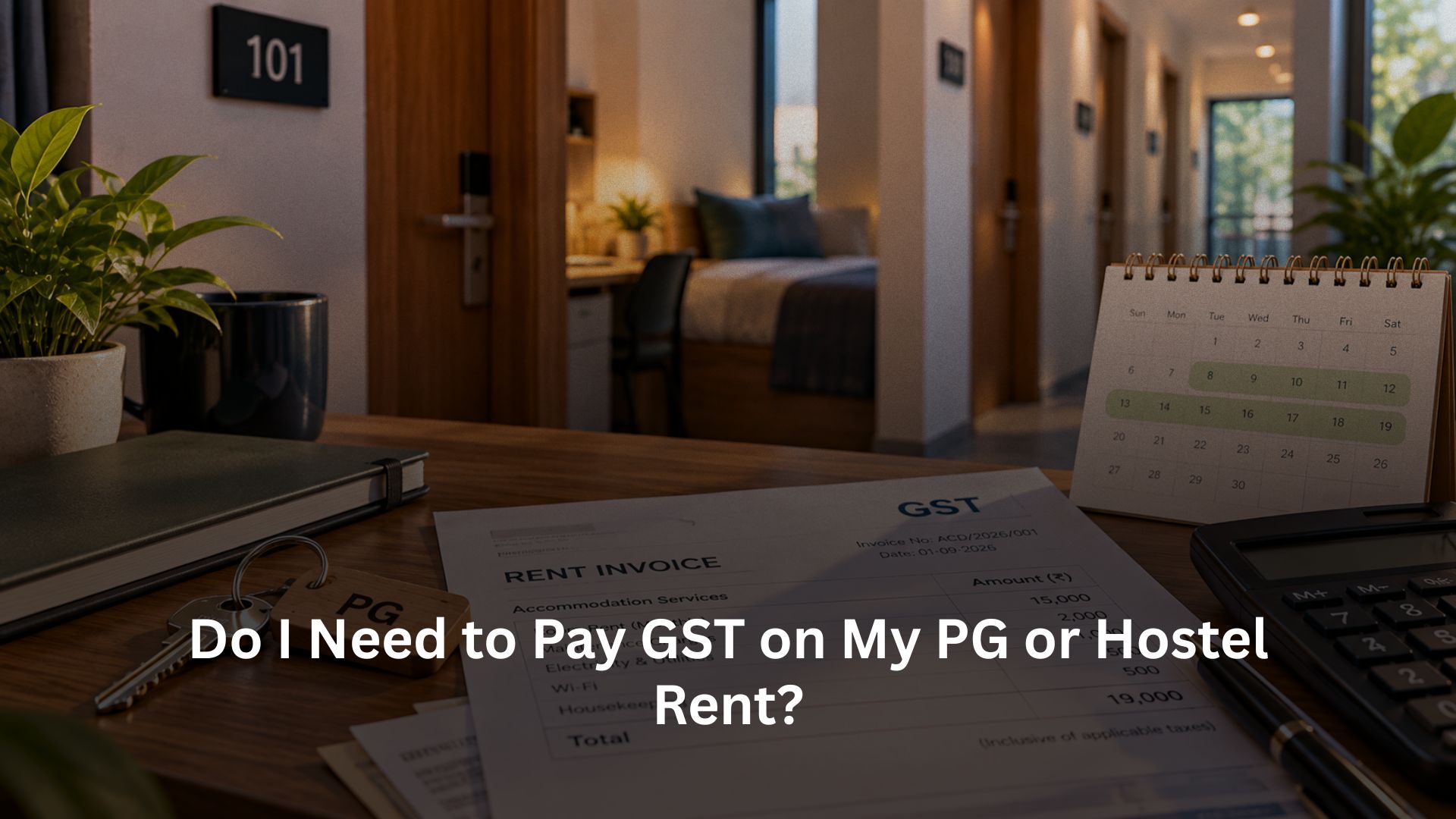
Running a PG or hostel involves much more than collecting rent every month. Owners have to manage occupancy, agreements, payments, food, utilities, maintenance, tenant records, and a growing list of compliance requirements. GST becomes particularly confusing because a PG may look like a residential rental from the outside, while the actual service being provided can be much broader.
A resident may pay one monthly amount that covers a bed or room, housekeeping, electricity, Wi-Fi, meals, laundry, security, or other facilities. Another property may charge for each service separately. The GST treatment cannot always be decided simply by looking at the amount collected or calling it “rent.”
This is especially important after the changes introduced for accommodation services from 15 July 2024. Qualifying accommodation services valued at up to ₹20,000 per person per month can fall under an exemption when supplied for a minimum continuous period of 90 days, subject to the applicable conditions.
But this does not mean every PG charging less than ₹20,000 is automatically GST-free.
The duration of the stay, nature of the accommodation, structure of the charges, GST status of the parties, and the transaction through which the property is being operated can all matter.
For PG and hostel owners, understanding these distinctions is important because GST compliance is not just about filing returns. It starts with how tenant stays, payments, agreements, and property-level transactions are recorded.
When Residential Rent Is GST-Free
The starting point is ordinary residential rent.
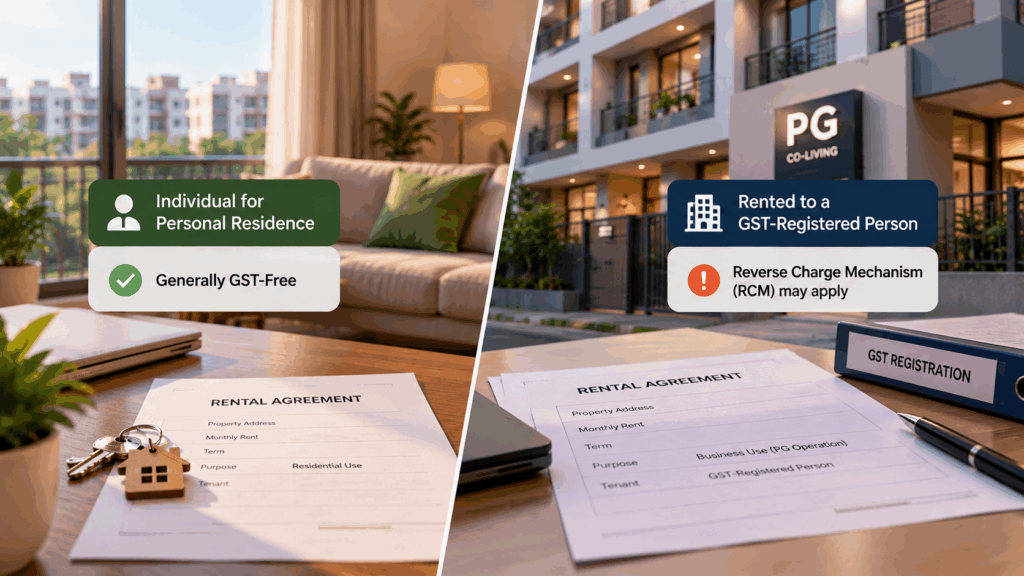
Under the GST framework, renting a residential dwelling for use as a residence is generally exempt, subject to the conditions of the exemption. This is the familiar situation where an individual rents a home for personal residential use.
However, the treatment can change when the residential dwelling is rented to a GST-registered person. A reverse-charge provision for renting a residential dwelling to a registered person came into effect from 18 July 2022. Under the notified arrangement, the registered recipient is responsible for the GST under RCM.
This means the GST question cannot be answered simply by asking whether the property is residential.
Consider two apartments rented for the same amount. One is occupied by an individual as their home. The other is rented to a GST-registered recipient as part of a business arrangement.
The physical property may be identical, but the GST implications can be different.
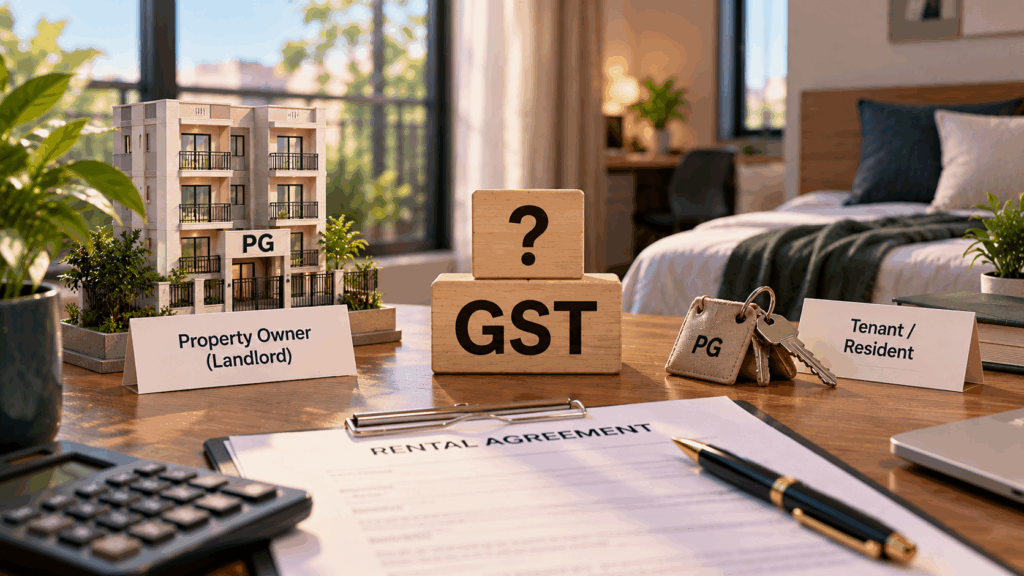
This distinction becomes particularly relevant for PG operators because many do not own the buildings they operate from. They may lease an entire property from a landlord and then provide accommodation to individual residents.
That creates two separate transactions that need to be examined independently.
For a broader understanding of residential rent and RCM, RentOk’s What is GST on Residential Rent and When Does It Apply to You? explains how the property, recipient, and purpose of the rental can influence the applicable GST treatment.
PG and Hostel Accommodation Works Differently
A PG or hostel is not necessarily the same thing as a conventional residential tenancy.
The resident may not simply be paying for the right to occupy a house. The operator may be providing a bundled accommodation experience that includes several services.
That is why the GST framework specifically addresses qualifying accommodation services.
From 15 July 2024, accommodation services valued at up to ₹20,000 per person per month can qualify for exemption when supplied for a minimum continuous period of 90 days, subject to the applicable conditions.
For operators, both conditions need to be considered together.
- The ₹20,000 limit: The accommodation service needs to be valued at no more than ₹20,000 per person per month for this particular exemption to apply. The figure should not be treated as a blanket GST threshold for every charge collected by a PG.
- The 90-day condition: The accommodation must be supplied for a minimum continuous period of 90 days. A monthly billing cycle by itself does not establish that the resident has satisfied this condition.
- The nature of the service: Owners should identify what they are actually supplying. A PG providing accommodation alongside food, laundry, housekeeping, or other services needs to understand how those components are structured.
- The supporting records: Agreements, occupancy dates, invoices, and payment records should be maintained consistently so that the treatment can be explained later.
Imagine a student paying ₹16,000 per month for a PG bed and staying continuously for six months. If the applicable conditions are satisfied, the accommodation service can fall within the exemption.
Now consider another resident paying the same ₹16,000 but staying for only a few weeks. The monthly amount is still below ₹20,000, but the 90-day condition has not been met.
That is why the amount cannot be considered separately from the duration of accommodation.
The Old ₹1,000-Per-Day Rule Is No Longer the Right Reference
One of the biggest sources of confusion around PG and hostel GST is outdated information.
Older articles and discussions may refer to accommodation below ₹1,000 per day being exempt. That was part of the earlier framework. The exemption for hotel accommodation below ₹1,000 per day was withdrawn with effect from 18 July 2022.
The later accommodation exemption introduced the ₹20,000-per-person-per-month and 90-day framework.
This matters because tax information often remains online long after the underlying rule has changed.
A PG operator who still uses the old ₹1,000-per-day calculation could end up applying an outdated approach to current accommodation transactions. The same problem can arise when an owner simply copies the GST treatment used by another PG without checking whether the two businesses actually operate under the same conditions.
The lesson is simple: GST treatment should be based on the current applicable provisions and the actual transaction, not an old pricing rule found online.
This becomes even more important when a PG operates multiple properties with different pricing structures or resident profiles.
Reverse Charge Mechanism and PG Property Leases
Reverse Charge Mechanism, or RCM, is another area where PG operators need to pay close attention.
Normally, GST is collected by the supplier and paid to the government. Under RCM, the recipient becomes responsible for paying GST in situations specifically notified under the GST framework.
For renting a residential dwelling to a registered person, the notified reverse-charge provision places the liability on the registered recipient. The provision took effect from 18 July 2022.
Now consider a typical PG business:
Property owner → PG operator → Resident
The property owner rents the premises to the PG operator.
The PG operator then provides accommodation to its residents.
These are two different transactions.
The GST treatment of the rent paid by the PG operator to the property owner does not automatically determine the treatment of the accommodation supplied to the resident.
This is where some operators get confused. They assume that because their residents are staying in a residential property, the rent they pay to the building owner must be treated in exactly the same way.
That is not necessarily the case.
If the PG operator is GST-registered and rents a residential dwelling from another person, the operator needs to examine whether the RCM provision applies to that particular arrangement.
This is one reason why keeping the property lease, landlord information, GST registration details, and rent payments properly documented is important.
For operators building their business from leased properties, GST is only one part of the compliance picture. RentOk’s What Licenses Do You Need to Run a PG in India? covers several other operational and regulatory areas that PG owners need to consider.
Who Is Actually Liable to Pay GST?
There is no universal rule that the landlord always pays GST or that the tenant always pays it.
GST liability depends on the nature of the transaction and the provision that applies to it.
For qualifying accommodation within the ₹20,000-per-person-per-month and 90-day exemption conditions, GST may not be payable on that accommodation service.
If the accommodation does not qualify for the exemption, the operator needs to determine the applicable tax treatment based on the relevant classification and prevailing GST provisions.
Then there is the separate question of rent paid by a PG operator to the owner of the building.
If the transaction falls under the notified RCM provision for renting a residential dwelling to a registered person, the registered recipient may have the GST liability.
For operators, it helps to separate the questions instead of trying to find one answer for the entire business.
- What exactly is being supplied? Determine whether the transaction is residential rent, accommodation, or accommodation combined with additional services.
- Who is receiving the service? The recipient’s GST registration status can influence the treatment of certain rental transactions.
- What is the value of the accommodation? The ₹20,000-per-person-per-month limit is relevant to the specific accommodation exemption.
- How long is the accommodation provided? The 90-day continuous period is an important condition of that exemption.
- What additional services are included? Food, utilities, laundry, housekeeping, and other facilities may need to be examined according to the actual arrangement.
This is why a PG owner should not simply decide that “GST is 18% on rent” or “PG rent is always exempt.”
Both approaches are too broad.
Food, Electricity and Other Charges Need Attention Too
A PG bill rarely consists of accommodation alone.
One resident may pay ₹15,000 for accommodation, ₹2,000 for meals, and a separate electricity amount. Another property may advertise one all-inclusive package that covers accommodation, food, housekeeping, electricity, and Wi-Fi.
From an operational perspective, these billing structures are very different.
The owner needs to know what the resident is actually being charged for and how those charges are recorded.
Suppose a PG advertises a monthly package of ₹18,000. If that amount includes several services, the operator should maintain clear records of the arrangement instead of simply labelling the entire amount “rent” and assuming that every component receives identical GST treatment.
At the same time, simply separating charges on an invoice does not automatically determine their tax treatment either. The underlying nature of the supply still matters.
Clear billing therefore serves two purposes.
It helps the tenant understand what they are paying for, while also giving the operator a cleaner financial record.
A structured payment system becomes especially useful here. RentOk’s How Property Management Software Helps You Collect Rent on Time discusses how organised payment workflows can reduce manual follow-ups and improve visibility over recurring rent collections.
For GST purposes, the broader principle is straightforward: if the underlying transaction is organised, the tax review becomes easier too.
What PG Owners Should Track for GST Filing
GST compliance does not begin when the return is due. It begins with the information a PG operator records every day.
Consider a PG with 150 residents across three properties. If tenant details, payments, and agreements are spread across spreadsheets, WhatsApp chats, paper registers, and staff records, verifying a transaction months later can become difficult.
The 90-day accommodation condition is one example. If an operator needs to verify a resident’s continuous stay, the information should be available through the occupancy record rather than reconstructed manually.
A GST-ready operational record should ideally include:
- Occupancy details: Check-in and check-out dates, room or bed allocation, extensions, and changes to the resident’s stay.
- Payment history: Rent charged, payments received, outstanding dues, refunds, discounts, and adjustments.
- Lease information: Property owner details, rental agreements, rent paid by the operator, and relevant GST documentation.
- Service details: Separately charged facilities such as food, electricity, laundry, or housekeeping.
- Tax records: Invoices, exemption-related documents, RCM records where applicable, and supporting documentation.
The goal is not to create more paperwork. It is to maintain a clear financial trail.
If a CA asks why a transaction was treated in a particular way, the operator should be able to trace the decision back to the relevant records. The same visibility also helps resolve payment disputes and reconcile tenant accounts.
For growing PG businesses, organised records can make financial management far more straightforward.
For more on structured rent tracking, read RentOk’s How to Track Rent Collection Performance.
Common GST Mistakes PG Operators Should Avoid
Most GST mistakes do not begin with complicated accounting.
They usually begin with an assumption.
An owner may hear that “PG rent is exempt” and apply that statement to every resident. Another may see the ₹20,000 figure and assume that any accommodation below that amount is automatically exempt. Someone else may continue using the old ₹1,000-per-day rule.
The problem is that none of these statements tells the complete story.
Some common mistakes include:
- Looking only at the rent amount: The ₹20,000 figure needs to be considered alongside the minimum continuous 90-day accommodation condition and the other applicable requirements.
- Using outdated GST information: The old ₹1,000-per-day exemption should not be used as the basis for current accommodation treatment.
- Treating every charge as accommodation: Food, laundry, utilities, housekeeping, and other services should be examined based on the actual arrangement and applicable GST provisions.
- Ignoring RCM on leased premises: A registered PG operator renting a residential dwelling should examine whether the notified reverse-charge provision applies to the rent paid to the property owner.
- Maintaining weak occupancy records: Without accurate check-in and check-out information, proving the duration of accommodation can become unnecessarily difficult.
- Mixing personal and business transactions: Owners operating multiple properties should keep business-level transactions and property records organised rather than combining everything into one informal ledger.
The broader lesson is that GST compliance works better when it is built into the property’s regular financial workflow.
It should not become a last-minute exercise every time a return has to be filed.
For operators looking at the wider financial side of property management, RentOk also covers topics such as TDS on Rent Under Section 194-IB. TDS and GST are different taxes, but both demonstrate why organised rent records become increasingly important as the number of properties and tenants grows.
GST on PG Rent: What Owners Should Remember
The most important point is that there is no single GST rule that applies to every PG or hostel arrangement.
For qualifying long-term accommodation, the ₹20,000-per-person-per-month exemption combined with the minimum continuous 90-day period is particularly important.
For property owners leasing residential premises to registered recipients, reverse-charge provisions need to be examined separately.
And for operators providing accommodation alongside food, electricity, housekeeping, laundry, or other services, the actual structure of the supply matters.
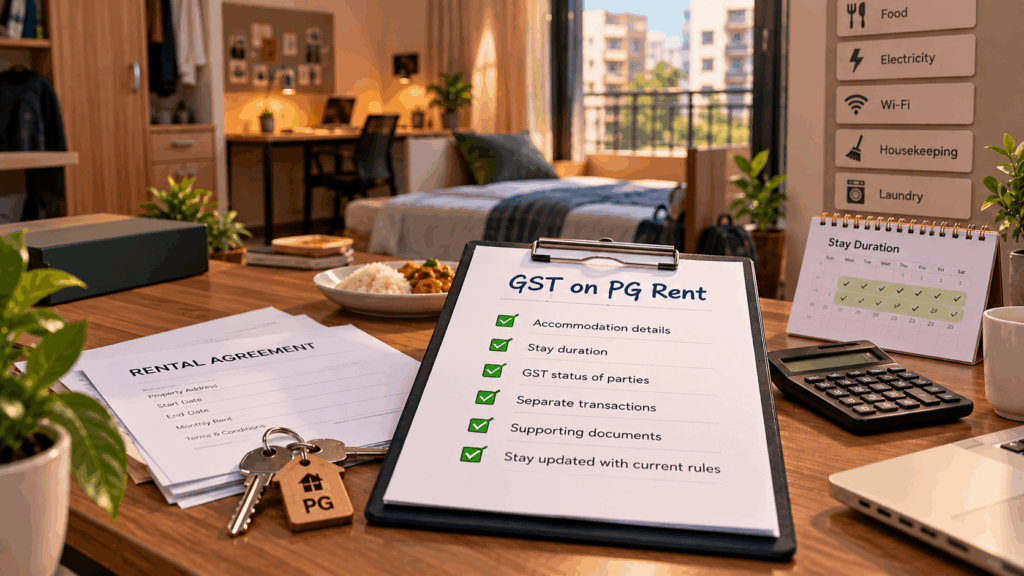
A useful checklist for PG owners is:
- Review the accommodation: Understand exactly what service the resident is receiving and how it is being billed.
- Check the stay duration: Maintain reliable occupancy records rather than relying on informal information.
- Review the parties: Know the GST status of the relevant parties, particularly when leasing property from another owner.
- Separate transactions: Do not automatically apply the GST treatment of the property lease to the accommodation supplied to residents.
- Maintain supporting records: Agreements, invoices, payments, occupancy information, and RCM-related documents should be accessible when required.
- Review current rules: Avoid relying on old GST articles or rules that may have changed.
GST is only one part of running a compliant PG business. Operators also need to think about permissions, tenant documentation, rent collection, maintenance, complaints, and daily property operations. For a broader look at how these processes fit together, PG and Hostel App Solutions: Bridging the Gap explores the role of technology in bringing multiple property workflows together.
How RentOk Helps You Keep GST-Ready Records
For a PG operator, the tax record often begins as an everyday operational record.
A tenant’s check-in date, room allocation, monthly charge, payment, pending due, and move-out date may look like ordinary property-management information. But together, these details create the financial trail that an operator may need when reviewing accommodation transactions.
RentOk helps PG and hostel operators organise these workflows through one connected property management system.
Tenant information, occupancy details, rent collections, dues, and property-level financial activity can be managed digitally instead of being scattered across spreadsheets, registers, and separate communication channels.
That makes it easier for operators to maintain visibility over the information behind their financial records.
For example, when tenant occupancy and payment information is structured, an operator can more easily review how long a resident stayed, what was charged, what was paid, and what remains outstanding. For businesses managing multiple properties, this becomes particularly useful because information can be reviewed at the property level instead of reconstructed manually.
RentOk does not decide whether a particular transaction is taxable or exempt, and it does not replace professional GST advice. The correct GST classification, RCM treatment, and filing position should be verified with a qualified tax professional where required.
What RentOk provides is the organised operational foundation that makes financial review easier.
For more practical property-management content, you can also explore the RentOk YouTube channel, where PG and rental operators can find content around managing everyday property operations.
Conclusion
GST on PG or hostel rent is not determined by the monthly rent amount alone.
The nature of the accommodation, value per person, duration of stay, GST status of the relevant parties, and the services included in the arrangement all need to be considered.
The ₹20,000-per-person-per-month exemption and minimum continuous 90-day period are particularly important for qualifying long-term accommodation. At the same time, operators leasing residential premises need to separately examine whether reverse-charge provisions apply to their own rental arrangement.
For PG owners, the practical takeaway goes beyond GST itself: good compliance starts with good records.
When tenant stays, payments, agreements, invoices, property leases, and financial information are organised throughout the year, it becomes much easier to review transactions and provide the information required by a tax professional.
As the number of tenants and properties grows, managing these records manually becomes increasingly difficult.
Track GST-Ready Records with RentOk and keep your tenant, occupancy, payment, and property records organised as your PG business grows.
Frequently Asked Questions
Find answers to common questions about this topic
About the Author
Ishika Pannu
Ishika Pannu brings you the latest insights and easy-to-apply strategies in property management—helping you simplify renting and grow with RentOk.
Stay ahead in property management with expert insights
Join thousands of property managers receiving exclusive tips delivered straight to your inbox.
Browse posts by category
Case Study
Cost of Living
Growth
Legal
Market Trends
News
Pg owner app
Property Management
Property Tax
Tech
RentOk
The easiest way to rent and manage your PGs and hostels.
Grievance Officer
Get the app


Contact us
hello@eazyapp.tech
HQ Office
COGROW, BASEMENT F-12/8A
BESIDE HOUSE OF STYLE SALON, SECTOR 28, DLF PHASE 1
GURUGRAM, HARYANA - 122002
South India Office
LUMIODESK COWORKING, 2ND FLOOR, 40, 14TH MAIN RD
BESIDE MC DONALD, 7TH SECTOR, HSR LAYOUT
BENGALURU, KARNATAKA - 560102
©️ 2026 EazyApp Tech Pvt Ltd. All rights reserved


