
Cost of Living
GST on PG Rent: What Tenants Pay

Written by
Ishika Pannu
Read Time
15 min read
Posted on
September 13, 2026
Overview
Overview
GST on PG Rent: What Tenants Pay
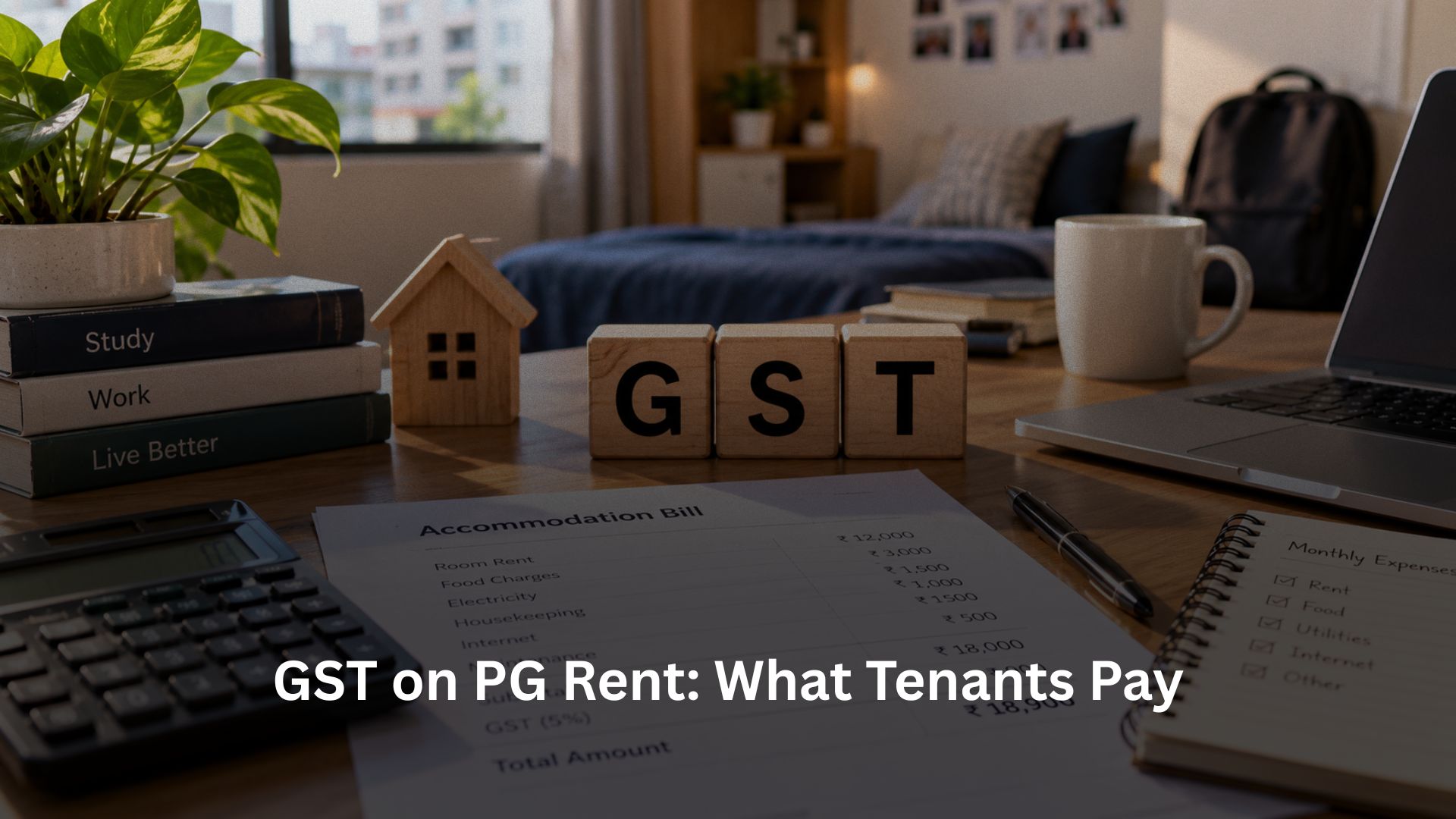
GST on PG rent can be confusing. A tenant may see one monthly amount on a PG listing, but the final bill can include several different charges. Accommodation, food, electricity, housekeeping, laundry, and other services may all form part of the payment.
This makes GST different from a simple residential rent transaction. The tax treatment depends on the nature of the accommodation, the value of the supply, and the duration of the stay. The way the operator structures and bills the service also matters.
A major change came into effect on 15 July 2024. Accommodation services valued at up to ₹20,000 per person per month can qualify for an exemption when the accommodation is supplied for a minimum continuous period of 90 days, subject to the applicable conditions.
This change is especially relevant for students and working professionals who stay in PGs and hostels for several months. It also matters to operators who manage long-term accommodation as a regular business.
However, the ₹20,000 figure should not be treated as a blanket “no GST” rule. The duration condition matters too. Older information about a ₹1,000-per-day exemption can also create confusion because that earlier accommodation exemption was withdrawn in 2022.
So, what does GST on PG rent actually mean for tenants?
Let’s break down the current framework, how GST may be calculated, what tenants should check on their bills, and how PG operators can keep their records organised.
Is PG Accommodation Taxable Under GST?
The first thing to understand is that not every PG arrangement has the same GST treatment.
A PG is more than a traditional residential rental in many cases. The operator may provide a room or bed along with housekeeping, meals, security, electricity, internet, laundry, or other facilities. The actual arrangement therefore matters when determining the applicable GST treatment.
This is why simply saying “PG rent is taxable” or “PG rent is exempt” can be misleading.
The GST framework provides an exemption for qualifying long-term accommodation services. The exemption applies where the value is within the prescribed limit and the accommodation is supplied for at least 90 continuous days.
For example, imagine a student rents a PG bed for ₹16,000 per month. The student signs an arrangement for six months and continues to occupy the accommodation throughout that period. If the applicable conditions are satisfied, the accommodation can fall within the exemption.
Now consider a person who pays ₹16,000 for a short stay that does not meet the 90-day condition. The monthly price is still below ₹20,000, but the exemption cannot be assumed only from the price.
The length of the stay is therefore an important part of the calculation.
PG owners also need to look beyond the word “rent”. Different charges collected from tenants may represent different supplies. This is particularly important when the property offers meals, laundry, transport, or other paid services.
If you are setting up a PG business, GST is only one part of the compliance picture. RentOk’s guide on What Licenses Do You Need to Run a PG in India? covers the wider permissions and compliance areas that operators should consider.

The ₹20,000 Per Month Exemption Explained
The ₹20,000 per person per month limit is an important figure for long-term PG and hostel accommodation.
The exemption applies from 15 July 2024. It covers accommodation services valued at up to ₹20,000 per person per month when supplied for a minimum continuous period of 90 days.
This is especially relevant to long-term PG residents. Students may stay for an entire semester or academic year, while working professionals may remain in the same PG for several months.
However, operators should consider these conditions together:
- Monthly value: The accommodation service must fall within the ₹20,000 per person per month limit. The applicable value should be considered when making the calculation.
- Minimum stay: The accommodation must be supplied for at least 90 continuous days. Monthly billing alone does not automatically satisfy this condition.
- Nature of service: Operators should review what is included in the accommodation arrangement. Other services may require separate consideration.
- Proper records: Agreements, occupancy dates, invoices, and payment records should support the treatment applied.
For example, a PG charging ₹18,000 per person per month may qualify for the exemption when a tenant stays continuously for six months, provided all other conditions are met.
A tenant staying for only a few weeks would need to be considered differently.
The key takeaway is that the ₹20,000 limit and 90-day condition work together. For PG operators, maintaining accurate occupancy records is therefore essential. These records help establish when a tenant moved in, their expected departure date, and the duration of their stay.
What Happened to the ₹1,000 Per Day GST Exemption?
If you search for GST hostel accommodation online, you may still find references to an exemption for accommodation costing less than ₹1,000 per day.
That information is based on the older GST framework. It should not be used as the current general rule for PG and hostel accommodation.
The GST Council recorded that the exemption for hotel accommodation below ₹1,000 per day was withdrawn with effect from 18 July 2022.
This matters because old tax articles continue to appear in search results. A tenant or PG operator relying on an outdated article could therefore arrive at the wrong conclusion about GST.
The current long-duration accommodation exemption is different. The relevant framework now focuses on accommodation valued at up to ₹20,000 per person per month, along with the minimum continuous stay requirement.
This does not mean that every PG charging less than ₹20,000 is automatically exempt.
The operator still needs to examine the actual accommodation arrangement and applicable provisions.
For tenants, the practical lesson is simple. Do not rely on the ₹1,000-per-day figure when checking a current PG bill. Ask the operator how the accommodation has been classified and why GST is or is not being charged.
How Is GST Calculated on PG Rent?
When an accommodation service is taxable, GST is calculated on the applicable value of the taxable supply.
There is no single GST rate for every PG bill in India. The applicable rate depends on the classification of the supply and the GST rate entry that applies.
PGs can also operate differently. Some provide basic accommodation, while others include food, housekeeping, utilities, laundry, or additional facilities.
For example, consider a taxable accommodation service with a value of ₹18,000. If the applicable GST rate is 5%, the GST would be ₹900.
₹18,000 × 5% = ₹900
The total would be ₹18,900, assuming ₹18,000 is the correct taxable value and no other charges apply.
This example only explains the calculation. It does not mean that every PG should charge 5% GST. Operators must first determine the correct classification and applicable rate.
A PG invoice may also include different components:
- Accommodation: The room or bed charge, subject to the applicable exemption and classification.
- Food and meals: GST treatment can vary depending on how these are supplied and billed.
- Utilities: Electricity and other utilities should be assessed based on the actual arrangement.
- Additional services: Laundry, housekeeping, transport, and other paid facilities may require separate consideration.
Clear, itemised billing helps operators apply the correct treatment and avoid confusion.
For PGs managing multiple tenants, digital rent records can also reduce billing errors. RentOk’s guide on how property management software helps you collect rent on time explains how structured payment tracking can simplify recurring collections.
What Do Tenants Actually Pay?
For tenants, GST becomes easier to understand when the monthly PG bill is transparent.
Suppose a property advertises a room for ₹18,000 per month. That number alone does not tell the tenant whether GST is included. It also does not explain whether electricity, food, housekeeping, or other facilities are included.
Before signing a long-term accommodation agreement, tenants should understand what the advertised price actually covers.
A useful check is to ask:
- Is the advertised rent the final amount? Confirm whether GST or other charges will be added separately to the quoted price.
- What services are included? Check whether electricity, meals, housekeeping, Wi-Fi, laundry, and maintenance are included in the monthly amount.
- How is the bill prepared? Ask whether the operator provides an invoice or payment receipt showing the relevant charges.
- What does the agreement say? The accommodation agreement should be consistent with the pricing and billing arrangement communicated to the tenant.
- What happens when the stay changes? Ask how extensions, early departures, or changes in occupancy are handled.
This becomes especially important when comparing different PGs.
A property with a lower advertised rent may not necessarily be cheaper after additional charges are added. Another PG may have a higher monthly price but include several facilities in the same amount.
For that reason, tenants should compare the final payable amount, not just the headline rent.

Can Tenants Claim Input Tax Credit on GST Paid?
Another common misunderstanding concerns Input Tax Credit, or ITC.
An individual tenant cannot simply claim GST paid on personal PG accommodation as a personal tax credit. ITC is part of the GST system and is subject to specific eligibility conditions.
For a student paying for their own accommodation, GST paid to a PG operator does not automatically become an amount that can be claimed back.
The situation can be different when accommodation is obtained by a registered business for business purposes. Even then, eligibility depends on the applicable GST provisions and supporting conditions.
The tenant’s position should also be separated from the operator’s ITC position.
These are two different questions.
A tenant being eligible for a particular GST treatment does not automatically mean that the accommodation provider can claim unrestricted ITC on its own purchases. Some accommodation rate entries may also carry specific restrictions on supplier-side ITC.
For most individual PG residents, the practical takeaway is straightforward:
Paying GST does not automatically mean you can claim it back.
If a company is paying for an employee’s accommodation, the company’s finance or tax team should examine the arrangement. It is better to confirm eligibility than to assume that every GST invoice creates an ITC benefit.
PG vs Hostel GST: Does the Name Change the Tax?
A PG and a hostel may operate differently, but the label used by the operator does not automatically determine the GST treatment.
Both can provide shared accommodation and may charge recurring monthly fees. Depending on the property, residents may also get food, housekeeping, security, and other facilities.
The actual nature of the supply is therefore more important than the signboard outside the property.
This is particularly relevant for operators who offer flexible accommodation models. A property may describe itself as a PG while operating with hostel-style services. Another property may use the word “hostel” while providing long-term accommodation to working professionals.
The GST analysis should focus on the actual arrangement.
The 2024 GST clarification specifically addressed hostel accommodation and similar long-duration accommodation services. It recognised the ₹20,000-per-person-per-month exemption for qualifying accommodation supplied for at least 90 continuous days.
That makes the duration and value of the accommodation important factors.
RentOk’s article on PG and Hostel App Solutions: Bridging the Gap also explains how closely PG and hostel operations can overlap from a management perspective.
The same idea applies here. The property label is useful for describing the business, but it should not replace an examination of the actual service.
What Should PG Owners Track for GST?
Good GST compliance begins with good operational records.
This becomes increasingly important as a PG grows. An owner managing ten tenants may remember most transactions. An operator managing several properties cannot depend on memory or scattered WhatsApp messages.
A structured system should keep the important information together.
- Tenant records: Maintain accurate details for every resident, including move-in dates and expected move-out dates. These records help establish the duration of accommodation.
- Occupancy information: Track which tenant occupies which room or bed. This becomes especially useful when multiple properties are involved.
- Payment history: Record every rent payment, pending amount, adjustment, and other collection. A clear payment history makes reconciliation easier.
- Additional charges: Keep accommodation, food, utilities, laundry, and other collections identifiable. This makes financial review more reliable.
- Invoices and receipts: Maintain consistent billing records for taxable and exempt supplies. Documentation should support the treatment applied to the transaction.
- Tax records: Where GST registration and tax payment apply, maintain the required GST records and filings according to the applicable rules.
RentOk’s recent article on How to Start a PG Business Legally in India also highlights the need to keep rent and other collections properly organised as a PG business grows.
The goal is not to create more paperwork.
The goal is to make the information easy to verify when the business owner, accountant, or tax professional needs it.
Common GST Mistakes PG Operators Should Avoid
GST mistakes in accommodation businesses often come from assumptions rather than complicated calculations.
An operator may copy the tax treatment used for another property. A tenant may rely on an old article. A billing team may add GST to every invoice without checking whether the accommodation qualifies for an exemption.
These errors can create avoidable disputes.
Some of the most common problems include:
- Using the old ₹1,000-per-day exemption: This is outdated and should not be presented as the current general exemption for accommodation.
- Ignoring the 90-day condition: The ₹20,000 monthly limit cannot be viewed separately from the minimum continuous accommodation period.
- Applying one rate to every PG: The correct rate depends on the applicable GST classification. Operators should not use a blanket percentage without checking the supply.
- Combining all charges into one amount: Food, utilities, laundry, and other services may require separate consideration.
- Failing to maintain occupancy records: Without clear move-in and move-out information, it becomes harder to support the treatment of long-term accommodation.
- Assuming GST automatically creates ITC: GST paid by a tenant does not automatically become a recoverable credit.
The best approach is to build a consistent process.
If an arrangement is unusual or involves several different services, professional GST advice is preferable to relying on a general internet explanation.

How RentOk Helps PG Owners Keep Rental Operations Organized
GST compliance is easier when the underlying rental data is organised.
RentOk helps PG and hostel operators manage important operational information through a structured digital system. This can reduce dependence on spreadsheets, payment screenshots, manual reminders, and scattered conversations.
For operators, this can make everyday tasks easier to track.
Tenant information can be organised alongside occupancy details. Rent payments can be monitored through structured records. Operators can also get better visibility into pending dues and property-level activity.
This becomes particularly useful when a business manages more than one PG or hostel.
RentOk’s How to Choose the Right PG Management Software guide also highlights the importance of features such as tenant management, rent tracking, room allocation, and complaint management when choosing software for PG operations.
RentOk does not replace a CA or GST professional. Tax classification and filing decisions should still be reviewed by the appropriate professional.
What RentOk can provide is the organised operational data that makes those decisions easier to manage.
Conclusion: Know the GST Before You Book Your PG
GST on PG rent cannot be understood through a single percentage or one simple exemption rule.
The accommodation arrangement needs to be examined properly. The value of the service matters. The duration of the stay matters. The services included in the payment can also matter.
For qualifying long-term accommodation, the current exemption covers accommodation valued at up to ₹20,000 per person per month when it is supplied for a minimum continuous period of 90 days, subject to the applicable conditions.
The older ₹1,000-per-day accommodation exemption should not be used as the current rule.
For tenants, the safest approach is to ask for a clear breakdown of the monthly amount. Check what is included, whether GST is being charged, and whether the final payable amount matches the agreement.
For PG operators, accurate tenant records and transparent billing are equally important. A structured system can make these processes easier as occupancy grows.
Looking for accommodation with clearer pricing and a more organised rental experience? Explore GST-compliant PG options on RentOk and find accommodation that fits your stay and budget.
Frequently Asked Questions
Find answers to common questions about this topic
About the Author
Ishika Pannu
Ishika Pannu brings you the latest insights and easy-to-apply strategies in property management—helping you simplify renting and grow with RentOk.
You may also like these
Related Articles

1 min read
When and Why Did Rent in Gurgaon Get So Expensive?
Written by
Posted on
Shivanshi Dheer
Dec 24, 2025

1 min read
What is the Cost of Renovating a PG/Hostel for Setup?
Written by
Posted on
Shivanshi Dheer
Sep 10, 2025
1 min read
Rent Trends in 2025: Delhi vs Bangalore vs Hyderabad
Written by
Posted on
Shivanshi Dheer
Aug 1, 2025

1 min read
Best Areas to Live in Hyderabad for Students and Working Professionals
Written by
Posted on
Shivanshi Dheer
Jun 15, 2025

1 min read
Ultimate List of Amenities for in a PG or Co-Living Space in India
Written by
Posted on
Shivanshi Dheer
Jun 11, 2025

1 min read
What Is the Cost of Living Index And How Is It Calculated?
Written by
Posted on
Shivanshi Dheer
May 29, 2025

1 min read
Best pg manager app in India 2023
Written by
Posted on
Anil Kandpal
Jun 6, 2023

1 min read
Looking for a rental property near you? Keep your search stress-free with these 6 points.
Written by
Posted on
Anil Kandpal
Apr 24, 2023

1 min read
A Peek into India’s Rising Demand for Rental Housing
Written by
Posted on
Aditya Shrivastav
Mar 6, 2023

1 min read
10 Signs of a good PG/Hostel/Flat In Delhi
Written by
Posted on
Anil Kandpal
Feb 7, 2023
Stay ahead in property management with expert insights
Join thousands of property managers receiving exclusive tips delivered straight to your inbox.
Browse posts by category
Case Study
Cost of Living
Growth
Legal
Market Trends
News
Pg owner app
Property Management
Property Tax
Tech
RentOk
The easiest way to rent and manage your PGs and hostels.
Get the app


Contact us
hello@eazyapp.tech
HQ Office
COGROW, BASEMENT F-12/8A
BESIDE HOUSE OF STYLE SALON, SECTOR 28, DLF PHASE 1
GURUGRAM, HARYANA - 122002
South India Office
LUMIODESK COWORKING, 2ND FLOOR, 40, 14TH MAIN RD
BESIDE MC DONALD, 7TH SECTOR, HSR LAYOUT
BENGALURU, KARNATAKA - 560102
©️ 2026 EazyApp Tech Pvt Ltd. All rights reserved


