
Cost of Living
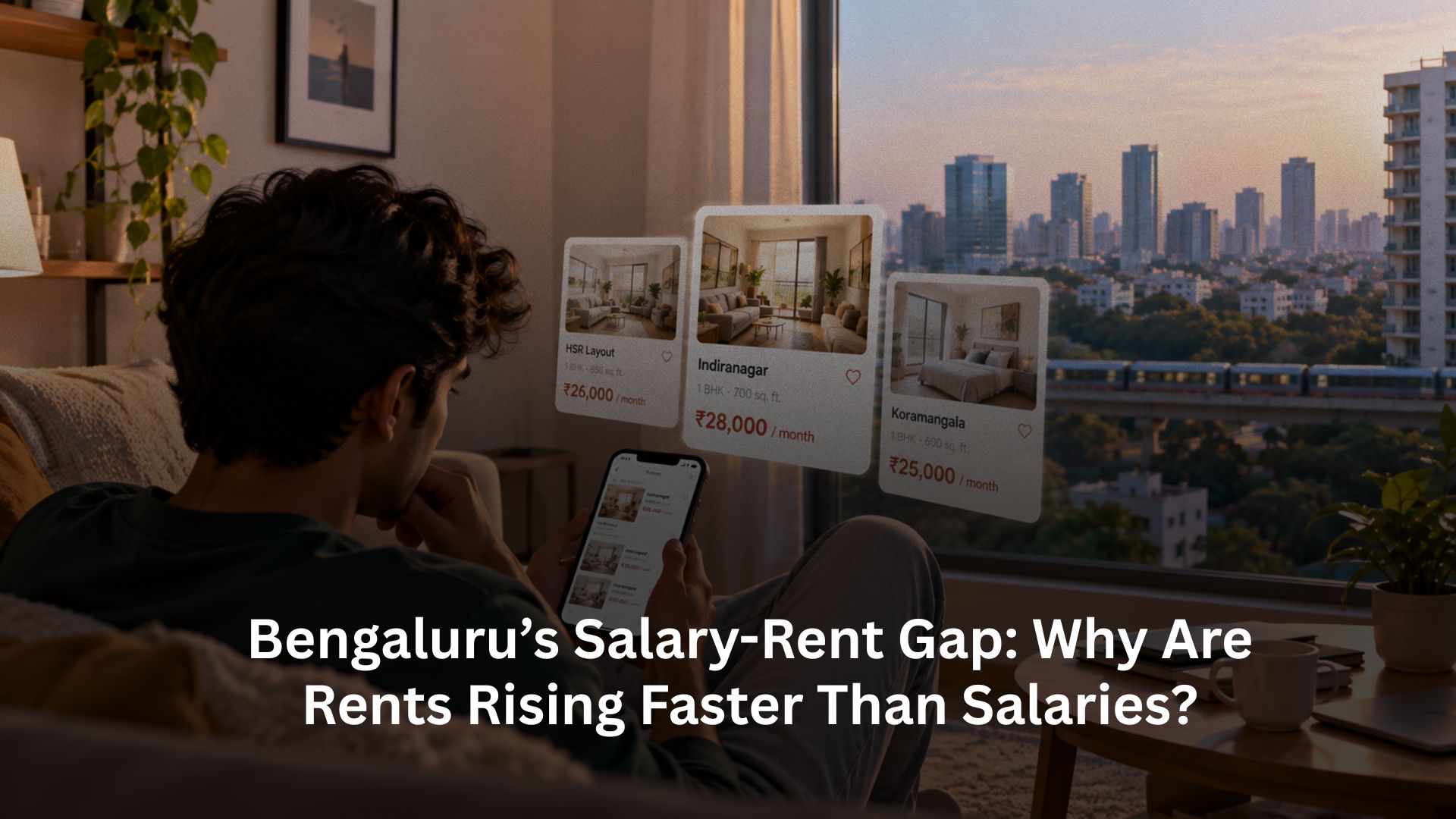
Bengaluru’s Salary-Rent Gap: Why Are Rents Rising Faster Than Salaries?

Written by
Ishika Pannu
Read Time
15 min read
Posted on
October 6, 2026
Overview
Overview
Bengaluru’s Salary-Rent Gap: Why Are Rents Rising Faster Than Salaries?
Bengaluru has always been a city where opportunity comes with a price.
As one of India’s biggest technology and employment hubs, it continues to attract professionals looking for better jobs, higher salaries, and career growth. But for many people moving into the city, the biggest challenge is no longer finding a job. It is finding a place to live without letting rent consume a disproportionate part of that salary.
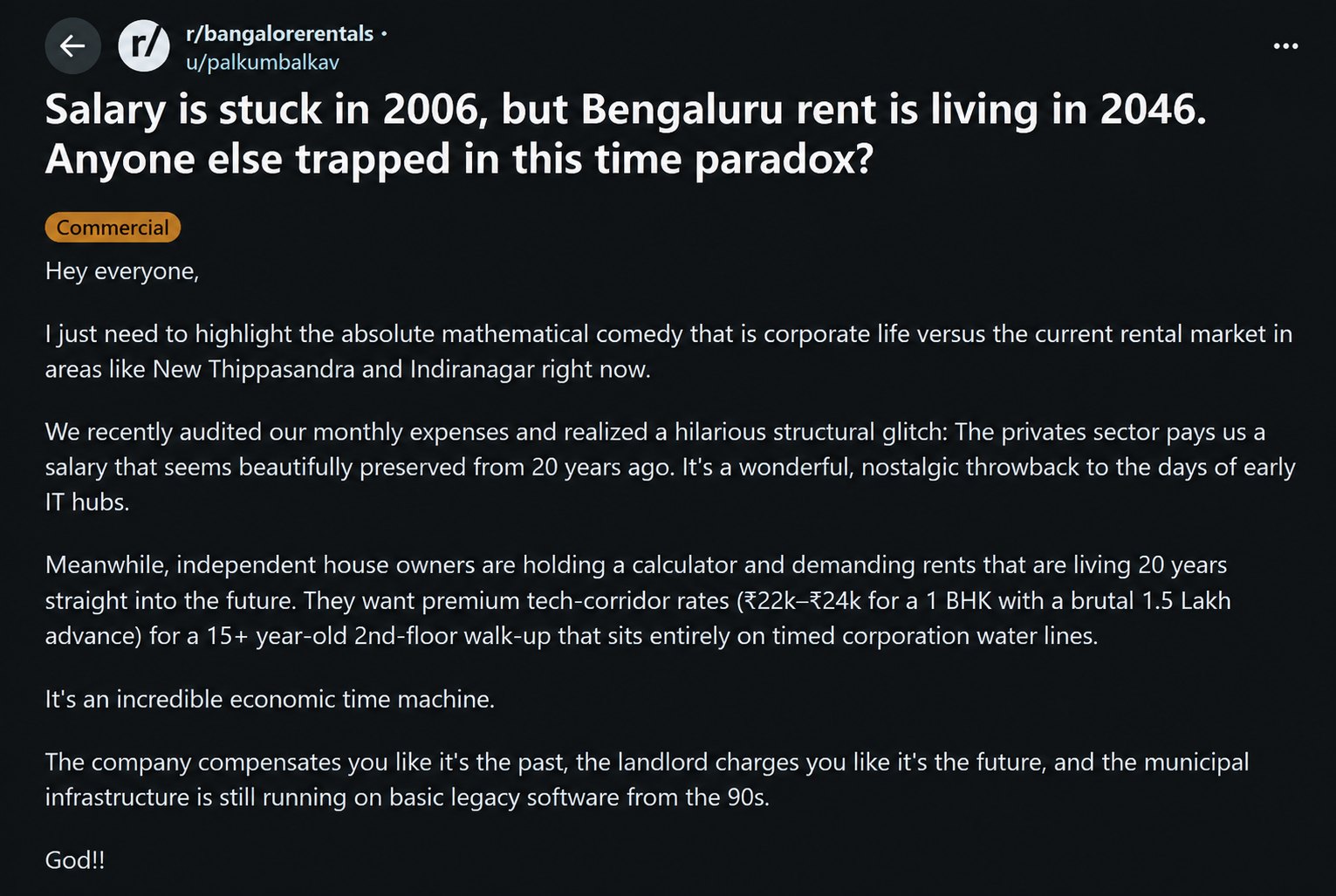
A recent Reddit post summed up this frustration with a line that was difficult to ignore: “Salary is stuck in 2006, but Bengaluru rent is living in 2046.” And what followed was a larger conversation around rising rents, large security deposits, salary expectations, and whether Bengaluru’s rental market is beginning to move faster than the people living in it.
The Reddit Post That Started the Conversation
The post focused on rental prices in areas such as New Thippasandra and Indiranagar. According to the Reddit user, a 1BHK was being offered for around ₹22,000–₹24,000 per month, along with a security deposit of approximately ₹1.5 lakh. The property was described as more than 15 years old, located on the second floor without a lift, and dependent on timed municipal water supply.
On its own, this is simply one tenant’s experience. But the reason the post attracted attention was that it represented a frustration many Bengaluru residents already recognise: the feeling that rent increases are no longer keeping pace with what ordinary private-sector employees can comfortably afford.
The discussion also moved beyond this particular apartment. People talked about annual rent hikes, large deposits, commuting costs, and the perception that anyone working in Bengaluru’s technology ecosystem must automatically have a high salary. In other words, the post was less about one ₹24,000 apartment and more about the economics behind the city’s rental market.
That is where the conversation becomes more interesting.
Are Newcomers Really Driving Bengaluru’s Rents?
Whenever rents rise in a fast-growing city, newcomers are often the easiest explanation. More people arrive, demand increases, landlords notice that tenants are willing to pay more, and asking prices move upward.
But Bengaluru’s situation is more complicated than simply saying that newcomers are responsible.
People move to Bengaluru because the city has jobs. As employment expands, housing demand naturally follows. The problem is that people are not looking for homes anywhere in Bengaluru. They are looking for homes that are reasonably accessible to their workplaces, colleges, transport networks, and daily necessities.
This creates concentrated demand around specific employment and residential corridors.
JLL’s Q2 2026 residential data reflects this pressure. Bengaluru’s rents increased 2.5% quarter-on-quarter, while the report noted that demand from technology professionals was outpacing housing supply. Residential launches also fell 20% quarter-on-quarter during the period.
So, the newcomer is not necessarily creating the problem. They are entering a market where demand is already significantly stronger than the available supply in several high-demand locations.
Bengaluru’s Rental Market Has a Supply Problem
This demand becomes particularly visible around Bengaluru’s major employment corridors.
When a large number of companies operate around areas such as Whitefield, Bellandur, Sarjapur Road, HSR Layout, Electronic City, or other major business clusters, thousands of employees naturally want to live within reasonable travelling distance. The closer the property is to these employment centres, the more competition it can attract.
At the same time, Bengaluru’s residential market cannot instantly create new housing whenever demand increases. Land availability, construction timelines, infrastructure, approvals and development costs all influence how quickly supply can respond.
JLL’s latest Bengaluru residential report also points towards rising construction costs and continued IT and Global Capability Centre expansion as factors supporting property demand and price growth. As central areas become more saturated, new residential activity is increasingly shifting towards corridors such as Whitefield, Sarjapur Road and Yelahanka.
This explains an important part of the rental equation:
- More jobs bring more people into the city.
- More people create additional housing demand.
- Demand becomes concentrated around employment and transport corridors.
- Limited suitable housing in those areas gives existing properties greater pricing power.
The result is a rental market where tenants can end up paying significantly more simply because the cheaper alternatives are farther away.
Why Would Someone Still Pay ₹30,000 or ₹40,000 in Rent?
This is probably one of the most misunderstood parts of Bengaluru’s rental market.
From the outside, paying ₹30,000 – ₹40,000 for a rental can look like a simple financial choice: if the rent is too high, find a cheaper house.
In reality, tenants are often choosing between rent and commute rather than between two equally convenient homes.
A cheaper apartment on the outskirts may reduce monthly rent, but it can also mean longer travel times, higher transportation costs, greater fatigue, and less flexibility around work. For someone spending most of the week in an office, those factors have a real value.
This is particularly relevant as office activity remains closely connected to Bengaluru’s technology ecosystem. JLL reported that technology companies accounted for 50% of Bengaluru’s quarterly office leasing volume in Q2 2026.
So when a tenant agrees to a higher rent near work, it does not necessarily mean they believe the property is worth that amount. Sometimes, they are simply paying for convenience because the alternative has its own cost.
The ₹20 LPA Assumption Can Distort the Rental Market
There is another layer to this conversation: what landlords assume their tenants can afford.
Bengaluru is widely known as India’s technology capital. That reputation can sometimes create a simplified picture of its rental population: if someone works in Bengaluru, they must be working in tech; if they work in tech, they must be earning well; and if they earn well, they should be able to afford a higher rent.
But the city’s tenant base is far more diverse.
Not every IT employee earns ₹15–20 lakh a year. Not every person renting near a technology corridor works directly in technology. Bengaluru also has students, early-career professionals, service-industry employees, entrepreneurs, families, and workers across a wide range of income levels.
When rental pricing starts being based on the assumption that every tenant can absorb a higher monthly cost, the asking price can move further away from what a large section of tenants can comfortably manage.
This is one reason the salary-rent debate feels so personal. A ₹5,000 increase in rent may look small from an owner’s perspective, but for a tenant already managing food, transport, utilities, EMIs, savings, and other expenses, it can change the entire monthly budget.

Rising Property Costs Matter Too
However, the rental market cannot be viewed entirely from the tenant’s side.
Property owners are also operating in an environment where the cost of owning and maintaining a property has increased. Construction costs, property prices, maintenance, financing, repairs and other operating expenses all influence the return an owner expects from a property.
JLL reported that Bengaluru property prices rose 3.1% quarter-on-quarter in Q2 2026, with rising construction costs among the factors supporting price growth.
For an owner, rent is therefore not simply a number picked from the market. It is part of a larger calculation involving:
- The cost of acquiring or developing the property
- Ongoing maintenance and repairs
- Utilities and staff-related expenses
- Vacancy and tenant turnover
- The return expected from the property
This does not automatically justify every rent being asked in Bengaluru. But it explains why owners may also feel pressure to increase rental income when their own costs rise.
The real challenge lies in finding the point where the property remains financially viable for the owner without becoming unaffordable for the tenant.
So, How Much Should Rent Increase Every Year?
Annual rent increases are another area where Bengaluru’s rental market often gets confusing because there is no single percentage that applies to every property.
A 5%–10% increase is commonly discussed as a market practice for renewals, particularly around 11-month agreements. However, the actual increase depends on the rental agreement, property, locality, existing rent, and current demand.
In practice, the market can look something like this:
- Around 5%: More common when owners want to retain reliable long-term tenants or when the property is in a relatively moderate-demand segment.
- Around 5%–10%: A commonly seen range in stronger rental markets, particularly where demand remains high.
- Above 10%: More likely when the existing rent is significantly below the prevailing market rate or the property is located in an especially high-demand segment.
These numbers should be understood as market practices rather than fixed rules. The agreement between the landlord and tenant remains important, and a renewal increase can vary considerably from one property to another.
The bigger issue is what happens when annual increases consistently outpace salary growth.
That is when a tenant who could comfortably afford a property two years ago may start looking elsewhere, even if they have otherwise been a good resident.
When Higher Rent Starts Becoming a Problem for Owners Too
It is easy to look at rising rents and assume that a higher asking price always means better returns for the property owner.
But rental income depends on occupancy, not just the advertised rent.
Imagine a property where increasing the monthly rent by ₹2,000 brings in more revenue whenever the room is occupied. That sounds positive. But if the increase causes the room to remain vacant for several weeks, the owner may lose more money through vacancy than they gained through the higher monthly price.
There is also the operational cost of replacing a tenant. Marketing the vacancy, handling enquiries, arranging visits, completing documentation, preparing the room and onboarding a new resident all require time and money.
This is why effective rental pricing needs to consider more than the highest amount someone might be willing to pay.
Owners also need to look at:
- Occupancy and vacancy periods
- Tenant retention
- Demand in the local market
- Property condition and amenities
- The total cost of acquiring a new tenant
For PG and co-living operators, this becomes even more important because a vacant bed represents lost revenue that cannot simply be recovered later.
This is also why tenant retention strategies become important when rental markets become more competitive. Keeping an existing tenant satisfied can often be operationally easier than repeatedly replacing residents who leave because the overall value no longer feels right.
What Does This Mean for Bengaluru’s PG and Co-Living Market?
Interestingly, the same affordability problem that makes independent rentals difficult can create an opportunity for professionally managed PGs and co-living properties.
When a tenant finds that a 1BHK near work is becoming too expensive, shared accommodation can become a more practical option. A PG can combine accommodation with services such as Wi-Fi, housekeeping, food, maintenance and other amenities, allowing residents to think about the total living experience rather than rent alone.
But this also changes what tenants expect from operators.
A resident paying for managed accommodation is not only paying for a bed or a room. They are also paying for convenience and a smoother day-to-day experience. If complaints take days to resolve, payments are difficult to track, communication is inconsistent, or basic services are unreliable, the tenant starts questioning whether the price is justified.
This is where the rental business becomes more than a real estate business. It becomes an experience business.
And once that happens, operational efficiency starts directly affecting occupancy and retention.
Why Tenant Experience Matters More When Rents Are High
A tenant may tolerate a small inconvenience when rent is low. The same inconvenience feels very different when they are paying ₹25,000, ₹30,000 or more every month.
Higher rental expectations naturally create higher expectations from the property.
Tenants want clear communication, complaints to be acknowledged, payments to be convenient, and everyday issues to be resolved without repeated follow-ups. This is also why structured communication and tenant-retention systems are becoming increasingly important for modern rental businesses.
For example, a property that responds quickly to maintenance complaints can protect tenant satisfaction even when its rent is not the lowest in the neighbourhood. Similarly, transparent payment processes and consistent communication can reduce the friction that often causes tenants to start looking for alternatives.
For operators dealing with growing occupancy, even something as basic as choosing the right communication channels for property management can make a noticeable difference. When rent reminders, complaint updates and operational announcements are handled through the right channels, communication becomes part of the tenant experience rather than another source of friction.
In a market where tenants already feel financially stretched, the difference between “expensive but worth it” and “expensive and frustrating” can have a significant impact on retention.

How RentOk Helps Owners Manage the Business Behind the Rent
This is where technology can make a difference.
RentOk helps PG, hostel and co-living operators bring important property operations into one connected platform. Instead of managing tenant information, payments, dues, complaints, expenses and communication through scattered spreadsheets, chats and manual records, owners can get a more structured view of what is happening across their properties.
For a Bengaluru operator, this becomes particularly useful when the market itself is changing quickly.
RentOk’s analytics and property-management workflows can help owners track areas such as:
- collections and pending dues,
- expenses and property-level performance,
- rent defaulters and payment activity,
- tenant and occupancy information,
- complaints and communication,
- and overall performance across multiple properties.
This becomes even more important when rent collection itself starts becoming difficult to track across a growing tenant base. A structured rent collection system can help owners understand not just whether rent was received, but how consistently the overall collection process is performing.
For operators looking to reduce repetitive follow-ups, automated rent collection and payment reminders can also make the monthly payment cycle more structured and predictable.
The purpose is not to tell an owner what rent to charge. Pricing still depends on the local market, property and tenant segment.
The value lies in helping owners understand what happens after that price is set.
Is occupancy stable? How well are your tenants staying? Are payments coming in on time, complaints getting resolved, and operating costs staying under control? Is the property generating the revenue the owner expects?
Those are the numbers that help turn rental management from guesswork into a more informed business decision.
Bengaluru’s Rent Problem Is Bigger Than Rent
The “salary stuck in 2006, rent living in 2046” line works because it captures a frustration that goes beyond one apartment.
Bengaluru is growing because people continue to come here for opportunities. Businesses continue to occupy office space, technology remains a major part of the city’s commercial activity, and residential demand continues to follow employment. At the same time, housing supply cannot always expand at the same pace or in exactly the locations where people want to live.
That is why blaming newcomers alone does not explain the rental market.
They are responding to the same system as everyone else. They need to live close enough to work, and when thousands of people have similar requirements, landlords naturally gain more pricing power.
For tenants, the challenge is finding the point where rent, location and quality of life still make sense. For owners, the challenge is finding the point where rental income, occupancy and tenant satisfaction remain sustainable.
And for Bengaluru’s PG and co-living operators, the answer increasingly lies in managing all three together.
Because in a city where rents can change faster than expectations, the smartest property businesses will not simply focus on charging more. They will focus on understanding more.
If you’re managing a PG, hostel, or co-living property and want better visibility into your tenants, payments, occupancy, complaints, and day-to-day operations, explore RentOk and see how a smarter property management system can help you run your rental business more efficiently.
Frequently Asked Questions
Find answers to common questions about this topic
About the Author
Ishika Pannu
Ishika Pannu brings you the latest insights and easy-to-apply strategies in property management—helping you simplify renting and grow with RentOk.
You may also like these
Related Articles
1 min read
GST on PG Rent: What Tenants Pay
Written by
Posted on
Ishika Pannu
Sep 13, 2026
1 min read
When and Why Did Rent in Gurgaon Get So Expensive?
Written by
Posted on
Shivanshi Dheer
Dec 24, 2025

1 min read
What is the Cost of Renovating a PG/Hostel for Setup?
Written by
Posted on
Shivanshi Dheer
Sep 10, 2025
1 min read
Rent Trends in 2025: Delhi vs Bangalore vs Hyderabad
Written by
Posted on
Shivanshi Dheer
Aug 1, 2025

1 min read
Best Areas to Live in Hyderabad for Students and Working Professionals
Written by
Posted on
Shivanshi Dheer
Jun 15, 2025

1 min read
Ultimate List of Amenities for in a PG or Co-Living Space in India
Written by
Posted on
Shivanshi Dheer
Jun 11, 2025

1 min read
What Is the Cost of Living Index And How Is It Calculated?
Written by
Posted on
Shivanshi Dheer
May 29, 2025

1 min read
Best pg manager app in India 2023
Written by
Posted on
Anil Kandpal
Jun 6, 2023

1 min read
Looking for a rental property near you? Keep your search stress-free with these 6 points.
Written by
Posted on
Anil Kandpal
Apr 24, 2023

1 min read
A Peek into India’s Rising Demand for Rental Housing
Written by
Posted on
Aditya Shrivastav
Mar 6, 2023
Stay ahead in property management with expert insights
Join thousands of property managers receiving exclusive tips delivered straight to your inbox.
Browse posts by category
Case Study
Cost of Living
Growth
Legal
Market Trends
News
Pg owner app
Property Management
Property Tax
Tech
RentOk
The easiest way to rent and manage your PGs and hostels.
Grievance Officer
Get the app


Contact us
hello@eazyapp.tech
HQ Office
COGROW, BASEMENT F-12/8A
BESIDE HOUSE OF STYLE SALON, SECTOR 28, DLF PHASE 1
GURUGRAM, HARYANA - 122002
South India Office
LUMIODESK COWORKING, 2ND FLOOR, 40, 14TH MAIN RD
BESIDE MC DONALD, 7TH SECTOR, HSR LAYOUT
BENGALURU, KARNATAKA - 560102
©️ 2026 EazyApp Tech Pvt Ltd. All rights reserved


