Market Trends
The Psychology of Tenant Retention: Reducing Churn in High-Density Housing

Written by
Ishika Pannu
Read Time
8 min read
Posted on
April 22, 2026
Overview
Overview
The Psychology of Tenant Retention: Reducing Churn in High-Density Housing
At full occupancy, most PGs appear stable. Rooms are filled, rent is coming in, and daily operations seem to be running without major issues. From the outside, everything looks under control.
But retention doesn’t fail suddenly. It weakens quietly, often without immediate visibility.
A tenant who seemed comfortable decides not to renew. Another leaves earlier than expected. Someone who never raised complaints moves out without much explanation. Over time, these individual exits begin to add up, and what initially feels like a minor fluctuation starts affecting overall stability.
In most cases, this isn’t a demand problem. It’s a system problem. And more specifically, it’s an experience problem.
Why Tenants Leave (Even When Nothing Seems Wrong)
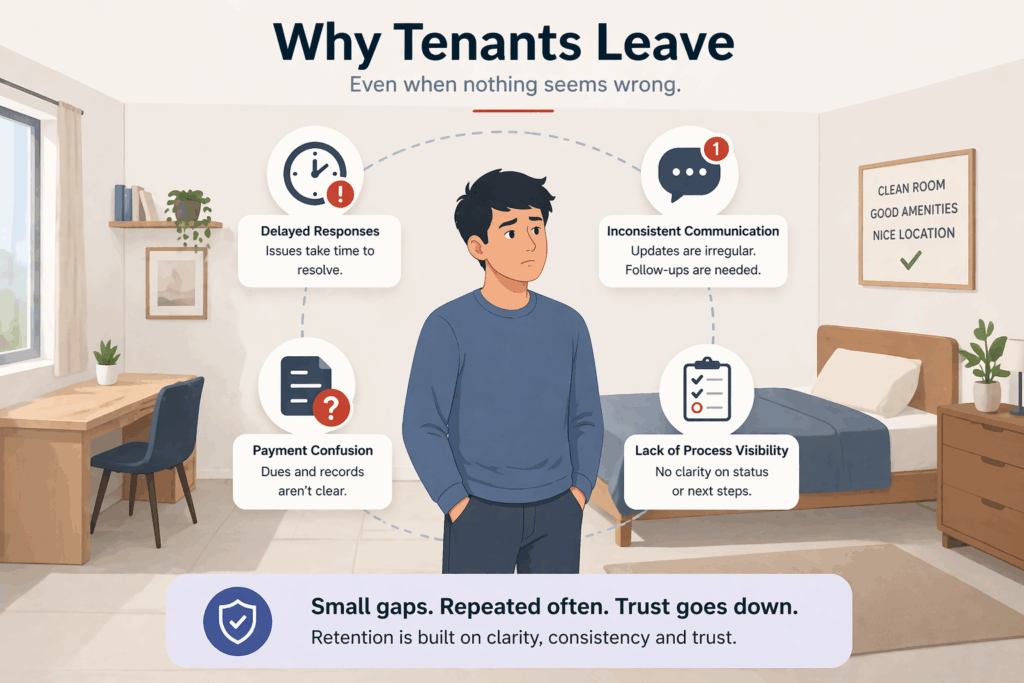
Most tenants don’t leave because of one major issue. In fact, if you ask them directly, many won’t point to a single reason at all.
Instead, their decision builds over time.
Small operational gaps, delays, unclear communication, repeated follow-ups, start creating friction. Individually, these issues don’t feel serious. But when they repeat, they change how tenants experience the property.
Over time, tenants begin to feel that things are not as smooth as they should be. They may not complain actively, but they notice patterns. And once those patterns become consistent, their confidence in staying begins to drop.
Some of the most common friction points include:
- Delayed responses to complaints, where issues are acknowledged but not resolved within a clear or predictable timeframe
- Confusion around payments or dues, especially when records are not immediately visible or clearly communicated
- Inconsistent communication, where tenants receive updates irregularly or have to follow up for basic clarity
- Lack of process visibility, making everyday interactions feel unstructured and dependent on manual coordination
These aren’t major failures. But repeated enough, they reduce trust and retention is built on trust.
Retention Is About How Easy It Feels to Stay
A common assumption is that tenants stay because of better rooms, lower pricing, or more amenities.
While these factors matter, they are not what sustain retention over time.
What actually influences retention is how easy the experience feels on a day-to-day basis.
When a tenant can raise an issue and knows it will be tracked, when a payment is made and instantly reflected, when communication is clear without requiring follow-ups, the system starts to feel reliable.
On the other hand, when basic actions require effort, even a well-maintained property starts to feel difficult to live in.
Tenants are not just evaluating what you provide. They are evaluating how smoothly everything works around them.
The Psychological Shift Before a Tenant Leaves
Tenants don’t decide to leave in a single moment. There is always a phase before that decision, a gradual shift in perception.
This shift usually begins when tenants start noticing recurring friction. They may not react immediately, but internally, their expectations begin to change. What was once acceptable starts feeling inefficient. What was once manageable starts feeling inconvenient.
At this stage, the experience becomes more noticeable than the infrastructure.
Even small issues begin to carry more weight because they reinforce an existing perception: that the system is not fully reliable.
By the time a tenant decides to leave, the problem has already existed for a while. The decision is simply the outcome.
Why Occupancy Alone Doesn’t Guarantee Retention
Many PG operations are designed around occupancy. The focus is on filling beds quickly and maintaining consistent inflow.
While this approach keeps revenue stable in the short term, it doesn’t address long-term retention.
Retention depends on consistency, not just availability.
A tenant is more likely to stay in a property where:
- Processes feel structured and predictable over time
- Communication does not require repeated effort
- Issues are handled without constant follow-ups
This doesn’t require additional services or major investments. It requires removing inconsistency from everyday operations.
That’s what creates a stable tenant base.
Tenant Experience Is Built Through Operations, Not Add-Ons
In high-density housing, tenant experience is often misunderstood. It’s not primarily shaped by facilities or extras. It is shaped by how operations function daily.
Every interaction contributes to the overall experience.
For example, a well-structured setup usually ensures:
- Clear onboarding, where expectations, rules, and financial terms are explained upfront without ambiguity
- Organised complaint handling, where issues are logged, tracked, and resolved with visibility
- Transparent payment systems, where tenants always know their dues, history, and status without asking
When these systems are in place, the experience feels smooth.
When they are missing, tenants feel the gaps immediately, even if everything else looks fine.
Communication Gaps: The Most Common Cause of Churn
Across most PG operations, retention issues can often be traced back to one underlying factor, lack of clarity.
Tenants don’t necessarily expect constant communication. What they expect is reliable communication.
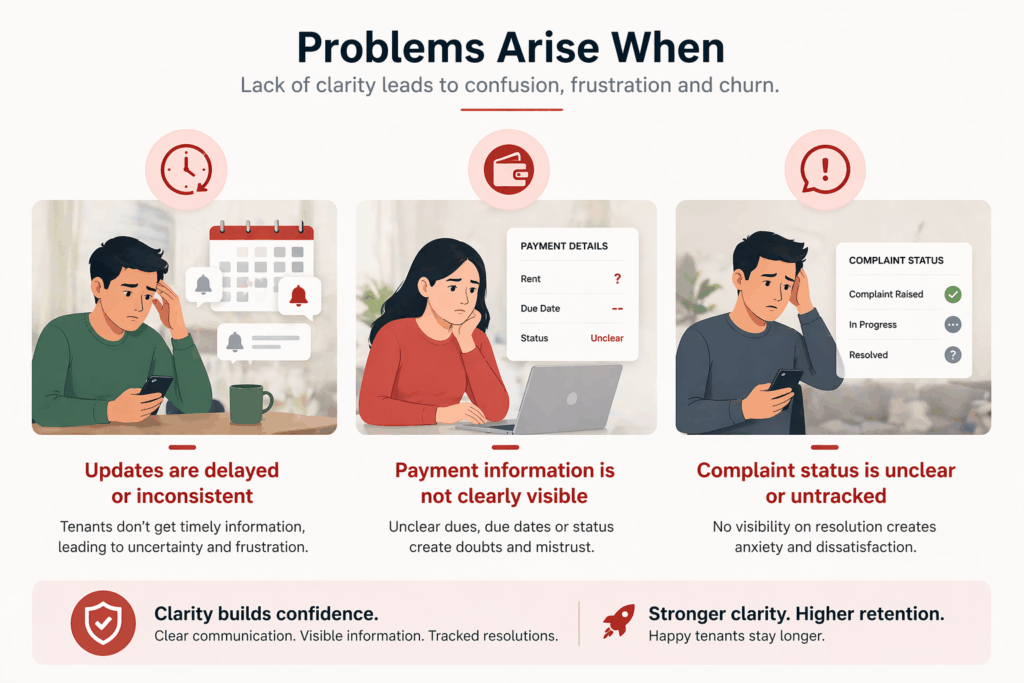
Problems arise when:
- Updates are delayed or inconsistent
- Payment information is not clearly visible
- Complaint status is unclear or untracked
In these situations, tenants are forced to fill in the gaps themselves. And those assumptions are rarely positive.
Clear communication reduces uncertainty. And reducing uncertainty is one of the strongest ways to improve tenant retention.
When Manual Systems Start Affecting Tenant Experience
Manual systems often work well in the early stages of a PG.
With fewer tenants, it’s possible to manage communication, payments, and complaints without much structure. However, as occupancy increases, these systems start becoming difficult to maintain.
Information gets scattered across different channels. Follow-ups depend on memory. Updates become inconsistent.
This is a common pattern in growing PG operations, where complexity increases but systems do not evolve alongside it
Tenants don’t see the internal challenge. They only experience the outcome, delays, confusion, and lack of clarity.
And that experience directly affects retention.
Using Technology to Create Consistency
Technology in this context is not about adding complexity. It is about creating consistency.
A structured system ensures that:
- Communication is standardised across tenants
- Tasks are tracked instead of remembered
- Information is always accessible when needed
This removes the dependency on manual coordination and reduces operational gaps.
Instead of reacting to issues, you begin to manage them proactively.
As a result, tenants experience fewer delays, clearer communication, and more predictable interactions, all of which contribute directly to retention.
Feedback Loops: Identifying Issues Before They Escalate
One of the biggest challenges in managing retention is timing. By the time tenants leave, the underlying issues are already clear, but the opportunity to fix them has passed.
Feedback loops help bring visibility earlier.
By tracking patterns such as recurring complaints, repeated delays, or common tenant concerns, you begin to understand what is actually affecting the experience.
This allows you to:
- Identify issues before they become patterns
- Improve systems based on real feedback
- Reduce friction proactively
Even simple tracking can create meaningful insights when done consistently.
The Real Cost of High Tenant Turnover
Tenant turnover is often viewed as a vacancy issue, but its impact is broader.
Frequent churn creates continuous operational pressure. You spend time onboarding new tenants, managing transitions, and filling gaps that could have been avoided.
It also affects stability. Instead of operating a steady system, you are constantly resetting it.
Retention reduces this cycle. It allows operations to stabilise, improves predictability, and reduces the need for constant intervention.
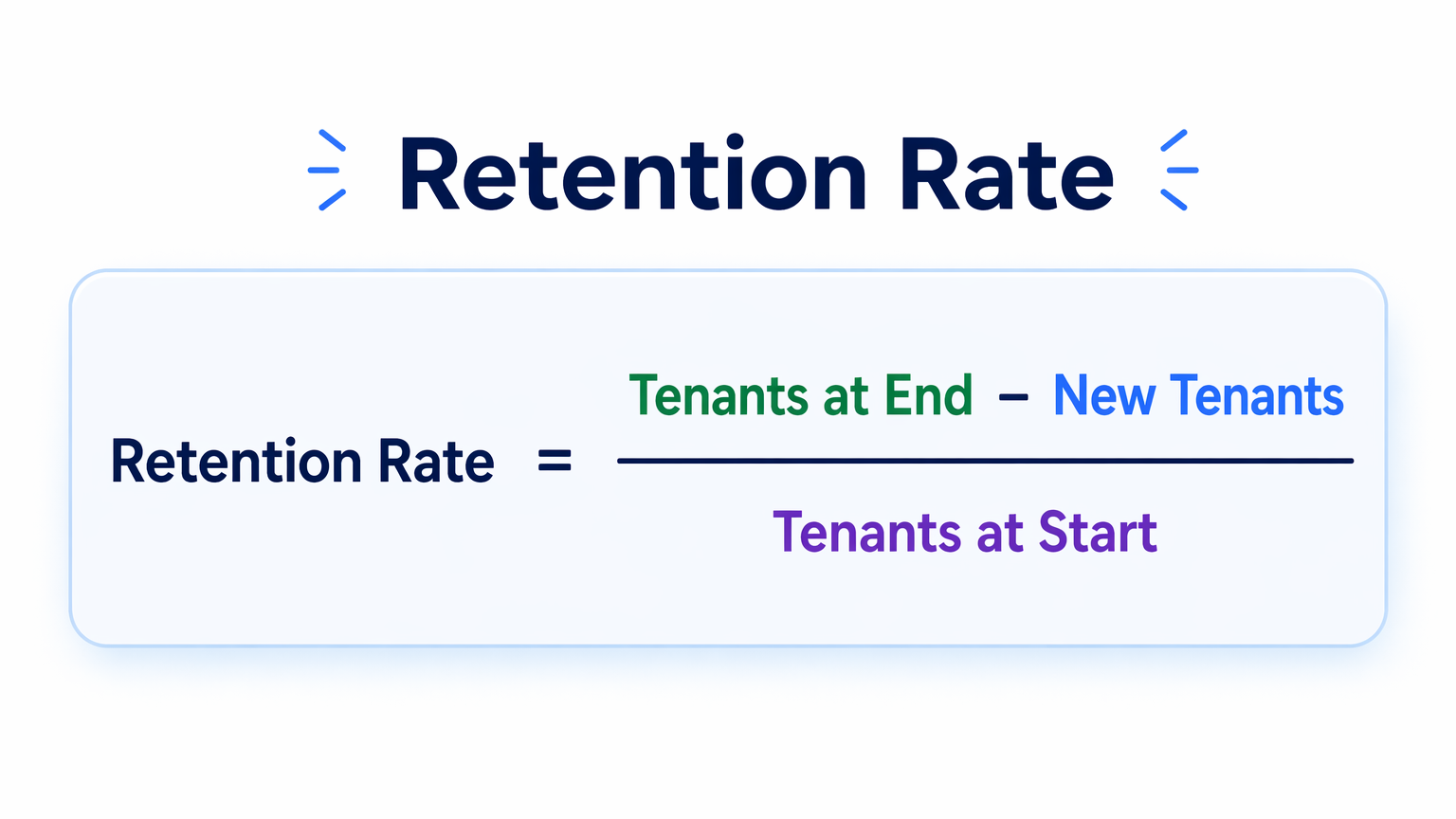
Retention Rate Calculator (Simple Way to Measure Stability)
Once you understand how turnover affects your operations, the next step is measuring it clearly. Without a simple metric, it becomes difficult to tell whether your retention is actually improving or gradually declining over time.
Retention Rate = (Tenants at End – New Tenants) / Tenants at Start
Tracking this consistently gives you a clearer view of how stable your occupancy really is. It also helps you understand whether the changes you’re making are actually improving tenant retention or just maintaining surface-level occupancy.
How Rentok Helps Improve Tenant Retention
As tenant volume increases, maintaining consistency manually becomes difficult. This is where a structured system like Rentok becomes useful.
Rentok helps bring clarity to the parts of your operations that directly influence tenant experience.
With Rentok, you can:
- Maintain organised tenant records, ensuring clarity across onboarding, stay, and exit
- Track complaints with proper visibility, so issues are resolved without repeated follow-ups
- Automate rent reminders and updates, reducing confusion around payments
- Maintain consistent communication across tenants, improving overall reliability
Because everything is connected, operations become more predictable.
And when operations become predictable, tenant experience improves, which directly impacts retention.
Final Thoughts
Tenant retention does not fail because of one major issue. It weakens through small, repeated inconsistencies that affect how tenants experience your system over time.
In high-density housing, tenants are constantly evaluating how easy it is to live within your setup. When interactions feel smooth, predictable, and well-managed, they stay longer. When things feel scattered or require effort, they begin to disengage.
Most retention challenges are not about pricing or infrastructure. They are about operational gaps that build gradually and reduce confidence.
If your current setup still depends on manual tracking or disconnected processes, those gaps may already be affecting your retention. A structured system like Rentok helps bring clarity, consistency, and control into your operations, allowing you to improve tenant experience without increasing effort.
Book a demo to see how Rentok helps you build a system that tenants don’t want to leave.
About the Author
Ishika Pannu
Ishika Pannu brings you the latest insights and easy-to-apply strategies in property management—helping you simplify renting and grow with RentOk.