Legal
Navigating the New Model Tenancy Act: A State-by-State Guide for 2026

Written by
Ishika Pannu
Read Time
10 min read
Posted on
April 22, 2026
Overview
Overview
Navigating the New Model Tenancy Act: A State-by-State Guide for 2026
Rental housing in India is entering a phase where informality is no longer sustainable.
For years, most PGs and rental properties operated on systems that were flexible but loosely structured. Agreements were created, but not always followed. Payments were tracked, but not always consistently. Communication happened, but not always documented.
This approach worked when operations were small.
But as rental setups expanded, more tenants, more turnover, more transactions, that flexibility started creating friction. Small gaps in clarity began to compound into larger operational issues. A missed payment update turns into a dispute. A vague agreement leads to disagreement at move-out. A lack of documentation makes resolution difficult.
These are not isolated problems. They are systemic.
The Model Tenancy Act (MTA) is not introducing these challenges. It is responding to them.
And what it is really doing is pushing rental housing toward something it has long lacked:
Structured, predictable systems.
What the Model Tenancy Act Is Really Changing
At first glance, the Act looks like a legal reform. But its real impact is operational.
Earlier, rental systems were built on flexibility. That flexibility allowed landlords to manage situations case by case, adjusting terms informally when needed. While this worked in simpler setups, it created inconsistencies as complexity increased.
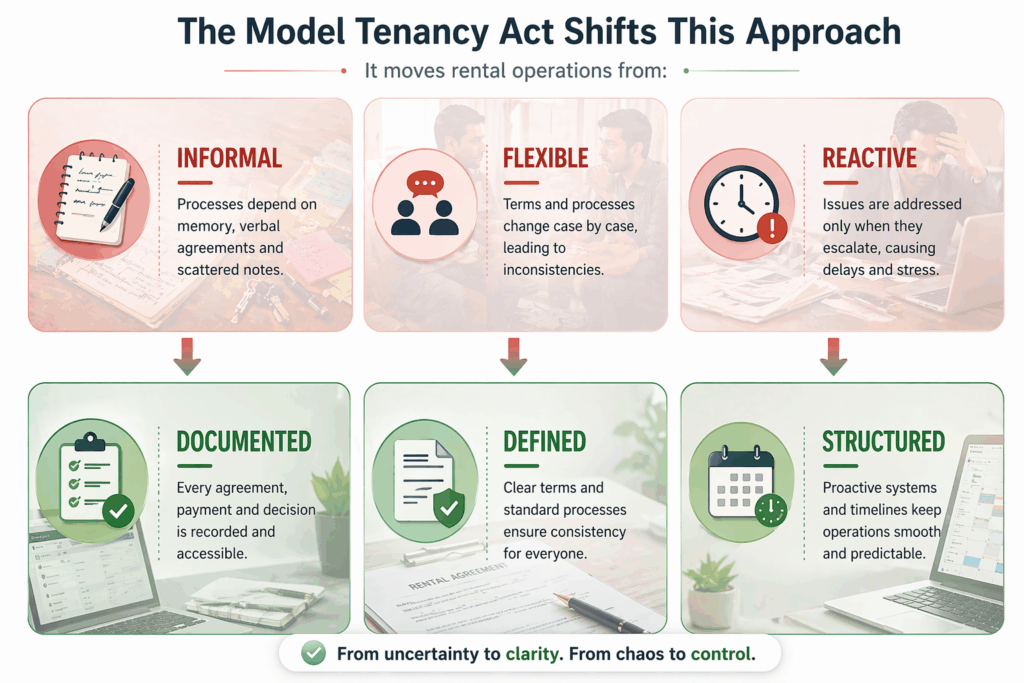
The Model Tenancy Act shifts this approach.
It moves rental operations from:
- Informal → Documented
- Flexible → Defined
- Reactive → Structured
This change shows up in how daily operations are expected to function.
Instead of relying on memory or scattered tools, landlords now need systems that ensure:
- Agreements clearly define expectations from the beginning, reducing ambiguity during conflicts
- Financial records are consistently maintained, so both landlord and tenant can verify transactions easily
- Communication and decisions are documented, making it easier to resolve issues without relying on recollection
This is not just about compliance. It is about creating a system where operations remain stable even as scale increases.
Written Agreements: From Formality to Operational Control
Most PG operators already use agreements, but the problem has rarely been the absence of agreements. It has been the lack of depth and consistency in how they are used.
In many cases, agreements:
- Are copied from generic templates without reflecting actual operations
- Do not clearly define all terms, leaving room for interpretation
- Are not revisited once the tenant moves in
This creates a gap between what is written and what is followed.
The Model Tenancy Act changes this expectation significantly.
Agreements are now expected to function as a central reference point throughout the tenancy. This means they should not just exist, they should actively guide how situations are handled.
A well-structured agreement typically ensures:
- Payment terms are clearly defined, including rent amount, due dates, and penalties, so financial expectations remain consistent
- Duration and renewal conditions are specified, reducing confusion around extensions or move-outs
- Responsibilities are clearly divided, so maintenance, damages, and usage do not become points of conflict
When agreements are this detailed, landlords no longer need to rely on interpretation. Instead, they can rely on clarity.
This reduces disputes not because rules are stricter, but because expectations are aligned from the start.
Security Deposit Cap: A Shift in How Risk Is Managed
The cap on security deposits is one of the most talked-about changes under the Act. However, its impact goes beyond limiting the amount landlords can collect upfront.
Earlier, deposits acted as a safety net.
They helped absorb:
- Delayed payments
- Minor damages
- Sudden tenant exits
With deposits now limited to two months’ rent for residential properties, that buffer is reduced.
This creates a fundamental shift.
Instead of relying on deposits, landlords must rely on systems.
To manage risk effectively, operators now need:
- Accurate rent tracking systems that identify pending dues early instead of allowing them to accumulate
- Transparent financial records that reduce misunderstandings about payments and adjustments
- Clear onboarding processes that ensure tenants understand financial expectations from the beginning
In many cases, disputes arise not because tenants refuse to pay, but because payment records are unclear or inconsistent. When deposits are no longer sufficient to cover gaps, these inconsistencies become more visible.
Eviction Rules: Defined, Structured, and Evidence-Driven
Eviction has traditionally been one of the most complex aspects of rental management. It often involved a mix of negotiation, delay, and uncertainty, where outcomes depended not just on facts, but on how situations were interpreted.
The Model Tenancy Act brings structure to this process by clearly defining when eviction is valid. It is now permitted under specific conditions such as:
- Persistent non-payment of rent
- Violation of agreement terms
- Misuse or damage of property
- Expiry of tenancy without renewal
However, the real shift is not just in when eviction can happen, but how it is enforced.
Eviction must now follow due process. This means decisions are no longer based on informal discussions or subjective judgment, they rely on verifiable records.
As a result, documentation becomes a core operational requirement rather than a backup.
Landlords who maintain:
- Clear and well-structured agreements that define terms upfront
- Accurate and regularly updated payment records
- Documented communication with tenants over time
are in a much stronger position to act when issues arise.
In such cases, eviction becomes a clear, record-backed process rather than a prolonged dispute.
But when documentation is weak, even valid cases are hard to enforce, not due to lack of grounds, but lack of proof.
This reflects a broader shift: in a structured system, outcomes depend on verifiable evidence, not intent.
Dispute Resolution: Faster Systems, Higher Expectations
The introduction of Rent Authorities, Courts, and Tribunals is aimed at reducing delays in resolving disputes.
This is a significant improvement over traditional processes, where cases could take years to resolve.
However, faster systems come with higher expectations.
To benefit from quicker resolution, landlords must provide:
- Clearly defined agreements
- Accurate financial records
- Consistent documentation of communication
Without these, disputes still become complicated, even if the system itself is faster.
In other words, speed does not replace clarity. It depends on it.
State-by-State Implementation: Why Uniform Assumptions Fail
One of the most misunderstood aspects of the Model Tenancy Act is its implementation.
It is not automatically enforced across India. Since rental laws fall under state jurisdiction, each state chooses how to adopt, or adapt, the framework. As a result, implementation varies significantly across regions.
Broadly, the landscape can be understood in three categories:
- States with strong alignment
These states have adopted frameworks close to the Act, with clearer rules, stronger documentation requirements, and more efficient dispute resolution systems. - States in transition
These regions are gradually updating existing laws, resulting in hybrid systems where old practices and new regulations coexist. - States under traditional systems
Here, older rent control laws continue to dominate, offering flexibility but often lacking structured enforcement and consistency.
This variation makes one thing clear: relying on uniform assumptions across states can lead to gaps in compliance and operations.
What This Means for PG Operators
You cannot operate based on general assumptions.
What works in one state may not apply in another, and relying on broad understanding can create gaps that only show up when issues arise.
Instead, you need to:
- Understand the specific rules applicable in your state
- Align your processes with local requirements, not generic practices
- Stay prepared for gradual changes, even if enforcement currently seems relaxed
Because once enforcement strengthens, adapting becomes more difficult, especially if your systems are not already structured. enforcement strengthens, adapting becomes more difficult.
Where Most PG Operators Still Face Challenges
Even with awareness of these changes, many operators struggle with execution.
The problem is rarely a lack of knowledge. It is inconsistency in systems, things exist, but they don’t function together in a reliable way.
Common gaps include:
- Agreements that exist but are outdated or not aligned with current practices, which creates confusion and weakens their usefulness during disputes
- Tenant information stored across multiple platforms, making it difficult to access quickly or verify when needed
- Payment tracking that is inconsistent, leading to mismatches in records and misunderstandings around dues or deposits
- Compliance treated as a one-time task rather than an ongoing process, resulting in records that become incomplete over time
These issues may not cause immediate disruption, but they reduce clarity across operations. When a problem arises, this lack of consistency makes resolution slower and more difficult, often turning simple situations into avoidable complications.
The Core Issue: Lack of Visibility
At the center of most operational and legal challenges is one key problem, lack of visibility.
When information is scattered across tools, files, or conversations, even simple questions become difficult to answer. Decisions get delayed, follow-ups are missed, and issues are only noticed after they escalate.
You should always have clarity on:
- Which tenants have completed documentation and verification
- Which agreements are active, expiring, or pending renewal
- Which payments are pending, delayed, or disputed
- Which records are missing or incomplete
Without this visibility, operations rely on memory instead of systems. This creates dependency on manual tracking, increases the chances of errors, and makes it harder to respond quickly when something goes wrong.
If this information is not easily accessible, your system becomes reactive.
And reactive systems are where most risks begin to build.
Turning Compliance Into a Daily System
Compliance is often seen as an additional responsibility, something to handle separately from day-to-day operations.
In reality, it is a result of how your system is structured.
When operations are organised, compliance is no longer a task you manage manually. It becomes an outcome of doing things consistently.
A structured setup ensures that:
- Tenant records are centralised and easy to access, reducing dependency on scattered tools and improving response time when information is needed
- Agreements are stored and updated consistently, so they remain relevant throughout the tenancy and not just at the time of move-in
- Payment tracking stays transparent and up to date, preventing small discrepancies from turning into larger disputes
- Communication is documented, creating a clear record that can be referred to whenever questions or conflicts arise
This reduces the need for constant follow-ups and manual checks, allowing operations to run with more clarity and less friction.

How Rentok Helps You Stay Aligned Without Extra Effort
As rental operations become more structured, manual systems start to show clear limitations, especially when managing multiple tenants, frequent transactions, and ongoing documentation.
Rentok addresses this by bringing all key operational elements into a single, connected system.
With Rentok, you can:
- Maintain structured tenant records, including KYC and agreements, in one place, so nothing is lost or difficult to retrieve
- Track rent payments, dues, and deposits with clarity, ensuring your financial data remains accurate and consistent
- Access real-time operational visibility instead of relying on fragmented tools, spreadsheets, or manual updates
- Keep records updated automatically, reducing the risk of missing, outdated, or incomplete information
Because everything is connected, compliance does not need to be managed separately.
It becomes part of your everyday workflow, consistent, visible, and easier to maintain as your operations grow.
Final Take: Why This Shift Matters More Than It Appears
The Model Tenancy Act is not just a regulatory change. It reflects a The Model Tenancy Act is not just a regulatory change. It reflects a broader shift toward more structured, transparent, and accountable rental operations.
If your current setup still depends on informal agreements, scattered records, or manual tracking, the risk may not be visible yet, but it is already building beneath the surface.
Operators who adapt early will not just stay compliant. They will build systems that are easier to manage, easier to scale, and far more predictable in the long run.
The shift is not about adding complexity.
It is about creating clarity in how your operations run every day.
Rentok helps bring tenant management, payments, and documentation into one connected system, so you stay aligned with changing regulations without adding extra effort.
About the Author
Ishika Pannu
Ishika Pannu brings you the latest insights and easy-to-apply strategies in property management—helping you simplify renting and grow with RentOk.