
Market Trends
Mastering Property Maintenance: The Preventive vs. Reactive Framework

Written by
Ishika Pannu
Read Time
8 min read
Posted on
April 21, 2026
Overview
Overview
Mastering Property Maintenance: The Preventive vs. Reactive Framework
Property maintenance rarely fails all at once.
It slips.
A minor issue gets ignored. A repair is delayed because it doesn’t feel urgent. A check is skipped because everything “seems fine.” Over time, these small decisions begin to overlap. What once felt manageable starts creating friction across your operations.
This is how most maintenance systems quietly turn reactive.
And by the time it becomes visible, you’re no longer managing maintenance, you’re responding to it.
Why Reactive Maintenance Feels Right (Until It Doesn’t)
In the early stages, reactive maintenance feels efficient.
There’s no need for planning. No need for tracking. You deal with issues only when they arise, and that keeps things simple.
For a smaller setup, this works.
But as your property grows, the same approach starts creating pressure. Tasks overlap, complaints increase, and your time shifts from managing operations to constantly fixing problems.
This is where most systems begin to lose structure, not because maintenance is difficult, but because it isn’t being handled consistently.
At this point, it becomes important to step back and rethink how your system operates. Instead of continuing to react, you start exploring ways to bring more clarity into your maintenance flow, how tasks are scheduled, tracked, and completed.
If you’re starting to notice these gaps, it may be worth taking a closer look at how a structured platform like Rentok helps you move from scattered maintenance to a more controlled and predictable system.
The Real Cost of Reactive Repairs
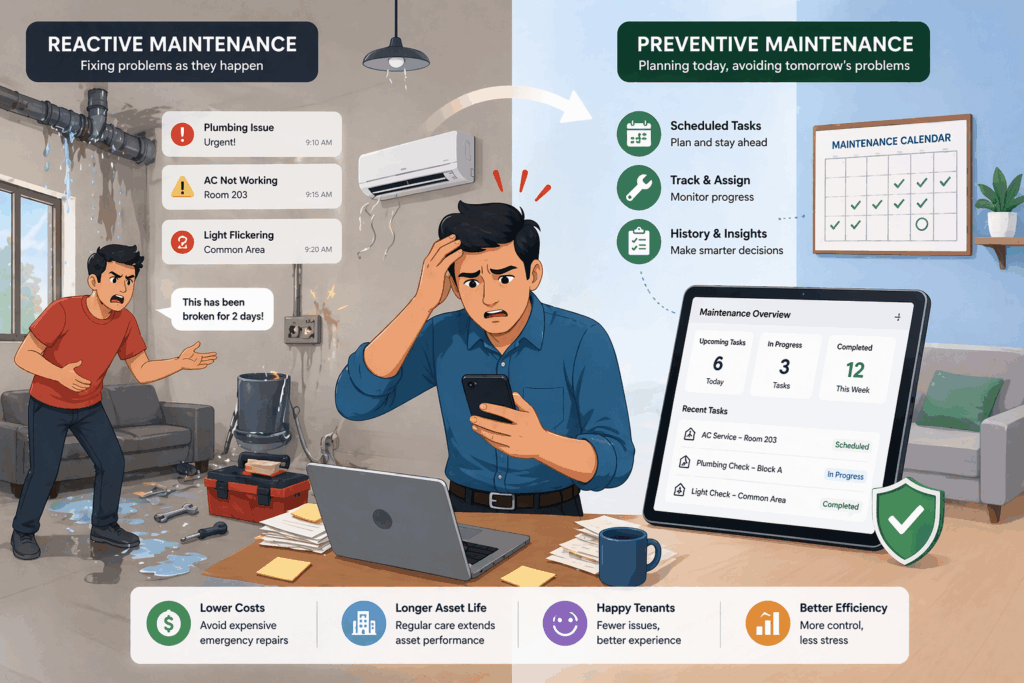
Reactive maintenance doesn’t look expensive at first.
You only spend when something breaks. There’s no upfront effort. No planning overhead.
But what often gets missed is how delays change the scale of the problem.
A small issue, when ignored, rarely stays small.
Over time, reactive repairs lead to:
- Escalation of damage, where minor faults grow into larger issues that require more time, more resources, and more coordination to resolve
- Higher service costs, as urgent repairs often come with premium labour, limited vendor availability, and rushed decision-making
- Operational disruption, where rooms or facilities may become temporarily unusable, affecting both occupancy and tenant experience
- Repeated fixes, where the same issue keeps returning because the root cause was never addressed properly
This creates a pattern where maintenance becomes unpredictable.
And unpredictability is what drives both cost and stress.
Preventive Maintenance: Changing the Timing of Work
Preventive maintenance doesn’t eliminate work.
It reorganises it.
Instead of waiting for issues to appear, you create a system where assets are checked, serviced, and reviewed at regular intervals. The goal is not to do more, it’s to avoid escalation.
This shift may seem small, but it changes how your entire operation functions.
With a preventive approach:
- Issues are identified early, before they turn into visible problems that require urgent attention
- Repairs are scheduled in advance, making them easier to manage without disrupting daily operations
- Maintenance costs become more predictable, as work is distributed instead of concentrated in emergency situations
- Asset performance improves, because regular checks reduce wear and extend usable life
The biggest difference is control.
You’re no longer waiting for problems to define your workload.
Costs of Reactive Repairs vs. Planned Maintenance
The difference between reactive and preventive systems becomes most visible in cost behaviour.
Reactive systems create spikes. Preventive systems create stability.
When maintenance is unplanned:
- You deal with sudden expenses that are difficult to anticipate or budget for
- Emergency repairs often require immediate vendor availability, increasing dependency and cost
- Delays in fixing issues can affect tenant experience, indirectly impacting retention and revenue
In contrast, planned maintenance allows you to:
- Spread costs across time instead of handling large, unexpected expenses
- Schedule vendor work in advance, improving both availability and pricing
- Maintain consistent property conditions, reducing the likelihood of tenant dissatisfaction
Over time, this shift reduces both financial and operational pressure.
Setting Up a Maintenance Calendar That Actually Works
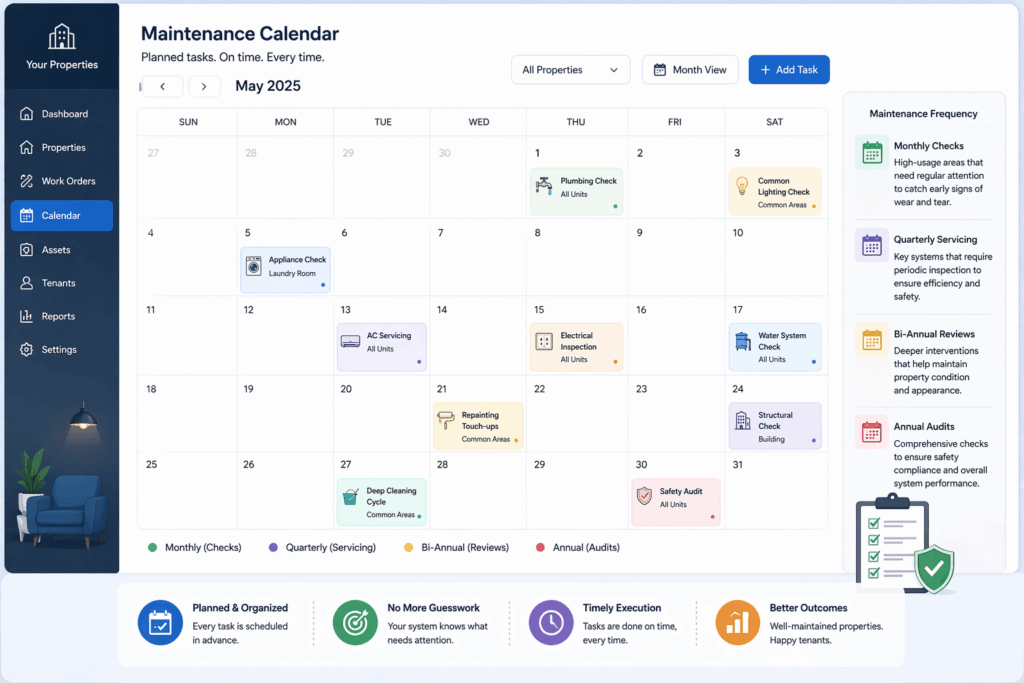
A maintenance calendar is where preventive systems begin, but only if it is built with clarity.
Most generic calendars fail because they lack detail. They say what to do, but not how, when, or where.
A functional calendar connects tasks directly to assets and timelines.
For example:
- Monthly checks can focus on high-usage areas such as plumbing fixtures, common lighting, and frequently used appliances where early signs of wear are easier to detect
- Quarterly servicing can include systems like air conditioning, electrical fittings, and water systems that require periodic inspection to maintain efficiency and safety
- Bi-annual reviews may involve deeper interventions such as repainting touch-ups, structural checks, and cleaning cycles that preserve property condition
- Annual audits typically focus on safety compliance, major servicing, and overall system evaluation
This level of structure removes guesswork.
You’re no longer deciding what to fix every day, your system already knows what needs attention.
Staff Tracking: Where Execution Usually Slips
Even with a strong plan, maintenance often breaks at the execution stage.
Tasks are assigned informally. Follow-ups depend on memory. Completion is rarely documented.
This creates gaps.
Without structured tracking:
- Tasks may be delayed because there is no clear ownership or accountability
- Completed work may go unrecorded, making it difficult to track what has actually been maintained
- Recurring issues may go unnoticed because there is no history to refer back to
A more structured approach introduces clarity into execution.
Instead of relying on informal communication, you:
- Assign tasks with clear responsibility, ensuring that each action has an owner
- Track progress in a visible system, making delays easier to identify and address
- Record completion details, creating a reliable history of maintenance activity
This transforms maintenance from a series of actions into a consistent process.
Property Repair Tracking: Why History Matters More Than You Think
Maintenance decisions are rarely one-time decisions.
They are influenced by what has happened before.
Without tracking repair history, you lose context. You may fix the same issue multiple times without realising it. You may continue repairing an asset that should have been replaced earlier.
Repair tracking brings clarity into these decisions.
It allows you to:
- Identify recurring issues by linking past repairs to current problems, helping you address root causes instead of repeating fixes
- Evaluate asset performance over time, making it easier to decide whether repair or replacement is more cost-effective
- Build a maintenance history that supports better planning, budgeting, and vendor coordination
Over time, this reduces guesswork and improves consistency.
You stop reacting to isolated issues and start managing patterns.
ROI of Preventive Maintenance
Preventive maintenance does not always feel impactful in the short term.
But over time, its effect becomes visible across your entire operation.
Instead of constant disruption, you experience stability.
Instead of unpredictable costs, you gain control.
The return shows up in multiple ways:
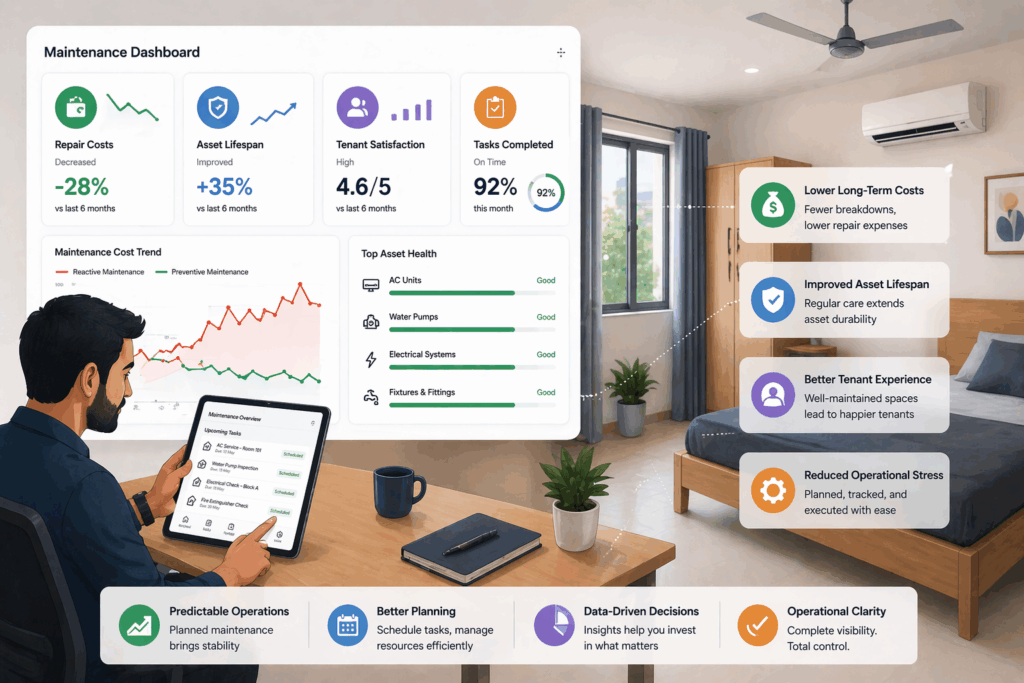
- Lower long-term costs, as early intervention reduces the need for large-scale repairs and emergency fixes
- Improved asset lifespan, because regular servicing prevents excessive wear and extends usability
- Better tenant experience, as consistent maintenance reduces complaints and improves living conditions
- Reduced operational stress, since tasks are planned, tracked, and executed within a predictable system
The biggest shift is not financial.
It’s operational clarity.
Why Manual Maintenance Systems Eventually Break
Many landlords attempt to build preventive systems using familiar tools, spreadsheets, notes, or messaging apps.
These tools work initially. They are simple and accessible.
But as operations grow, they begin to show limitations.
Information becomes scattered. Updates are missed. Tracking becomes inconsistent.
Over time, this leads to:
- Incomplete records that make it difficult to understand what has been done and what is pending
- Missed maintenance cycles because reminders are not structured or visible
- Increased reliance on memory, which becomes unreliable as tasks scale
- Reduced visibility across properties, making it harder to maintain consistency
This is not a failure of effort.
It’s a limitation of the system.
How Rentok Helps You Move from Reactive to Preventive Maintenance
As maintenance becomes more structured, the need for a centralized system becomes clear.
This is where Rentok fits in, not as an additional layer, but as a system that connects your maintenance workflow.
Instead of managing tasks across multiple tools, Rentok allows you to:
- Set up structured maintenance schedules aligned with your property and assets
- Track repair tasks from assignment to completion with clear visibility
- Maintain asset-level records, ensuring every room and facility is accounted for
- Build a detailed repair history that supports better long-term decisions
Because everything is connected, you reduce dependency on manual tracking and scattered communication.
You move from reacting to issues… to managing a system that prevents them.
Final Thoughts
Property maintenance isn’t just about fixing what breaks, it’s about shaping how your system responds before problems escalate.
Reactive systems may feel manageable at first, but as issues begin to overlap, they create delays, inefficiencies, and rising costs. A preventive approach, while requiring some upfront effort, brings consistency and simplifies operations over time.
The real difference lies in structure.
When maintenance is planned, tracked, and visible, everything begins to stabilise, from costs and workflows to tenant experience. Instead of constantly reacting, you gain clarity and control over how your property runs.
If your current setup still relies on handling issues as they arise, hidden inefficiencies may already be building up.
A structured approach doesn’t just reduce repairs, it transforms day-to-day operations.
About the Author
Ishika Pannu
Ishika Pannu brings you the latest insights and easy-to-apply strategies in property management—helping you simplify renting and grow with RentOk.