Market Trends
Top 10 Landlord Risks: Identifying Hidden Risks in Your PG

Written by
Ishika Pannu
Read Time
7 min read
Posted on
April 21, 2026
Overview
Overview
Top 10 Landlord Risks: Identifying Hidden Risks in Your PG
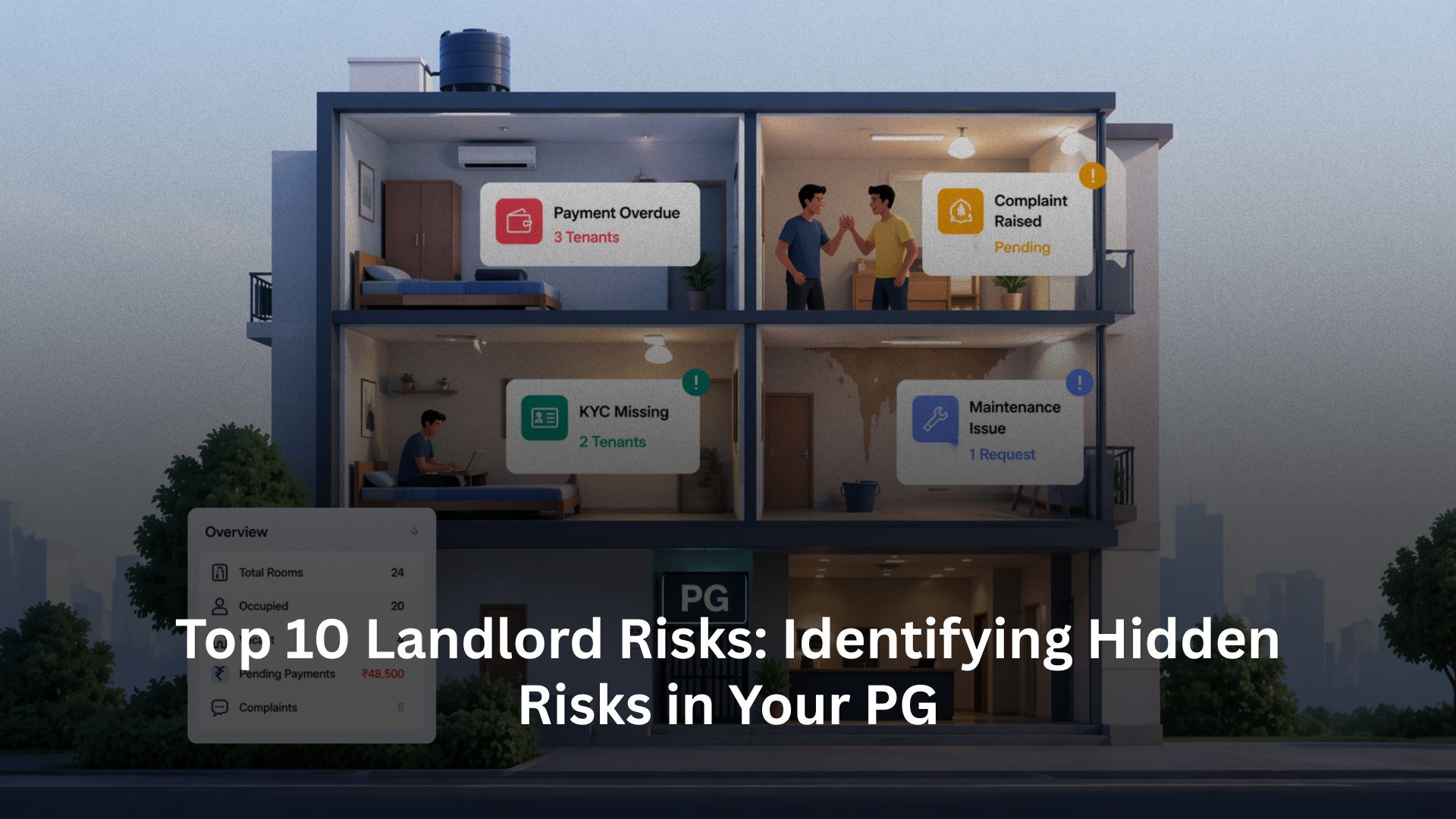
Running a PG often feels stable in the early stages. Rooms fill up, tenants settle in, and daily operations move at a pace that seems manageable. Rent comes in regularly, and most issues get handled without much disruption.
But as your PG grows, this stability starts to shift.
More tenants bring more complexity. Payments overlap, tenant movement increases, and everyday decisions require more coordination than before. What once worked through memory or simple tracking begins to feel scattered. The challenge isn’t demand, it’s the lack of structure supporting that demand.
This is where hidden risks begin to take shape. Not as sudden disruptions, but as small gaps that quietly build over time and start affecting control.
Where Most Landlord Risks Actually Begin
In most PGs, risks don’t come from major mistakes. They develop from inconsistent systems.
You may already have the right processes in place. But if they aren’t structured or consistently followed, they stop supporting your operations effectively.
For instance, many operators face situations like:
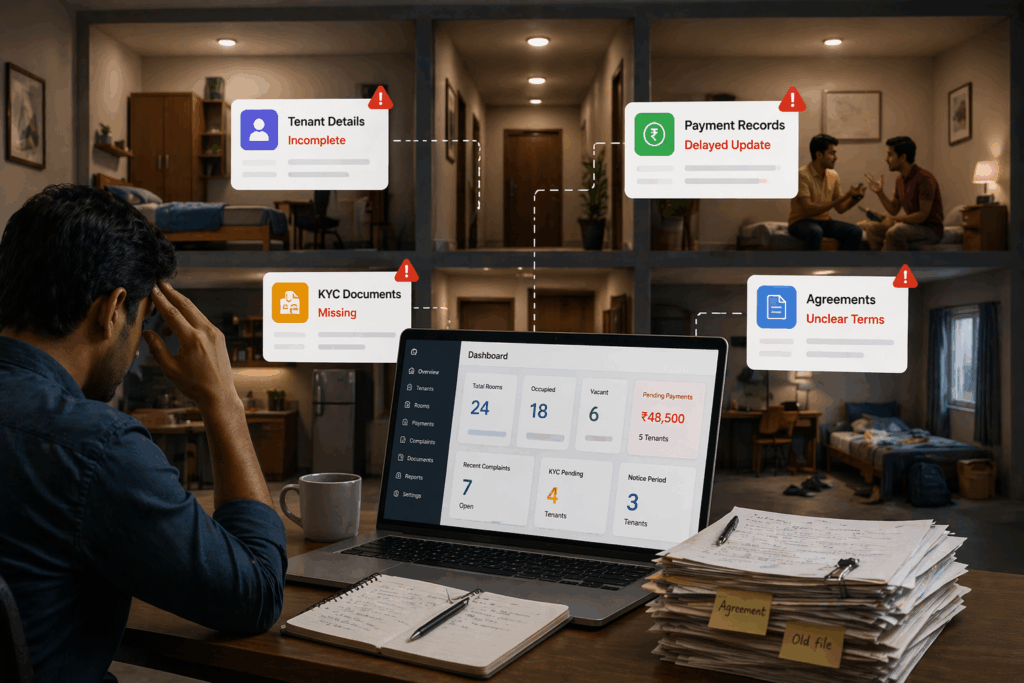
- Tenant details exist but take time to retrieve during disputes or urgent decisions
- Payment records are maintained but don’t reflect real-time status or adjustments
- Agreements are created but lack enough clarity to handle unexpected scenarios
Individually, these gaps seem manageable. But together, they reduce visibility.
And when visibility reduces, risks don’t stay theoretical, they start impacting operations.
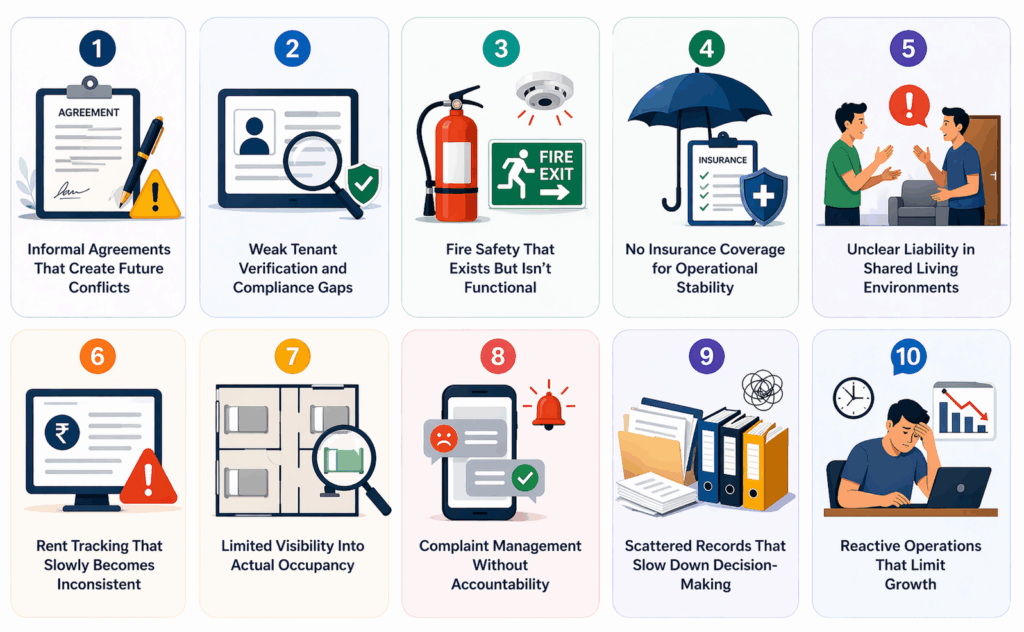
1. Informal Agreements That Create Future Conflicts
Many PG operators treat agreements as a starting formality rather than a working document. They rely on standard templates or verbal understanding, assuming that clarity will hold as long as both sides cooperate.
But real pressure doesn’t show up during onboarding, it shows up during conflict.
When agreements lack detail, common issues arise:
- Deposit deductions become difficult to justify because damage conditions were never clearly defined
- Tenants interpret notice periods differently, leading to disagreements during early exits
- Late payment policies get applied inconsistently, which creates confusion and weakens enforcement
A well-structured agreement reduces ambiguity. It ensures that every situation follows a defined process instead of being handled case by case.
2. Weak Tenant Verification and Compliance Gaps
Tenant verification often gets delayed when occupancy is high and quick onboarding becomes the priority. But skipping this step creates long-term exposure.
Verification is not just a compliance requirement, it gives you control over who stays in your property.
Without proper verification:
- You lack reliable identity records for tenants
- Handling disputes becomes harder due to missing documentation
- Legal accountability becomes difficult in critical situations
A consistent verification process ensures that every tenant is properly documented. This strengthens both safety and operational clarity.
3. Fire Safety That Exists But Isn’t Functional
Fire safety is often treated as a checklist requirement. Many PGs install the required equipment but fail to maintain it properly.
This creates a gap between compliance and readiness.
In many cases:
- Fire extinguishers are installed but not checked regularly
- Exit routes exist but remain unclear or inaccessible
- Tenants are unaware of emergency procedures
This leads to a false sense of security.
Real safety comes from preparedness, ensuring that systems work when needed, not just that they exist.
4. No Insurance Coverage for Operational Stability
Insurance is one of the most overlooked aspects of landlord risk management. Many operators avoid it because it feels like an additional cost.
But avoiding insurance doesn’t reduce risk, it shifts the entire burden onto you.
When unexpected situations occur:
- Property damage directly impacts your finances
- Accidents can result in liability claims
- Recovery depends entirely on your own resources
Even basic coverage provides a safety net. It protects your operations from sudden disruptions that could otherwise create long-term setbacks.
5. Unclear Liability in Shared Living Environments
PGs operate in shared spaces, where responsibility often overlaps.
Without clear policies, even simple issues can become complicated.
For example:
- Tenants may deny responsibility for shared asset damage
- Common area costs may not be clearly assigned
- Operators may need to intervene without a structured basis
These situations consume time and create repeated friction.
Clear liability guidelines help you resolve issues faster and more fairly. They reduce confusion and prevent unnecessary escalation.
6. Rent Tracking That Slowly Becomes Inconsistent
Rent collection starts simple but becomes more complex as your PG grows.
It evolves from a basic task into a system that requires:
- Tracking multiple payment cycles across tenants
- Managing partial, delayed, or adjusted payments
- Updating records consistently and accurately
Without structure, small gaps appear:
- Some payments get recorded late or incorrectly
- Follow-ups become inconsistent
- Pending dues are not always visible
These issues gradually affect cash flow and increase administrative effort.
Accurate rent tracking requires consistency, not just collection.
7. Limited Visibility Into Actual Occupancy
Most PG operators believe they understand their occupancy. But without structured tracking, this visibility often stays incomplete.
You may know that rooms are occupied, but lack clarity on:
- Bed-level availability within shared spaces
- Upcoming vacancies based on tenant movement
- Opportunities to optimize partially filled rooms
This affects both planning and revenue.
When visibility is limited, decisions rely on assumptions instead of actual data.
Clear occupancy tracking helps you make better decisions and maximize utilization.
8. Complaint Management Without Accountability
Complaints are a natural part of PG operations. But how you manage them determines tenant satisfaction.
In many setups:
- Complaints come through calls or messages
- There is no central tracking system
- Follow-ups depend on memory
This creates inconsistency and delays.
A structured system ensures that:
- Every complaint is recorded properly
- Resolution timelines are clear
- Recurring issues become visible
When complaints are handled systematically, they improve operations instead of disrupting them.
9. Scattered Records That Slow Down Decision-Making
As your PG grows, the amount of data you handle increases significantly.
Tenant records, payment details, agreements, and complaints all exist, but not always in one place.
This creates friction in daily operations.
For example:
- Retrieving tenant information takes longer than necessary
- Payment verification requires checking multiple sources
- Accessing agreements during disputes becomes time-consuming
These delays reduce efficiency and increase the chances of error.
Centralizing records improves both speed and accuracy in decision-making.
10. Reactive Operations That Limit Growth
All the risks discussed above lead to one larger issue, reactive operations.
When systems are not structured:
- You respond to problems after they appear
- You depend on manual checks instead of clear insights
- You spend more time resolving issues than preventing them
This limits your ability to scale effectively.
A structured approach allows you to anticipate issues instead of reacting to them.
The Real Problem Isn’t Risk, It’s Visibility
Most landlord risks are not isolated. They stem from one underlying issue, lack of visibility.
Even when operations seem stable, you may still lack clarity on:
- Which payments are pending
- Which tenants plan to move out
- Which complaints remain unresolved
- Whether compliance requirements are fully met
Without visibility, risks remain hidden until they become difficult to manage.
How Structured Systems Help Reduce These Risks
As operations grow, manual methods start creating gaps. Not because they are wrong, but because they don’t scale effectively.
Structured systems help you bring everything into one workflow.
They allow you to:
- Maintain complete tenant records and documentation in one place
- Track payments with real-time clarity
- Monitor occupancy at both room and bed level
- Manage complaints with proper tracking and accountability
When information stays connected, decisions become faster and more accurate.
Instead of chasing data, you work with it.
Risk Audit Checklist for PG Landlords
To assess your current setup, consider the following:
- Are your agreements detailed enough to handle disputes without ambiguity?
- Do you maintain proper verification records for every tenant?
- Can you instantly view pending payments without manual tracking?
- Are your safety systems functional and regularly maintained?
- Is your operational data centralized and easily accessible?
- Can you track complaints from start to resolution without gaps?
If these answers are unclear, the issue likely lies in your system, not your effort.
Conclusion
Landlord risks in PG operations don’t appear suddenly, they build quietly through gaps in visibility, inconsistent processes, and lack of structure. As your PG grows, these gaps start affecting control, revenue, and tenant experience in ways that are easy to miss.
Managing efficiently isn’t about doing more work, but about having a system where everything is clear, consistent, and visible. That’s what helps you spot and control risks before they grow.
If you’re still relying on manual tracking or scattered tools, some of these risks likely already exist, you just don’t see them yet. A structured system brings clarity, helps you catch issues early, and gives you better control over your operations.
About the Author
Ishika Pannu
Ishika Pannu brings you the latest insights and easy-to-apply strategies in property management—helping you simplify renting and grow with RentOk.