
Property Tax
How Does RBI’s New Weekly Credit Reporting Rule Affect Rent Payments?

Written by
Ishika Pannu
Read Time
14 min read
Posted on
September 22, 2026
Overview
Overview
How Does RBI’s New Weekly Credit Reporting Rule Affect Rent Payments?
Rent payments are becoming part of a wider conversation about digital finance, financial discipline, and payment transparency in India. Tenants now use UPI, bank transfers, and online payment platforms to pay their monthly rent. Landlords and PG operators also depend on digital tools to collect payments and track outstanding dues.
At the same time, the Reserve Bank of India (RBI) has been strengthening the credit information reporting system. These changes aim to make borrower information more current and useful for lenders. They have also raised questions about how frequently financial activity is recorded and whether regular rent payments can affect a tenant’s credit score.
This topic needs to be understood carefully. RBI’s credit reporting framework applies to eligible credit institutions and credit information companies. It does not mean that every rent payment automatically appears on a tenant’s CIBIL report. A regular rent transaction is different from a loan or credit account.
RBI introduced fortnightly credit information reporting through its August 2024 circular. Later directions introduced additional reporting reference dates. These developments reflect the financial sector’s growing focus on timely and accurate information.
However, the changes should not be presented as an automatic CIBIL reporting system for all rent payments. Instead, landlords, tenants, and PG operators should understand how credit reporting works. They should also recognise the importance of maintaining accurate digital rent records.
What Does RBI’s New Credit Reporting Cycle Change?
Credit reporting allows financial institutions to share borrower information with Credit Information Companies (CICs). These companies use the information to prepare credit reports. Lenders may refer to these reports when assessing loan applications, credit cards, and other borrowing facilities.
Credit information can include outstanding balances, account status, repayment behaviour, and other relevant details. This information helps lenders understand a borrower’s financial obligations.
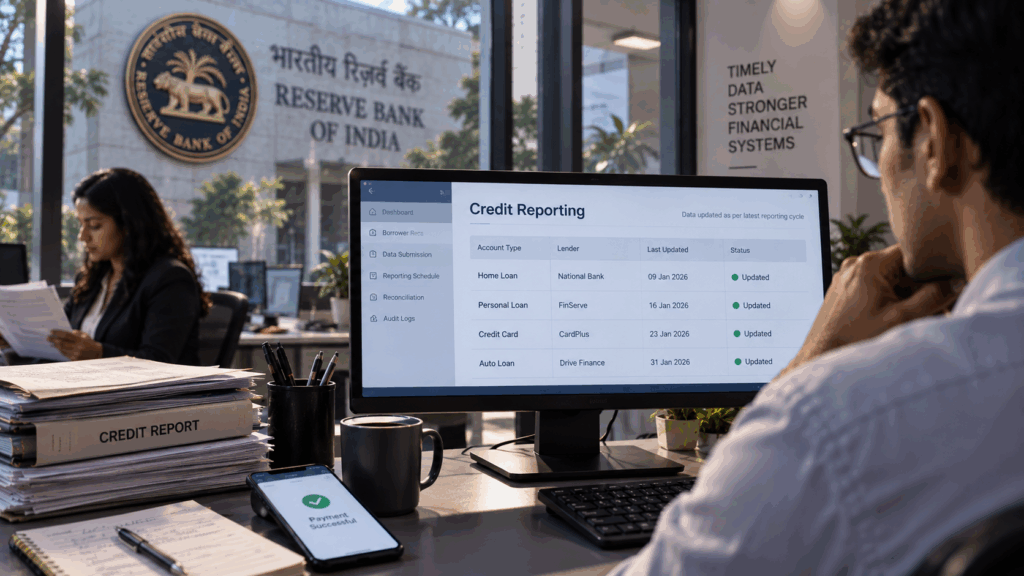
Earlier, credit information was generally updated on a monthly basis. RBI’s August 2024 circular introduced a fortnightly reporting requirement. It referred to the 15th and the last day of each month as reporting dates.
Later directions introduced additional reporting reference dates for applicable credit institutions. These include the 9th, 16th, 23rd, and the last day of the month. The exact reporting process depends on the applicable requirements and the institution involved.
The objective is to reduce the gap between actual credit activity and the information available to lenders. More frequent reporting can help create a more current picture of a borrower’s financial position.
However, faster reporting does not mean that every financial transaction becomes part of a credit report.
What changes with more frequent credit reporting?
The shift towards regular reporting can influence the financial ecosystem in several ways:
- Credit information becomes more current. Lenders may receive updated information about eligible credit accounts more frequently. This can reduce their dependence on older account records.
- Accuracy becomes increasingly important. Credit institutions must submit reliable information within the prescribed timelines. Incorrect account details can create problems for borrowers.
- Repayment changes may be reflected sooner. When reporting happens more frequently, changes in outstanding balances or account status may reach credit information companies faster.
- Data management requires stronger systems. Institutions need reliable processes for collecting, checking, submitting, and correcting financial information.
For landlords and PG owners, the main takeaway is not that every rent payment must be reported to CIBIL. The more relevant lesson is the importance of maintaining accurate and traceable financial records.
Does Rent Appear on a CIBIL Report?
Rent is a regular financial obligation for many people. However, paying rent on time does not automatically mean that the payment appears on a CIBIL report.
A CIBIL report primarily contains credit information supplied by eligible reporting institutions. This may include personal loans, home loans, credit cards, and other reported credit facilities.
A standard rental agreement usually does not create a credit account. The tenant agrees to pay rent to a landlord, property owner, or accommodation provider. The payment may be made through UPI, bank transfer, cash, or a payment platform.
The payment method alone does not determine whether the transaction will appear in a credit report. A digital receipt confirms that money was transferred. It does not automatically convert the transaction into reported credit information.
Rent payments could be connected to credit reporting if an eligible arrangement or recognised reporting mechanism exists. This would depend on the product structure, parties involved, and applicable reporting rules.
Tenants should therefore avoid making assumptions about their credit score.
For example, a tenant may believe that paying rent through an app will automatically increase their CIBIL score. Another tenant may assume that a delayed rent payment will immediately damage their credit history. Both assumptions require further verification.
Rental records and credit reports are different
A rental ledger records the financial relationship between a tenant and a property operator. A credit report records eligible credit information reported by participating institutions.
A rental ledger may include:
- Monthly rent charges and applicable additional fees.
- Payment dates, amounts, and transaction references.
- Partial payments and outstanding balances.
- Late fees, adjustments, and deposit settlements.
- Payment history connected to a particular tenant or room.
A credit report follows a different structure. It focuses on eligible credit accounts and repayment information reported by participating institutions.
Maintaining a rental ledger does not automatically improve a tenant’s credit score. It still offers important benefits. Accurate records help tenants and property operators verify payments and resolve disagreements.
Property owners can also learn more about organised financial management through How to Collect Rent Online from Tenants in India. The article explains how digital rent collection can improve payment tracking and reduce manual work.
Why Could More Frequent Reporting Matter to Tenants?
The direct impact of credit reporting changes applies to eligible credit accounts. Still, these developments highlight the importance of better financial organisation.
Many tenants manage several recurring obligations. These may include rent, education expenses, credit card bills, subscriptions, and loan repayments. Each payment has its own due date and documentation requirements.
A tenant may pay rent on time but miss a credit card payment. In that situation, the credit card account may affect the person’s credit report. The rent payment may not appear in the report.
This distinction is important. Rental payments and credit repayments involve different systems. They should not be treated as identical financial activities.
More frequent reporting also makes it useful for borrowers to review their credit information regularly. If someone notices an incorrect balance or repayment status, they should contact the relevant lender and follow the appropriate correction process.
Financial discipline matters beyond credit scores
Paying rent on time remains important, even when the payment does not affect a CIBIL score.
Delayed rent can create problems for both tenants and property owners. It may lead to repeated reminders, additional charges, and disagreements about outstanding balances. For landlords, delayed collection can affect cash flow and financial planning.
Tenants can improve their payment habits by maintaining a simple monthly process:
- Track payment dates in advance. A clear calendar helps tenants plan their expenses before the rent due date arrives.
- Save payment confirmations. Receipts and transaction references can help resolve questions about payment status.
- Review the payable amount. Tenants should check whether rent includes electricity, food, maintenance, or other applicable charges.
- Communicate early about delays. Informing the property operator in advance can reduce confusion and support better coordination.
- Check the ledger regularly. Reviewing the account helps tenants identify incorrect entries before they become larger disputes.
These practices support financial organisation. They also create a clearer relationship between tenants and property managers.
What Should Landlords and PG Owners Know?
The discussion around credit reporting highlights an important responsibility for rental businesses. Property operators need to maintain accurate financial records, regardless of whether rent payments are reported to credit bureaus.
Many landlords and PG operators still use spreadsheets, bank statements, WhatsApp messages, and payment screenshots. These methods may work for a small property. However, they become harder to manage as occupancy increases.
Consider a PG with several residents. Some tenants may pay the full amount on the due date. Others may make partial payments. Some may transfer money from a parent’s bank account. Others may pay rent along with electricity or food charges.
If these transactions are not recorded correctly, the operator may struggle to identify the actual outstanding amount. Staff members may also send incorrect reminders or duplicate payment requests.
The challenge is not only collecting rent. It is maintaining a reliable financial record after receiving the payment.
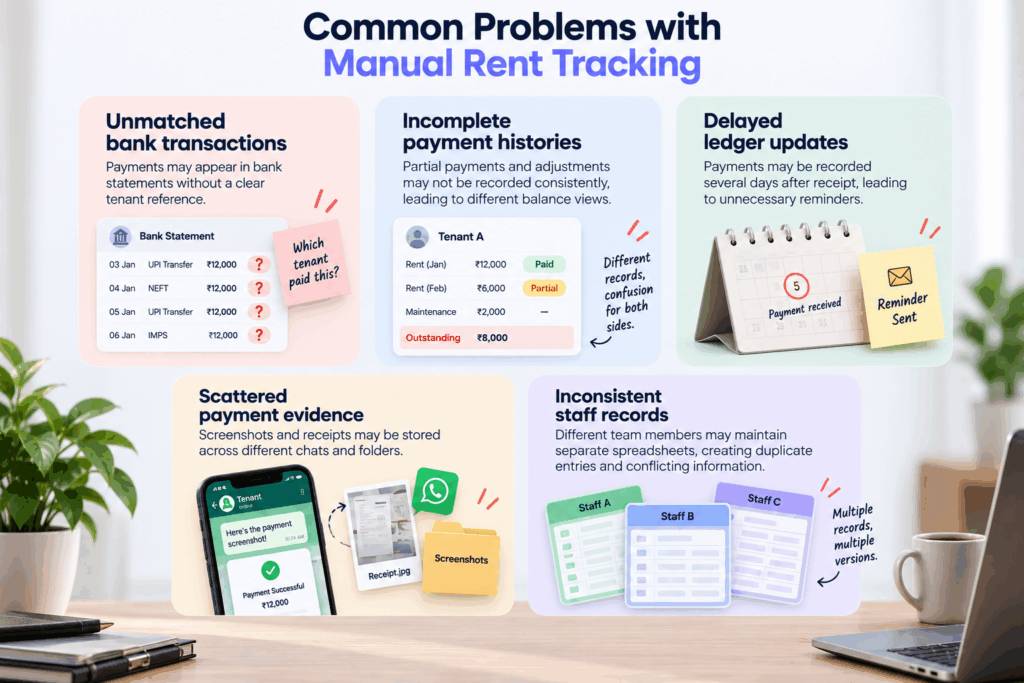
Common problems with manual rent tracking
Manual processes can create several gaps in payment management:
- Unmatched bank transactions: A payment may appear in a bank statement without a clear tenant reference. This makes reconciliation difficult when several residents pay similar amounts.
- Incomplete payment histories: Partial payments and adjustments may not be recorded consistently. The tenant and operator may then have different views of the outstanding balance.
- Delayed ledger updates: Payments may be recorded several days after receipt. This can lead to reminders being sent for amounts that have already been paid.
- Scattered payment evidence: Screenshots and receipts may be stored across different conversations. Finding the correct document can take unnecessary time.
- Inconsistent staff records: Different team members may maintain separate spreadsheets. This can create duplicate entries and conflicting information.
A centralised property management system can reduce these problems. It gives operators a consistent process for recording payments and reviewing outstanding dues.
For a deeper look at payment performance, property owners can read How to Track Rent Collection Performance. The article discusses useful metrics such as on-time payments, delayed payments, outstanding dues, and collection time.
Why Clean Digital Rent Records Matter
A digital rent record should provide more than a simple paid or unpaid status. It should explain the financial position of every tenant.
A complete record should show the amount charged, payment received, and balance remaining. It should also provide context for adjustments, partial payments, or unusual transactions.
This becomes especially important when a property manages several buildings or a large tenant base. A small recording error can become difficult to identify when it is repeated across many accounts.
Clean records support daily operations. They can also help during financial reviews, tenant complaints, deposit settlements, and internal audits.
What makes a rent record audit-ready?
An audit-ready rent record is organised, traceable, and supported by relevant information. It should allow the operator to review a transaction without searching through multiple conversations.
Important elements include:
- Correct tenant identification: Every payment should be linked to the right tenant, room, bed, or property account. This reduces confusion between residents with similar names.
- Detailed transaction history: The record should include the amount charged, amount received, payment date, and transaction reference.
- Clear outstanding balance: The system should distinguish between full payments, partial payments, pending dues, and adjustments.
- Supporting documentation: Receipts and payment confirmations should be accessible when the tenant or operator needs to verify a transaction.
- Regular updates: Records should be updated promptly. This helps staff work with current information and reduces unnecessary follow-ups.
Property operators can also explore How Property Management Software Helps You Collect Rent on Time. The article explains how automation can connect reminders, payment tracking, receipts, and tenant ledgers.
How Can Technology Improve Rent Payment Transparency?
Digital payment systems have made rent collection more convenient. However, convenience alone does not guarantee accurate records.
A tenant may complete a payment within seconds. The operator still needs to connect that payment to the correct tenant account. The amount must also be reconciled with the actual dues.
A connected rental management workflow can simplify this process. It can link rent generation, reminders, payment collection, receipts, and ledger updates.
For example, the system may generate a monthly rent charge based on the property’s settings. The tenant receives a reminder and completes the payment through an available method. The transaction can then be recorded against the correct account.
The exact workflow depends on the software and configuration used by the property. The objective remains consistent: reduce manual work and improve financial visibility.
Features that support better rent management
A property management platform can support rental operations through several functions:
- Automated rent generation: Recurring rent charges can be created according to the property’s payment cycle. This reduces repetitive data entry.
- Digital payment options: Tenants can use convenient payment methods. This creates a more consistent collection experience.
- Tenant-wise ledgers: Each tenant’s payment history can be maintained in one place. Operators can review payments and pending balances more easily.
- Automated reminders: Scheduled reminders reduce the need for staff to contact every tenant manually. They also create a predictable collection process.
- Financial reports: Operators can review pending dues, collection performance, and payment trends. These insights support better planning.
Property owners exploring recurring payment options can also read What Is Autopay for Rent Collection?. The article explains how UPI Autopay can support recurring rent payments after the tenant provides the required approval.
These features do not automatically make rent payments part of a CIBIL report. Their purpose is different. They help property owners maintain accurate rental information and manage collections more efficiently.
What Should Tenants Do When a Payment Record Is Incorrect?
Payment errors can occur even when the tenant has completed the transaction. A payment may remain unlinked because of an incorrect reference, delayed reconciliation, or a mismatch in the payer’s name.
Tenants should retain payment confirmations until the transaction appears correctly in the rental ledger. If an issue occurs, they should share the transaction reference with the property operator.
Property owners should review the transaction before marking it as unpaid. A payment from a parent’s or family member’s account may not immediately match the tenant’s name.
The operator should check the amount, date, and transaction reference before making a decision. A clear correction process can prevent unnecessary conflict.
The process should include:
- Reviewing the tenant’s payment confirmation and transaction reference.
- Checking the relevant bank statement or payment dashboard.
- Matching the amount with the tenant’s outstanding balance.
- Updating the ledger after verification.
- Sharing confirmation with the tenant once the correction is complete.
For situations involving unpaid dues after a tenant has moved out, property owners can refer to How to Recover Rent from a Tenant Who Has Already Vacated. Proper documentation becomes especially important when financial disagreements arise.

How RentOk Helps You Keep Rent Records Audit-Ready
RentOk helps landlords, PG owners, and property managers organise rental operations through a centralised platform. It supports important activities such as rent management, payment tracking, tenant records, and outstanding dues monitoring.
Instead of depending on separate spreadsheets, payment screenshots, and manual reminders, operators can manage financial information through a more structured system. Tenant-wise records help them review payment histories and identify pending amounts.
RentOk also supports digital payment workflows and automated reminders. These features can reduce repetitive staff work and create greater consistency in the collection process. Operators managing multiple properties can benefit from improved visibility across their rental operations.
The platform does not mean that every rent payment is automatically reported to CIBIL. Its purpose is to help property owners maintain accurate, accessible, and organised rental records. This supports better reconciliation, clearer communication, and more efficient property management.
For operators who want to strengthen their financial workflow, RentOk provides tools that bring rent collection and property operations into one connected system.
Conclusion
RBI’s evolving credit reporting framework reflects the growing importance of timely and accurate financial information. However, tenants and property owners should understand that ordinary rent payments do not automatically appear on CIBIL reports.
Credit reporting requirements primarily apply to eligible credit institutions and credit information companies. A rent payment becomes part of a credit report only when an appropriate reporting arrangement or eligible financial product exists.
For rental businesses, the more practical priority is maintaining accurate and accessible payment records. Clear ledgers can reduce disputes, improve collection visibility, and support better financial planning.
As rental operations become more digital, property owners need systems that can track payments, manage dues, and maintain reliable tenant information.
Keep Rent Records Audit-Ready on RentOk. Simplify rent collection, organise tenant-wise payment records, and build a more transparent financial workflow with RentOk’s digital property management solutions.
Frequently Asked Questions
Find answers to common questions about this topic
About the Author
Ishika Pannu
Ishika Pannu brings you the latest insights and easy-to-apply strategies in property management—helping you simplify renting and grow with RentOk.
Stay ahead in property management with expert insights
Join thousands of property managers receiving exclusive tips delivered straight to your inbox.
Browse posts by category
Case Study
Cost of Living
Growth
Legal
Market Trends
News
Pg owner app
Property Management
Property Tax
Tech
RentOk
The easiest way to rent and manage your PGs and hostels.
Get the app


Contact us
hello@eazyapp.tech
HQ Office
COGROW, BASEMENT F-12/8A
BESIDE HOUSE OF STYLE SALON, SECTOR 28, DLF PHASE 1
GURUGRAM, HARYANA - 122002
South India Office
LUMIODESK COWORKING, 2ND FLOOR, 40, 14TH MAIN RD
BESIDE MC DONALD, 7TH SECTOR, HSR LAYOUT
BENGALURU, KARNATAKA - 560102
©️ 2026 EazyApp Tech Pvt Ltd. All rights reserved


