
Tenant Rights
Can My Landlord Evict Me Without Notice?

Written by
Ishika Pannu
Read Time
16 min read
Posted on
October 5, 2026
Overview
Overview
Can My Landlord Evict Me Without Notice?
Being told to leave a rented property immediately can put a tenant in a difficult position. There may be no time to find another place, arrange the move, settle pending payments, or understand why the landlord wants the tenancy to end.
But a landlord having a reason to seek possession does not automatically mean a tenant can be asked to leave overnight.
The first thing to understand is that there is no single eviction notice period that applies to every rental arrangement in India. The answer can depend on the rent agreement, the type of tenancy, and the law that applies to the property.
This is why statements such as “a landlord always has to give 30 days’ notice” can be misleading. The same applies to the idea that a landlord can remove a tenant whenever they want.
The starting point should always be the tenancy itself.
What does the agreement say? Is there a fixed term? Is there a lock-in period? Does the agreement mention a termination notice? Is the property covered by a specific state tenancy or rent-control law?
These questions can change the answer considerably.
For tenants, the rent agreement is therefore more than routine paperwork. It sets out many of the terms that govern the relationship between the landlord and tenant.
If you are reviewing an agreement, RentOk’s guide on How to Read a Rent Agreement Before Signing: What to Watch Out For covers important clauses that can affect your tenancy later.
Does a Landlord Always Have to Give Notice?
The short answer is: it depends.
For certain leases covered by the Transfer of Property Act, 1882, Section 106 provides default rules for termination. These rules apply where there is no contrary contract, local law, or established usage.
For a lease of immovable property used for purposes other than agriculture or manufacturing, Section 106 generally treats the lease as month-to-month. It provides for 15 days’ written notice in the circumstances covered by the provision.
That does not mean every tenant in India has a 15-day notice period.
A rental agreement can contain a different notice period. A state-specific tenancy law can also provide a different framework. Some properties may fall under rent-control legislation with additional protections.
The agreement should therefore be the first place you look.
Before deciding whether an eviction demand is valid, check:
- The termination clause: Look for the section dealing with termination, notice, expiry, or vacating the property. This may specify how either party can end the tenancy.
- The notice period: Check whether the agreement requires 30, 60, or 90 days’ notice. Do not assume that a common market practice applies to your tenancy.
- The applicable law: Identify the state and legal framework governing the property. Different tenancy arrangements can be treated differently.
- The reason for termination: The legal position can change depending on whether the issue involves unpaid rent, breach of agreement, expiry, or another ground.
- The required process: A landlord having a valid reason to seek possession does not automatically mean the landlord can physically remove the tenant.
This distinction is important.
The right to seek possession and the right to immediately take possession are not always the same thing.
For a broader understanding of notice requirements, see RentOk’s What Is the Legal Notice Period Before Vacating a Rented Property?.

What Are the Legal Grounds for Eviction?
A landlord’s ownership of a property does not mean that every eviction can happen immediately.
The grounds for eviction can depend on the tenancy and the law governing it. In some situations, unpaid rent can become a ground for seeking possession. Other cases may involve a breach of the agreement, unauthorized subletting, damage, expiry of the tenancy, or another legally recognized ground.
The important part is that the reason and the process are separate questions.
A landlord may have a legitimate reason to seek possession. The landlord may still need to follow a particular procedure.
This distinction becomes especially important in properties covered by rent-control legislation. Such laws can prescribe specific grounds and procedures for eviction.
For example, a dispute involving unpaid rent should not be reduced to a simple statement that “the tenant has not paid, so they must leave tomorrow.” The landlord should first establish what is actually outstanding and what the agreement and applicable law provide.
The tenant should also have an opportunity to understand the allegation and respond where the applicable process requires it.
RentOk’s guide on How to Handle Tenant Evictions Professionally looks at this issue from the property operator’s perspective. It highlights why documentation, formal notices, and structured communication matter during an eviction.
For tenants, the same principle is useful.
If you receive an eviction notice, do not focus only on the deadline. Read the reason, the agreement, and the process being relied upon.
What Counts as an Illegal “Self-Help” Eviction?
This is one of the most important distinctions in an eviction dispute.
A landlord may have a genuine claim to possession. That does not mean the landlord can simply take the property back by force.
Changing the locks to prevent a tenant from entering, removing belongings, physically forcing someone out, or otherwise taking possession without following the applicable legal process can raise serious legal issues.
Indian courts have repeatedly emphasized the importance of due process in disputes involving possession.
The basic principle is straightforward: a person claiming a right to possession should use the remedy provided by law instead of taking possession through force.
This does not mean a tenant can remain in a property indefinitely.
If the tenancy has legally ended and the landlord has a valid right to recover possession, the landlord can pursue the remedies available under the applicable law. The issue is how that right is enforced.
The difference can be summarized simply:
Lawful eviction involves the applicable legal process. Self-help eviction attempts to bypass that process.
This distinction is particularly important for PGs, hostels, and co-living properties. Operators may deal with several tenant exits at the same time. A casual approach can quickly turn an operational issue into a dispute.
RentOk’s article on Managing Tenant Lock-in Periods Without Conflict also explores how clear communication and documented exit terms can reduce conflict between tenants and property operators.
What Should You Do If Your Landlord Tells You to Leave Immediately?
Your first step should be to understand exactly what the landlord is asking.
If the demand was made verbally, ask for the request in writing. A written record makes the situation easier to understand. It also creates a clear record of what the landlord has actually said.
Next, collect the documents connected with your tenancy.
Keep copies of:
- The signed rent agreement: This establishes the contractual terms for rent, notice, lock-in, termination, deposit, and other obligations.
- Payment records: Keep rent receipts, bank statements, UPI confirmations, or other evidence showing payments made during the tenancy.
- Written communication: Save relevant emails, WhatsApp messages, notices, and other conversations about the property or the dispute.
- Property records: Move-in photographs, inventory lists, and handover documents can become important if damage or missing items are alleged.
- The eviction notice: Keep the original notice and note when and how you received it.
Do not delete conversations simply because they seem unimportant.
A message discussing rent, repairs, notice, or a previous agreement can become relevant later. The more organized your records are, the easier it is to understand what actually happened.
If the landlord is attempting to lock you out, remove your belongings, or physically force you to leave, the situation can require prompt legal advice.
The appropriate remedy depends on the facts and the law that applies to the property. A tenant should therefore avoid assuming that a general online rule will settle a real dispute.
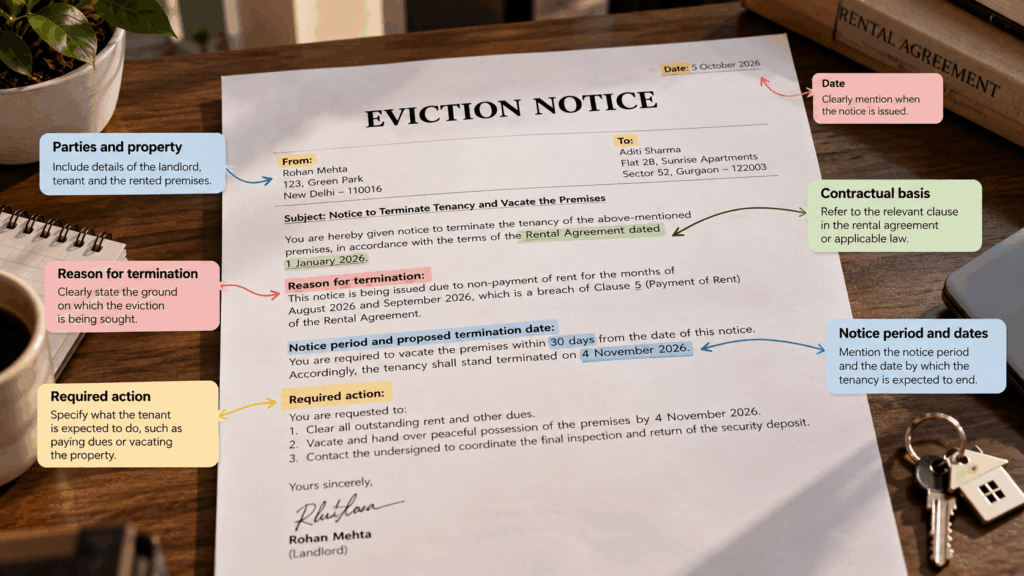
What Should an Eviction Notice Include?
There is no single format that applies to every eviction notice in India.
The exact requirements can depend on the tenancy, the agreement, and the applicable law. Still, the notice should provide enough information for the tenant to understand the landlord’s position.
Depending on the circumstances, a notice may identify:
- The parties and property: It should be clear who is giving the notice, who is receiving it, and which property or premises it concerns.
- The reason for termination: Where the landlord is relying on a particular ground, the tenant should be able to understand what that ground is.
- The relevant dates: The notice should make the proposed termination date or required compliance date clear.
- The contractual basis: Where relevant, the notice may refer to the agreement or the particular clause being relied upon.
- The required action: The tenant should understand whether the notice demands payment, compliance with a condition, or delivery of possession.
Section 106 of the Transfer of Property Act also contains requirements regarding the form and delivery of certain notices. These include written notice signed by or on behalf of the person giving it.
But a document titled “Eviction Notice” does not automatically make an eviction legally valid.
The contents matter. So does the agreement. So does the law governing the tenancy.
This is why tenants should read the complete notice instead of focusing only on the date by which they have been told to leave.
What If the Tenant Has Violated the Rent Agreement?
A tenant who breaches the agreement can face consequences. But the nature of those consequences depends on the agreement and applicable law.
Consider a tenant who repeatedly fails to pay rent. Another tenant may sublet the property without permission. Someone else may cause serious damage or repeatedly violate important property rules.
These situations can give a landlord grounds to take action. But the correct response still depends on the terms of the tenancy and the legal process that applies.
A professional approach starts with documentation.
The landlord or property manager should be able to identify:
- The obligation: What exactly was the tenant required to do under the agreement?
- The breach: What specific action or failure is being alleged?
- The evidence: When did the issue occur, and what records support the allegation?
- The communication: Was the tenant informed about the issue where appropriate?
- The next step: What notice or remedy is required under the agreement and applicable law?
This process protects both sides.
It also reduces the risk of a dispute becoming a matter of conflicting verbal statements.
The same principle applies to lock-in periods. RentOk’s article on What Happens If You Break Your Rent Agreement Before the Lock-In Period? explains why lock-in and notice clauses need to be read separately.
What Happens When the Agreement Has a Lock-In Period?
A lock-in period is often confused with a notice period. They are not the same.
A lock-in period generally represents a minimum contractual commitment. A notice period deals with the advance notice required before ending the tenancy.
Suppose an agreement contains a six-month lock-in and a 30-day notice period.
If the tenant wants to leave during the third month, they cannot automatically assume that giving 30 days’ notice resolves every contractual issue. The agreement may contain a separate early-exit clause.
The wording of that clause matters.
It may specify financial consequences, outline conditions for early termination, or allow the parties to mutually agree to an earlier exit.
This is why tenants should not treat phrases such as “six-month lock-in” or “one-month notice” as complete explanations.
Read the surrounding clauses.
RentOk’s How to Negotiate Rent and Maintenance Terms Before Signing also highlights the importance of discussing lock-in and notice terms before signing. This can prevent confusion when circumstances change later.
For landlords, clear exit clauses also improve operational planning. Unexpected move-outs affect vacancy, room preparation, lead generation, and revenue forecasting.
What If There Is No Notice Period in the Agreement?
An agreement that does not mention a notice period does not necessarily mean that the tenancy can be ended without notice.
When the contract is silent, the applicable legal framework becomes more important.
Section 106 of the Transfer of Property Act provides default rules for certain leases where there is no contrary contract, local law, or usage. For some month-to-month leases covered by the provision, this includes a 15-day written notice requirement.
The Model Tenancy Act, 2021 takes a different approach in its model framework. Where the tenancy agreement does not specify a notice period, it provides for at least one month’s notice before a tenant gives up possession.
These provisions should not be confused.
The Model Tenancy Act is a model framework for adoption by States and Union Territories. It is not automatically the governing law for every rental property in India.
That means the location and legal framework still matter.
RentOk’s article on Why Rent Agreement Rules Are Different in Every Indian State explains why tenants should not assume that a rule followed in one state automatically applies elsewhere.
The practical lesson is simple: do not choose a notice period based only on what is commonly followed in your city.
Check the agreement first. Then identify the law that applies to the tenancy.
Can a Landlord Evict a Tenant Without Notice in an Emergency?
An emergency can change the circumstances. It does not automatically remove every legal requirement.
Suppose there is serious property damage or an immediate safety concern. The landlord may need to take urgent steps to protect people or the property.
That is different from assuming that an emergency gives the landlord unlimited authority to remove a tenant.
Similarly, serious misconduct by a tenant does not automatically mean that the landlord can change the locks or physically remove them.
The response should depend on the actual circumstances.
Where there is a genuine safety risk or serious dispute, professional legal advice may be necessary. The appropriate steps can differ depending on the facts and the applicable law.
The key distinction is between acting urgently to address a genuine problem and using urgency as a reason to bypass the legal process.
How Can Tenants Avoid Eviction Disputes?
The easiest eviction dispute to handle is often the one that never develops.
For tenants, that starts with understanding the agreement before signing it. Notice periods, lock-in clauses, payment obligations, maintenance responsibilities, termination conditions, and deposit rules can all become important later.
A tenant should also maintain clear records throughout the tenancy.
For landlords and property managers, the same principle applies. Agreements should be clear. Important conditions should be explained. Notices and communication should be documented.
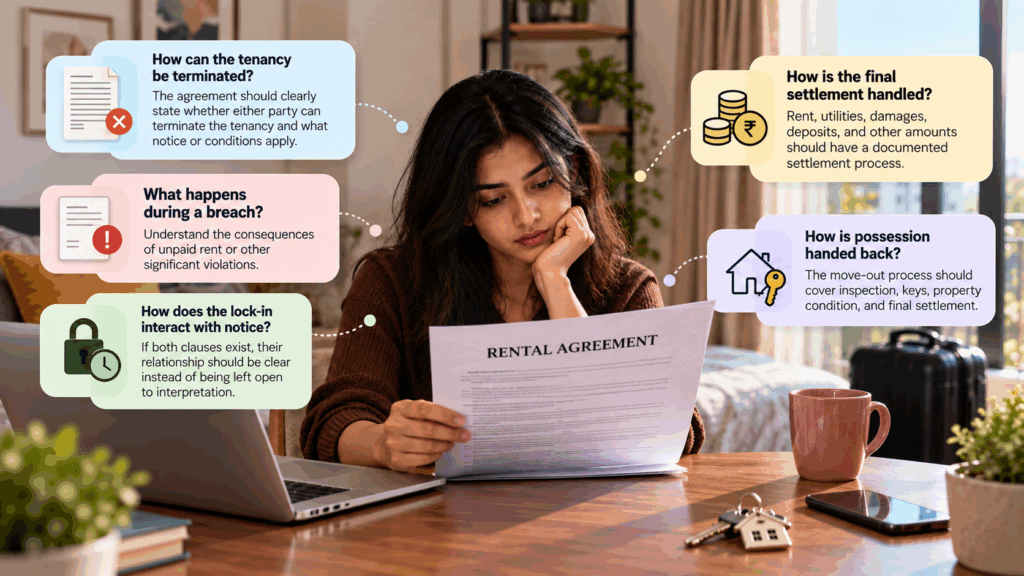
A well-structured rental arrangement should answer practical questions such as:
- How can the tenancy be terminated? The agreement should explain whether either party can terminate the tenancy and what notice or conditions apply.
- What happens during a breach? The parties should understand the consequences of unpaid rent or other significant violations.
- How does the lock-in interact with notice? If both clauses exist, their relationship should be clear instead of being left open to interpretation.
- How is the final settlement handled? Rent, utilities, damages, deposits, and other amounts should have a documented settlement process.
- How is possession handed back? The move-out process should cover inspection, keys, property condition, and final settlement.
Clear documentation does not guarantee that disagreements will never happen.
What it does is give both sides a common reference point when circumstances change.
That is especially valuable in PGs and co-living properties, where property teams may be handling many tenant agreements and exits simultaneously.
How RentOk Helps With Better Tenant and Agreement Management
For landlords, PG operators, and co-living businesses, eviction-related disputes can often be linked to a broader documentation problem.
Agreement details may sit in one file. Payment records may be in another system. Tenant information may be maintained in spreadsheets. Move-in and move-out conversations may remain buried in WhatsApp chats.
RentOk helps bring these property-management workflows into one more structured system.
Operators can manage tenant information, track payments and dues, maintain agreement-related records, and manage check-in and check-out details. This creates better visibility into the tenancy lifecycle.
That visibility becomes useful when a property team needs to verify information quickly.
Instead of searching across several spreadsheets and conversations, operators can work with organized tenant and property records. This can make everyday coordination easier and reduce the confusion that often comes with manual property management.
RentOk also supports broader workflows around tenant communication and daily property operations. The goal is not for software to decide whether an eviction is legally valid. That depends on the agreement and the law applicable to the tenancy.
The role of a property-management system is different.
It helps operators maintain better records, improve operational visibility, and create more consistent processes as the property grows.
Conclusion
Understanding your rights as a tenant starts with understanding the agreement you signed. Notice periods, lock-in clauses, termination conditions, and applicable tenancy laws can all affect what happens when a landlord asks you to leave.
At the same time, landlords and property managers need a structured process for handling tenancy exits. Clear agreements, proper documentation, transparent communication, and organized records can prevent many disputes before they escalate.
Understand Your Agreement Terms on RentOk and keep your rental journey clearer from the beginning.
Frequently Asked Questions
Find answers to common questions about this topic
About the Author
Ishika Pannu
Ishika Pannu brings you the latest insights and easy-to-apply strategies in property management—helping you simplify renting and grow with RentOk.
You may also like these
Related Articles
1 min read
Can My Landlord Restrict Guests or Visitors in My Rented Home?
Written by
Posted on
Ishika Pannu
Oct 3, 2026

1 min read
What Counts as Normal Wear and Tear vs Damage I’ll Be Charged For?
Written by
Posted on
Ishika Pannu
Oct 2, 2026

1 min read
Notice Period for Vacating a Rented Flat in India
Written by
Posted on
Ishika Pannu
Oct 1, 2026
Stay ahead in property management with expert insights
Join thousands of property managers receiving exclusive tips delivered straight to your inbox.
Browse posts by category
Case Study
Cost of Living
Growth
Legal
Market Trends
News
Pg owner app
Property Management
Property Tax
Tech
RentOk
The easiest way to rent and manage your PGs and hostels.
Grievance Officer
Get the app


Contact us
hello@eazyapp.tech
HQ Office
COGROW, BASEMENT F-12/8A
BESIDE HOUSE OF STYLE SALON, SECTOR 28, DLF PHASE 1
GURUGRAM, HARYANA - 122002
South India Office
LUMIODESK COWORKING, 2ND FLOOR, 40, 14TH MAIN RD
BESIDE MC DONALD, 7TH SECTOR, HSR LAYOUT
BENGALURU, KARNATAKA - 560102
©️ 2026 EazyApp Tech Pvt Ltd. All rights reserved


