
Tenant Rights
What Counts as Normal Wear and Tear vs Damage I’ll Be Charged For?

Written by
Ishika Pannu
Read Time
16 min read
Posted on
October 2, 2026
Overview
Overview
What Counts as Normal Wear and Tear vs Damage I’ll Be Charged For?
Moving out of a rental property sounds simple. You give notice, clear your dues, return the keys, and wait for your security deposit to be settled.
In reality, this is often where one of the most common rental disputes begins.
A tenant may leave a room in what they consider good condition. The property manager may notice marks, broken fixtures, stains, or missing items during the final inspection. The next question is usually the same: Is this normal wear and tear, or is it damage that the tenant should pay for?
The distinction matters for both sides.
A rented room cannot remain exactly the same as it was on the day of move-in. Paint fades. Furniture gets used. Fixtures age. Floors experience regular foot traffic. These changes are a normal part of operating a rental property.
At the same time, tenants are expected to take reasonable care of the property. Damage caused by negligence, misuse, or intentional actions can be different from ordinary deterioration.
The difficult part is knowing where that line falls.
For PG owners and property managers, this is more than a security deposit issue. Poor documentation can lead to disputes, delayed settlements, and negative tenant experiences. A clear inspection process makes the final handover much easier.
That process should start before the tenant moves in, not when they move out.
What Does Normal Wear and Tear Actually Mean?
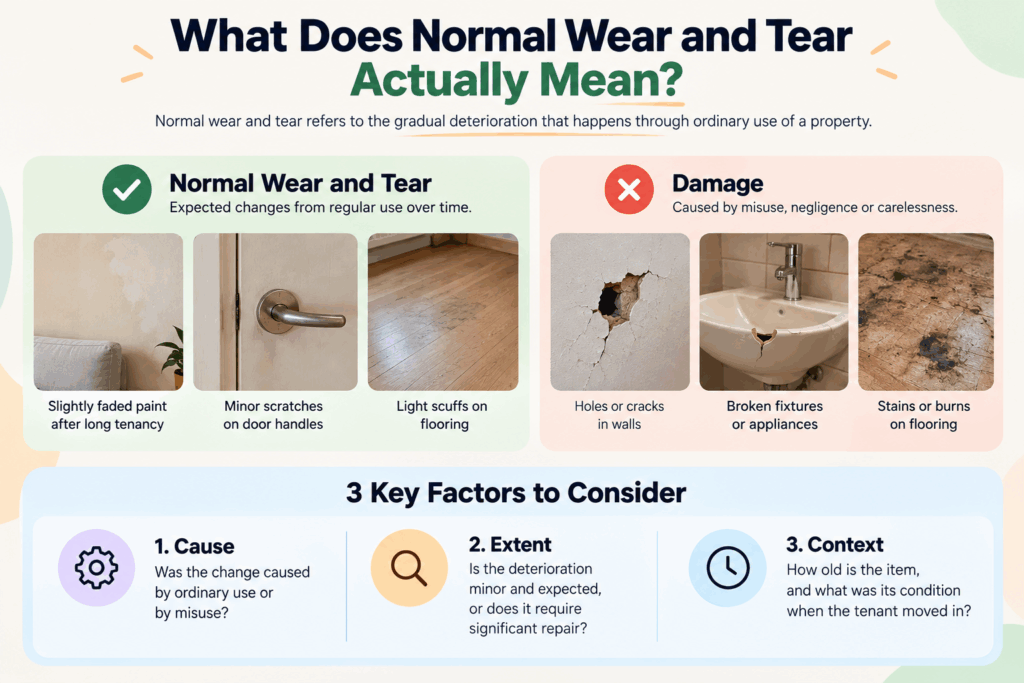
Normal wear and tear refers to the gradual deterioration that happens through ordinary use of a property.
This is an important distinction because renting out a property comes with an expected level of ageing. A tenant can take good care of a room and still leave it looking slightly different from the day they moved in.
The Model Tenancy Act, 2021, provides a useful framework here. It says that premises should be maintained in the condition they were in at the start of the tenancy, except for normal wear and tear. It also expects tenants to take reasonable care of the premises. However, the Model Tenancy Act is a framework for states and Union Territories to adopt. It should not be treated as one nationwide rule for every tenancy.
The actual agreement and applicable local law also matter.
In practical property management, three things help determine the difference:
- Cause: Was the change caused by ordinary use or by misuse?
- Extent: Is the deterioration minor and expected, or does it require significant repair?
- Context: How old is the item, and what was its condition when the tenant moved in?
A slightly faded wall after a long tenancy is not the same as a wall with extensive damage. An ageing appliance is also different from an appliance broken through careless use.
The inspection should therefore look at the complete picture.
What Usually Falls Under Normal Wear and Tear?
There is no universal checklist that can classify every mark or defect. The condition of the property, length of the tenancy, age of the item, and applicable agreement can all affect the assessment.
Still, some examples are generally closer to ordinary wear and tear.
A room that has been occupied for two years will naturally show more signs of use than a room occupied for two months. Expecting both rooms to look identical at move-out would not reflect how rental properties actually operate.
Common examples can include:
- Minor wall marks and gradual paint fading: Small scuffs can appear through normal movement, furniture placement, and everyday living. Paint can also lose its original finish over time.
- Normal furniture deterioration: Hinges may loosen, surfaces may lose their polish, and furniture can show signs of repeated use without being deliberately damaged.
- Ordinary flooring wear: Floors and carpets experience continuous foot traffic. Some deterioration is expected even when tenants use the property responsibly.
- Age-related appliance issues: An older appliance may become less efficient or require replacement because of its age. That does not automatically make the tenant responsible.
- Small signs of occupation: Minor changes that naturally occur during everyday use should be assessed in context rather than treated as automatic deductions.
This is why a move-out inspection should not ask only, “What is different?”
It should also ask, “Why is it different?”
That second question is often what separates a fair assessment from an unnecessary dispute.
For a deeper look at how deposits are handled, RentOk also covers security deposit rules and legal considerations for rental properties. The article explains why deposit practices can differ across India and why local rules matter.
So, What Actually Counts as Damage?
Damage generally goes beyond the deterioration expected from normal occupation.
It can result from negligence, misuse, intentional actions, or failure to take reasonable care of the property. The key is to establish whether the tenant’s actions caused a condition that would not reasonably have occurred through ordinary use.
Consider a simple example.
A chair becomes slightly worn after two years of regular use. That is one situation. A chair is broken because it was used improperly. That is another.
The same principle applies to walls, appliances, fixtures, furniture, and other items provided with the property.
A property manager should consider:
- The original condition of the item: An old cupboard with an existing damaged hinge should not be assessed like a new cupboard handed over in perfect condition.
- The extent of the problem: A small mark and major physical damage may require very different responses.
- The likely cause: Evidence of misuse matters more than simply observing that an item is no longer in its original condition.
- The repair option: A repair may be appropriate where the item can be restored without full replacement.
- The tenancy terms: Any proposed deduction should be consistent with the agreement and applicable law.
This is where documentation becomes extremely important.
Without a record of the original condition, even a genuine damage claim can become difficult to establish.
Why Move-In Documentation Matters So Much
The easiest time to prevent a move-out dispute is when the tenant is moving in.
At that stage, the property team can inspect the room and record its condition before the tenant begins using it. This creates a baseline for the entire tenancy.
Imagine a tenant moves into a furnished PG room. There is already a small stain on the mattress. Nobody records it.
Six months later, the tenant moves out. The same stain is noticed during inspection.
Who caused it?
Without a move-in record, the answer becomes difficult to establish. The tenant may say it was already there. The property manager may remember it differently.
This problem becomes even more common in larger properties. Different staff members may handle the move-in and move-out. A room may also change hands several times in a year.
A proper record reduces that uncertainty.
For more on this process, RentOk’s guide on How to Manage Move-In and Move-Out Smoothly covers the importance of structured onboarding, deposit records, room allocation, inspections, and final settlement.
What Should a Move-In Condition Record Include?
A good inspection does not need to become a complicated administrative exercise. It needs to be consistent.
The property team should record the condition of the items that are most likely to matter during the final settlement. Photos can add another layer of evidence, especially for existing marks or damage.
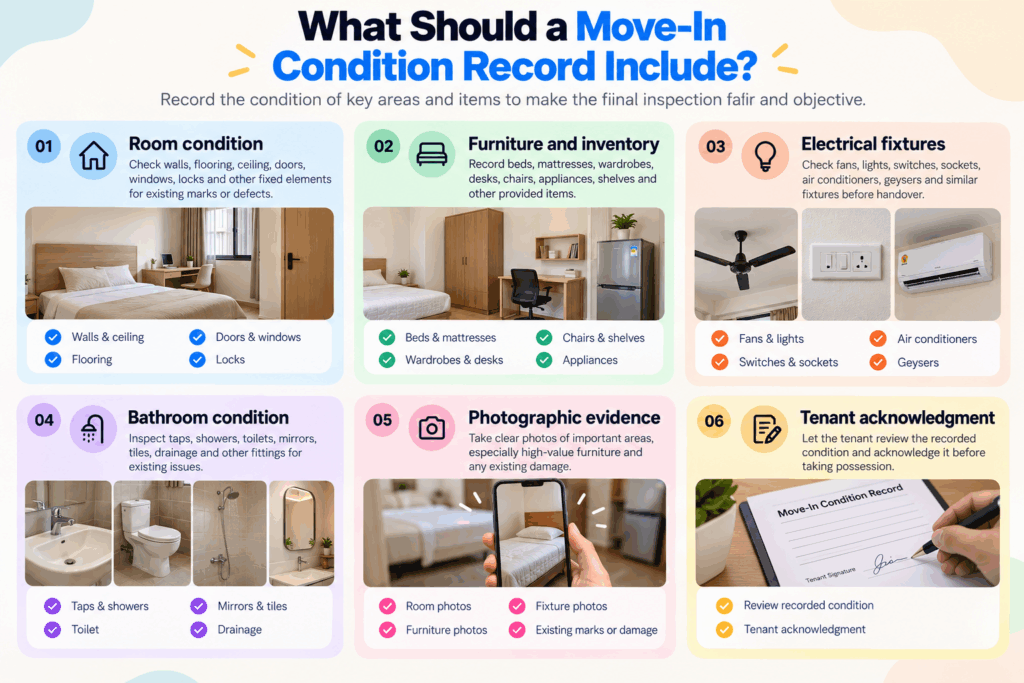
For a furnished PG or co-living property, the inspection can cover:
- Room condition: Walls, flooring, ceiling, doors, windows, locks, and other fixed elements should be checked for existing marks or defects.
- Furniture and inventory: Beds, mattresses, wardrobes, desks, chairs, appliances, shelves, and other provided items should be recorded clearly.
- Electrical fixtures: Fans, lights, switches, sockets, air conditioners, geysers, and similar fixtures should be checked before handover.
- Bathroom condition: Taps, showers, toilets, mirrors, tiles, drainage, and other fittings should be inspected for existing issues.
- Photographic evidence: Important areas should be photographed before occupancy, especially high-value furniture and existing damage.
- Tenant acknowledgment: Where the process allows, the tenant should have an opportunity to review the recorded condition before taking possession.
The objective is simple.
You want to know what the property looked like before the tenant became responsible for it.
That information can make the final inspection much more objective.
How Should a Fair Move-Out Inspection Work?
A move-out inspection should be a comparison between two documented points.
The first is the condition at move-in. The second is the condition at move-out.
The property manager can then identify what changed during the tenancy and assess whether the change is reasonably attributable to the tenant.
A useful inspection should answer four questions:
- What was the condition when the tenant moved in?
- What is the condition now?
- What changed during the tenancy?
- Does the tenant have responsibility for that change?
This sounds straightforward. It becomes much harder when the original condition was never documented.
The inspection should also cover more than visible damage. Property teams may need to check keys, access cards, furniture, appliances, utilities, pending dues, and other items linked to the tenant’s occupancy.
The goal is not to find reasons to deduct money. The goal is to establish the actual condition of the property.
This is also where a standardized move-in and move-out process becomes useful. Every tenant should go through the same basic process, regardless of which staff member handles the handover.
What About Security Deposit Deductions?
The security deposit is where wear-and-tear decisions become financially important.
A landlord or property manager may have valid reasons to make deductions. These can include unpaid dues, missing property, or damage beyond ordinary use. But the exact rules depend on the tenancy agreement and applicable law.
The important principle is transparency.
A tenant should be able to understand how the final amount was calculated. A property manager should also be able to support the deduction with a clear record.
A useful settlement record can separate:
- Outstanding dues: Unpaid rent, utilities, or other agreed charges should be clearly identified instead of being combined into one unexplained figure.
- Damage-related costs: The property manager should identify the damaged item and explain why it is considered tenant responsibility.
- Missing inventory: Keys, remotes, appliances, furniture, or other supplied items should be checked against the original inventory.
- Final settlement: The original deposit, deductions, and refundable balance should be visible in the final calculation.
RentOk’s guide to getting your security deposit back explains why clear records and written settlement details can make the final stage of a tenancy more transparent.
The same principle applies from the operator’s side.
When the property team has a documented history, it becomes easier to explain why a deduction was made. It also becomes easier to identify when a deduction should not be made.
Repair or Replacement? That Difference Matters
One of the most overlooked parts of deposit management is the difference between repairing an item and replacing it.
Consider an old chair that has been used for several years. It may now look worn and need maintenance. That does not automatically mean the departing tenant should pay for a completely new chair.
Now consider a newer chair that has been broken through careless use. The situation is different.
The property manager should therefore look at the age, original condition, extent of damage, cause, and reasonable repair options.
A blanket rule of “anything broken gets charged” can create unnecessary disputes. It can also make the property appear unfair in the eyes of tenants.
A better approach is to assess the actual loss or repair requirement.
This matters even more in furnished PGs. Beds, mattresses, wardrobes, desks, chairs, fans, appliances, and other items move through several occupancy cycles. Their condition naturally changes over time.
A professional operator needs a system that can distinguish maintenance cost from tenant-caused damage.
Documentation Protects Tenants Too
Inspection records are often seen as protection for the property owner. They serve another important purpose.
They also protect tenants.
Suppose a tenant is asked to pay for a damaged cupboard. The tenant has a move-in photograph showing that the cupboard already had the same defect. That record can immediately change the conversation.
The same principle works in the other direction.
If a property manager has clear move-in and move-out photographs, inventory records, and handover details, a genuine damage claim becomes easier to explain.
This is why good documentation should not be viewed as a tool for taking more deductions.
It is a tool for making fewer disputed deductions.
That difference matters.
RentOk’s article on handling security deposits and legal best practices also highlights documentation as a key part of professional deposit management.
Common Mistakes That Create Wear-and-Tear Disputes
Most deposit disputes are not created by one dramatic event. They usually develop because the property management process leaves too much room for interpretation.
Some mistakes appear repeatedly across rental operations:
- Skipping the move-in inspection: Without a starting record, the property team has little evidence when the final condition is questioned.
- Treating every repair as tenant damage: Properties have normal maintenance and replacement costs. Not every expense should automatically become a tenant deduction.
- Using vague deduction descriptions: “Room damage” is not very useful. A specific record of the item, condition, and repair requirement provides much more clarity.
- Using different inspection standards: If every staff member follows a different process, similar cases can produce inconsistent outcomes.
- Keeping records across disconnected systems: Photographs in one phone, payment details in Excel, and conversations in WhatsApp make the final settlement harder to reconstruct.
- Waiting until move-out to check everything: Problems become much harder to establish when nobody recorded the property’s condition at the beginning.
These are not only documentation problems.
They are operational problems.
As the number of tenants increases, the cost of relying on memory also increases. This is one reason structured systems become more valuable as a rental business grows.
RentOk’s guide to rental management systems and property management tools explores this broader shift from manual records toward connected rental operations.
Why a Clear Inspection Process Improves Tenant Experience
A transparent move-out process can change how tenants perceive the entire property.
A tenant may not agree with every deduction. But they are more likely to understand it when the property manager can show what changed, what the original condition was, and how the final amount was calculated.
That is very different from receiving a deduction with no explanation.
This matters for PGs and co-living properties because tenant experience does not end when the tenant decides to leave. The final interaction can influence reviews, referrals, and the likelihood that the tenant recommends the property to someone else.
The same idea applies to the wider rental experience. Good documentation creates clarity at both ends of the tenancy.
It also makes the property team’s work easier.
Instead of asking, “Do you remember what happened in Room 204?” the team can check the record.
Instead of searching through months of WhatsApp messages, they can refer to the relevant inspection details.
That is what a professional property management process should achieve.

How RentOk Helps You Document Move-In and Move-Out Condition
As a rental business grows, condition records can quickly become scattered across spreadsheets, paper forms, photographs, and WhatsApp conversations. This makes it difficult to maintain a reliable history for every room and tenant.
RentOk brings key tenant and property workflows into a more structured system. Its move-in and move-out processes can help property teams maintain records around occupancy, room condition, handover details, payments, dues, and tenant information.
This creates a stronger record across the tenant lifecycle.
For operators, that means they can maintain better visibility over:
- Move-in information: Record the tenant’s onboarding details and establish a clearer starting point for the occupancy period.
- Property and room records: Keep relevant property information connected to the tenant instead of maintaining isolated records.
- Payment and deposit information: Track financial details alongside the tenant’s wider history for easier final settlement.
- Move-out details: Maintain a structured record of the tenant’s exit and the information required for final settlement.
- Operational history: Keep important tenant and property information organized so the team does not have to reconstruct events from memory.
The benefit becomes even clearer when a business manages multiple properties.
A small property may manage condition records manually. A growing PG business needs consistency. RentOk helps create that structure so property teams can spend less time reconstructing information and more time managing the operation.
Conclusion: Document the Condition Before You Need the Proof
Normal wear and tear and genuine damage are not always separated by one simple rule.
The property’s original condition matters. The age of the item matters. The extent of the deterioration matters. The cause matters. The tenancy agreement and applicable law matter too.
For tenants, documenting the room at move-in can prevent confusion later. For property managers, maintaining consistent records can support legitimate deductions and prevent unfair ones.
The best time to document a property’s condition is before there is a dispute.
A strong move-in record creates the baseline. A structured move-out inspection shows what changed. A clear settlement record then connects the two.
That approach makes the process easier for everyone involved.
Document Move-In/Move-Out Condition on RentOk and create a more organized record of tenant handovers, property condition, and final settlements across your rental operations.
Frequently Asked Questions
Find answers to common questions about this topic
About the Author
Ishika Pannu
Ishika Pannu brings you the latest insights and easy-to-apply strategies in property management—helping you simplify renting and grow with RentOk.


Stay ahead in property management with expert insights
Join thousands of property managers receiving exclusive tips delivered straight to your inbox.
Browse posts by category
Case Study
Cost of Living
Growth
Legal
Market Trends
News
Pg owner app
Property Management
Property Tax
Tech
RentOk
The easiest way to rent and manage your PGs and hostels.
Grievance Officer
Get the app


Contact us
hello@eazyapp.tech
HQ Office
COGROW, BASEMENT F-12/8A
BESIDE HOUSE OF STYLE SALON, SECTOR 28, DLF PHASE 1
GURUGRAM, HARYANA - 122002
South India Office
LUMIODESK COWORKING, 2ND FLOOR, 40, 14TH MAIN RD
BESIDE MC DONALD, 7TH SECTOR, HSR LAYOUT
BENGALURU, KARNATAKA - 560102
©️ 2026 EazyApp Tech Pvt Ltd. All rights reserved


