
Tenant Rights
Can My Landlord Restrict Guests or Visitors in My Rented Home?

Written by
Ishika Pannu
Read Time
15 min read
Posted on
October 3, 2026
Overview
Overview
Can My Landlord Restrict Guests or Visitors in My Rented Home?
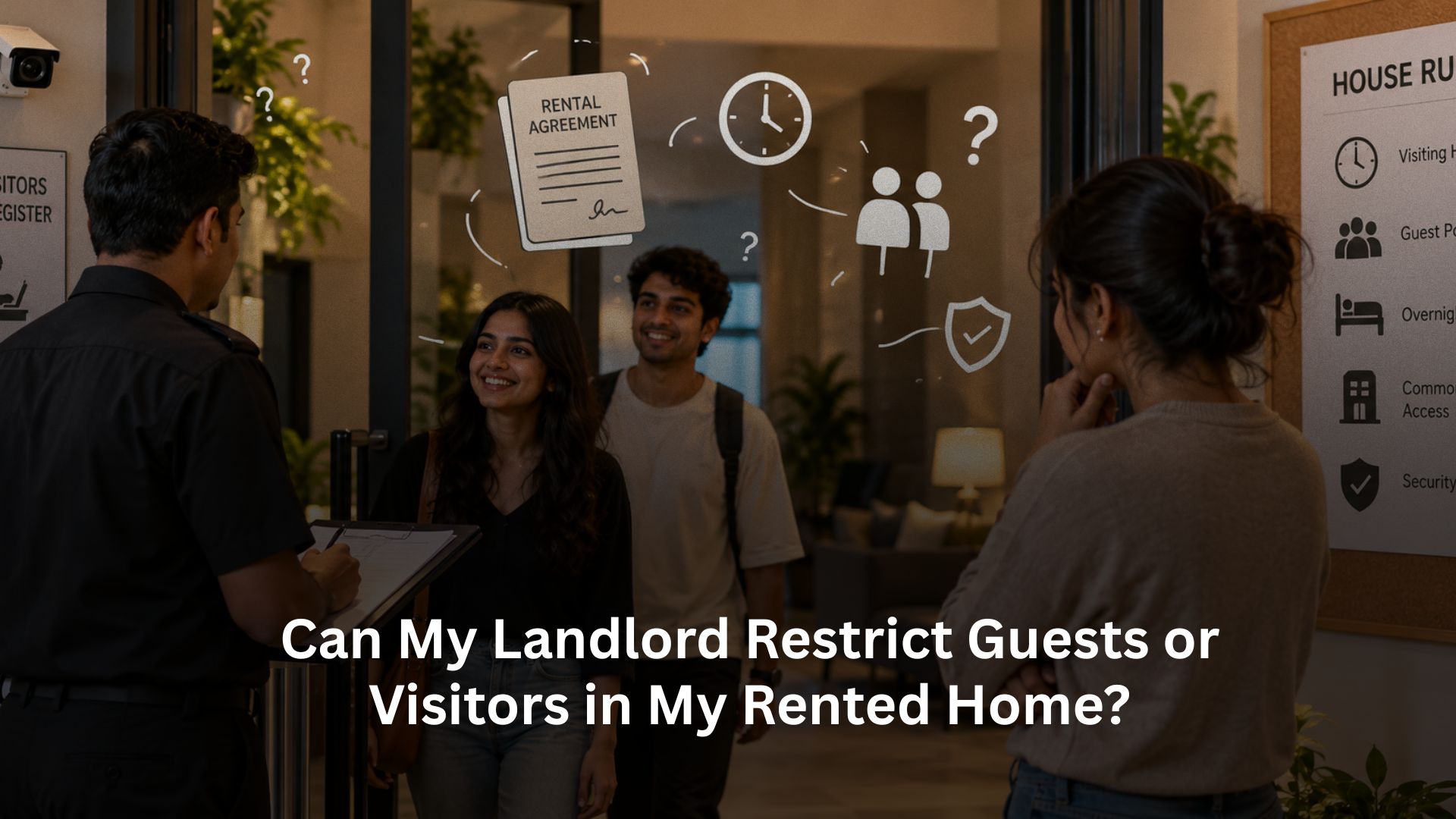
Having someone over at home is a normal part of living in a rented property. A friend may come over after work. A sibling may visit for a few days. Someone from college or the office may drop by for a few hours.
But visitors can become a sensitive issue in rental housing.
The situation becomes even more complex in PGs, hostels, and co-living spaces. These properties have multiple residents sharing entrances, corridors, kitchens, lounges, and other facilities. Management also has to think about security, resident comfort, and access control.
This creates a common question among tenants:
Can a landlord restrict guests or visitors in a rented home?
There is no single answer that applies to every rental arrangement in India. The position can depend on the tenancy, the type of property, the rental agreement, and applicable local requirements.
The nature of the restriction also matters.
A property may have a visitor registration process. It may have specific visiting hours. It may have separate rules for overnight guests. These are different from a blanket attempt to control every person a tenant can invite.
For landlords and property managers, the bigger lesson is clear. Visitor policies should not be created casually. They should be documented, explained, and applied consistently.
For tenants, the same principle works in reverse. Visitor rules should be checked before signing the agreement. This can prevent disagreements later.
What Can a Landlord Actually Regulate?
A landlord has a legitimate interest in managing how a property operates. This is especially true when several people live in the same building.
A visitor policy can create reasonable boundaries around access. It can also protect the safety and comfort of residents.
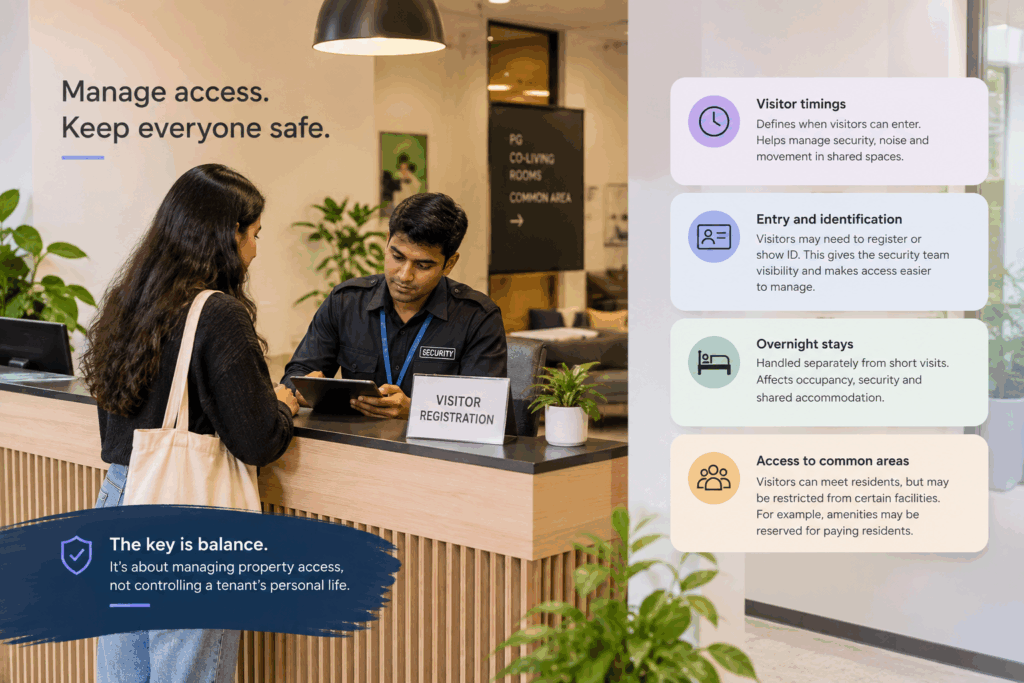
Depending on the property, the rules may cover visiting hours, registration, overnight stays, and access to shared spaces.
For example, a property may require visitors to register at the entrance. This gives the security team visibility over people entering the premises. A PG may also restrict visitors from entering certain areas that are meant only for residents.
Some common areas that a visitor policy can address include:
- Visitor timings: The property can define visiting hours where appropriate. This helps manage late-night movement, noise, and security in shared accommodation. Clear timings also prevent residents from receiving different instructions from different staff members.
- Entry and identification: Visitors may need to register at reception or with security. The process can help the property maintain a basic record of external visitors. It can also make access easier to manage during busy periods.
- Overnight stays: An overnight guest is different from a visitor who stays for two hours. Overnight stays can affect occupancy, security, and shared accommodation. A property may therefore create a separate process for them.
- Access to common areas: Visitors may be allowed to meet residents but not use every facility. For example, certain amenities may be reserved for paying residents. Such restrictions should be clearly communicated.
The important distinction is between managing property access and controlling a tenant’s personal life.
A registration process is an operational rule. A broad restriction on someone’s personal relationships raises a different question.
This distinction should remain at the centre of any well-designed visitor policy.
Are Visitor Bans Automatically Enforceable?
This is where many discussions about tenant rights become too simple.
It is not accurate to assume that a landlord can prohibit every visitor simply because they own the property. It is equally broad to say that a landlord can never restrict visitors.
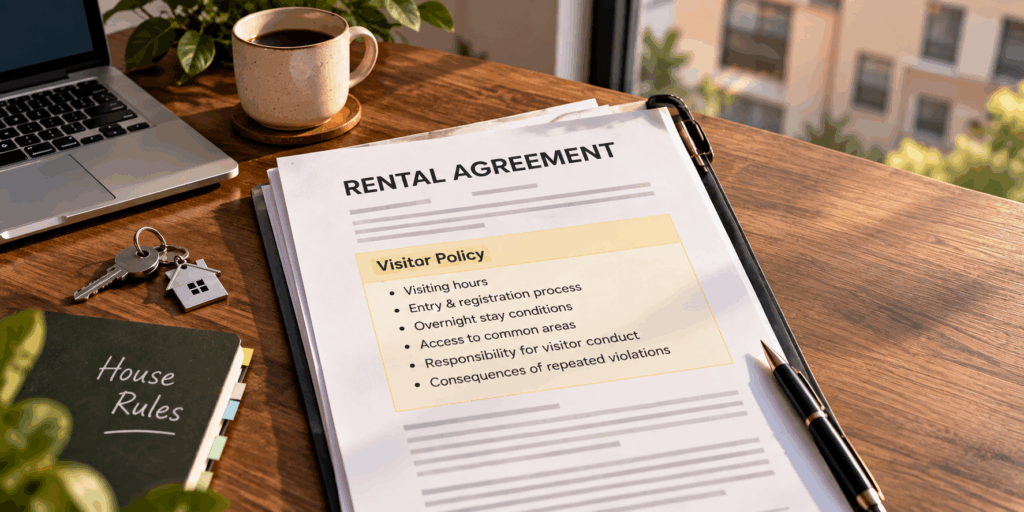
The first document to examine is usually the rental agreement and accompanying house rules.
A properly drafted agreement can establish conditions around the use of the property. It can also address guests, shared areas, occupancy, subletting, noise, and other property-specific matters.
RentOk’s guide on How to Read a Rent Agreement Before Signing specifically highlights visitor rules as something tenants should examine before signing. It also points out that PGs and co-living properties can have additional operational rules.
A visitor policy becomes easier to understand when it clearly answers a few practical questions:
- Are visitors allowed during specified hours?
- Does an overnight guest need prior approval?
- Is visitor registration required at the entrance?
- Can visitors use shared facilities?
- Are there separate rules for weekends or holidays?
- What happens if a visitor damages property or violates house rules?
The exact legal effect of a particular clause depends on the circumstances. It can also depend on applicable state or local law.
That is why neither tenants nor landlords should rely on a generic statement such as “guest restrictions are always legal” or “guest restrictions are never legal.”
The actual agreement and applicable rules matter.
Privacy and Property Management Have to Coexist
A rental property is still a person’s living space. Renting a home does not mean that every aspect of a tenant’s personal life becomes subject to management approval.
At the same time, shared accommodation creates operational responsibilities.
Imagine a 150-bed PG where visitors can freely enter residential floors. Management may have very little visibility over who is inside the building. Other residents may also feel uncomfortable if external visitors can move around without any process.
Now consider the opposite situation.
Suppose visitors are completely prohibited. The property has not explained the reason, and the restriction was never part of the original arrangement. That can create a different kind of conflict.
The practical answer lies between these extremes.
A well-designed policy should create reasonable boundaries without becoming unnecessarily intrusive.
For example, a property can require visitors to register at the entrance. It can define visiting hours, limit access to certain areas, and create a separate procedure for overnight guests.
These measures focus on the operation of the property.
They do not need to become a system for monitoring every personal interaction a tenant has.
Why PGs and Co-Living Properties Need Clear Visitor Policies
Visitor management becomes more important as the number of residents increases.
A small rental property may manage visitors through familiarity. The owner may know most residents personally. Security may also recognise regular guests.
That approach becomes difficult at scale.
A larger PG may have several floors and multiple shifts of security staff. Residents may change frequently. There may also be housekeeping teams, vendors, delivery workers, maintenance staff, and visitors entering every day.
Without a defined process, confusion develops quickly.
One security guard may allow something that another guard refuses. A tenant may receive one instruction from the property manager and another from reception. A rule may exist in a WhatsApp message but nowhere in the tenant’s official documentation.
This is why visitor management should be treated as part of the property’s wider operating system.
RentOk’s Tenant Handbook for PGs: Rules Without Restrictions takes a similar approach. It explains why guest policies need clarity around timings, identification, overnight stays, and common-area access.
A visitor policy works best when it connects with the rest of the property experience.
What Should Be Written in the Agreement?
One of the easiest ways to prevent visitor disputes is to establish the rules before the tenant moves in.
The agreement should reflect the actual arrangement between the property and the resident. It should not leave important conditions to informal conversations.
This becomes especially important in PGs and co-living properties. These properties often have more operational rules than a traditional residential lease.
RentOk’s PG Rental Agreement Format explains why PG agreements may need to cover shared facilities, food, utilities, house rules, visitors, and other operational conditions.
A useful visitor section can address:
- Visiting hours and access procedures: State when visitors can enter the property. If registration is required, explain where and how it happens. Avoid vague wording if the property follows specific timings.
- Overnight visitor conditions: If overnight stays require approval, the process should be explained in advance. Residents should know whether additional documentation or registration is required.
- Shared-space restrictions: If visitors cannot access certain facilities, mention those areas clearly. This prevents residents from learning about the restriction only after a disagreement occurs.
- Responsibility for visitor conduct: Residents should understand their responsibility for visitors while they are on the premises. This can cover damage, noise, cleanliness, and other applicable house rules.
- Consequences of repeated violations: The agreement should explain how repeated breaches are handled. This gives management a defined process instead of leaving every incident to individual discretion.
A good agreement does not need pages of complicated language.
Its purpose is to remove ambiguity.
For a broader checklist, RentOk’s Why Your Rent Agreement Must Be Registered – And How to Do It also discusses guest rules alongside other important rental terms.
What Belongs on a Notice Board?
Not every operational detail needs to sit inside the main rental agreement.
A notice board, tenant handbook, or digital property guide can communicate the day-to-day process.
For example, the agreement may state that visitors are allowed between certain hours. A notice near the entrance can remind residents and visitors of those timings.
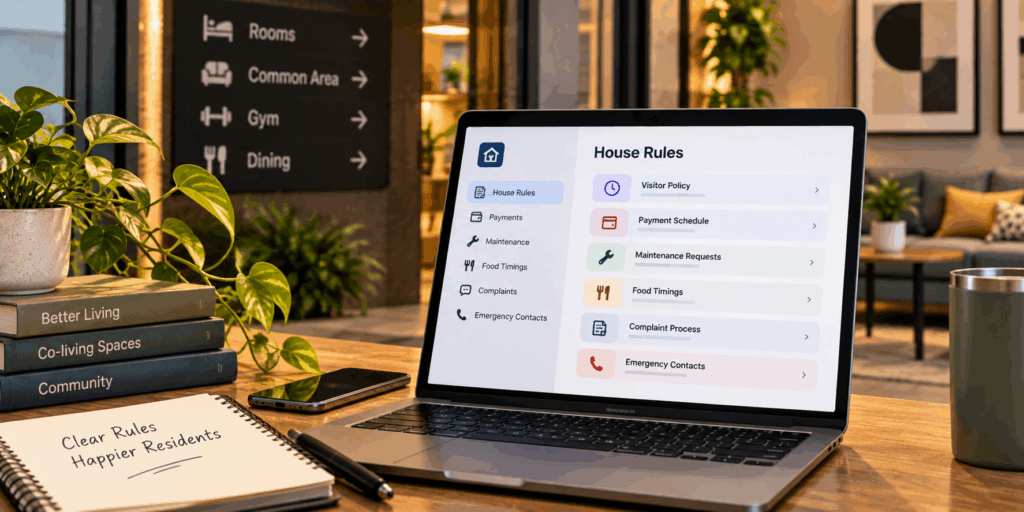
A digital house-rules page can also provide:
- Security desk and property contact details.
- Visitor registration instructions and applicable timings.
- Emergency contact information for residents.
- Temporary access changes or maintenance-related restrictions.
- Reminders about existing common-area and visitor policies.
There is an important distinction here.
A notice should communicate an established process. It should not become the easiest way to introduce a major new restriction without properly considering the existing agreement.
This is particularly important when a property has many residents.
A clear digital handbook can make the same information available to everyone. It can also reduce the number of repetitive questions handled by property staff.
What If the Rules Were Never Explained?
Many tenant disputes start with something much simpler than a legal disagreement.
The tenant and the landlord simply remember the arrangement differently.
A tenant may remember being told that friends could visit. Management may later say that visitors were only allowed during limited hours.
Another tenant may have received verbal permission for an overnight guest. The security team may have received a different instruction.
These situations are difficult because the underlying problem is not always the rule itself.
It is the lack of clear documentation.
This is why tenant onboarding should include more than collecting documents and receiving payment.
RentOk’s How to Onboard a New Tenant in Under 10 Minutes explains how property policies can be communicated as part of the onboarding process. It specifically includes visitor guidelines among the information that should be explained to new residents.
A good onboarding process should make the tenant aware of:
- Visitor and guest policies.
- Maintenance and complaint procedures.
- Food and facility timings, where applicable.
- Shared-space expectations.
- Payment and rent-related procedures.
- Emergency contacts and other important property information.
The benefit is simple.
The tenant knows what to expect. The management team also has a clear process to follow.
Can Rules Change After the Tenant Moves In?
Property operations can change.
Security requirements may change. Building management may introduce new procedures. A property may identify problems with its existing visitor process.
Updating a procedure is not automatically the problem.
The problem is poor communication.
Suppose a PG previously allowed visitors until 9 PM. Management later decides to introduce a 7 PM cutoff. Residents will naturally want to know why the timing changed and when the new rule takes effect.
A professional operator should communicate such changes clearly.
The message should explain what has changed and when it applies. It should also identify where residents can ask questions.
This approach is much better than relying on verbal instructions.
Digital communication is particularly useful here. The same message can reach residents across the property. Staff members can also refer back to the same information when questions arise.
For a property managing frequent move-ins, this level of consistency can save considerable administrative effort.
Consistency Matters as Much as the Rule
A visitor policy can be perfectly clear on paper and still create problems when it is applied inconsistently.
Imagine two residents have visitors under similar circumstances. One visitor is allowed inside without any questions. The other is stopped at the entrance.
The resident will naturally question the process.
This is why property teams need a clear internal procedure. Security staff should understand the same rules that residents have been given.
The process should establish:
- Who handles approval: Residents should know whether approval comes from security, the property manager, a warden, or another designated person. Different staff members should not give conflicting answers.
- What gets recorded: If visitors must be registered, the same basic process should be followed each time. This improves consistency and makes the system easier to manage.
- When exceptions apply: Emergencies or unusual situations may require flexibility. Staff should know who can approve an exception and how that decision should be recorded.
- How repeated violations are handled: A defined escalation process prevents every incident from becoming a fresh argument between the resident and the property team.
Consistency becomes even more important as the property grows.
What works through personal familiarity in a 20-bed property may not work in a 200-bed property.
Digital House Rules Can Reduce Unnecessary Disputes
One of the simplest improvements a rental property can make is to make its house rules easy to find.
Residents should not have to search through months of WhatsApp conversations to find out whether visitors are allowed after a particular hour.
They should not have to call the property manager every time they forget the registration procedure.
A digital house-rules system can provide one reliable place for important information.
The same system can include visitor policies, payment schedules, maintenance procedures, food timings, complaint processes, emergency contacts, and other operational information.
This approach also helps the property team.
Instead of explaining the same rule repeatedly, staff can direct residents to the relevant information. New residents can receive the rules during onboarding. Updates can also be communicated more consistently.
RentOk’s broader approach to digital tenant onboarding reflects this shift. Its digital tenant onboarding workflow connects tenant information, documentation, and onboarding steps into a more structured process.
The objective is not to create more restrictions.
It is to make existing expectations easier to understand.
How RentOk Helps Manage House Rules and Tenant Communication
Visitor management is only one part of running a rental property professionally.
The larger challenge is keeping tenant information, agreements, communication, payments, complaints, and property operations organised at the same time.
RentOk brings several of these workflows into one connected property-management system. This helps operators reduce their dependence on scattered spreadsheets, individual messages, and manual records.
For visitor and house-rule management, a structured digital approach can help operators communicate policies during onboarding. It can also keep tenant information organised and make important property communication easier to access.
This becomes especially useful when an operator manages multiple properties. The team can work with more consistent processes instead of relying on individual employees to remember what they told each resident.
RentOk also supports broader tenant-management workflows, including digital onboarding, tenant information, agreements, payments, and communication.
The goal is not to make property rules stricter.
The goal is to make them clearer, more accessible, and easier to manage.
When residents understand the rules from the beginning, management spends less time resolving avoidable misunderstandings.
Final Thoughts
The question of whether a landlord can restrict guests or visitors does not have one blanket answer for every rental property in India.
The agreement matters. The property type matters. The nature of the restriction matters. Applicable local requirements may also matter.
For tenants, the safest approach is to read the visitor and guest clauses before signing. If a rule is unclear, ask for clarification before moving in.
For landlords and PG operators, the responsibility is just as important. Visitor policies should be reasonable, clearly documented, properly communicated, and applied consistently.
A strong visitor policy balances several interests. It considers tenant privacy while also addressing security and shared-property requirements.
Most importantly, it should not depend on verbal instructions.
The clearer the policy is at the beginning, the less room there is for disagreement later.
Good property management is not about creating the longest list of restrictions. It is about creating a system where residents know what is expected and staff know how to manage it.
If your property still relies on scattered messages and verbal instructions to communicate important house rules, it may be time to make the process more structured.
Frequently Asked Questions
Find answers to common questions about this topic
About the Author
Ishika Pannu
Ishika Pannu brings you the latest insights and easy-to-apply strategies in property management—helping you simplify renting and grow with RentOk.

Stay ahead in property management with expert insights
Join thousands of property managers receiving exclusive tips delivered straight to your inbox.
Browse posts by category
Case Study
Cost of Living
Growth
Legal
Market Trends
News
Pg owner app
Property Management
Property Tax
Tech
RentOk
The easiest way to rent and manage your PGs and hostels.
Grievance Officer
Get the app


Contact us
hello@eazyapp.tech
HQ Office
COGROW, BASEMENT F-12/8A
BESIDE HOUSE OF STYLE SALON, SECTOR 28, DLF PHASE 1
GURUGRAM, HARYANA - 122002
South India Office
LUMIODESK COWORKING, 2ND FLOOR, 40, 14TH MAIN RD
BESIDE MC DONALD, 7TH SECTOR, HSR LAYOUT
BENGALURU, KARNATAKA - 560102
©️ 2026 EazyApp Tech Pvt Ltd. All rights reserved


