Growth
Designing for Density: Furniture Hacks to Increase Bed Count Without Crowding

Written by
Ishika Pannu
Read Time
7 min read
Posted on
April 29, 2026
Overview
Overview
Designing for Density: Furniture Hacks to Increase Bed Count Without Crowding
Increasing bed count in a PG is often treated as a straightforward equation, more beds mean more revenue. On paper, that logic holds. In practice, it rarely does. The moment density is increased without design thinking, the space begins to resist its own purpose. Movement becomes restricted, personal boundaries blur, and the room starts feeling like it’s working against the tenant instead of for them.
This is where most operators get it wrong. Density is not a numbers game. It is a design discipline.
A well-designed high-density room does not feel crowded. It feels efficient. Tenants can move comfortably, access their belongings without friction, and live without constantly negotiating space. The difference lies in how the room is structured, not how many beds are placed inside it.
Why Most High-Density PG Rooms Fail
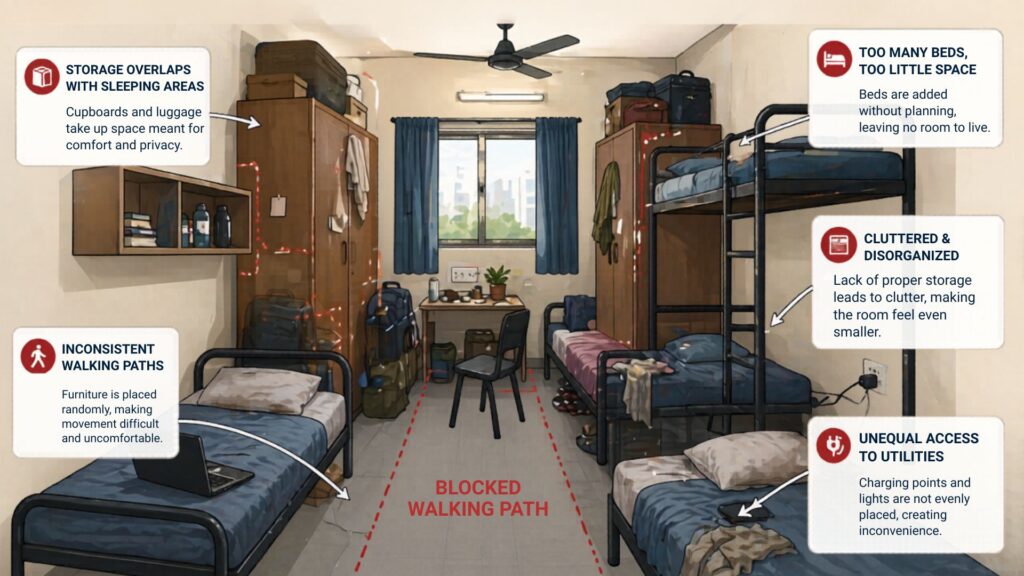
The typical approach to increasing capacity is reactive. A room appears underutilized, so an additional bed is introduced. Furniture is adjusted around it, storage is squeezed in, and the layout is modified just enough to “make it work.” What’s missing is a system.
Over time, these incremental changes lead to a breakdown in usability:
- Walking paths become inconsistent, forcing tenants to navigate around furniture rather than through the room naturally
- Storage overlaps with sleeping areas, making everyday actions like accessing a bag or opening a cupboard inconvenient
- Shared utilities such as charging points and lighting become unevenly distributed, creating imbalance within the same room
None of these issues are dramatic in isolation. But together, they create a subtle but persistent discomfort. Tenants may not articulate it clearly, but they feel it, and eventually, they act on it.
The Principle That Actually Works: Design Before Density
To increase capacity without compromising experience, the approach needs to shift from placement to planning. Every element inside the room must justify its presence, not just physically, but functionally.
This means thinking in terms of:
- How space is used across different times of the day
- How tenants interact with furniture and layout
- How movement flows within the room
A well-designed high-density room does not feel full. It feels organized.
Vertical Space Utilization: Unlocking Capacity Without Expanding Footprint
One of the most underutilized opportunities in PG design is vertical space. Most layouts are designed horizontally, where beds, storage, and movement all compete for the same floor area. This creates immediate limitations.
Vertical design changes the equation entirely.
By shifting functions upward, you free up usable floor space while maintaining or even increasing capacity.
This can be achieved through:
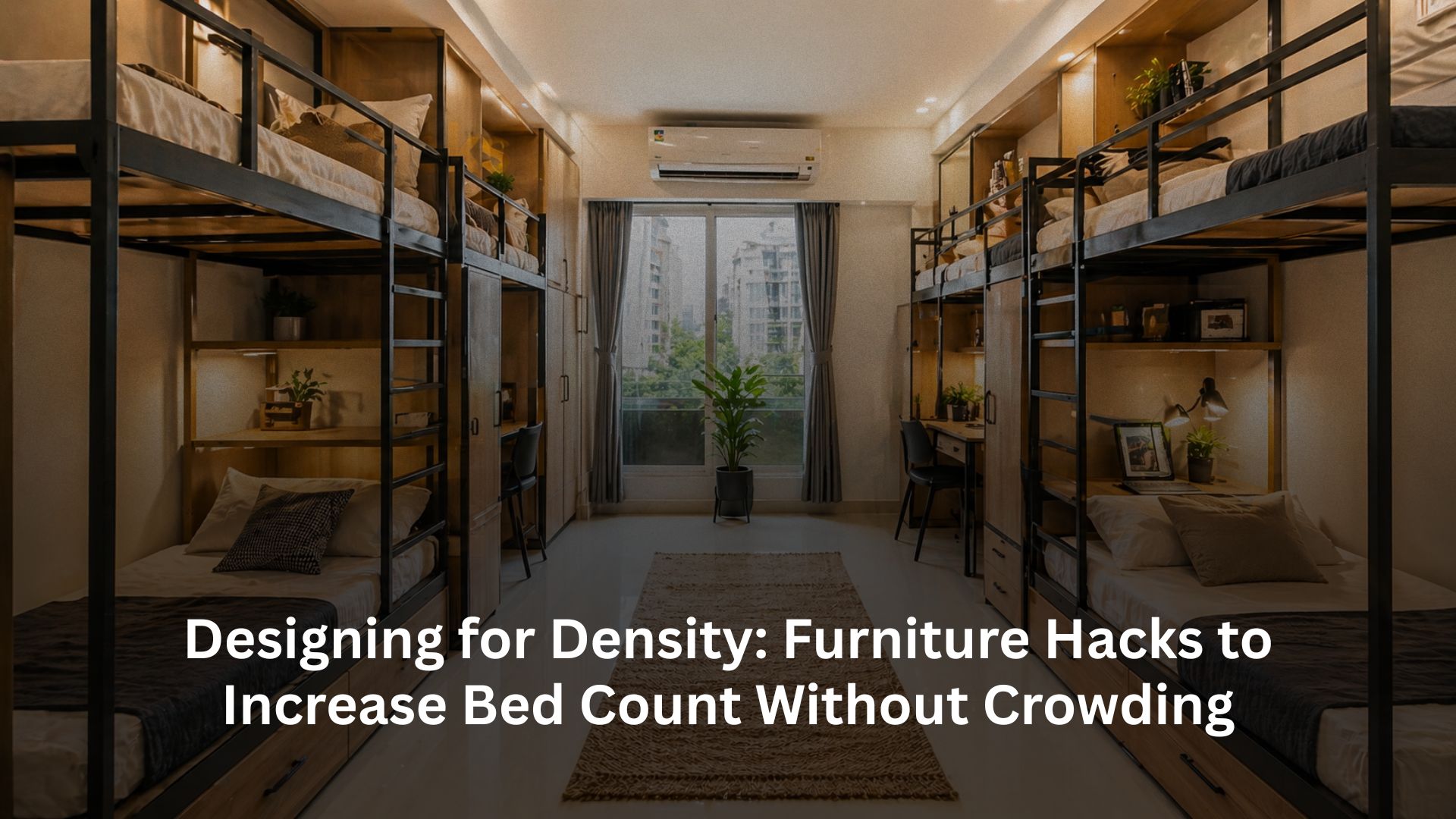
- Bunk bed systems that are designed with adequate headroom and structural stability, ensuring comfort is not compromised
- Wall-mounted storage units that eliminate the need for bulky floor cupboards, allowing more open movement space
- Overhead shelving that uses unused vertical zones without interfering with daily activity
When implemented correctly, vertical design does not feel like compression. It feels like optimization.
Multi-Functional Furniture: Reducing Redundancy in the Room
Another common inefficiency in PG rooms is duplication. Separate furniture pieces are often used for functions that can be combined. A bed, a table, and a storage unit each occupy their own footprint, even when they can be integrated.
Multi-functional furniture addresses this by reducing redundancy.
Instead of increasing the number of elements, it increases the utility of each element. For example:
- Beds can incorporate built-in storage drawers, eliminating the need for additional cupboards
- Foldable or wall-mounted desks can provide functional workspaces without permanently occupying floor space
- Modular wardrobe systems can combine hanging space, shelving, and compartments within a single unit
This approach allows the room to maintain functionality while reducing clutter. The result is not just more space, it is better-used space.
Layout Planning: Designing for Movement, Not Just Placement
One of the most overlooked aspects of high-density design is movement. A room can technically accommodate more beds, but if tenants cannot move comfortably within it, the design fails.
Movement should not feel like navigation. It should feel natural.
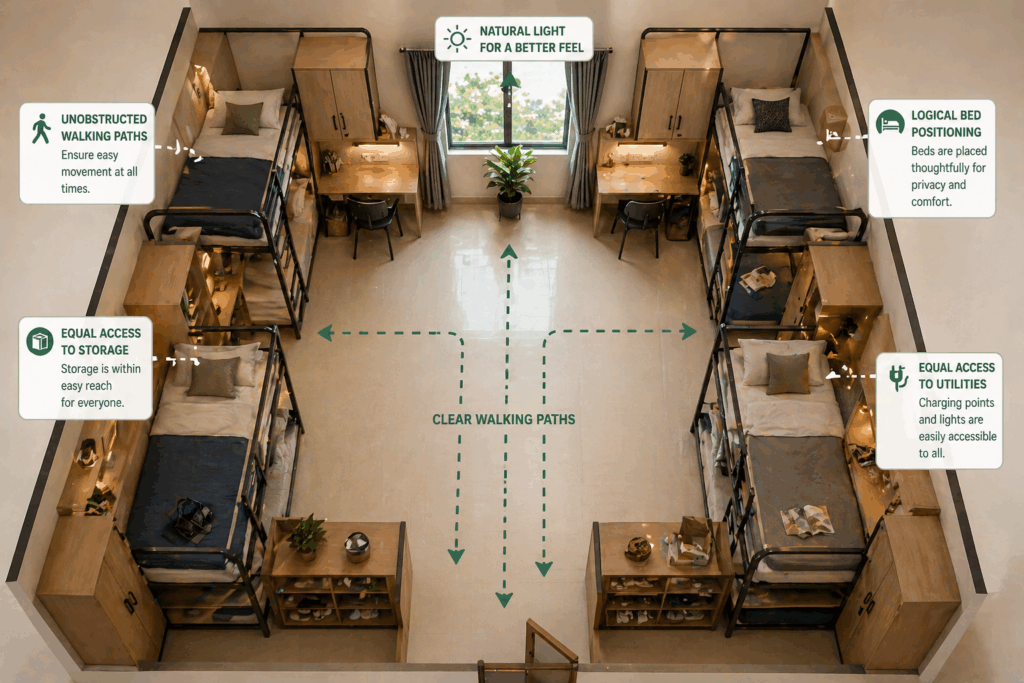
A well-planned layout ensures:
- Clear walking paths that remain unobstructed at all times
- Equal accessibility to storage and utilities for all occupants
- Logical positioning of beds, ensuring no tenant feels cornered or restricted
This requires thinking beyond static placement. The room must function dynamically, supporting daily routines without friction.
Lighting and Mirrors: Expanding Perception Without Expanding Space
Physical space is limited, but perceived space is flexible. Design elements such as lighting and mirrors play a crucial role in shaping how a room feels.
Lighting should not be treated as a single overhead source. Instead, it should be layered to create depth and eliminate visual congestion. This includes:
- Ambient lighting to maintain overall brightness
- Task lighting near beds or study areas to support individual activities
- Strategic illumination of corners to prevent dark zones that make the room feel smaller
Mirrors, when placed correctly, amplify this effect. They reflect light, create visual depth, and reduce the sense of confinement. A well-lit room with reflective surfaces can feel significantly more open, even at higher density.
Storage Design: Preventing Clutter Before It Starts
Clutter is often mistaken for a space issue. In reality, it is a storage issue.
When tenants do not have clearly defined storage areas, personal belongings spill into shared space. This immediately reduces usability and makes the room feel overcrowded.
Effective storage design focuses on:
- Providing dedicated storage for each tenant, ensuring clear ownership and boundaries
- Designing compartments that are easy to access, reducing friction in daily use
- Aligning storage placement with movement flow, so it does not interfere with navigation
When storage is structured, the room remains organized even at higher occupancy levels.
Compliance: Balancing Capacity With Regulation
Increasing bed count is not purely a design decision. It must align with regulatory norms.
This includes:
- Minimum space requirements per occupant, which vary by region but are critical for safety and legality
- Fire safety standards, including clear exit paths and accessible safety equipment
- Ventilation and lighting requirements, ensuring adequate airflow and natural light
Ignoring compliance may allow short-term capacity gains, but it creates long-term risk. Sustainable density is always achieved by balancing design efficiency with regulatory adherence.
Where Density Strategies Break Down
Even with the right intent, density upgrades often fail due to inconsistent execution. The most common issues include:
- Adding beds without redesigning storage, leading to cluttered environments
- Ignoring ventilation and airflow, which affects comfort over time
- Applying the same layout across different room types without accounting for variations in size or shape
- Overlooking tenant behavior patterns, resulting in designs that look efficient but do not function well in practice
These gaps do not immediately reduce occupancy. But they gradually impact satisfaction, which eventually affects retention.
Building a Scalable Design System
To ensure long-term success, density should not be treated as a one-time adjustment. It should be part of a repeatable system.
A scalable approach includes:
- Standardizing room layouts for different configurations, ensuring consistency across the property
- Defining furniture specifications that align with both capacity and comfort
- Regularly reviewing layouts based on tenant feedback and usage patterns
- Maintaining furniture and infrastructure to ensure continued usability
This transforms density from an experiment into a structured capability.
How Rentok Helps You Manage High-Density Operations
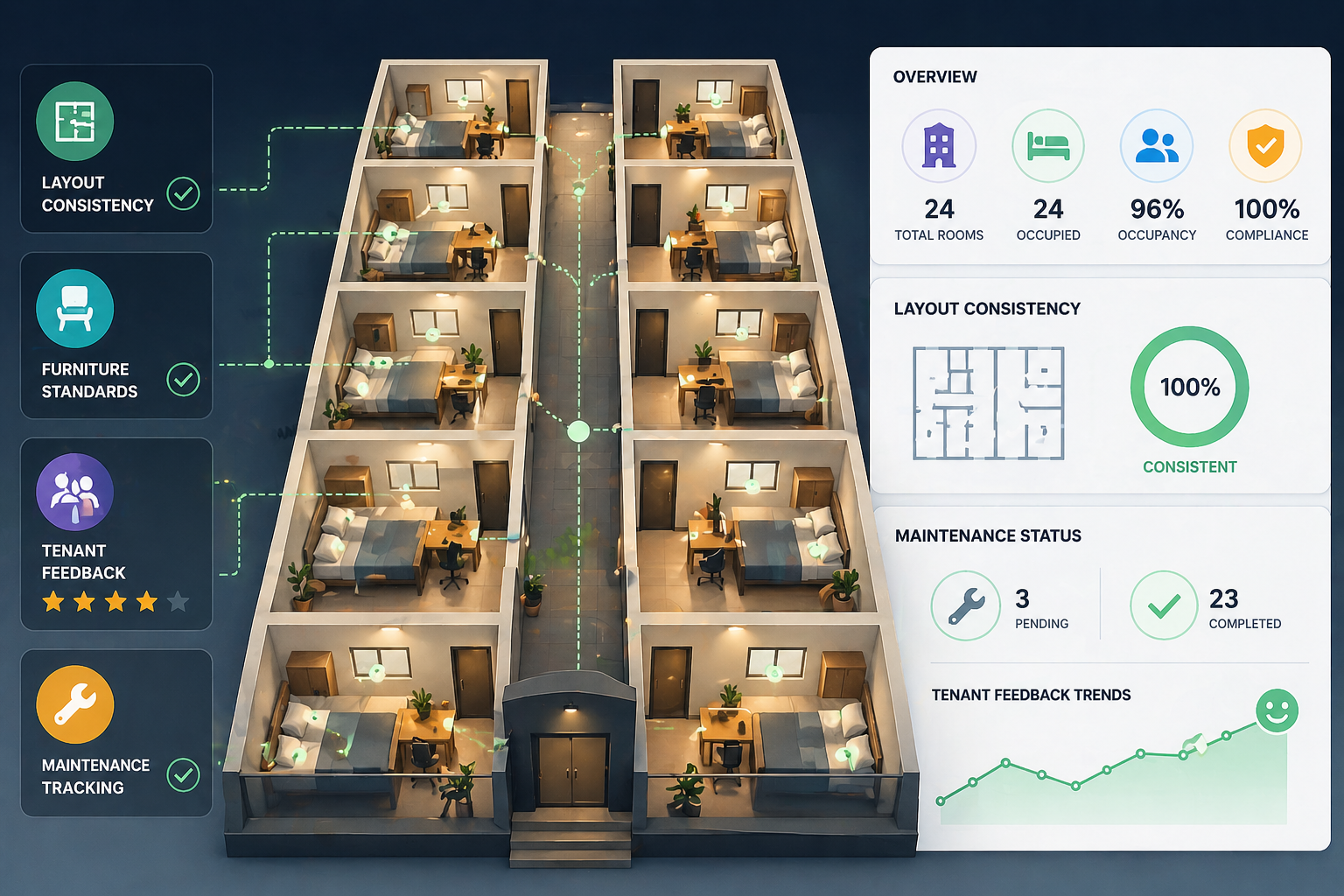
As capacity increases, operational complexity increases alongside it. More tenants mean more interactions, more tracking, and more coordination. Without a structured system, even well-designed spaces can become difficult to manage.
Rentok brings clarity to this layer by helping you maintain visibility across your property. From tracking occupancy at the bed level to managing tenant records and communication, it ensures that higher density does not translate into operational confusion. With everything organized in one place, you are able to maintain consistency in experience even as your capacity scales.
Conclusion: Designing for Density Without Losing Control
Increasing bed count is not about fitting more people into a room. It is about ensuring that every additional occupant does not reduce the quality of the experience for others.
The most efficient PGs are not the ones with the highest number of beds. They are the ones where space feels intentional, movement feels natural, and daily living feels effortless, even at higher occupancy levels.
If your current setup increases capacity at the cost of comfort, the trade-off will eventually show up in retention and stability. A more structured approach to design allows you to scale without compromising what actually matters.
Explore RentOk to understand how better structure, both in space and operations, can help you build a PG that grows efficiently while maintaining a consistent tenant experience.
About the Author
Ishika Pannu
Ishika Pannu brings you the latest insights and easy-to-apply strategies in property management—helping you simplify renting and grow with RentOk.