Market Trends
How to Reduce Late Rent Payments in Hostels

Written by
Ishika Pannu
Read Time
5 min read
Posted on
February 20, 2026
Overview
Overview
How to Reduce Late Rent Payments in Hostels
Running a hostel is already operationally heavy.
Admissions. Complaints. Maintenance. Food. Electricity. Staff management.
Now add this, every single month:
25% tenants pay on time.
40% say, “I’ll pay by evening.”
20% go silent.
15% need repeated follow-ups.
If you’re trying to reduce late rent payments, the solution is not stricter tone or more aggressive reminders.
It’s structure.
Late payments are rarely about money alone. They are about systems, psychology, and consistency. When rent collection depends on memory, mood, or manual follow-ups, delays become predictable.
This guide breaks down how to build a proper rent reminder strategy that reduces delays, without damaging tenant relationships.
Late Payments Are a System Problem (Not a Tenant Problem)
Most hostel owners treat late payments as a behavioral issue.
But look closely.
If due dates aren’t clearly documented, reminders are inconsistent, late fees are optional, and tracking is manual, then delays aren’t surprising.
In hostels, especially student housing, tenants operate on habit. If the system feels flexible, payment becomes flexible.
Your job is not to remove flexibility from the relationship.
Your job is to remove flexibility from the process.
Why Tenants Actually Delay Rent
Delays usually stem from structural gaps, not intentional defiance.
Ambiguous Due Dates
If your agreement doesn’t clearly define the exact due date, grace period, and late fee structure, tenants create their own interpretation.
Clarity removes interpretation.
Reminder Dependency
If tenants only pay when you personally text them, you’ve conditioned them to wait.
That’s not discipline. That’s a manual trigger system.
No Immediate Consequence
If late fees exist only on paper, or are waived randomly, urgency disappears.
Consistency builds seriousness.
Manual Collection Culture
Cash collection, informal bank transfers, and WhatsApp nudges make rent feel negotiable instead of contractual.
Once rent feels casual, delays become culture.
The Psychology Behind Effective Rent Reminders
A good rent reminder strategy aligns with human behavior.
People respond to predictability and repetition.
They respond to neutral tone and clear consequences.
They do not respond well to emotional follow-ups or inconsistent enforcement.
When reminders go at fixed times every month, before due date, on due date, and after grace period, tenants start adjusting their behavior automatically.
Habit follows structure.
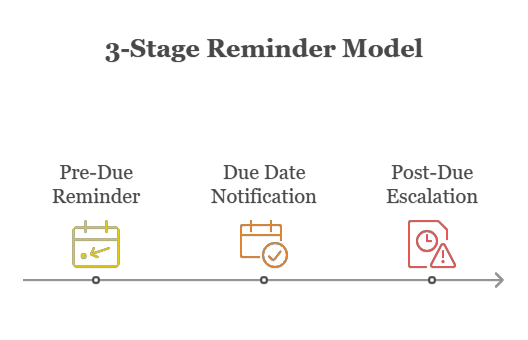
The 3-Stage Reminder Model
Instead of reacting after rent becomes overdue, create a structured communication cycle.
1st Stage: Pre-Due Reminder (2–3 days before)
This reduces “I forgot” excuses and prepares tenants in advance.
2nd Stage: Due Date Notification (On the 1st)
A professional reminder reinforces the payment obligation without sounding aggressive.
3rd Stage: Post-Due Escalation (After grace period)
Late fee application is communicated calmly and clearly at this stage.
What makes this model effective is consistency, fixed reminder dates, standardized language, and a predictable monthly pattern.
Over time, the system removes emotional friction because the process feels automatic rather than personal.
Designing a Practical Late Fee System
Late fees are behavioral correction tools, not punishment.
But they must be structured.
In Indian hostels, common systems include:
- ₹50–₹100 per day after grace period
- Flat ₹500 after 5 days
- 2–5% of monthly rent
The exact amount matters less than enforcement.
If applied selectively, it fails.
If applied systematically, it works.
Your rental rules should clearly define:
- Due date
- Grace period
- Late fee structure
- Accepted payment modes
- Escalation timeline
Without written rules, every delay turns into negotiation.
Why Manual WhatsApp Reminders Don’t Scale
Personal WhatsApp messages create dependency.
You must remember to send them.
The tone changes monthly.
Tenants treat them casually.
When reminders are automated and standardized, the psychological shift is immediate.
It moves from:
“Owner is asking for rent.”
to
“Rent cycle has triggered.”
That shift increases seriousness without increasing aggression.
What Is Rent Cycle Automation?
Rent cycle automation means your monthly rent process runs without manual intervention.
Invoices generate automatically.
Reminders are scheduled.
Late fees apply based on defined rules.
Pending reports update in real time.
Instead of chasing payments, you monitor performance.
Instead of remembering who hasn’t paid, you see it instantly.
That operational clarity reduces both delays and stress.
Where RentOK Changes the Game
This is exactly where structured platforms like RentOK make a measurable difference.
RentOK is built specifically for PGs and hostels, not generic property systems.
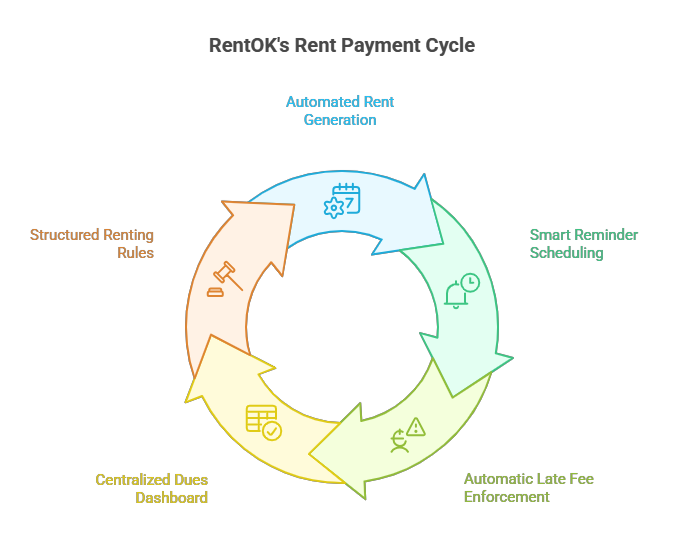
Here’s how it directly helps reduce late payments:
Automated Rent Generation
Every month, rent cycles are created automatically. No manual Excel copying.
Smart Reminder Scheduling
Pre-due, due-date, and overdue reminders go automatically — with consistent tone.
Automatic Late Fee Enforcement
Once grace period ends, late fees apply based on your defined rules. No emotional enforcement required.
Centralized Dues Dashboard
You can instantly see who has paid and who hasn’t — across all rooms and properties.
Structured Renting Rules
Clear policies can be documented and consistently applied, reducing negotiation and confusion.
When systems are automated, payment behavior improves because discipline no longer depends on you personally following up.
You move from chasing rent to managing operations.
What Happens When Structure Is Delayed?
Late payments don’t just affect cash flow.
They affect staff salaries, vendor payments, authority perception, and operational stability.
More importantly, they slowly build a culture where deadlines feel optional.
Once that culture forms, correcting it becomes harder.
Structured systems prevent that drift early.
Final Takeaway
You don’t reduce late rent payments by being stricter.
You reduce them by being predictable.
Clear rental rules.
Defined grace periods.
Automated reminders.
Consistent late fee enforcement.
Centralized tracking.
That’s how hostels move from informal management to professional operations.
If your current system relies on Excel sheets and manual WhatsApp follow-ups, it may be time to evaluate something more structured.
Book A Demo with RentOK and see how automated rent cycles, reminder systems, and centralized tracking can reduce late payments, without increasing friction with tenants.
Because when the system becomes strong, follow-ups become minimal.
About the Author
Ishika Pannu
Ishika Pannu brings you the latest insights and easy-to-apply strategies in property management—helping you simplify renting and grow with RentOk.