Pg owner app
Rent Receipt Format India: What Every Receipt Must Include


Written by
Ishika Pannu
Read Time
12 min read
Posted on
June 18, 2026
Overview
Overview
Rent Receipt Format India: What Every Receipt Must Include
A rent receipt is one of the most commonly used rental documents in India, yet it is often one of the most misunderstood. Many tenants only think about rent receipts when filing their income tax returns, while many landlords issue them only when specifically requested. In reality, rent receipts play a much bigger role than simply acknowledging a payment.
They serve as official proof that rent has been paid for a specific property and rental period. Whether a tenant wants to claim House Rent Allowance (HRA), maintain financial records, apply for reimbursement from an employer, or resolve a future dispute regarding rental payments, a properly prepared rent receipt can become an important supporting document.
Despite their importance, a surprising number of rent receipts are either incomplete or missing essential details. Something as simple as an incorrect rental amount, a missing landlord signature, or the absence of a revenue stamp when required can create unnecessary complications later.
Understanding what should be included in a rent receipt is therefore important for both tenants and landlords. A properly structured receipt not only improves documentation but also ensures that the record remains useful whenever verification or compliance requirements arise.

What Is a Rent Receipt?
A rent receipt is a written acknowledgment provided by a landlord confirming that rent has been received from a tenant. It acts as documentary evidence of a rental transaction and records important information such as the amount paid, the rental period covered, and the details of both parties involved.
While rent receipts may seem like a routine administrative formality, they often become important when financial documentation is required. In many situations, a tenant may need to prove that rent payments were made consistently over a period of time. Without proper receipts, establishing this record can become difficult.
For landlords, rent receipts create a transparent payment trail. They help maintain organized records and reduce confusion regarding payment history, outstanding dues, or rental disputes.
A standard rent receipt typically serves multiple purposes:
- It provides documented proof that rent has been received for a particular month or rental period, reducing the chances of future payment-related disagreements.
- It supports HRA claims during income tax filing, especially for salaried employees whose employers require rent payment documentation.
- It helps both landlords and tenants maintain accurate financial records that can be referred to whenever verification becomes necessary.
- It creates transparency in rental transactions by formally recording payment details rather than relying solely on verbal confirmation.
As rental transactions become increasingly digital, rent receipts continue to remain relevant because they provide a structured and universally accepted record of payment.
Why Rent Receipts Are Important in India
Many people assume that online bank transfers or UPI transactions eliminate the need for rent receipts. While digital payment records certainly provide evidence that money was transferred, they do not always explain the purpose of the transaction.
For example, a bank statement may show that ₹15,000 was transferred to a landlord’s account, but it may not clearly establish:
- Which property the payment relates to.
- The rental period being covered.
- Whether the amount represents rent, a security deposit, maintenance charges, or another payment.
- Whether the landlord officially acknowledges receiving the amount as rent.
This is where a rent receipt becomes valuable.
For tenants, the most common reason for requiring rent receipts is HRA compliance. Many employers ask employees to submit rent receipts periodically, especially when annual rent payments exceed prescribed limits.
For landlords, receipts help establish consistency and transparency. When rental records are maintained properly, payment histories become much easier to track and verify.
Beyond taxation and documentation, rent receipts also contribute to smoother landlord-tenant relationships. Clear records reduce ambiguity, which ultimately helps prevent misunderstandings regarding payment timelines or outstanding dues.
What Information Must Every Rent Receipt Include?
A rent receipt is only useful when it contains all the necessary information. Missing details can reduce its effectiveness and, in some situations, even affect its acceptance for tax or verification purposes.
A properly prepared rent receipt should include the following components.
1. Name of the Tenant
The receipt should clearly mention the full name of the individual who is paying the rent.
This may seem obvious, but many informal receipts simply state that payment has been received without identifying the tenant properly. Including the tenant’s full name ensures that the payment record can be linked to the correct individual whenever required.
2. Name of the Landlord
The landlord’s full name should be clearly mentioned on the receipt.
This information establishes who received the payment and helps validate the authenticity of the transaction. If the property is managed through an authorized representative, the relationship should be documented appropriately.
3. Address of the Rented Property
The complete address of the property should always be included.
This is particularly important because many tenants may have lived in multiple rental properties over time. The property address helps identify exactly which premises the payment relates to.
A complete address should ideally include:
- Building or house number.
- Street or locality name.
- City and state.
- PIN code wherever applicable.
This makes the receipt significantly more useful for documentation and verification purposes.
4. Rent Amount Paid
The exact amount received as rent should be mentioned clearly.
It is considered good practice to mention the amount both numerically and in words. Doing so minimizes the possibility of errors, alterations, or confusion regarding the payment value.
For example:
₹18,000 (Rupees Eighteen Thousand Only)
This simple addition improves clarity and professionalism.
5. Rental Period
Every rent receipt should specify the period for which rent has been paid.
Instead of simply stating that payment was received, the receipt should clearly indicate whether the payment relates to:
- January 2026
- April–June 2026
- Financial Year 2025–26
- Any other defined rental period
This detail becomes particularly important during HRA submissions and record verification.
Sample Rent Receipt Format
A simple rent receipt format typically includes the following structure:
Rent Receipt
Receipt No: _______
Date: _______
Received a sum of ₹________ from Mr./Ms. __________ towards rent for the property located at ______________________________ for the month/period of __________.
Payment Mode: __________
Landlord Name: __________
Landlord Signature: __________
This format covers the essential elements required in most rental situations while remaining simple and easy to maintain.

When Is a Revenue Stamp Required?
One area that frequently creates confusion is the use of revenue stamps.
Under common rental documentation practices, a revenue stamp is generally required when rent is received in cash and the amount exceeds the prescribed threshold. The stamp serves as additional evidence that the landlord has acknowledged receipt of the payment.
Although digital payments have reduced reliance on revenue stamps significantly, understanding this requirement remains important because many rental arrangements across India still involve cash transactions.
Tenants should not assume that every receipt requires a revenue stamp. The requirement depends on the payment method and applicable rules at the time of the transaction.
Common Mistakes People Make While Creating Rent Receipts
Most rent receipt issues arise not because people intentionally ignore documentation requirements, but because they overlook small details that later become important.
Some of the most common mistakes include:
- Issuing receipts without mentioning the rental period, making it difficult to establish which month’s rent was actually paid.
- Forgetting to include the complete property address, which reduces the receipt’s usefulness during verification or compliance checks.
- Using inconsistent names across rental agreements, payment records, and receipts, creating unnecessary documentation mismatches.
- Failing to obtain the landlord’s signature when required, which may affect the receipt’s credibility in certain situations.
- Generating receipts retrospectively for multiple months without maintaining proper payment records, making verification more difficult.
Can Digital Rent Receipts Be Used?
As rental transactions increasingly move online, many tenants and landlords wonder whether digitally generated rent receipts are legally acceptable. The short answer is yes. In most situations, digital rent receipts are widely accepted as long as they contain all the required information and accurately reflect the rental transaction.
In fact, digital documentation has become the preferred option for many landlords because it eliminates the hassle of creating, storing, and retrieving physical records every month. For tenants, digital receipts offer the convenience of maintaining an organized payment history that can be accessed whenever required for tax filing, employer submissions, or financial verification.
A properly generated digital rent receipt should include the same information that would appear on a physical receipt:
- The tenant’s name and the landlord’s name should be clearly mentioned to establish the parties involved in the transaction.
- The rental property’s address should be included so that the payment can be linked to a specific tenancy arrangement.
- The amount paid, rental period, payment date, and mode of payment should be recorded accurately to avoid future confusion.
- The landlord’s signature, digital acknowledgment, or approved validation method should be present wherever applicable.
The important thing to understand is that digital receipts are not a shortcut around documentation requirements. They simply provide a more efficient way to maintain the same records that would otherwise be created manually.
For landlords managing multiple properties or tenants, digital receipts also help create consistency. Instead of preparing documents individually every month, receipts can be generated in a standardized format, reducing administrative effort and minimizing errors.
Rent Receipt Format for HRA Claims
One of the biggest reasons people search for rent receipt formats in India is because of House Rent Allowance (HRA).
For salaried employees, HRA can significantly reduce taxable income. However, claiming this benefit often requires documentary proof showing that rent payments were actually made during the financial year.
This is where properly maintained rent receipts become important.
Many employees only begin collecting rent receipts when tax declarations are due. By that stage, reconstructing several months of rental documentation can become time-consuming and, in some cases, inaccurate.
A compliant HRA rent receipt should clearly establish:
- The identity of the tenant making the payment and claiming the housing benefit.
- The landlord who received the rent and acknowledged the transaction.
- The exact amount paid during the specified rental period.
- The address of the rented accommodation for which HRA is being claimed.
- The date and acknowledgment of the transaction through signature or other accepted validation methods.
For higher rental amounts, additional documentation may also be required depending on prevailing tax guidelines and employer requirements.
The most practical approach is to generate rent receipts every month instead of waiting until the end of the financial year. This ensures that records remain accurate, organized, and readily available whenever needed.
A consistent documentation process also reduces the chances of discrepancies between:
- Rental agreements
- Bank payment records
- Tax declarations
- Employer submissions
When all these records align properly, the HRA claim process becomes much smoother.
Why Manual Rent Receipt Creation Often Becomes a Problem
At first glance, creating a rent receipt appears simple. Many landlords assume they can quickly draft one whenever a tenant requests it.
The challenge usually appears over time.
As months pass, landlords often need to track multiple tenants, varying rental amounts, maintenance charges, deposit adjustments, and payment dates. When receipts are created manually, inconsistencies start appearing.
For example:
- One month’s receipt may contain the complete address while another may not.
- Payment amounts may be entered differently across different receipts, creating avoidable discrepancies.
- Older receipts may become difficult to locate when tenants request historical records.
- Formatting changes from month to month can make documentation appear unprofessional.
For tenants, the issue is equally frustrating. When receipts need to be submitted urgently for tax filing or employer verification, delays in obtaining properly formatted documents can create unnecessary stress.
This is why many landlords and tenants are gradually moving toward structured receipt generation systems rather than relying on manual templates.
The objective is not simply convenience.
It is consistency.
Consistent documentation reduces errors, improves record keeping, and makes future verification significantly easier.
Best Practices for Maintaining Rent Receipt Records
Creating a rent receipt is only one part of the process. Maintaining those records properly is equally important.
A well-organized documentation system helps both tenants and landlords avoid future difficulties when proof of payment is required.
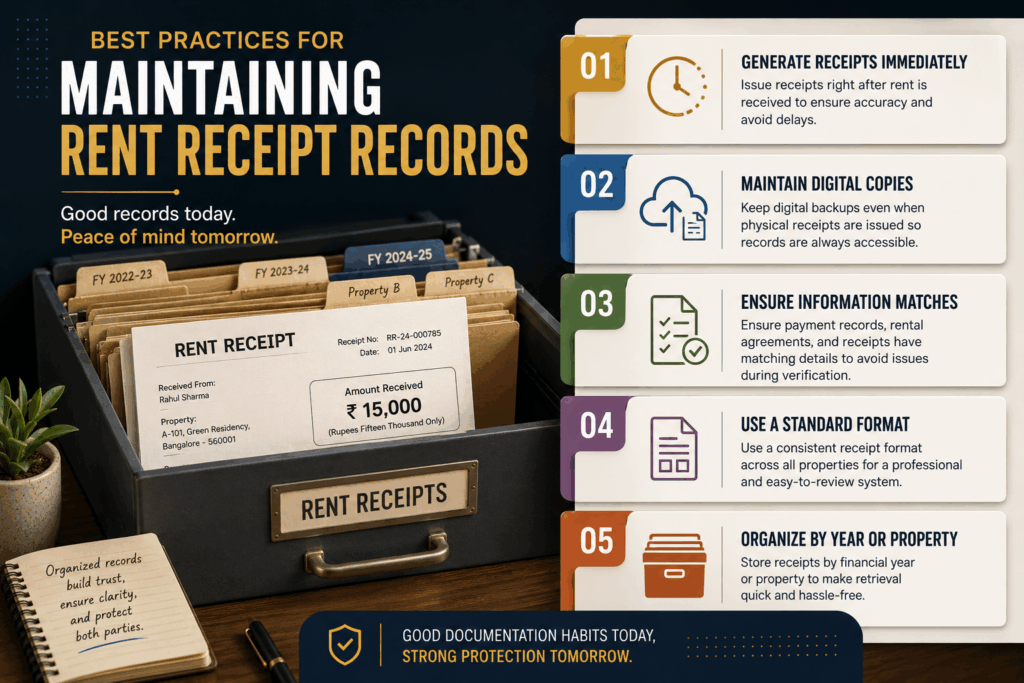
Some practical best practices include:
- Generating receipts immediately after rent is received instead of waiting until multiple months have passed, which reduces the chances of missing or inaccurate information.
- Maintaining digital copies even when physical receipts are issued so that records remain accessible in case documents are misplaced.
- Ensuring that payment records, rental agreements, and rent receipts contain matching information to avoid inconsistencies during verification.
- Using a standardized format across all receipts so that documentation remains professional and easy to review.
- Storing receipts by financial year or property to simplify retrieval whenever historical records are required.
Good documentation habits may seem minor on a monthly basis, but they become extremely valuable over the course of several years of tenancy.
Generate Professional Rent Receipts with RentOk
Creating rent receipts manually every month may work when there is only one tenant. However, as documentation requirements increase, maintaining consistency becomes much more challenging.
RentOk’s Rent Receipt Generator simplifies this entire process by helping landlords and tenants create professional rent receipts within seconds. Instead of manually formatting documents, checking required fields, and maintaining multiple templates, users can generate receipts through a structured system designed specifically for rental documentation.
The Rent Receipt Generator helps ensure that important details such as tenant information, landlord details, property address, rental amount, payment period, and transaction records are captured properly in a standardized format.
This not only saves time but also improves documentation accuracy. Whether you need rent receipts for HRA claims, employer submissions, financial records, or routine rental management, using a dedicated generator helps eliminate many of the inconsistencies commonly associated with manual receipt creation.
For landlords managing multiple tenants and for tenants who require organized documentation throughout the year, a structured rent receipt generation system can significantly simplify record keeping.
Conclusion
A rent receipt may appear to be a simple document, but its importance extends far beyond acknowledging a rental payment. It serves as proof of rent paid, supports HRA claims, improves financial record keeping, and creates transparency between landlords and tenants.
The effectiveness of a rent receipt depends largely on the information it contains. Details such as tenant and landlord names, property address, rental period, payment amount, and proper acknowledgment should always be included to ensure that the document remains useful whenever verification becomes necessary.
As rental transactions continue becoming more digital, generating accurate and professionally formatted rent receipts has become easier than ever. Instead of relying on manual templates and inconsistent records, use the Rent Receipt Generator by RentOk to create compliant rent receipts instantly and maintain organized rental documentation throughout the year.
About the Author
Ishika Pannu
Ishika Pannu brings you the latest insights and easy-to-apply strategies in property management—helping you simplify renting and grow with RentOk.