Market Trends
Tracking Staff Performance: From Cleaning to Security

Written by
Ishika Pannu
Read Time
10 min read
Posted on
May 13, 2026
Overview
Overview
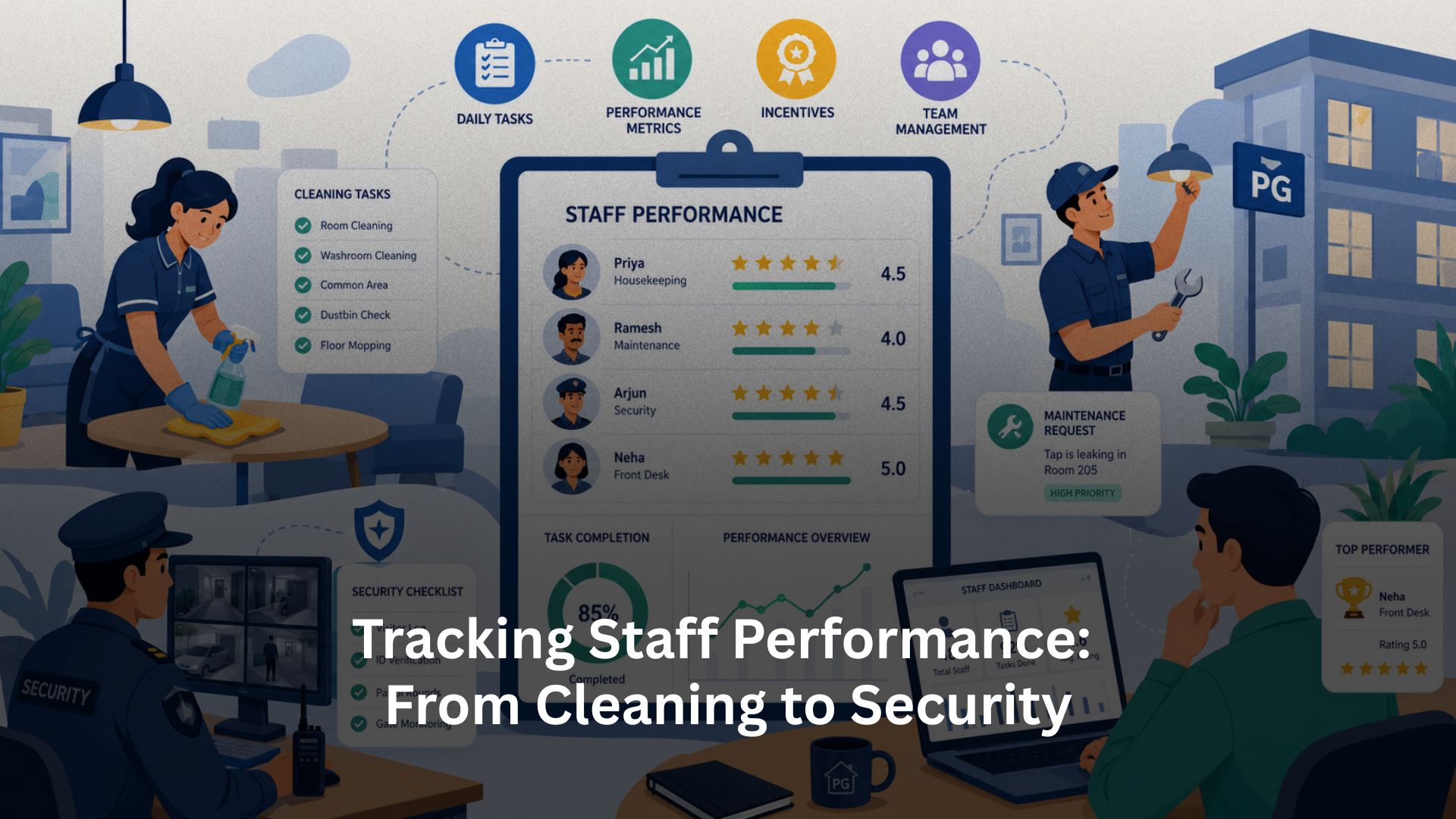
Tracking Staff Performance: From Cleaning to Security
In the rental housing business, tenants rarely judge a property only by its rooms or amenities. What truly shapes their experience is the consistency of day-to-day operations. A PG may have well-designed interiors, comfortable furniture, and a prime location, but if common washrooms are not cleaned properly, maintenance requests take too long to resolve, or security feels careless, residents immediately begin questioning the professionalism of the entire property.
This is why staff performance has become one of the most important operational pillars in modern PG and co-living management.
Today’s residents expect more than accommodation. They expect systems that feel organized, responsive, and professionally managed. And these expectations are fulfilled not by infrastructure alone, but by the people running operations behind the scenes every single day.
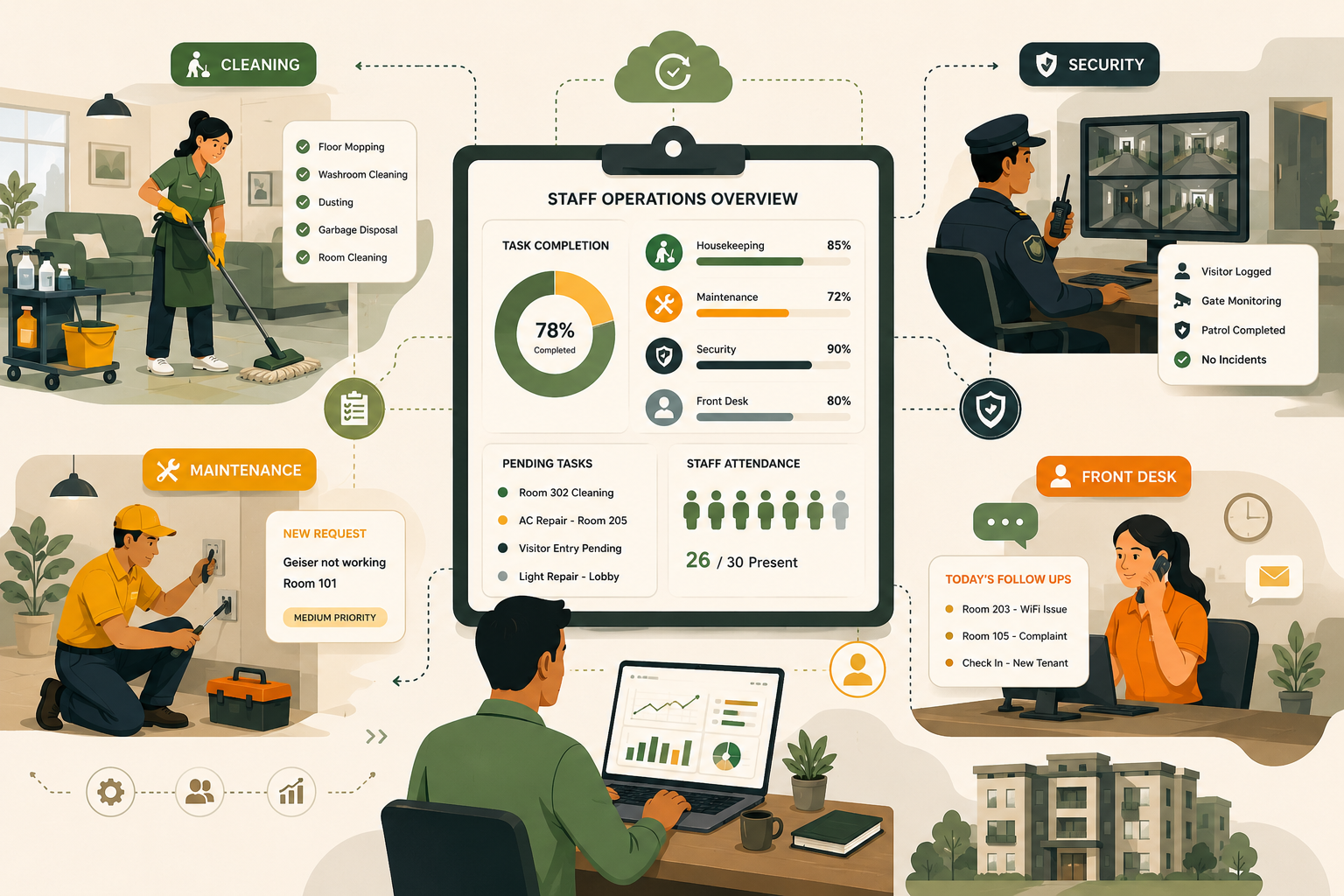
Housekeeping teams maintain hygiene standards. Security staff manage access and safety. Maintenance workers ensure that operational disruptions are resolved quickly. Front-desk coordinators handle communication and resident support. Together, these teams define how smoothly the property functions.
The challenge, however, is that many PG operators still manage staff through informal coordination systems. Tasks are assigned verbally, accountability depends heavily on supervision, and performance reviews are often based on assumptions instead of measurable operational visibility. This may work temporarily in smaller setups, but as occupancy grows and operations become more complex, the lack of structure begins creating operational inconsistency.
And operational inconsistency is one of the fastest ways to lose tenant trust.
Why Staff Management Has Become More Complex in Modern PGs
A few years ago, most rental accommodations operated with relatively basic service expectations. Tenants mainly focused on affordability and location. But the rental housing industry has evolved significantly, especially with the rise of co-living spaces and professionally managed PGs.
Modern tenants now expect:
- Faster complaint resolution without repeated follow-ups or delays from the management team.
- Cleaner and more hygienic shared spaces that remain consistently maintained throughout the day.
- Better security coordination, especially in properties with higher occupancy and shared access areas.
- Professional communication from staff members handling onboarding, maintenance, and resident concerns.
- Operational consistency that makes daily living feel organized instead of chaotic.
At the same time, operators are managing:
- Larger resident volumes with higher turnover rates across rooms and floors.
- Multiple operational teams working in rotating shifts throughout the day.
- More maintenance requests because of increasing appliance and infrastructure usage.
- Higher service expectations driven by online reviews and competitive rental markets.
This operational complexity makes informal management systems increasingly unreliable.
The problem is not always that staff members are underperforming. In many cases, the real issue is that expectations, responsibilities, and accountability mechanisms are not clearly structured.
The Biggest Operational Mistake: Managing Staff Reactively
One of the most common mistakes property operators make is addressing staff performance only after complaints start increasing.
For example:
- Cleaning schedules are reviewed only after residents complain about hygiene.
- Maintenance coordination improves only after repeated delays frustrate tenants.
- Security monitoring becomes stricter only after an operational incident occurs.
This reactive approach creates unnecessary operational pressure because problems are being solved after they have already affected tenant experience.
High-performing rental businesses work differently.
Instead of reacting constantly, they create operational systems that make performance visible on a daily basis. They track responsibilities, monitor consistency, and identify operational gaps early before those issues escalate into larger resident dissatisfaction.
This shift from reactive supervision to structured performance management is what separates scalable rental operations from unstable ones.
Daily Task Lists: The Foundation of Staff Accountability
One of the simplest but most effective ways to improve operational consistency is implementing structured daily task lists.
In many PGs, employees understand their broad responsibilities but lack clarity around:
- what exactly needs to be completed,
- by what time,
- under whose supervision,
- and how completion is verified.
This creates ambiguity. And ambiguity almost always leads to inconsistency.
Daily task tracking solves this problem by turning vague responsibilities into measurable operational workflows.
For housekeeping teams, this may include:
- scheduled cleaning cycles for washrooms and common areas,
- room preparation for move-ins,
- garbage disposal timing,
- and hygiene checks across shared spaces.
Maintenance teams can use structured task lists to track:
- pending repair requests,
- appliance inspections,
- plumbing or electrical follow-ups,
- and escalation timelines for unresolved issues.
Security operations may require tracking systems for:
- visitor log maintenance,
- shift attendance verification,
- access monitoring,
- and incident reporting.
The biggest advantage of structured task allocation is that operational quality becomes measurable instead of assumption-based.
Why Daily Task Lists Improve Operational Stability
When implemented properly, daily staff tracking systems create several long-term operational benefits:
- Teams become more consistent because responsibilities are clearly defined instead of communicated casually throughout the day.
- Supervisors spend less time repeating instructions manually and more time improving operational quality strategically.
- Missed tasks become easier to identify before they escalate into larger tenant complaints or operational failures.
- Shift coordination improves significantly because incoming teams can understand pending responsibilities clearly.
- Employees develop stronger accountability because performance expectations become transparent and trackable.
This level of operational clarity is extremely important in high-density PGs where even small inconsistencies become visible quickly.
Why Housekeeping Quality Directly Affects Tenant Retention
Among all operational departments, housekeeping usually has the strongest daily impact on tenant perception.
A resident may tolerate occasional maintenance delays. But repeated cleanliness issues immediately affect how professionally the property is perceived. Unclean common areas, poorly maintained washrooms, overflowing bins, or inconsistent room cleaning create frustration far faster than operators often realize.
The reason is simple: cleanliness is experienced every single day.
Unlike amenities that tenants may use occasionally, hygiene standards constantly shape how comfortable the property feels operationally.
This is why experienced operators treat housekeeping as a system rather than a routine chore.
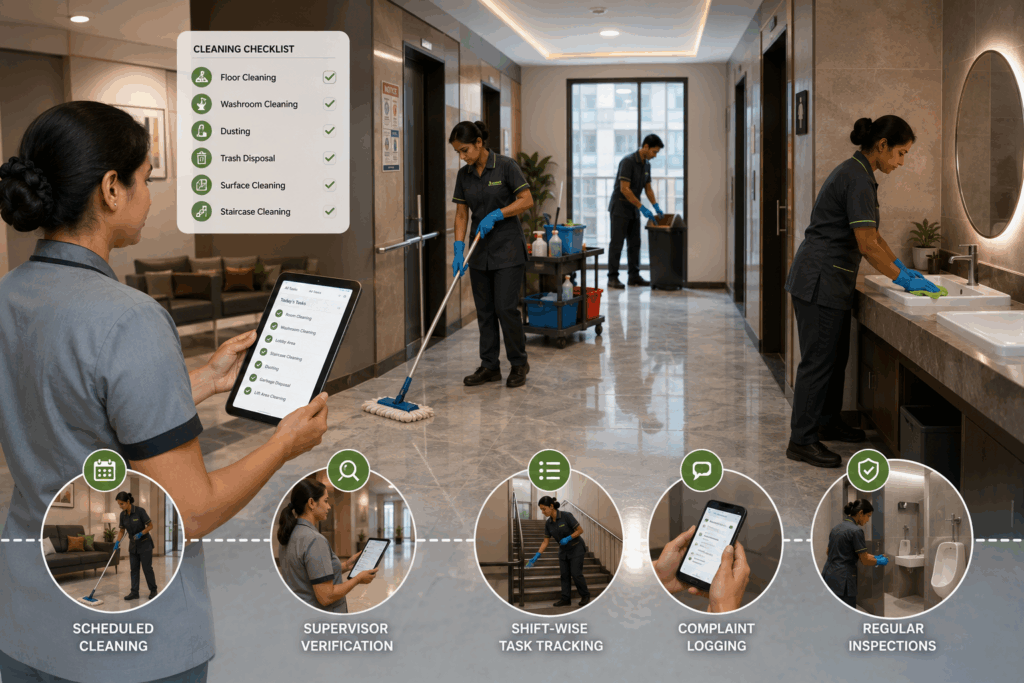
Strong housekeeping management usually involves:
- Clearly defined cleaning schedules across different areas of the property.
- Supervisor verification systems to ensure cleaning quality remains consistent.
- Shift-wise task tracking so responsibilities remain visible throughout the day.
- Complaint logging systems that identify recurring hygiene issues quickly.
- Regular inspections of high-usage areas such as washrooms, dining spaces, and staircases.
Without these systems, cleaning quality becomes dependent on individual staff behavior instead of operational structure.
And that creates inconsistency.
Security Teams Need Structured Oversight Too
Many property owners evaluate security performance only by checking whether guards are physically present at the gate.
But modern rental operations require much more than physical presence alone.
Security staff today often handle:
- visitor management,
- package coordination,
- emergency response,
- resident support,
- access monitoring,
- and incident reporting.
This means security operations directly influence both resident comfort and operational safety.
In larger co-living spaces especially, unstructured security coordination creates multiple risks:
- visitor records become inconsistent,
- unauthorized access increases,
- incident reporting becomes unclear,
- and communication gaps begin affecting resident confidence.
This is why professional operators increasingly track security performance operationally rather than informally.
Important Areas That Security Tracking Usually Covers
| Security Function | Why It Matters Operationally |
|---|---|
| Visitor Management | Helps maintain better access visibility and resident safety within shared properties. |
| Shift Attendance | Prevents coordination gaps during shift transitions or unexpected absences. |
| Incident Reporting | Creates accountability and improves response quality during operational issues. |
| Entry Monitoring | Reduces unauthorized movement inside high-occupancy properties. |
| Resident Coordination | Improves tenant confidence during emergencies or late-hour situations. |
When security processes become structured, the property itself starts feeling more professionally managed.
Why Performance Metrics Matter More Than Assumptions
One major reason staff management becomes inconsistent is because operators often evaluate employees emotionally instead of operationally.
For example:
“This employee looks hardworking.”
Or:
“That team seems busy all day.”
But visible effort does not always translate into operational efficiency.
Performance metrics create objectivity. Instead of depending entirely on assumptions, operators gain measurable insights into how teams are actually functioning.
This does not mean turning the property into a rigid corporate environment. It simply means understanding operational patterns clearly enough to improve consistency.
Useful Metrics That PG Operators Commonly Track
- Cleaning completion rates help identify whether housekeeping schedules are being followed consistently across shifts and floors.
- Maintenance resolution time reveals how efficiently operational issues are being handled before tenant frustration increases.
- Repeat complaint frequency helps operators identify recurring service quality problems within specific teams.
- Staff attendance consistency improves shift planning and reduces sudden operational disruptions.
- Resident feedback patterns reveal how tenants actually experience daily staff interactions across the property.
These metrics are valuable because they shift staff management from guesswork to operational visibility.
Incentive Models: Why Recognition Improves Performance
One common mistake in staff management is focusing entirely on penalties whenever operational issues happen.
But sustainable operational consistency is rarely built through pressure alone.
Employees perform better when:
- expectations are clear,
- systems feel fair,
- and good work is acknowledged consistently.
This is where incentive models become important.
Incentives do not always need to be large financial rewards. Even structured recognition systems can improve motivation significantly when staff members feel their effort is visible and valued.
Incentive Areas That Often Improve PG Operations
- Rewarding housekeeping teams for maintaining consistently positive inspection and hygiene feedback.
- Recognizing maintenance staff who resolve complaints quickly without repeated follow-ups from residents.
- Providing attendance-based incentives for teams handling difficult rotational shifts consistently.
- Appreciating security staff who maintain disciplined visitor management and professional resident coordination.
- Offering performance-linked growth opportunities for employees showing long-term operational reliability.
The goal is not just improving productivity temporarily. It is building operational stability over time.
Why Staff Coordination Matters More Than Individual Performance
Many operational problems inside PGs are not caused by one department alone. They happen because teams fail to coordinate efficiently with each other.
For example:
- housekeeping may clean rooms late because maintenance repairs were delayed,
- front-desk teams may struggle because updates are not communicated clearly,
- or security staff may face confusion during resident onboarding because records are incomplete.
Tenants do not evaluate these issues separately.
They experience them collectively as operational inefficiency.
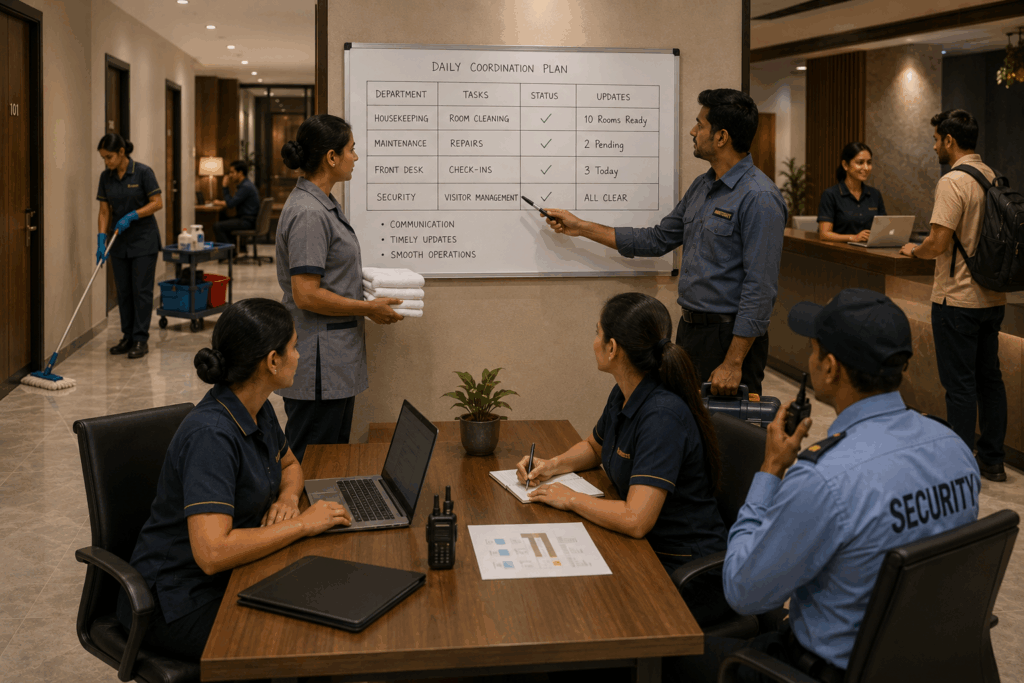
This is why strong rental operations focus heavily on workflow coordination across departments instead of managing teams in isolation.
Properties function smoothly when:
- communication is centralized,
- responsibilities remain visible,
- and workflows follow structured systems rather than reactive coordination.
How RentOk Helps Streamline Staff and Property Operations
As rental businesses scale, manually coordinating housekeeping schedules, maintenance requests, security tracking, tenant communication, and occupancy management becomes increasingly difficult. Information often gets scattered across spreadsheets, calls, registers, and WhatsApp groups, making operational visibility harder to maintain consistently.
RentOk helps simplify these operational challenges by centralizing property management workflows into one organized system. Instead of relying entirely on fragmented manual coordination, operators can create a more structured management environment where operational visibility improves across teams and properties.
With RentOk, property managers can:
- Maintain centralized tenant and property records that improve coordination between operational teams.
- Track occupancy, payments, and maintenance workflows more systematically across the property.
- Improve communication visibility so staff responsibilities and updates remain easier to manage.
- Reduce manual dependency for routine operational coordination and follow-ups.
- Create more organized operational processes that improve accountability across teams.
This operational clarity becomes increasingly valuable as properties grow because consistency becomes harder to maintain manually at scale.
Conclusion
In modern PG and co-living operations, staff performance is no longer a background management issue. It directly influences tenant satisfaction, operational stability, online reputation, and long-term retention.
Residents may initially choose a property because of pricing or location, but their daily experience is ultimately shaped by how smoothly operations function behind the scenes. Cleanliness, maintenance responsiveness, security coordination, and staff professionalism collectively determine whether a property feels reliable and professionally managed.
And achieving that level of consistency requires more than effort alone.
It requires:
- structured systems,
- measurable accountability,
- better workflow visibility,
- and stronger operational coordination across teams.
The most successful rental operators today are not simply managing buildings. They are building operational ecosystems designed to deliver consistency even as occupancy and complexity increase.
If you want to streamline staff coordination, improve operational visibility, and create more structured property management workflows, explore RentOk and discover how organized systems can help your rental business operate more efficiently at scale.
About the Author
Ishika Pannu
Ishika Pannu brings you the latest insights and easy-to-apply strategies in property management—helping you simplify renting and grow with RentOk.