Case Study
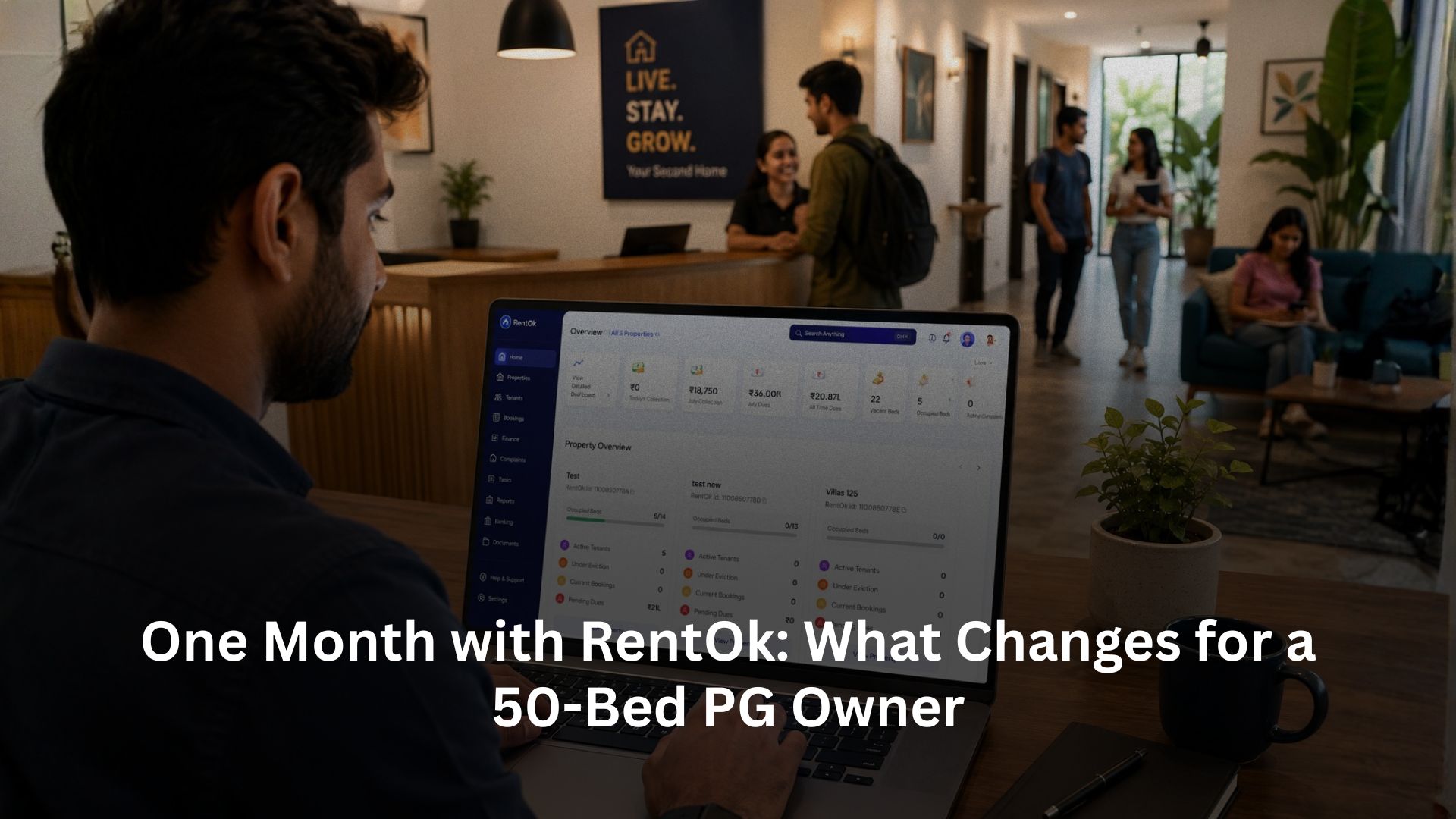
One Month with RentOk: What Changes for a 50-Bed PG Owner

Written by
Ishika Pannu
Read Time
14 min read
Posted on
July 15, 2026
Overview
Overview
One Month with RentOk: What Changes for a 50-Bed PG Owner
Many PG owners assume operational problems only begin after crossing 200 or 300 beds. In reality, the biggest growing pains often appear much earlier, between 40 and 80 beds. At this stage, spreadsheets, notebooks, and WhatsApp are no longer enough, but many operators haven’t yet adopted a structured management system.
This case study follows the first month of a fictional, but highly realistic, 50-bed PG owner using RentOk. While the property and owner are illustrative, the operational challenges and improvements reflect situations experienced by PG operators every day.
The property enjoyed strong occupancy, regular enquiries, and a solid reputation among students and working professionals. On the surface, everything seemed to be running smoothly. Behind the scenes, however, daily operations depended on manual coordination, and routine tasks were becoming increasingly difficult to manage.
The biggest challenges included:
- Rent collection: Monthly reminders were sent manually, making timely collections dependent on constant follow-ups.
- Maintenance tracking: Complaints were shared through calls or WhatsApp, with no clear way to monitor progress or confirm resolution.
- Financial management: Rent, deposits, expenses, and utility payments were spread across multiple spreadsheets and notebooks, making reconciliation slow and error-prone.
- Tenant communication: Staff repeatedly answered the same questions about rent, visitor policies, Wi-Fi, and maintenance because information wasn’t available in one place.
None of these issues were business-threatening on their own. Together, however, they created a system that relied on manual effort instead of efficient processes.
This is where many growing PG businesses reach a turning point. Occupancy continues to rise, but every new tenant adds more administrative work rather than improving profitability or operational efficiency. The next phase of this case study explores how consolidating these workflows inside RentOk transformed everyday property management.
The Starting Point: Before RentOk
At the start of the month, the owner wasn’t searching for property management software. The goal was much simpler: reduce the daily workload without affecting the tenant experience.
The 50-bed PG was almost fully occupied, enquiries arrived regularly, and revenue was steady. The real challenge wasn’t attracting tenants, it was managing an increasingly busy operation.
Each day began by checking bank transactions to identify rent payments, followed by updating spreadsheets, replying to WhatsApp messages, coordinating housekeeping, following up with late payers, tracking maintenance requests, and handling new enquiries. By evening, several routine tasks were still left unfinished.
Month-end made the situation even more apparent. Instead of reviewing occupancy, revenue, or growth opportunities, hours were spent matching payments, verifying outstanding dues, and reconciling scattered records.
The biggest operational bottlenecks were:
- Slow payment verification: Rent payments had to be checked and updated manually throughout the day.
- Scattered tenant records: Agreements, KYC documents, deposits, rent history, and conversations were stored across multiple platforms.
- Limited business visibility: Simple questions like “How much rent is pending?” or “Which rooms become vacant next month?” required manual calculations.
- Manual follow-ups: Rent reminders, maintenance updates, and move-in coordination all depended on someone remembering to take action.
None of these problems prevented the business from running. Together, however, they consumed valuable time and made it difficult to focus on improving occupancy, enhancing the tenant experience, or planning future expansion.
The turning point came when the owner realised the business didn’t need more tenants, it needed better systems to manage the ones it already had.
This is exactly why many landlords eventually transition to dedicated property management software. If you’re evaluating whether it’s the right time to make that shift, read Why You Need Property Management Software for Landlords to understand how structured systems improve day-to-day operations.

Week 1: Replacing Chaos with Structure
The first week wasn’t about automation. It was about creating clarity.
Like most operators transitioning from manual processes, the initial objective wasn’t to transform the business overnight. It was simply to bring every important piece of information into one place.
The onboarding process began by organising tenant records, room allocations, rent details, deposits, agreements, and basic property information inside RentOk. This transition reflected a challenge faced by many growing PG operators: once tenant numbers increase, spreadsheets and manual registers become increasingly difficult to manage. If you’re still using Excel, our guide on The Easiest Way to Manage 100+ Tenants Without Using Excel explains the limitations of manual systems and how modern operators scale efficiently. By the end of onboarding, information that had previously been scattered across notebooks, spreadsheets, and WhatsApp conversations was unified within a single operational dashboard.
For the first time, the owner didn’t need to search through multiple files to answer routine questions.
Simple information like pending dues, occupied rooms, tenant details, or upcoming move-outs became much easier to access.
The immediate improvements weren’t dramatic, but they were noticeable.
- Tenant records became easier to manage, reducing the time spent searching for agreements, payment history, or KYC documents whenever a resident needed support.
- Occupancy status became more transparent, making it easier to understand which rooms were occupied, reserved, or likely to become available soon.
- Payment information started becoming organised, allowing the owner to track collections and outstanding dues from one system instead of multiple spreadsheets.
- Daily coordination required fewer follow-ups, simply because information was now easier to find and share with staff.
Perhaps the biggest change during the first week wasn’t technological, it was operational.
Instead of constantly reacting to problems, the owner began developing better visibility into the business.
Rather than asking:
“Did this tenant pay?”
or
“Which room is becoming vacant next month?”
the answers were already available.
That shift may seem small, but for growing rental businesses, operational visibility often becomes the foundation for every future improvement.
The First Realisation: Running a Property Isn’t the Same as Managing One
By the end of the first week, something unexpected became clear.
The property hadn’t gained more tenants.
Revenue hadn’t increased overnight.
Operational costs hadn’t suddenly disappeared.
Yet the business already felt easier to manage.
This highlighted an important distinction that many growing PG owners eventually experience: running a property and managing a property are two very different things.
A property can continue operating through manual effort for years. But sustainable growth depends on systems rather than constant supervision.
Once routine operational data becomes organised, owners spend less time remembering information and more time making decisions.
That shift doesn’t immediately appear in financial reports. It appears in the daily experience of managing the business.
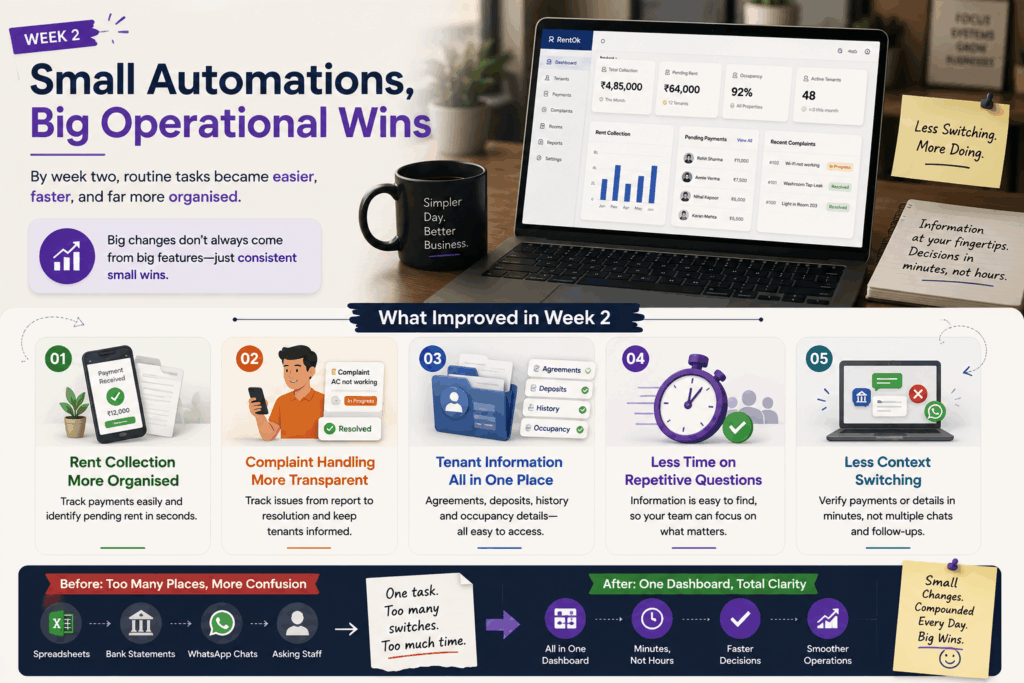
Week 2: Small Automations, Big Operational Wins
By the second week, the focus shifted from organising information to improving day-to-day operations. The owner had become comfortable using RentOk, and routine tasks that once required constant manual intervention started becoming more streamlined.
Interestingly, the biggest improvements weren’t flashy. There wasn’t one feature that transformed the business overnight. Instead, it was the accumulation of small efficiencies that began making a noticeable difference.
Rent reminders, payment records, tenant information, and occupancy details were now available in one place. Instead of switching between spreadsheets, bank statements, and WhatsApp chats throughout the day, the owner could monitor most activities from a single dashboard.
This also changed the way the staff worked. Earlier, operational decisions often depended on asking questions like, “Has this tenant paid?” or “Was this complaint resolved?” Now, the answers were already visible.
As a result, routine coordination became much faster.
Some of the improvements noticed during the second week included:
- Rent collection became more organised because payment tracking no longer depended entirely on manual verification. Staff could quickly identify pending payments, reducing the time spent matching bank transactions with tenant names.
- Complaint handling became more transparent. Instead of losing track of maintenance requests inside personal chats, issues could be monitored from the moment they were reported until they were resolved, helping tenants receive quicker updates.
- Tenant information was no longer scattered. Agreements, deposits, contact details, payment history, and occupancy records were available together, making everyday management significantly more efficient.
- Managers spent less time answering repetitive operational questions. Since information was easier to access, routine coordination no longer interrupted the day’s workflow as frequently as before.
One noticeable change was the reduction in context switching.
Previously, a single task like verifying a tenant’s payment could involve checking a bank statement, opening a spreadsheet, searching old WhatsApp messages, and confirming details verbally with staff.
Now, that process took minutes instead of several back-and-forth conversations.
While each improvement seemed relatively small on its own, together they reduced the operational friction that had become part of everyday work.
Better Visibility Changed Decision-Making
Most property owners associate software with automation, but automation isn’t the first benefit they experience. Better visibility is.
As the second week progressed, the owner realised that decisions no longer relied on assumptions or memory. Instead, they were based on information that was readily available.
For example, reviewing the property’s financial health became much simpler because outstanding dues, recent collections, occupancy levels, and tenant records were no longer maintained separately.
This also helped answer operational questions much faster.
Instead of spending half an hour compiling information, decisions could be made almost immediately.
Some examples included:
- Which tenants still had pending dues?
- Which rooms were likely to become vacant soon?
- Which maintenance requests required follow-up?
- How much rent had already been collected this month?
- Were there any pending deposits that still needed adjustment?
Having quick access to this information helped the owner become more proactive rather than reactive.
Instead of solving yesterday’s problems, attention gradually shifted toward planning the next few weeks.
Week 3: The Business Starts Feeling Different
By the third week, the improvements were no longer limited to saving time.
The overall experience of managing the property had changed.
Earlier, the owner’s day was largely driven by interruptions. A tenant needed a payment confirmation, housekeeping wanted room information, a staff member asked about pending complaints, or someone needed access to an agreement.
None of these tasks were particularly difficult.
The challenge was that they happened repeatedly throughout the day.
With operational information centralised, these interruptions reduced significantly.
That created something many property owners don’t initially expect, mental bandwidth.
Instead of constantly switching between administrative tasks, the owner finally had time to focus on improving the business itself.
This included:
- Reviewing occupancy trends instead of simply filling vacant rooms whenever someone moved out.
- Spending more time improving tenant experience because routine operational coordination consumed less of the day.
- Planning marketing activities and referral initiatives rather than relying only on listing platforms for enquiries.
- Looking at monthly performance with greater confidence because financial information was easier to interpret and verify.
One interesting observation emerged during this period.
The number of hours spent working hadn’t changed dramatically.
What changed was how those hours were being used.
Less time was spent managing information.
More time was spent managing the business.
One of the biggest outcomes of operational efficiency is having more time to focus on growth instead of administration. Our article on The Landlord’s Life: How to Automate and Regain Your Weekends explains how automation helps property owners reduce repetitive work without compromising tenant experience.
Before vs After: One Month of Operational Change
After nearly four weeks, the owner compared the property’s operations with how things looked before implementing RentOk.
The difference wasn’t measured only in numbers.
It was reflected in the way the property functioned every day.
| Before RentOk | After One Month |
|---|---|
| Payment records spread across multiple spreadsheets and bank statements | Centralised payment tracking with better visibility |
| Manual rent reminders every month | More structured collection workflow |
| Complaint updates scattered across chats | Better complaint tracking and status visibility |
| Tenant information stored in multiple places | One organised tenant management system |
| Occupancy planning depended on manual tracking | Clearer occupancy insights and room visibility |
| Month-end reconciliation required hours of manual work | Financial records became easier to review and verify |
| Owner spent most of the day coordinating operations | More time available for planning business growth |
The owner summarised the experience quite simply:
“The workload didn’t disappear. It became organised.”
That distinction mattered.
Because growing businesses rarely fail due to a lack of effort.
They struggle because effort alone cannot replace operational systems.
Lessons Other PG Owners Can Take Away
Every property operates differently, but the experience from this case study reflects a pattern seen across many growing rental businesses.
The transition from manual operations to structured management often begins long before businesses expand to hundreds of beds.
Some important takeaways include:
- Operational systems should grow alongside occupancy. Waiting until the property becomes too large usually means solving problems after they’ve already started affecting collections, tenant satisfaction, and staff productivity.
- Visibility is often more valuable than automation in the early stages. When information is organised, better decisions naturally follow.
- Manual work compounds as occupancy increases. A process that works for 20 tenants may become a daily bottleneck at 50 or 60 tenants without any changes to the property itself.
- Technology works best when it simplifies existing workflows rather than replacing them completely. The objective isn’t to remove people from operations; it’s to help them work more efficiently.
If tenant turnover continues affecting your occupancy, it’s also worth reading Managing Tenant Lock-in Periods Without Conflict, where we discuss how transparent policies can reduce disputes while improving occupancy stability.

How RentOk Helps
Managing a 50-bed PG doesn’t become difficult because of occupancy alone. It becomes difficult when payments, tenant records, maintenance requests, agreements, communication, and reporting are managed through disconnected systems.
RentOk is built as an all-in-one property management platform that brings tenant management, payments, occupancy tracking, reporting, and communication into a single connected system. By centralising these day-to-day operations, it helps property owners spend less time coordinating routine tasks and more time growing their business. Features such as automated rent collection, complaint management, digital agreements, financial reporting, tenant records, and real-time operational visibility simplify the entire rental management process.
If you’re comparing different approaches, our article All-in-One Property Management Software: Is It Worth It? explains why many operators are moving away from disconnected tools.
Whether you’re managing a single property or preparing to expand across multiple locations, having structured systems in place improves visibility, creates operational consistency, and reduces the manual work that often limits growth.
Ready to See What Changes in Your First Month?
Every PG owner reaches a point where manual processes begin limiting growth. The earlier you build structured operational systems, the easier it becomes to scale without adding unnecessary complexity.
Start your free RentOk trial today and experience how a single platform can simplify rent collection, tenant management, occupancy tracking, and everyday operations. If you’re already using RentOk and have seen similar improvements, we’d love to hear your story, your experience could become the next success story that inspires other property owners to modernise their operations.
Frequently Asked Questions
Find answers to common questions about this topic
About the Author
Ishika Pannu
Ishika Pannu brings you the latest insights and easy-to-apply strategies in property management—helping you simplify renting and grow with RentOk.
You may also like these
Related Articles
1 min read
Security Deposits: The Hidden Cost of Renting
Written by
Posted on
Ishika Pannu
Jul 17, 2026

1 min read
Odisha’s ₹210 Crore Push for Women Workforce Housing
Written by
Posted on
Ishika Pannu
Jun 9, 2026
1 min read
RentOk Case Study : A College Student Scaled to 3500-Beds PG
Written by
Posted on
Anil Kandpal
Jan 15, 2026
Stay ahead in property management with expert insights
Join thousands of property managers receiving exclusive tips delivered straight to your inbox.
Browse posts by category
Case Study
Cost of Living
Growth
Legal
Market Trends
News
Pg owner app
Property Management
Property Tax
Tech
RentOk
The easiest way to rent and manage your PGs and hostels.
Grievance Officer
Get the app


Contact us
hello@eazyapp.tech
HQ Office
COGROW, BASEMENT F-12/8A
BESIDE HOUSE OF STYLE SALON, SECTOR 28, DLF PHASE 1
GURUGRAM, HARYANA - 122002
South India Office
LUMIODESK COWORKING, 2ND FLOOR, 40, 14TH MAIN RD
BESIDE MC DONALD, 7TH SECTOR, HSR LAYOUT
BENGALURU, KARNATAKA - 560102
©️ 2026 EazyApp Tech Pvt Ltd. All rights reserved


