Growth
The Easiest Way to Manage 100+ Tenants Without Using Excel

Written by
Ishika Pannu
Read Time
9 min read
Posted on
June 1, 2026
Overview
Overview
The Easiest Way to Manage 100+ Tenants Without Using Excel
If you’re managing a PG, hostel, or co-living property today, chances are Excel played a major role in helping you get started.
Almost every operator begins the same way. One spreadsheet tracks tenant details. Another records rent payments. A third keeps occupancy records. Over time, separate files get created for expenses, deposits, maintenance, and staff management. Initially, this system feels organized because the property is still small enough for the owner to keep most information in their head.
The challenge starts when the business grows.
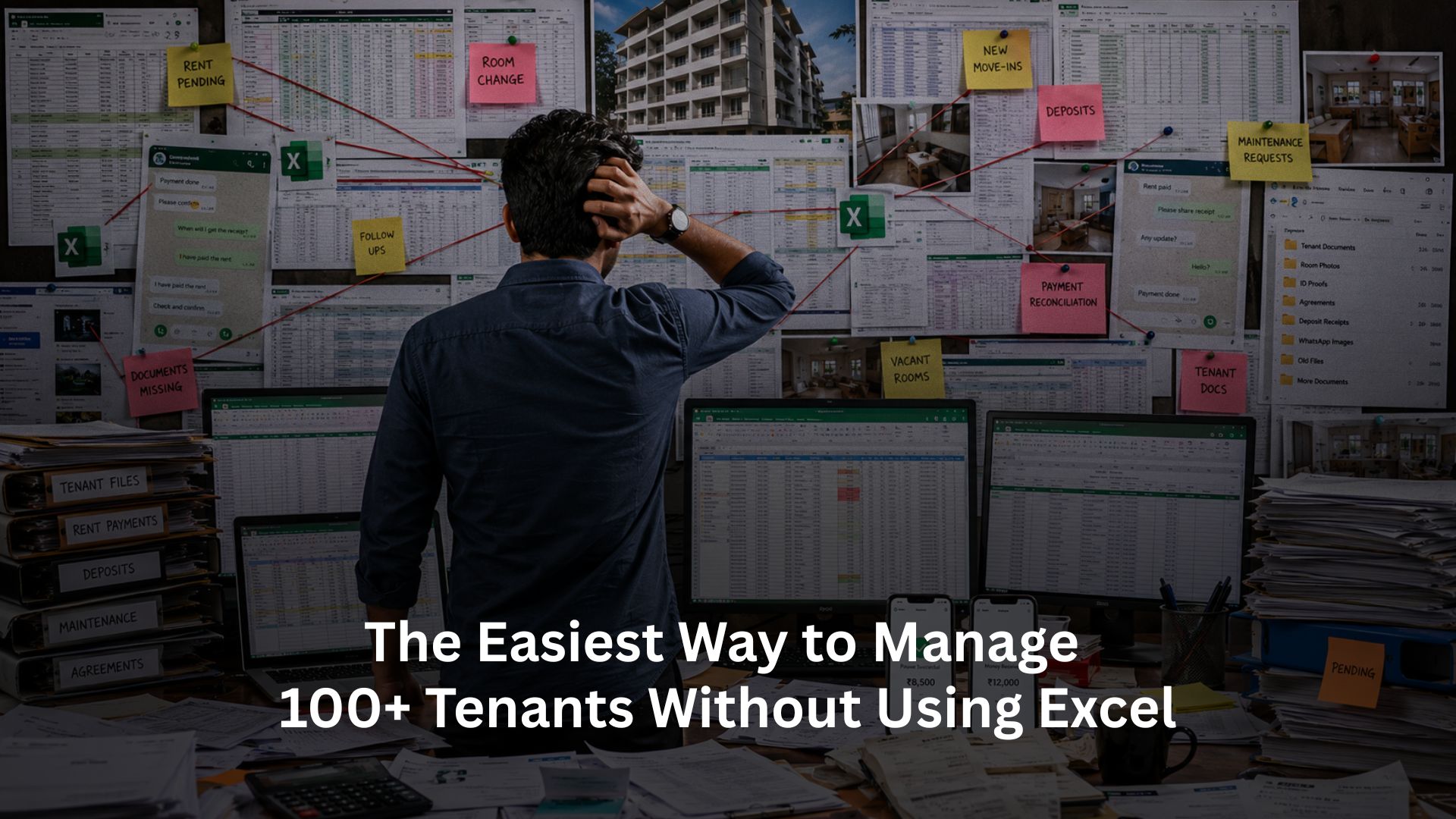
Managing 15 tenants and managing 150 tenants are completely different operational realities. Once occupancy crosses the 100-tenant mark, the business stops being about record keeping and starts becoming about coordination. Payments need to be tracked daily. Complaints need timely follow-ups. Rooms need to be allocated correctly. Vacancies need to be filled quickly. Staff need oversight. Tenant documentation needs to remain accessible.
At that stage, Excel is no longer helping you scale. In many cases, it is slowing you down.
The strongest PG operators are not necessarily the ones with the best properties. More often, they are the ones with the best systems. They have visibility into what is happening across their business without spending hours searching through spreadsheets, WhatsApp chats, and payment screenshots.
That is why more operators are moving away from Excel and adopting dedicated tenant management systems designed specifically for rental operations.
Where Excel Starts Failing for Growing PGs
Excel is extremely good at storing information. The problem is that growing PGs need more than information storage. They need operational visibility.
When occupancy is low, updating spreadsheets feels manageable. A few tenant records, a handful of rent payments, and occasional room changes can be tracked manually without creating much pressure. As the number of residents increases, however, the volume of updates grows dramatically.
Suddenly, information is changing every day.
New tenants are moving in. Existing residents are changing rooms. Deposits are being adjusted. Rent payments are arriving through multiple channels. Maintenance requests are being raised regularly. What was once a simple spreadsheet slowly becomes a system that requires constant maintenance.
This usually creates a few recurring problems:
- Rent tracking becomes increasingly difficult because payment confirmations, bank transfers, UPI transactions, and pending dues all need to be reconciled manually before managers can understand who has actually paid.
- Occupancy records often become outdated because room changes, move-ins, and move-outs happen faster than staff can consistently update spreadsheets.
- Tenant documents get scattered across folders, devices, emails, and WhatsApp chats, making retrieval frustrating whenever information is needed urgently.
- Property managers spend more time maintaining records than acting on them, which reduces overall operational efficiency.
The issue is not that the information does not exist. The issue is that accessing and managing it becomes increasingly difficult as the business grows.

The Hidden Cost of Spreadsheet Dependency
Most operators compare Excel against software costs and conclude that spreadsheets are cheaper.
On paper, that seems logical.
What often gets ignored is the amount of time required to keep spreadsheets operational.
Every payment requires an update.
Room transfers must be recorded.
Complaints need ongoing tracking.
New move-ins require documentation.
Move-outs often involve multiple adjustments.
Individually, these tasks take only a few minutes. Collectively, they consume a significant amount of management bandwidth.
The hidden costs usually appear in areas such as:
- Delayed operational decisions because managers first need to gather information from multiple sources before taking action.
- Higher staff dependency because critical knowledge often lives inside spreadsheets maintained by specific employees.
- Increased chances of manual errors that create confusion around payments, occupancy, and tenant records.
- Slower response times because information retrieval itself becomes a task rather than an instant process.
This is why many growing PG owners feel busy all the time but struggle to identify where their day actually goes.
A large portion of it is spent managing systems that were never designed to support large-scale rental operations.
Why Visibility Matters More Than Data
One of the biggest misconceptions in property management is believing that more data automatically leads to better control.
It doesn’t.
Many operators already have all the information they need. The problem is that the information is trapped inside spreadsheets, folders, and chats.
A manager should be able to answer operational questions immediately.
Questions like:
- How many beds are vacant today?
- Which tenants have pending rent?
- Which complaints are still unresolved?
- What is the occupancy percentage across all properties?
- Which residents are expected to move out this month?
These are not monthly reporting questions. These are daily management questions.
When answers require searching through multiple files, operations slow down. When answers are available instantly, managers can focus on solving problems rather than finding information.
That difference becomes increasingly important as occupancy grows.
The Power of a Visual Dashboard
This is where dedicated tenant management systems create a significant advantage.
A dashboard transforms information into visibility.
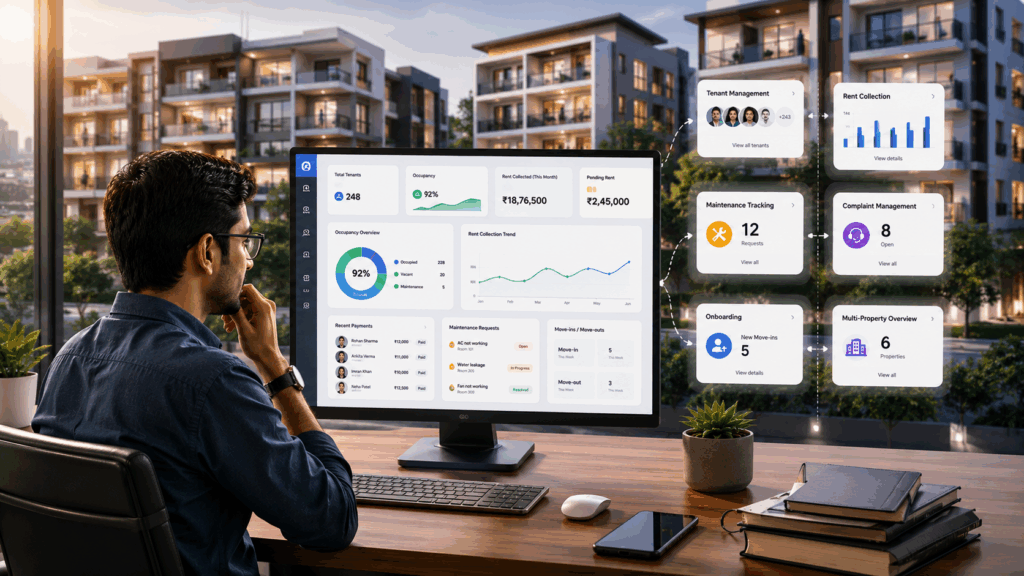
Instead of opening multiple spreadsheets and manually compiling reports, operators can view key business metrics from a single screen. This allows them to understand the health of the property immediately without spending time searching for data.
A strong dashboard typically provides visibility into:
- Occupancy levels across rooms, floors, and properties so vacancies can be identified before they start affecting revenue.
- Rent collection performance, helping managers understand which payments have been received and which require follow-up.
- Complaint and maintenance status, ensuring issues are resolved before they begin affecting tenant satisfaction.
- Upcoming move-ins and move-outs that require operational planning and room preparation.
The value of this visibility is difficult to overstate.
When managers spend less time gathering information, they have more time to improve occupancy, streamline operations, and enhance tenant experiences.
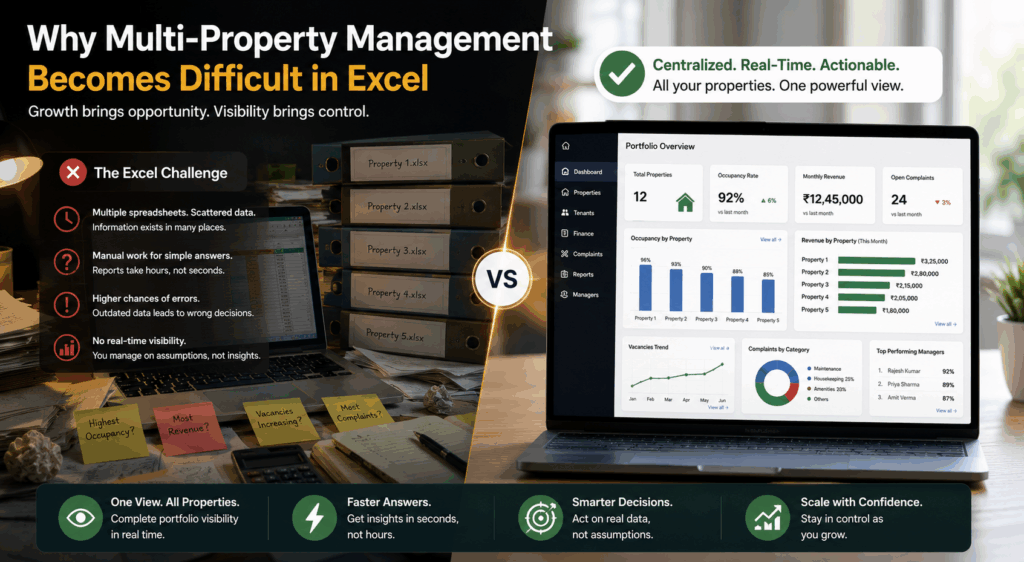
Why Multi-Property Management Becomes Difficult in Excel
Most successful operators eventually expand beyond a single property.
Growth is exciting, but it introduces a new challenge: visibility across multiple locations.
Many landlords attempt to solve this by creating separate spreadsheets for each property. Initially, this feels manageable. Over time, however, reporting becomes fragmented because information exists in multiple places.
Questions that should have simple answers suddenly require manual effort.
For example:
- Which property currently has the highest occupancy rate?
- Which location generated the most revenue this month?
- Where are vacancies increasing unexpectedly?
- Which property is receiving the most complaints?
- Which manager is performing most effectively?
Without centralized reporting, owners often rely on assumptions instead of real operational insights.
The strongest operators understand that growth is not just about acquiring more properties. It is about maintaining control as the portfolio expands.
That becomes difficult when critical information is spread across multiple spreadsheets.
Automating the Move-In Process
Move-ins are among the most important moments in the tenant journey.
A smooth onboarding process creates confidence. A disorganized one creates confusion before the tenant has even settled in.
Unfortunately, manual onboarding becomes increasingly difficult as occupancy grows. Different staff members may follow different processes. Documents may be collected inconsistently. Payment information may not be updated immediately.
These small inconsistencies create larger operational problems later.
A structured onboarding system helps standardize every move-in.
This typically includes:
- Collecting tenant information and KYC documentation through a consistent workflow rather than scattered conversations.
- Recording deposits and payment details in a way that remains accessible throughout the tenant lifecycle.
- Updating occupancy records instantly so room availability stays accurate at all times.
- Sharing onboarding instructions and property guidelines consistently with every resident.
The objective is not simply efficiency.
The objective is creating operational consistency that remains reliable regardless of occupancy levels.
Better Systems Create Better Tenant Experiences
Most owners think tenant management systems benefit management teams.
In reality, tenants often feel the impact even more.
Residents rarely care whether a property uses Excel or dedicated management software.
What matters to them is the overall experience. They want confidence that payments are tracked accurately, complaints are resolved promptly, and communication remains clear and professional. Ultimately, responsiveness and operational efficiency play a far greater role in shaping resident satisfaction than the tools being used behind the scenes.
Strong systems improve these experiences because they reduce operational friction.
The benefits usually become visible through:
- Faster complaint resolution because issues are tracked systematically instead of being buried inside chats and calls.
- More consistent communication that keeps residents informed without relying on staff memory.
- Better payment visibility that reduces disputes and confusion around collections.
- Smoother onboarding and move-out experiences that make the property feel professionally managed.
Operational efficiency and tenant satisfaction are often more connected than many landlords realize.
Why the Future of Property Management Is Beyond Excel
Excel will always remain a useful business tool.
The issue is not that spreadsheets are bad.
The issue is that growing rental businesses require capabilities that spreadsheets were never designed to provide. Visibility, automation, communication, reporting, onboarding, complaint tracking, and multi-property oversight all become increasingly important as occupancy grows.
At some point, operators must decide whether they want to spend their time maintaining spreadsheets or growing their business.
The most successful rental businesses usually make that decision early.
They invest in systems that help them scale without increasing administrative complexity.
Because ultimately, growth should create opportunities, not additional chaos.
How RentOk Helps Property Owners Manage 100+ Tenants Efficiently
Managing large occupancies requires more than accurate records. It requires complete visibility across the entire operation.
RentOk helps landlords, PG owners, and co-living operators centralize tenant records, occupancy tracking, rent collection, complaint management, onboarding workflows, and operational reporting within one connected platform. Instead of switching between spreadsheets, payment screenshots, WhatsApp conversations, and documentation folders, managers gain a clear view of what is happening across their properties.
This allows teams to reduce manual work, improve operational consistency, strengthen tenant communication, and make faster decisions based on real-time visibility. As occupancy grows, having this level of control becomes increasingly valuable because it enables operators to focus on growth instead of administration.
Conclusion
Excel has helped thousands of PG owners organize their businesses, and for smaller operations it remains a useful tool. However, once occupancy crosses 100 tenants, the challenges facing the business change significantly. The goal is no longer simply storing information. The goal is maintaining visibility, consistency, and control across an increasingly complex operation.
The operators who scale successfully are rarely the ones working the hardest. More often, they are the ones using systems that allow them to manage growth efficiently. If your team spends more time updating spreadsheets than managing tenants, it may be time to rethink the way your operations are structured.
Explore RentOk and discover how a modern tenant management system can help simplify operations, improve visibility, and support the next stage of your property’s growth.
About the Author
Ishika Pannu
Ishika Pannu brings you the latest insights and easy-to-apply strategies in property management—helping you simplify renting and grow with RentOk.