Cost of Living
Cost of Living in Bangalore for Freshers and Students


Written by
Ishika Pannu
Read Time
11 min read
Posted on
November 14, 2026
Overview
Overview
Cost of Living in Bangalore for Freshers and Students
Your Bangalore budget can change before you spend anything on a weekend out. A PG with usable meals, a flat that needs furniture and a room requiring two daily auto rides create different financial commitments. The useful cost of living in Bangalore is the full price of your routine, including the cash you need before moving in.
For planning, a student might test ₹12,000–₹30,000 monthly, while a fresher might compare ₹20,000–₹45,000 scenarios. These are broad budgeting bands, not surveyed averages or different prices based on occupation. Below, ₹25,000, ₹40,000 and ₹60,000 show how accommodation, food and travel choices change the allocation, and why you should compare them with take-home pay, not CTC.
What do ₹25,000, ₹40,000 and ₹60,000 a month cover?
These illustrative per-person monthly budgets describe different living arrangements. The ₹25,000 example assumes a shared PG with regular meals and Wi-Fi; the ₹40,000 example assumes a private bedroom in a shared flat; ₹60,000 allows for a private apartment or higher-priced accommodation. Actual quotes may differ.
| Monthly allocation | ₹25,000 budget | ₹40,000 budget | ₹60,000 budget |
|---|---|---|---|
| PG package or rent | ₹12,000 | ₹18,000 | ₹28,000 |
| Food outside the package / all food | ₹3,000 | ₹6,000 | ₹10,000 |
| Utilities, mobile and household services | ₹1,000 | ₹2,000 | ₹3,000 |
| Travel | ₹2,000 | ₹4,000 | ₹6,000 |
| Personal care, outings and other spending | ₹3,000 | ₹5,000 | ₹7,000 |
| Contingency allocation | ₹4,000 | ₹5,000 | ₹6,000 |
| Total | ₹25,000 | ₹40,000 | ₹60,000 |
The contingency row is money set aside, not compulsory consumption. Deposits, tuition, major purchases and long-term savings sit outside this table. The higher budgets buy more choice; they do not establish what every fresher needs to spend.
Can you manage below ₹25,000?
Yes, with favourable accommodation and controlled extras. A ₹12,000–₹18,000 student budget needs a subsidised hostel, an inexpensive shared stay or strong meal inclusions; ₹18,000–₹30,000 allows more choice. A ₹20,000–₹28,000 fresher scenario may work similarly; ₹30,000–₹45,000 provides more flexibility. Neither guarantees savings without checking rent and travel.
If your take-home salary is ₹40,000 and you allocate ₹25,000, ₹15,000 remains before loans, family transfers and additional savings commitments. Spending ₹40,000 on the same salary leaves no such margin. Choose a sustainable ceiling before shortlisting rooms.
Confirm your first salary date before moving. Joining midway through payroll can mean a smaller first payment or a longer wait, while deposits and rent remain payable upfront. Students should similarly check when scholarships or family transfers arrive rather than assuming that monthly funding matches every payment deadline.
Rent: PG packages versus a shared flat
For PG rent in Bangalore, sharing type matters as much as locality. Stanza Living’s Bengaluru guidance, checked on 13 November 2026, lists standard-locality double-sharing ranges of ₹8,500–₹14,000 and single occupancy at ₹13,000–₹22,000, with higher premium-locality figures. These are provider references, not city averages or guaranteed bookings.
A shared PG search around ₹8,000–₹15,000 can be a starting point; confirm food and Wi-Fi rather than assuming inclusion. A ₹12,000–₹20,000 single-room target may find options, but some managed residences exceed it. RentOK’s city-wise PG rent guide explains why bed and private-room prices need separate comparison.
Is the flat quote for your room or the whole home?
An advertised ₹24,000 2BHK means something different from a ₹24,000 private bedroom. One BTM Layout listing advertised a semi-furnished 2BHK at ₹24,000 with a ₹50,000 deposit. Two residents splitting rent equally would pay ₹12,000 each before running costs; confirm live availability and terms.
Treat ₹10,000–₹22,000-plus as a possible individual housing allocation, not one verified price covering flat shares, studios and whole 1BHKs equally. Add maintenance, furnishings and bills. RentOK’s PG-versus-flat comparison separates the monthly expense from setup cash and privacy differences.
A university hostel can reduce accommodation spending, but eligibility, room allocation, mess charges and academic-year fees vary. Check your institution’s current schedule instead of treating a generic ₹3,500–₹8,000 range as a guaranteed offer.

Food and household bills need separate assumptions
A meal package only helps when you use it
With PG meals included, ₹2,000–₹3,000 for outside food can be a useful allowance, not an unavoidable minimum. Check packed lunches, late dinners, weekend service and dietary preferences. Missing an included dinner because of your shift can create a second food expense.
For cooking, test ₹4,000–₹6,000 per person for groceries and food, then add any cook’s fee separately. Sharing staples can help, but agree on personal purchases and wastage. A kitchen without a working fridge or basic utensils also needs setup spending.
A ₹4,000–₹10,000 delivery allowance can disappear quickly if restaurants provide most meals. For illustration, two ₹200 meals daily cost ₹12,000 over 30 days, before breakfast. Count the complete checkout amount on Swiggy or Zomato, including delivery and other charges, rather than only the dish price.
Electricity, Wi-Fi and help can sit outside rent
Use ₹600–₹2,500 for electricity, water and gas and ₹400–₹1,000 for mobile and internet as initial allowances to replace with actual bills. They are not fixed provider tariffs. Split the household’s complete payable bill according to your agreement, including any applicable taxes.
Ask a PG operator about sub-meter readings, included usage limits, AC charges, laundry and backup power. In a flat, add cleaning help and consumables. RentOK’s rent-inclusions guide explains why “Wi-Fi available” does not necessarily mean “Wi-Fi included”.
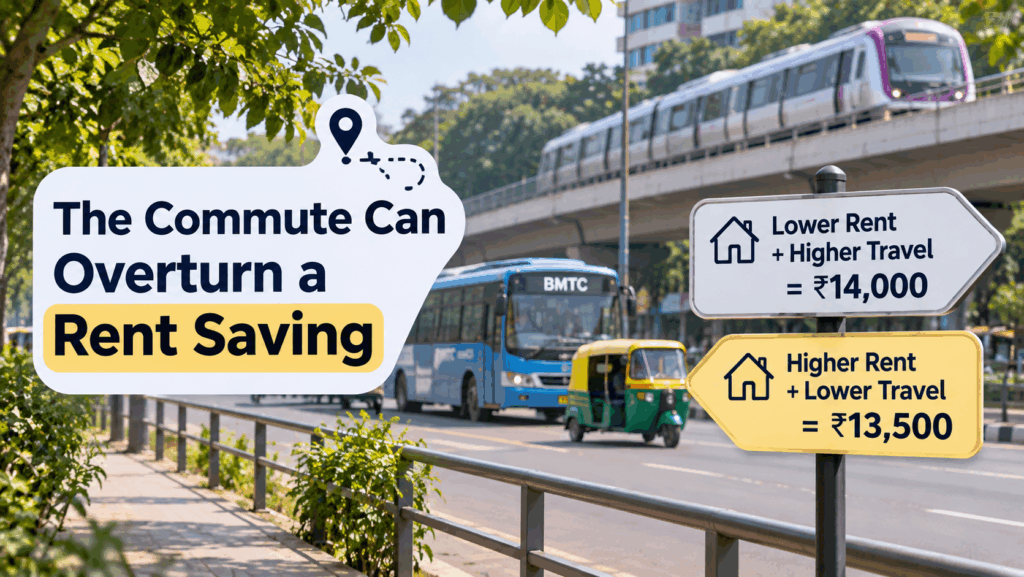
The commute can overturn a rent saving
Build travel from office or college days, return fares and last-mile costs. A ₹1,000–₹2,000 Metro allowance may fit some routes, not every daily journey. For example, a ₹100 return trip over 22 days costs ₹2,200 before autos or weekend travel.
Check your station pair through BMRCL’s fare information. Confirm that the route operates for your journey; do not choose accommodation around a proposed line or a station name without checking the actual access point.
For buses, the supplied ₹1,200 monthly-pass benchmark needs updating. November reporting on BMTC’s revision puts the ordinary monthly pass at ₹1,500. Confirm the current price, coverage and eligible concession through BMTC before buying; AC, extended-area and airport services can follow different arrangements.
When is the closer room actually cheaper?
Compare rent plus travel, not rent alone. In an illustrative choice, ₹10,000 rent plus ₹4,000 travel totals ₹14,000. A closer room at ₹12,000 plus ₹1,500 travel totals ₹13,500, saving ₹500 monthly despite higher rent.
Autos and cabs can add ₹3,000–₹5,000-plus to a routine, but even that may not cover frequent long trips. Check live quotes at your travel times and allow for occasional late returns. Time spent waiting and changing vehicles matters alongside the fare.
Hidden costs begin before the first month ends
A refundable deposit is not monthly consumption, but you must fund it upfront. Do not assume a uniform two-to-ten-month requirement across Bengaluru; get the actual quote and refund terms. RentOK’s deposit-refund guide explains why deposits and advance rent need separate records.
Using the ₹24,000 flat example, two residents splitting the ₹50,000 deposit need ₹25,000 each, plus their ₹12,000 first-month rent share. That is ₹37,000 each before other move-in expenses, assuming the agreed split. The listing does not establish every resident’s contractual liability.
Look beyond those two payments:
- Brokerage and documentation: Ask for the full quote, payment trigger and tax treatment. RentOK’s rental-brokerage guide helps distinguish an agent’s fee from rent and deposits.
- Furniture and connections: Budget for bedding, kitchen equipment, appliance rental, installation, delivery and eventual removal. “Semi-furnished” does not promise a mattress or washing machine.
- Service add-ons: Confirm water-tanker recovery, parking, laundry, mandatory maintenance and any joining charge. Ask what changes with consumption or renewal.
- Exit and overlap: Notice periods, lock-ins, moving charges and overlapping stays can affect your next move. Keep enough cash to avoid depending on an immediate deposit refund.
A ₹2,000–₹4,000 personal-spending allowance may cover modest outings and care, but medical needs, travel home and large purchases deserve separate reserves. Tuition and semester expenses also sit outside ordinary living costs.
Flatmates should also agree what happens when someone leaves. An equal rent split depends on the household arrangement; the landlord need not automatically reduce the whole-flat bill while you search for a replacement.
Which lower-cost areas can offer a workable commute?
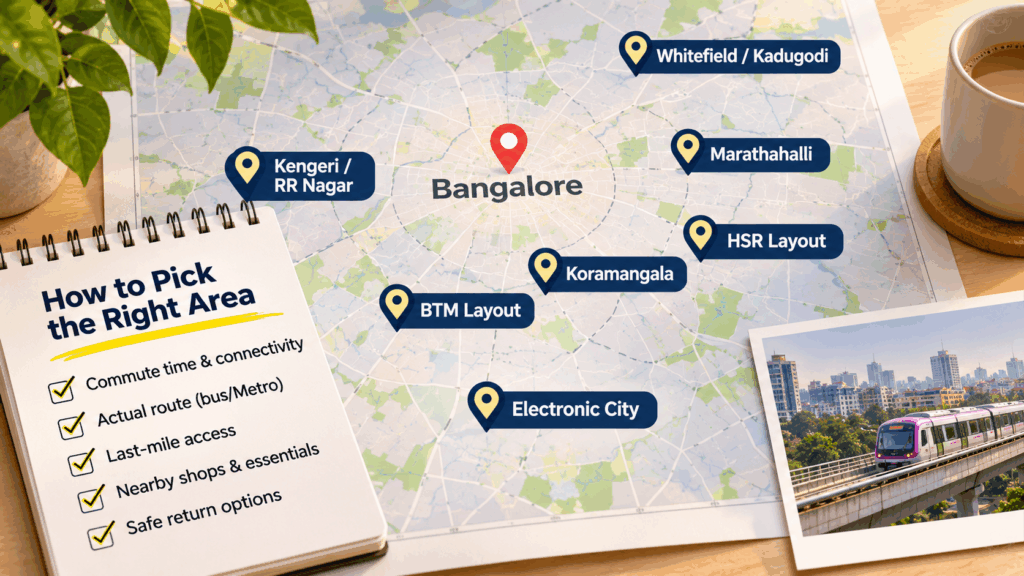
There is no single cheapest area with a good commute for everyone. Start with the exact campus gate or office entrance, then compare nearby rooms and public-transport alternatives. An area popular with freshers can still be expensive on the street closest to a major employer.
| Search area | The practical test |
|---|---|
| Electronic City | Compare the relevant phase, office gate and actual bus or Metro connection |
| Whitefield, Kadugodi or nearby pockets | Check station access and the final journey to the workplace |
| Marathahalli and surrounding pockets | Test the bus route, road crossing and peak-hour last mile |
| BTM Layout | Compare the precise college or work journey; do not assume every destination is nearby |
| Kengeri or RR Nagar pockets | Consider them when your west-side destination or operating transit route fits |
| Koramangala and HSR Layout | Compare specific offers; popularity and proximity do not guarantee budget rent |
These are search directions, not a rent ranking. Inspect the walking route, lighting, shops and return options. Check the trip at your reporting time, especially when the property advertises “near Metro” without explaining the walk.
For the first few months, a suitable PG with usable meals can reduce setup work while you learn the city. After tracking actual expenses, reconsider a flat with confirmed roommates. Lower rent helps only if the accommodation and daily routine remain workable.
How RentOK helps make Bangalore accommodation costs clearer
Accurate budgeting needs more than an advertised rent. At participating properties, RentOK helps owners maintain room information, resident charges and payment records, supporting clearer conversations with students and freshers about the accommodation they are considering.
- Present the right room category: Property websites can show rent, photos and facilities, while operators track sharing types and available beds. Confirm the exact room and inclusions before using the price in a budget.
- Keep recorded charges visible: Tenant ledgers and payment history help teams review rent and other dues. Residents should check that those records match the accepted package and retain their own copies.
- Organise regular collections: RentOK supports recurring bill addition and payment reminders, helping operators administer agreed charges consistently instead of relying on scattered messages.
- Review financial records: Reports help property teams monitor recorded collections, dues and expenses. They support administration rather than determine a fair market rent or guarantee savings for residents.
RentOK is a property-management platform, not a personal grocery planner or automatic flatmate expense-splitting service. Operators should explain mandatory extras and variable billing before booking, then keep the agreement and subsequent records consistent with that explanation.
Conclusion
The right Bangalore budget follows your housing choice and daily routine. Shared accommodation and usable meals can keep spending lower; private space, delivery-heavy eating and regular cabs can move it sharply upward. Treat the ₹25,000, ₹40,000 and ₹60,000 examples as choices to test against real quotes, not targets you must spend.
Compare the complete monthly bill, fund move-in separately and leave room for savings and irregular expenses. Check the commute before paying a token. For PG and shared-accommodation operators, start your free trial on RentOK to organise room details, dues and payment records so new residents can understand the costs behind their stay.
Frequently Asked Questions
Find answers to common questions about this topic
About the Author
Ishika Pannu
Ishika Pannu brings you the latest insights and easy-to-apply strategies in property management—helping you simplify renting and grow with RentOk.