Growth
How to Transition from Student Hostels to Corporate Co-living

Written by
Ishika Pannu
Read Time
8 min read
Posted on
April 30, 2026
Overview
Overview
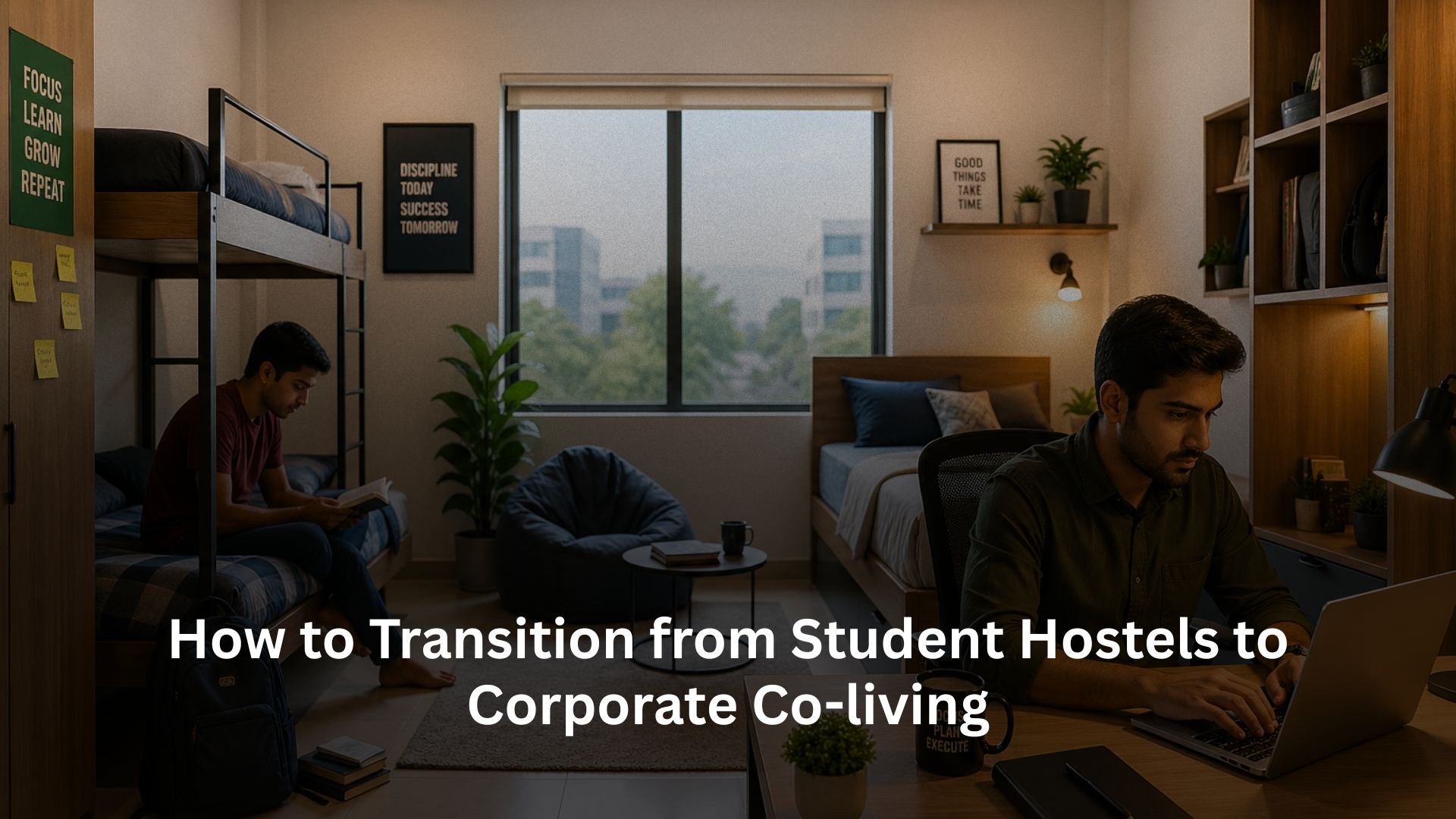
How to Transition from Student Hostels to Corporate Co-living
For most PG operators, student housing is where the journey begins. It is relatively predictable, demand follows academic cycles, and expectations are clearly defined around affordability and basic functionality. As a result, operations are typically designed for volume, not refinement.
However, over time, a visible shift begins to emerge. A growing segment of tenants, particularly working professionals, starts entering the same markets, but with very different expectations. Unlike students, they are not just looking for a place to stay; instead, they are evaluating how well a property supports their daily lifestyle.
Therefore, transitioning from student hostels to corporate co-living is not simply a change in tenant type. Rather, it is a structural shift in how your property is designed, operated, and experienced.
Understanding the Core Difference Between Student and Corporate Living
At first glance, both models may appear similar. After all, they provide accommodation in shared environments. However, when you look closer, the operational dynamics are fundamentally different.
Student housing typically revolves around:
- Seasonal occupancy cycles, where move-ins and move-outs are predictable but concentrated around academic timelines, making revenue patterns uneven
- Price-sensitive tenants, who prioritize affordability and location over convenience or service quality
- A higher tolerance for inconsistency, where delays or inefficiencies are often accepted as part of the experience
In contrast, corporate co-living operates on a different foundation:
- Longer and more stable stay durations, which reduce vacancy cycles and create predictable revenue streams
- A willingness to pay more, but only when the value is consistently delivered through experience
- Low tolerance for operational gaps, where even small delays or inconsistencies directly affect satisfaction
Because of this, the transition is not about replacing one audience with another. Instead, it is about aligning your operations with a more demanding, experience-driven tenant base.

Why This Transition Improves Business Stability
From a financial perspective, the shift toward corporate tenants changes the nature of your income.
Instead of constantly filling rooms, you begin retaining tenants for longer durations. Consequently, this reduces not only vacancy but also the time and effort spent on repeated onboarding.
In addition, corporate tenants contribute to higher lifetime value because:
- They tend to stay longer, which reduces churn and stabilizes occupancy over time
- They are more likely to opt for additional services, thereby increasing revenue per tenant
- They require less frequent replacement, which lowers marketing and acquisition costs
That said, these advantages only materialize when the experience matches expectations. Otherwise, higher-paying tenants simply leave faster, which defeats the purpose entirely.
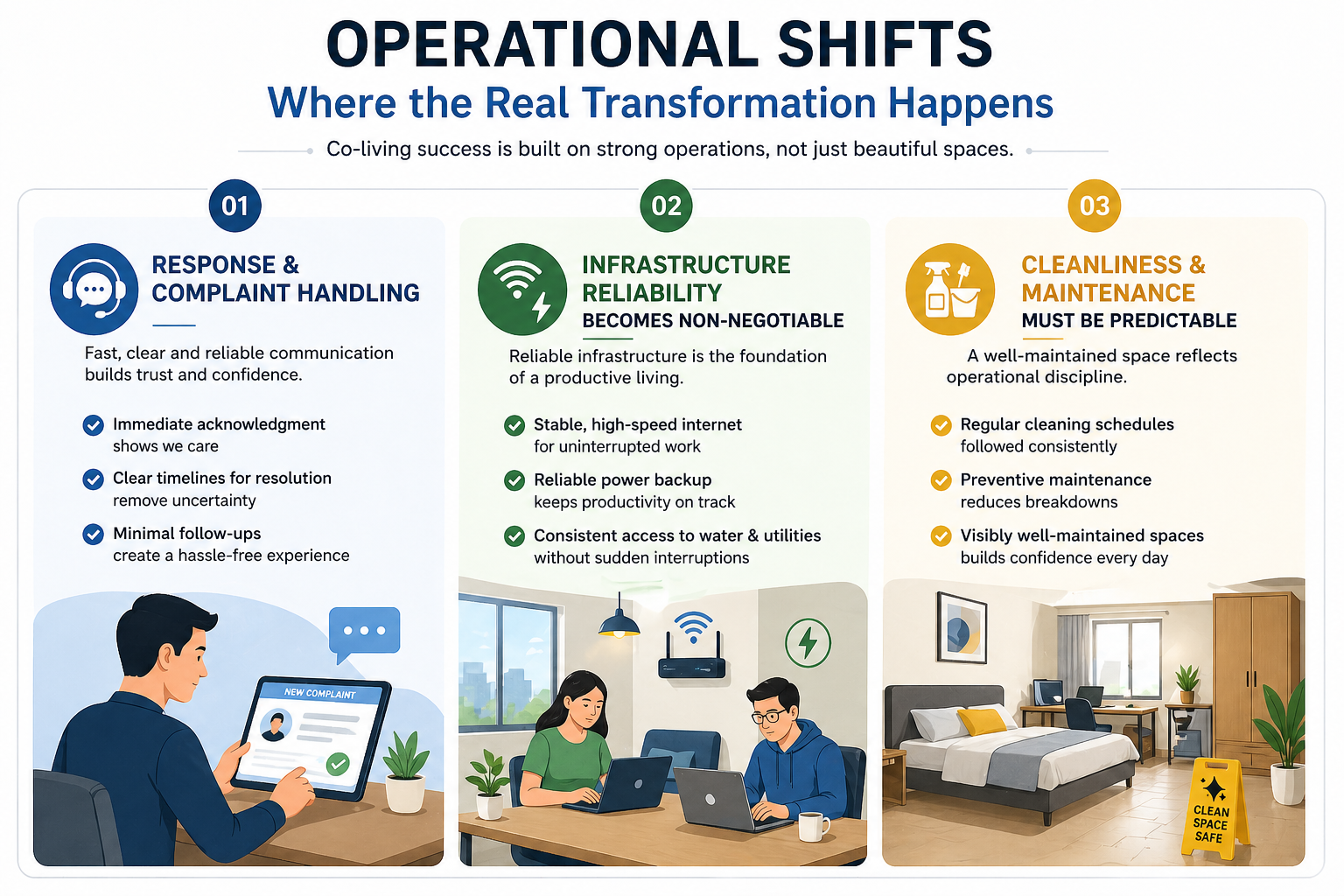
Operational Shifts: Where the Real Transformation Happens
Many operators assume that upgrading interiors is enough to attract corporate tenants. However, this is where most transitions fail.
In reality, co-living is defined far more by operations than by appearance.
Response and Complaint Handling
In student setups, delays are often tolerated. However, in a corporate environment, expectations are significantly higher.
Professionals expect:
- Immediate acknowledgment of issues, even if resolution takes time, because responsiveness signals control
- Clear timelines for resolution, so they are not left guessing about outcomes
- Minimal need for repeated follow-ups, as constant chasing reduces trust
Therefore, complaint handling must shift from informal coordination to a structured system. Without this, even minor issues escalate quickly.
Infrastructure Reliability Becomes Non-Negotiable
At the same time, infrastructure expectations also evolve.
While student housing may treat internet and utilities as features, corporate co-living treats them as essential infrastructure.
This includes:
- Stable, high-speed internet that supports uninterrupted work and communication
- Reliable power backup, ensuring that outages do not disrupt productivity
- Consistent access to water and utilities, without sudden interruptions or variability
Importantly, tenants are not impressed by occasional excellence. Instead, they value consistency. Even small disruptions can create disproportionate dissatisfaction.
Cleanliness and Maintenance Must Be Predictable
Similarly, maintenance standards must shift from reactive to proactive.
Corporate tenants expect:
- Regular cleaning schedules that are followed consistently, not occasionally
- Preventive maintenance that reduces breakdowns before they occur
- A visibly well-maintained environment that reflects operational discipline
As a result, consistency becomes more important than intensity. A system that works every day builds more trust than one that works occasionally but inconsistently.
Rethinking Space for Work-Integrated Living
Another critical shift lies in how tenants use space, and this is often overlooked during transitions.
Students typically use rooms for rest and basic activities. However, professionals use the same space for work, calls, and extended periods of focus. As a result, the expectations from the room change significantly.
Therefore, your property must adapt not just physically, but functionally.
This involves:
- Creating work-friendly zones or quiet areas that allow uninterrupted focus, especially during calls or deep work sessions
- Improving lighting conditions so the space remains comfortable for long hours of usage, not just visually adequate
- Reducing overcrowding to ensure tenants feel a sense of control, movement, and personal space
Ultimately, the goal is not to add luxury. Instead, it is to align the space with how it is actually used every day.
Marketing Strategy: Repositioning Your Property
As your operations evolve, your positioning must evolve as well. Otherwise, even meaningful improvements may go unnoticed by the right audience.
Earlier, your messaging may have focused on affordability and availability. However, corporate tenants respond to a different narrative, one centered around experience and reliability.
Your communication should emphasize:
- Ease of living, where everyday processes like payments and issue reporting feel simple and require minimal effort
- Reliability, where services function consistently without repeated follow-ups
- Structure, where systems are clear, communication is transparent, and expectations are predictable
In other words, you are no longer selling a room. You are offering a system that works, and that distinction drives better tenant decisions.
Pricing Strategy: Structuring Value Instead of Raising Rent
Naturally, corporate tenants are willing to pay more. However, increasing rent without improving experience creates resistance rather than growth.
Instead, a layered pricing approach works more effectively.
This means:
- Keeping base rent competitive, so entry remains accessible while staying aligned with the market
- Introducing optional services, allowing tenants to customize their experience instead of paying for bundled features
- Offering premium upgrades that create additional revenue without disrupting the core pricing structure
As a result, tenants feel they are paying for value and flexibility, not just higher pricing.
Managing the Transition Without Disrupting Operations
In most cases, the transition does not happen overnight. Instead, there is a phase where both student and corporate tenants coexist, creating a temporary gap in expectations.
During this period, structured execution becomes essential.
You should:
- Introduce upgrades gradually, ensuring improvements are visible but manageable from an operational standpoint
- Communicate changes clearly, so expectations remain aligned across different tenant groups
- Implement systems before scaling, ensuring operations can handle higher expectations consistently
By doing so, you reduce friction and allow the transition to happen smoothly rather than forcefully.
Where Most Operators Get It Wrong
Despite good intent, many transitions fail due to incomplete execution rather than lack of opportunity.
Common mistakes include:
- Focusing on visual upgrades while ignoring operational gaps, leading to a mismatch between appearance and experience
- Increasing rent prematurely without delivering measurable improvements in daily living
- Targeting professionals without changing underlying systems, resulting in poor tenant alignment
As a result, properties often attract better tenants initially but fail to retain them, which limits long-term growth.
Building a Co-living System That Scales
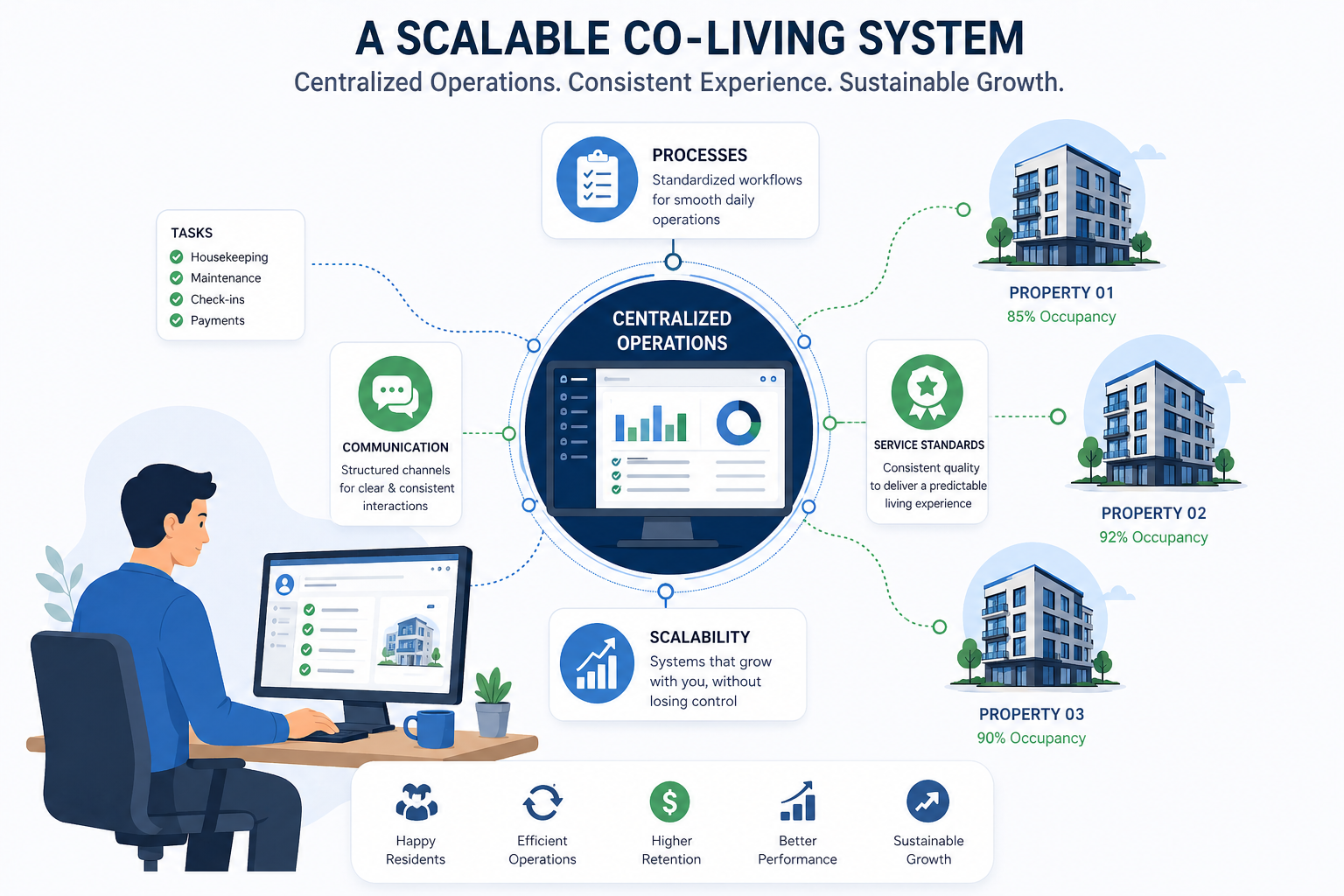
For long-term success, co-living must function as a system, not just a setup.
This requires:
- Clearly defined processes for daily operations, reducing dependency on manual effort or individual judgment
- Structured communication channels, ensuring clarity and consistency across all tenant interactions
- Consistent service standards, so experience remains predictable over time
- Scalable systems that allow expansion without losing control or quality
When these elements are in place, operations become stable, and growth becomes sustainable.
How RentOk Helps You Execute This Transition Effectively
As you move toward corporate co-living, operational complexity increases significantly. Managing tenants, services, and communication manually becomes inefficient and error-prone.
This is where RentOk enables a structured transition.
With RentOk, you can:
- Maintain organized tenant records that give you complete visibility across rooms and properties
- Track complaints systematically and ensure timely resolution, reducing follow-ups and delays
- Manage rent, dues, and communication in one place, eliminating confusion and inconsistencies
- Monitor day-to-day operations with clarity, ensuring that standards remain consistent
Because of this, your property shifts from reactive management to controlled operations, which is essential for meeting corporate tenant expectations.
Conclusion: From Accommodation to Experience-Led Living
Ultimately, transitioning to corporate co-living is not about changing your tenant base. Instead, it is about changing how your property operates.
The most successful operators are not those who invest heavily in aesthetics. Rather, they are the ones who build systems that deliver consistency, reliability, and ease of living.
If your current setup still relies on informal processes or reactive management, the transition will always remain incomplete. However, with the right structure in place, your property can evolve into a space that not only attracts better tenants but also retains them.
About the Author
Ishika Pannu
Ishika Pannu brings you the latest insights and easy-to-apply strategies in property management—helping you simplify renting and grow with RentOk.