Market Trends
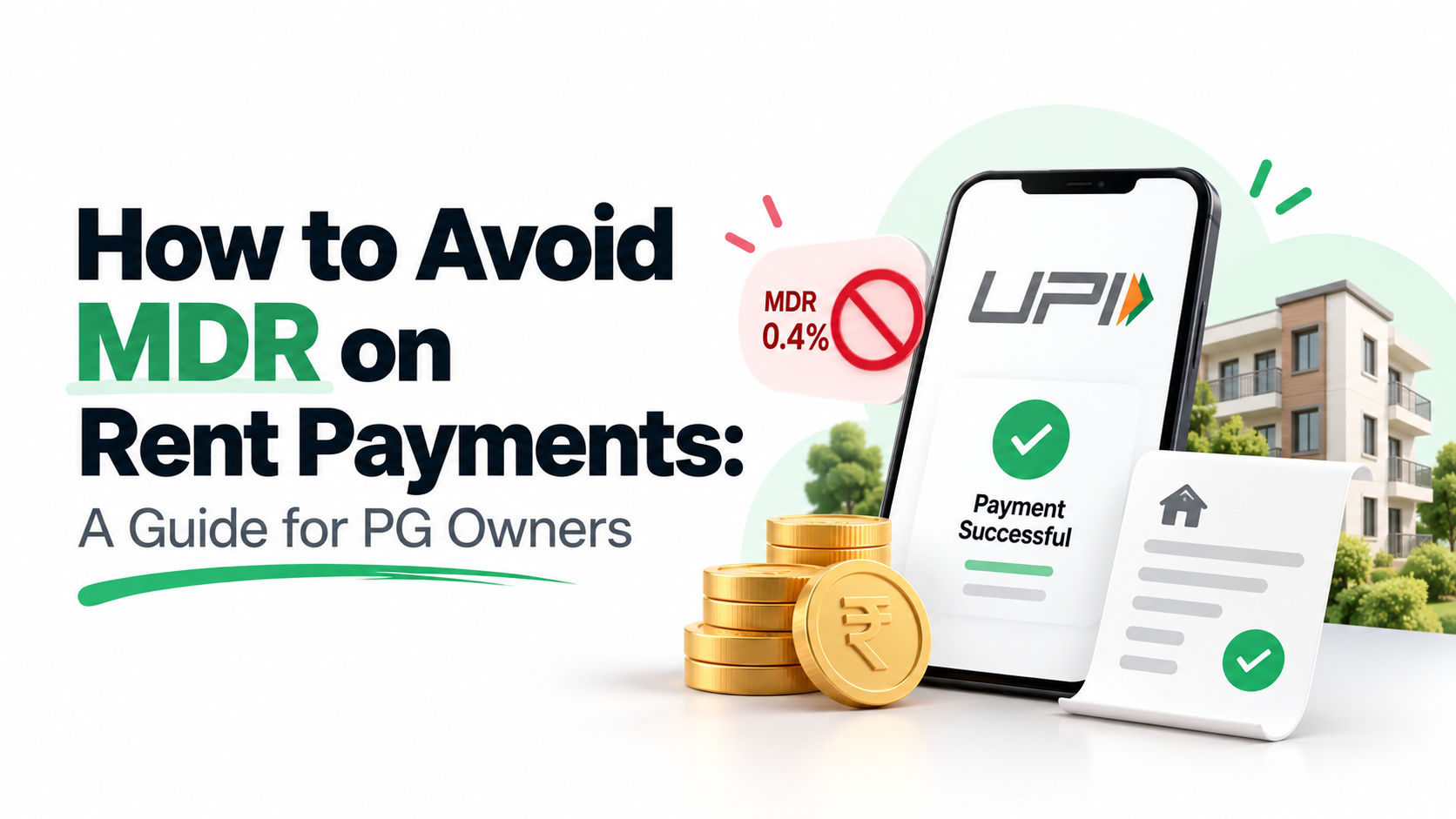
How to Avoid MDR on Rent Payments: A Guide for PG Owners

Written by
Shivanshi Dheer
Read Time
9 min read
Posted on
October 6, 2026
Overview
Overview
From 15 October 2026, most UPI rent payments above ₹2,000 will cost PG, hostel and co-living owners 0.4% + GST on every payment. Almost every monthly rent payment is above ₹2,000, so this new charge, called MDR, will apply to the majority of rent collected through UPI.
The good news is that there are simple, fully legal ways to avoid or reduce it. Rent collected through UPI AutoPay mandates carries no MDR, regardless of the amount, and RentOk offers several other low-cost and free ways for tenants to pay.
This guide explains what MDR is, how much it will cost a typical PG, whether it can be passed on to tenants, and the practical ways to avoid or reduce it.
What is MDR, and what changes from 15 October 2026?
MDR, or merchant discount rate, is a fee a business pays for accepting digital payments. It has applied to card payments for years, but UPI payments to businesses have been free until now.
On 15 September 2026, NPCI issued a circular introducing MDR on selected person-to-merchant (P2M) UPI payments, effective 15 October 2026. The key rules are:
| Payment type | MDR from 15 October 2026 |
|---|---|
| UPI payments to a business, up to ₹2,000 | Nil |
| UPI payments to a business, above ₹2,000 | 0.4% of the amount |
| UPI payments to a business, ₹75,000 and above | Capped at ₹300 per payment |
| UPI AutoPay and recurring mandates | Nil, at any amount |
| Person-to-person UPI transfers | Nil |
| Small merchants receiving up to ₹1 lakh a month through UPI QR | Nil |
The charge is paid by the business, not the person paying. For a PG owner, that means MDR is deducted from the rent you receive, and the amount settled to your account will be slightly lower than the rent the tenant paid.
How much will MDR cost a PG owner?
On a single payment, 0.4% looks small. Across every tenant, every month, it adds up quickly. The table below shows the cost if all rent is collected through regular UPI payments (QR codes or payment links).
| Property size | Average monthly rent | Monthly rent collected | MDR per month | MDR per year |
|---|---|---|---|---|
| 20 beds | ₹8,000 | ₹1,60,000 | ₹640 | ₹7,680 |
| 50 beds | ₹9,000 | ₹4,50,000 | ₹1,800 | ₹21,600 |
| 100 beds | ₹10,000 | ₹10,00,000 | ₹4,000 | ₹48,000 |
| 300 beds | ₹10,000 | ₹30,00,000 | ₹12,000 | ₹1,44,000 |
For an operator with 100 beds, that is nearly ₹50,000 a year in charges that did not exist before. These figures are 0.4% before GST. With 18% GST on the fee, a single UPI payment of ₹10,000 costs the owner about ₹47. Larger security deposits paid through UPI attract the same 0.4%, up to the ₹300 cap per payment.
Can you pass MDR on to your tenants?
No. NPCI has stated that merchants cannot pass MDR on to customers, who pay only the posted price. Adding a “UPI charge” or surcharge to a tenant’s bill for paying through UPI is therefore not allowed.
This means the cost stays with the owner unless the payment is made in a way that does not attract MDR in the first place. That is why the method of collection matters more than ever.
How to avoid MDR on rent payments
1. Collect rent through UPI AutoPay (the most effective option).
The Department of Financial Services has confirmed that automated recurring payments, known as UPI Mandates or AutoPay, do not carry the prescribed MDR. This applies to any amount. As a result, AutoPay is a natural fit for rent, because rent is a fixed, recurring monthly payment, exactly the kind of payment mandates exist for.
With AutoPay, the tenant approves a mandate once in their UPI app, and RentOk then debits the rent automatically each month on a fixed date. If a debit fails, RentOk retries it, so the owner no longer needs to chase payments.
What’s more, on RentOk, an AutoPay payment costs a flat ₹15, compared with about ₹47 for a regular UPI payment of ₹10,000. RentOk has negotiated this rate with its banking partners and keeps no margin on it.
2. Use e-NACH for higher rents
For monthly dues above ₹15,000, a bank-account mandate through e-NACH (auto bank debit) is a practical alternative. e-NACH runs on the National Automated Clearing House rather than on UPI, so the new UPI MDR framework does not apply to it. Just like AutoPay, the tenant approves it once, RentOk collects payments automatically, and the fee is ₹15 per payment.
3. Pay with a RuPay debit card.
Payments made with a RuPay debit card carry no charge at all, so the owner receives the full rent. Tenants might have a RuPay debit card from their bank.
4. Pay through a personal virtual account.
On RentOk, every tenant gets a personal virtual account. Tenants, or their parents, can pay by IMPS, NEFT or RTGS, and the money lands in the owner’s bank account, automatically marked as paid against the right tenant. Because these are bank transfers rather than UPI payments, they cost ₹15 per payment on RentOk instead of the UPI rate.
5. Pay in split, in parts of ₹2,000.
UPI payments of ₹2,000 or less carry no MDR. Tenants can pay their rent in parts of up to ₹2,000 each, free of charge, and RentOk records them as a single entry in the owner’s passbook.
6. Check whether you qualify as a small merchant.
Small merchants receiving up to ₹1 lakh a month through UPI QR into their bank account continue to pay zero MDR, regardless of the size of individual payments. This may help very small PGs, but most properties with more than about ten beds will cross the limit. Confirm your classification with your bank.
Compare the fee on each payment mode.
The more tenants who use the lower-cost modes, the more of the rent reaches you. The examples below are for rent of ₹10,000 collected through RentOk.
| Payment mode | Fee on ₹10,000 rent |
|---|---|
| Regular UPI (QR code or payment link) | About ₹47 |
| UPI AutoPay | ₹15 |
| e-NACH (auto bank debit) | ₹15 |
| Personal virtual account (IMPS, NEFT, RTGS) | ₹15 |
| RuPay debit card | ₹0 |
| Pay in split parts of ₹2,000 | ₹0 |
What does not work
- Adding a surcharge to tenants who pay by UPI. As covered above, the rules do not allow merchants to pass MDR on to customers.
- Going back to cash. It avoids MDR but brings back the problems digital payments solved: no automatic records, more handling, delays and disputes. On top of that, tenants pay ATM charges of ₹20 or more once they use up their free withdrawals.
How to move your tenants to AutoPay on RentOk
RentOk AutoPay supports both UPI AutoPay (for dues up to ₹15,000) and e-NACH (for dues above ₹15,000), so every tenant can be How to move your tenants to AutoPay on RentOk
RentOk AutoPay supports both UPI AutoPay (for dues up to ₹15,000) and e-NACH (for dues above ₹15,000), so you can cover every tenant.
- Turn on AutoPay for your property. In the RentOk Manager app, open Dues & Payment Settings and tap Enable AutoPay. Choose whether AutoPay is mandatory and which tenants are eligible, then save.
- Send reminders to all tenants in one tap. RentOk sends each tenant a link to set up AutoPay, so you don’t have to follow up individually.
- Tenants approve once. Each tenant picks what AutoPay should cover (all dues or rent only), chooses a date, and approves in PhonePe, Google Pay, Paytm, BHIM or through their bank account.
- RentOk collects rent automatically every month. It notifies tenants 24 hours before each debit, marks payments as paid, and sends receipts automatically.
Meanwhile, new tenants can set up AutoPay during online check-in, so they start on AutoPay from their first month. For a complete walkthrough, read our guide to RentOk AutoPay.
Switch before 15 October
MDR will apply to regular UPI rent payments from 15 October 2026, and the cost cannot be passed on to tenants. Moving your tenants to AutoPay is the simplest way to keep receiving your full rent, while also ending the monthly cycle of reminders and follow-ups.
If you already use RentOk, turn on AutoPay in the Manager app today and send reminders to all your tenants in one tap. New to RentOk? Visit the RentOk AutoPay page to book a demo.
Frequently Asked Questions
Find answers to common questions about this topic
About the Author
Shivanshi Dheer
Shivanshi Dheer sharing actionable strategies and information on PG/hostel management to help simplify renting and scale with RentOk.
You may also like these
Related Articles
1 min read
RentOk AutoPay & e-NACH for Automatic Rent Collection
Written by
Posted on
Shivanshi Dheer
Oct 6, 2026
1 min read
What’s Included in My Rent and What Am I Paying Extra For?
Written by
Posted on
Ishika Pannu
Sep 30, 2026

1 min read
Which Indian City Gives Landlords the Best Rental Yield Right Now?
Written by
Posted on
Ishika Pannu
Sep 28, 2026
1 min read
How Much Can My Landlord Legally Increase My Rent Each Year?
Written by
Posted on
Ishika Pannu
Sep 23, 2026

1 min read
India’s Rental Market Grows 16%: What Owners Should Know
Written by
Posted on
Ishika Pannu
Sep 22, 2026
1 min read
Why Landlords Check CIBIL Scores Before Renting
Written by
Posted on
Ishika Pannu
Sep 21, 2026
1 min read
Why Students Need Tenant Verification Done Before Moving Into a PG
Written by
Posted on
Ishika Pannu
Sep 14, 2026
1 min read
What to Do When Your Landlord Won’t Make Repairs
Written by
Posted on
Ishika Pannu
Sep 12, 2026
1 min read
Satya Niketan Building Collapse: What Happened in Detail?
Written by
Posted on
Shivanshi Dheer
Sep 9, 2026
1 min read
Why Your Rent Agreement Must Be Registered – And How to Do It
Written by
Posted on
Shivanshi Dheer
Aug 21, 2026
Stay ahead in property management with expert insights
Join thousands of property managers receiving exclusive tips delivered straight to your inbox.
Browse posts by category
Case Study
Cost of Living
Growth
Legal
Market Trends
News
Pg owner app
Property Management
Property Tax
Tech
RentOk
The easiest way to rent and manage your PGs and hostels.
Grievance Officer
Get the app


Contact us
hello@eazyapp.tech
HQ Office
COGROW, BASEMENT F-12/8A
BESIDE HOUSE OF STYLE SALON, SECTOR 28, DLF PHASE 1
GURUGRAM, HARYANA - 122002
South India Office
LUMIODESK COWORKING, 2ND FLOOR, 40, 14TH MAIN RD
BESIDE MC DONALD, 7TH SECTOR, HSR LAYOUT
BENGALURU, KARNATAKA - 560102
©️ 2026 EazyApp Tech Pvt Ltd. All rights reserved


