
Market Trends
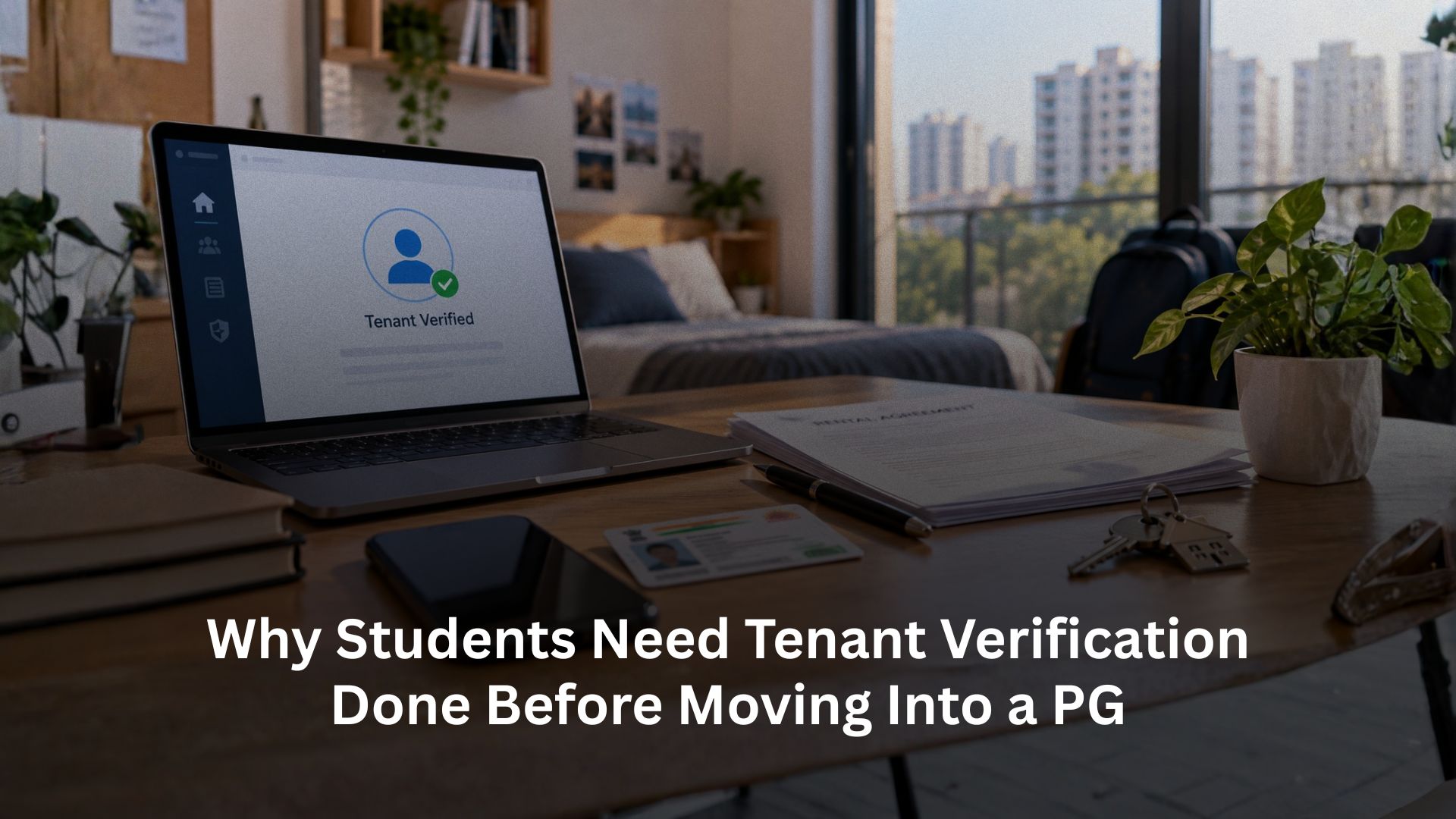
Why Students Need Tenant Verification Done Before Moving Into a PG

Written by
Ishika Pannu
Read Time
15 min read
Posted on
September 14, 2026
Overview
Overview
Why Students Need Tenant Verification Done Before Moving Into a PG
Moving to a new city for college is often a student’s first experience of living away from home. Finding a suitable PG becomes one of the first things on the checklist. Location, rent, food, amenities, and safety usually get most of the attention.
There is another part of moving in that deserves equal attention: tenant verification.
For students, the process can sometimes feel confusing. They could be moving from another city or state and may not have local address proof yet. For many, it can also be confusing to understand which documents a PG owner expects them to submit. Being unfamiliar with the process can make finding and moving into a PG more stressful than it needs to be.
At the same time, PG owners have a responsibility to maintain accurate tenant records. This becomes even more important when a property houses dozens of students who move in and out during the academic year.
Tenant verification is therefore not just a paperwork exercise. It creates a reliable connection between the tenant, the property, and the information provided during onboarding.
However, there is one important distinction to understand. Tenant verification requirements are not identical across India. The applicable process can depend on the state, city, police jurisdiction, and type of accommodation.
Some police departments provide dedicated tenant or PG verification services. Others have different procedures for submitting tenant information. This is why both students and PG owners should follow the process applicable to their specific location.
For students moving to a new city, understanding this process before handing over documents can make the entire move-in experience much smoother.
Why does tenant verification matter for students?
A student living in a PG is still a resident of that property. The fact that the person is studying rather than working does not remove the need for proper tenant records where verification is required.
This becomes particularly relevant in student-heavy cities. A single PG may have residents from several different states. Each student can have a different permanent address, college, emergency contact, and move-in date.
A structured verification process helps connect these details.
For the PG owner, it creates a clearer record of who is occupying the property. For the student, it provides greater clarity around the information submitted during the rental process.
The process also becomes easier to manage when verification is treated as part of onboarding rather than a task that is remembered later.
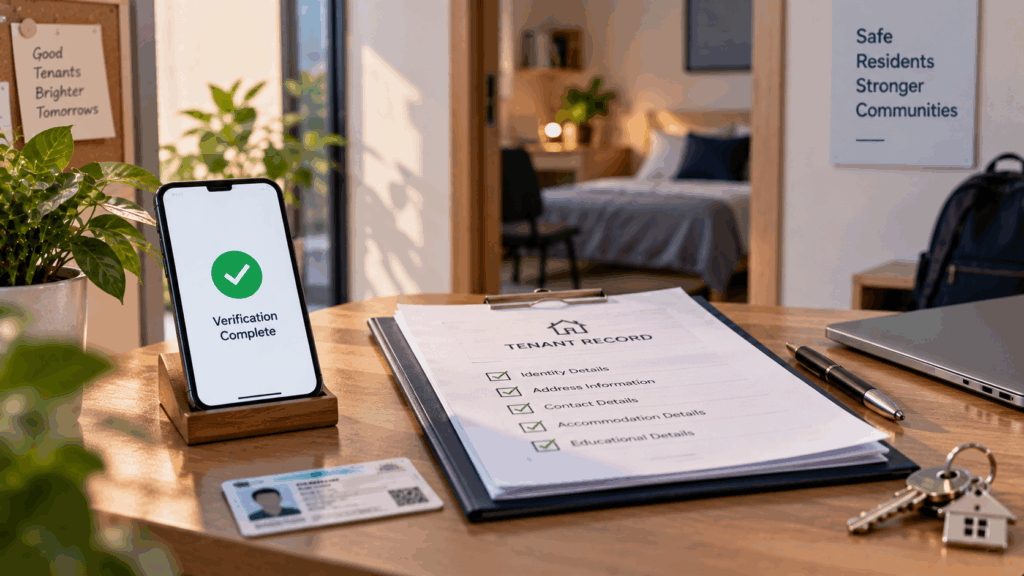
A typical student tenant record may involve:
- Identity information: This establishes who the student is and connects their personal details with the accommodation they are renting.
- Permanent and current addresses: A student’s family home may be in another city, while the PG becomes their current residential address during college.
- Contact information: Phone numbers and other relevant contact details help maintain a reliable tenant record throughout the stay.
- Accommodation details: The student’s information should be connected to the specific PG, building, room, or bed where applicable.
- College or educational details: Depending on the local verification process, information about the student’s college or educational institution may also be requested.
The exact requirements can vary. Students should therefore avoid assuming that a document list used by a friend in another city will automatically apply to them.
RentOk’s recent guide on what documents are required for tenant police verification provides a useful overview of the documents that may commonly form part of a tenant verification record.

What documents do students usually need?
The documents required for student tenant verification depend on the local process. There is no single checklist that applies in exactly the same way to every PG across India.
Still, students can expect the process to involve basic identity and residential information.
A government-issued identity document is usually an important starting point. Depending on the applicable procedure, students may also need to provide photographs, address details, contact information, and property-related information.
Some verification processes may also ask for educational or occupation-related details.
The important thing is not to collect every possible document simply because it might be useful. The student and PG owner should identify what the applicable authority actually requires.
This is especially important because identity proof and address proof are not necessarily the same thing.
An identity document establishes who the student is. It does not automatically prove that the student has been living at the PG for a particular period.
Similarly, a permanent address is not the same as a current address.
Understanding this distinction can prevent confusion during onboarding.
Keep the information consistent
Students should check that the information provided across their documents and forms is consistent. A small spelling difference in a name or an incomplete address may create unnecessary clarification later.
Before submitting the information, students should check:
- Whether their name is entered correctly across the required forms and documents.
- Whether the permanent address includes the relevant city, district, state, and other requested details.
- Whether the current PG address is complete and matches the actual property where they will be staying.
- Whether the phone number and other contact information provided to the PG are current.
- Whether any additional college or emergency-contact information requested by the applicable process has been provided accurately.
These checks take very little time. They can, however, prevent avoidable back-and-forth during the move-in process.
What if a student does not have a local address proof?
This is one of the biggest concerns for students moving to a new city.
Consider a student from Lucknow who moves to Delhi for college. Their permanent address is still their family home in Lucknow. They have just moved into a PG near their university.
Naturally, they may not have a Delhi electricity bill or another traditional document showing a long history at their new address.
That does not mean they should provide incorrect information.
The correct approach is to clearly distinguish between the permanent address and the current address.
The permanent address can remain the student’s family address. The PG can be recorded as the current place of residence, wherever the applicable verification process requires it.
Some official verification formats specifically distinguish between present and permanent residence details. The information required will still depend on the relevant jurisdiction.
Students should therefore speak to the PG manager if they are unsure about the required document.
They should not:
- Enter a friend’s or relative’s local address simply because it is easier to provide.
- Change their permanent address to the PG address when the form specifically asks for permanent residence.
- Submit documents that do not belong to them.
- Assume that the lack of local address history makes verification impossible.
Instead, students should explain their situation and ask what alternative information or documentation is accepted under the applicable process.
RentOk’s guide on tenant police verification and its document requirements also explains why the required documents can differ by location and how tenant information forms part of the wider verification process.
Why the process can differ from one city to another
One of the most important things to understand about tenant verification is that India does not operate one identical verification workflow for every rental property.
The responsible police authority may differ. The form may differ. The online portal may differ. Even the information requested can vary.
This matters for students because many of them move between cities for education.
A student may have heard that their friend completed verification through an online portal in one city. That does not mean the same procedure applies to their new PG.
For PG owners, the issue becomes even more important when properties are spread across multiple cities.
A professional operator should identify the applicable local procedure instead of relying on a generic checklist.
For example, RentOk’s state-by-state guide to online tenant police verification explains why landlords need to check the police or government process applicable to the property’s location.
This location-based approach helps avoid one of the most common compliance mistakes: assuming that a process followed successfully in one city will automatically work somewhere else.
How PG owners handle student verification
From a PG owner’s perspective, student verification becomes more complicated as occupancy increases.
Imagine a 100-bed PG near a university. During the beginning of an academic session, several students may move in within the same week.
Each student can have different documents and different permanent addresses. Some may have moved from another state. Others may already live locally.
If verification is handled through scattered WhatsApp messages and paper files, keeping track of every tenant quickly becomes difficult.
A structured process should begin during onboarding.
The PG team should know what information needs to be collected, which documents are missing, and whether the verification process has been initiated.
A practical workflow can include:
- Collecting tenant information during onboarding: Student details should be captured as part of the move-in process instead of being requested repeatedly later.
- Checking document completeness: The property team should identify missing information before the tenant file is considered complete.
- Following the local verification process: The PG should use the relevant police or government procedure for the property’s location.
- Recording the verification status: Management should be able to see whether verification is pending, submitted, completed, or requires further action.
- Keeping the record connected to occupancy: The tenant’s verification information should remain associated with the relevant property and occupancy record.
This becomes especially useful when staff members change or multiple people manage different parts of the property.
A verification process should not depend on one employee remembering what happened several months ago.

Why verification should be part of the move-in process
One of the biggest operational mistakes PG operators can make is treating verification as a separate activity.
A student moves in. Rent is collected, the room is assigned, and the agreement is signed. Then someone remembers that verification still needs to be completed.
By that point, the tenant’s information may already be spread across different systems.
A better approach is to make verification part of the onboarding workflow itself.
The process can then move in a clear sequence:
Tenant details → KYC/document collection → agreement → verification → room allocation → move-in
The exact order may vary by property and local requirements. The important part is that every stage has a defined place.
This approach also makes it easier to identify incomplete tenant files.
RentOk’s article on digital KYC for PG owners is relevant here because KYC and police verification are different processes, but both can form part of a structured tenant onboarding system.
When these processes are organized from the beginning, students receive clearer instructions and property managers spend less time chasing missing information.
What should students check before submitting their documents?
Tenant verification is not only the responsibility of the PG owner.
Students are also sharing personal information during the rental process. They should therefore understand what they are submitting and why.
Before handing over documents, students should ask the PG manager what information is required for the onboarding or verification process.
They should also make sure that the property itself is clearly identified.
A student should ideally know:
- The full name and address of the PG or accommodation, so their current residence is recorded correctly.
- Which documents are being collected, rather than sending every personal document available without understanding the requirement.
- Whether the rental agreement has been prepared, and whether the terms match what was discussed before booking.
- Who is responsible for the verification submission, especially when the PG collects documents on behalf of the tenant.
- How the submitted information is handled, since identity and contact information should be managed responsibly.
Students should also retain copies of important rental documents and payment records.
This is particularly useful if there is a dispute later about the tenancy, deposit, notice period, or move-out date.
Verification is therefore not something students should fear. A transparent process can actually be a positive sign that the PG has a structured approach to tenant management.
What happens when verification is handled manually?
Manual processes may work when a property has only a few tenants.
The problems become more visible when the number of residents increases.
A PG with 10 tenants may be able to maintain a spreadsheet without much difficulty. A property with 100 or 500 residents needs a more structured system.
Manual verification can create several operational problems.
A staff member may forget to submit a tenant’s information. Another employee may not know whether a document has already been collected. A verification acknowledgement may remain buried in an email.
The problem is not always the lack of effort. It is the lack of visibility.
This is why digital property management systems are becoming more relevant for PG and hostel operators.
A strong system should help the team answer simple questions quickly:
Has the tenant submitted the required information?
Is anything missing?
Has verification been initiated?
What is the current status?
Which property and room is associated with the tenant?
When these answers are available in one place, the management team spends less time searching for information.
RentOk’s guide to tenant verification workflows also highlights the importance of standardization, visibility, centralized records, and jurisdiction awareness for professional rental operations.
Verification is also about building trust
There is another reason student verification matters.
It can influence how students perceive the PG from the very beginning.
A property that clearly explains its onboarding requirements creates a different experience from one that suddenly asks for documents through multiple WhatsApp messages without any explanation.
Professionalism is visible in small processes.
When the PG clearly explains what is required, keeps records organized, and communicates the next steps, students are more likely to feel that their accommodation is being managed properly.
The same principle applies to personal information.
Students should expect PG operators to handle their documents responsibly. Operators, in turn, should avoid collecting unnecessary information simply because it is convenient.
Verification should create clarity, not confusion.
For operators looking at the wider issue of identity checks, RentOk’s article on how to spot a fake ID during tenant verification provides another useful perspective on why verification needs a defined process rather than depending entirely on individual judgment.
How RentOk Helps With Student Tenant Verification
Managing student tenants becomes difficult when KYC documents, agreements, occupancy records, payments, and verification information are maintained separately. RentOk helps PG and hostel operators bring key tenant-management activities into a more organized digital workflow.
Instead of relying entirely on spreadsheets, paper records, or scattered conversations, operators can maintain better visibility over tenant information and onboarding activity. This is particularly useful for student-focused properties where many residents may move in around the same academic period.
RentOk also supports digital KYC and tenant verification workflows, helping operators reduce repetitive administrative work and maintain more structured tenant records. Its tenant police verification workflow is designed to connect tenant information with the verification process, making compliance easier to manage as the property grows.
For a PG owner, the real benefit is not simply completing one verification. It is creating a repeatable process that works for the next tenant, the next room, and eventually the next property.
Conclusion
For students moving to a new city, tenant verification should be viewed as a normal part of responsible PG onboarding. It helps establish a clearer record of who is living at the property and connects the tenant with the accommodation they have chosen.
The exact requirements can vary by location. Students should therefore follow the process applicable to their city and provide accurate information rather than trying to create documents or addresses they do not have.
For PG owners, the bigger challenge is consistency. Verification becomes harder when tenant information is scattered across files, spreadsheets, and conversations. A structured onboarding process can make the experience easier for both the property team and the student.
The right PG should not make verification feel like unnecessary paperwork. It should make the process clear, organized, and easy to understand from the beginning.
Find Verified Student PGs on RentOk and explore student accommodation where a more structured rental experience starts from the move-in process itself.
Frequently Asked Questions
Find answers to common questions about this topic
About the Author
Ishika Pannu
Ishika Pannu brings you the latest insights and easy-to-apply strategies in property management—helping you simplify renting and grow with RentOk.
You may also like these
Related Articles

1 min read
What to Do When Your Landlord Won’t Make Repairs
Written by
Posted on
Ishika Pannu
Sep 12, 2026

1 min read
Satya Niketan Building Collapse: What Happened in Detail?
Written by
Posted on
Shivanshi Dheer
Sep 9, 2026

1 min read
Why Your Rent Agreement Must Be Registered – And How to Do It
Written by
Posted on
Shivanshi Dheer
Aug 21, 2026

1 min read
How to Invest in Property for Rental Income in India
Written by
Posted on
Shivanshi Dheer
Aug 20, 2026

1 min read
Semi-Furnished vs Fully Furnished: Which is Better for Renters?
Written by
Posted on
Shivanshi Dheer
Aug 20, 2026

1 min read
What is the Model Tenancy Act and How Does It Protect Landlords?
Written by
Posted on
Ishika Pannu
Aug 19, 2026

1 min read
RentOk vs TrackMyPG: An Honest Comparison for Indian PG Owners
Written by
Posted on
Ishika Pannu
Aug 12, 2026
1 min read
Pune Police Crackdown: What PG Owners Need to Know
Written by
Posted on
Ishika Pannu
Aug 10, 2026

1 min read
Why Occupancy Alone Doesn’t Explain Rental Success
Written by
Posted on
Ishika Pannu
Aug 7, 2026

1 min read
What Does RentOk Cost? A Plain-English Pricing Breakdown
Written by
Posted on
Ishika Pannu
Jul 29, 2026
Stay ahead in property management with expert insights
Join thousands of property managers receiving exclusive tips delivered straight to your inbox.
Browse posts by category
Case Study
Cost of Living
Growth
Legal
Market Trends
News
Pg owner app
Property Management
Property Tax
Tech
RentOk
The easiest way to rent and manage your PGs and hostels.
Get the app


Contact us
hello@eazyapp.tech
HQ Office
COGROW, BASEMENT F-12/8A
BESIDE HOUSE OF STYLE SALON, SECTOR 28, DLF PHASE 1
GURUGRAM, HARYANA - 122002
South India Office
LUMIODESK COWORKING, 2ND FLOOR, 40, 14TH MAIN RD
BESIDE MC DONALD, 7TH SECTOR, HSR LAYOUT
BENGALURU, KARNATAKA - 560102
©️ 2026 EazyApp Tech Pvt Ltd. All rights reserved


