
Market Trends
What to Do When Your Landlord Won’t Make Repairs

Written by
Ishika Pannu
Read Time
15 min read
Posted on
September 12, 2026
Overview
Overview
What to Do When Your Landlord Won’t Make Repairs
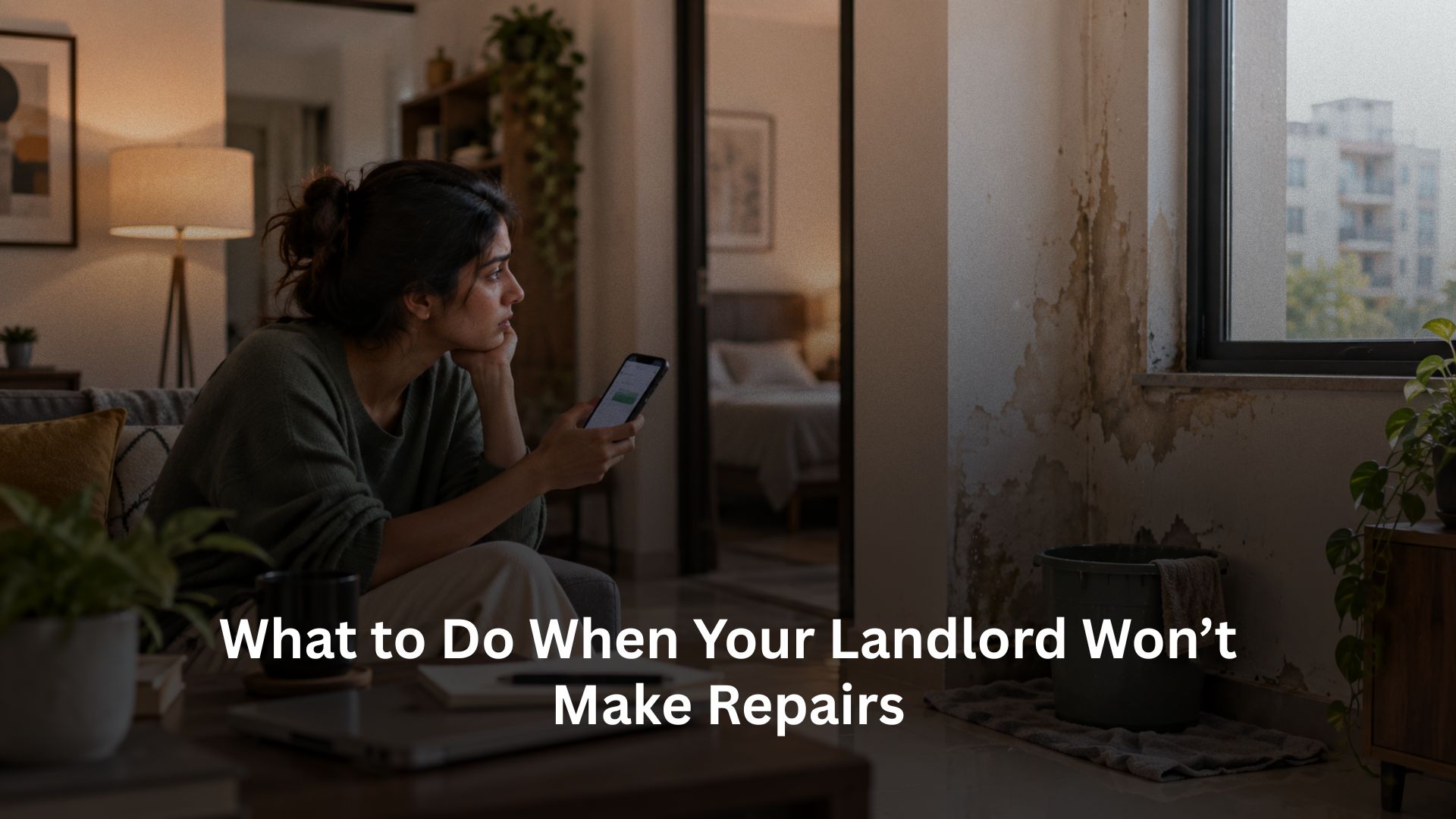
A leaking tap, faulty switch, broken lock, or water seepage can quickly become more than a minor inconvenience. The problem becomes worse when the landlord does not respond after being informed.
For tenants, the challenge is not only getting the repair completed. It is also understanding who is responsible, how to report the issue properly, what evidence to keep, and what to do when repeated requests are ignored.
Maintenance responsibilities can vary from one rental arrangement to another. The rent agreement may assign certain repairs to the landlord and others to the tenant. The nature of the damage also matters.
The Model Tenancy Act, 2021 provides a framework for repair and maintenance responsibilities. However, it is a model framework. It does not automatically govern every tenancy in India. The agreement and applicable state or local law must also be considered.
This makes the process important. A tenant should not immediately stop paying rent or arrange expensive repairs without checking the applicable rules.
Instead, follow a clear process. Review the agreement, identify responsibility, report the issue in writing, maintain a record, and escalate the matter when necessary.
What Are a Landlord’s Maintenance Obligations?
The first step is to determine who is responsible for the repair.
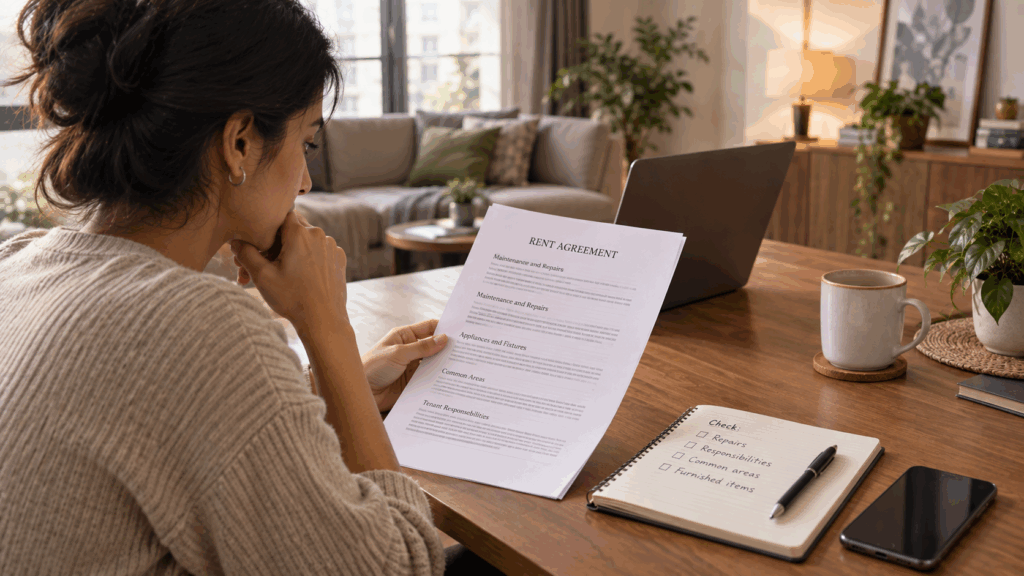
A rent agreement should ideally explain the division of maintenance responsibilities. It may cover routine repairs, structural issues, appliances, fixtures, common facilities, and tenant-caused damage.
The Model Tenancy Act follows a similar approach. Its repair provisions divide responsibilities between the landlord and tenant. They also allow the agreement to establish specific responsibilities.
This means tenants should not assume that every broken item is automatically the landlord’s responsibility.
For example, a major plumbing problem may be different from damage caused by careless use. Normal wear and tear should also be considered separately from deliberate or negligent damage.
Before sending a complaint, check the relevant clauses in your agreement. RentOk’s guide on how to read a rent agreement before signing explains why maintenance clauses deserve attention alongside deposits, notice periods, and termination conditions.
Some agreements also divide minor repairs between the parties. Others may have separate provisions for furnished properties or shared accommodation.
Before raising the issue, check for:
- Major repairs: See whether structural, plumbing, electrical, or other significant repairs are assigned to the landlord under the agreement.
- Minor maintenance: Some agreements place routine repairs or small replacements on the tenant. Check the actual wording before assuming responsibility.
- Tenant-caused damage: Damage caused by misuse or negligence may be treated differently from normal wear and tear.
- Shared facilities: Apartments, PGs, and co-living properties may have separate rules for common areas and shared services.
The goal is not to find someone to blame. It is to establish responsibility before deciding what action to take.
Start With a Written Maintenance Request
If you have only called the landlord, put the complaint in writing.
A written request creates a clear record of when the issue was reported. It also shows what you asked the landlord to do. This can become important if the problem continues or turns into a formal dispute.
Your first message does not need to sound like a legal notice. Keep it professional and specific.
Explain what has happened, when you noticed it, and how it is affecting your use of the property. Then ask for a clear action, such as an inspection or repair.
A useful maintenance request should cover:
- The exact problem: Describe the issue clearly. “The bathroom pipe is leaking continuously” is more useful than simply saying that there is a plumbing problem.
- When it started: Mention when you first noticed the issue. Also mention if you reported it earlier.
- The impact: Explain whether the problem affects normal use, causes damage, or creates a possible safety concern.
- The action required: Ask whether the landlord can arrange an inspection, technician visit, or repair.
Keep the original message and the landlord’s response.
If the landlord says that a technician will visit on a particular date, retain that communication too. If nobody arrives, the record becomes useful during your next follow-up.
The goal is not to make every conversation formal. It is to avoid a situation where both sides remember the same conversation differently.
Build a Proper Paper Trail
A maintenance complaint can change over time. A small leak may become serious water damage. A faulty electrical fitting may become a safety concern. A broken appliance may deteriorate further while the tenant waits.
This is why photographs and videos can be valuable.
Take clear photographs when the problem first appears. If the condition changes, document that change as well. Where possible, retain dated records so the timeline is easy to establish.
Your records should not stop at photographs. Keep the communication and financial details connected to the repair.
- Photographs and videos: Capture the affected area clearly. Include enough of the surrounding property to show where the problem is located.
- Messages and emails: Save maintenance requests, follow-ups, responses, and promised repair dates.
- Repair estimates: If a technician provides an estimate, retain the quotation. It can help establish what work was considered necessary.
- Invoices and payment records: If you are permitted to arrange a repair, keep the final bill and proof of payment.
- A simple timeline: Note when the problem started, when it was reported, and when follow-ups were made.
This documentation can become especially useful when a repair later affects the security deposit.
For example, if a landlord claims that a deduction is required because of damage, photographs from the relevant period can help establish the actual condition of the property.
RentOk’s guide on what to do if your landlord refuses to return your security deposit explains why payment records, property-condition evidence, and written communication can matter when rental disagreements arise.
Good documentation protects both sides. It gives the landlord a clearer picture of the issue. It also gives the tenant evidence of what was reported.
What If the Landlord Does Not Respond?
If your first request receives no response, send a follow-up instead of repeatedly making the same informal request.
Refer to the earlier message. Restate the problem briefly. Then ask the landlord to confirm when the issue will be inspected or repaired.
The urgency should depend on the problem.
A loose cupboard handle does not require the same response as a major water leak or serious electrical fault. If the issue creates a safety concern, state that clearly.
Tenants should also remain cooperative about access.
If the landlord arranges for a plumber, electrician, or other professional to inspect the property, confirm a suitable time. Keep the appointment details in writing.
The Model Tenancy Act also contains provisions concerning entry for repairs and inspections. Its framework provides for prior notice in specified circumstances.
This creates a useful principle for both parties.
The tenant should report the issue and provide reasonable access. The landlord should have a fair opportunity to inspect and address the problem.
If communication still fails, a formal notice may become appropriate.
When Should You Send a Legal Notice?
A legal notice is generally a later step. It may be appropriate when ordinary communication has failed or when the maintenance issue is serious.
It should not be the first response to every minor repair.
Before sending a notice, gather the relevant documents. This includes the agreement, maintenance requests, photographs, responses, estimates, and invoices.
The notice should focus on facts. Avoid exaggerated claims or unsupported legal threats.
It should explain what the problem is, when it was reported, and what action you are requesting. It can also provide a reasonable period for the landlord to respond.
For a significant dispute, getting legal advice can be useful.
A formal notice can include:
- The maintenance problem: Explain the issue accurately and state how it affects the property.
- Previous communication: Mention when you reported the issue and whether the landlord responded.
- The required action: State whether you are requesting an inspection, repair, replacement, or another specific remedy.
- A reasonable timeframe: Give the landlord an appropriate opportunity to respond based on the seriousness of the issue.
- The next step: Explain that you may consider remedies available under the agreement and applicable law if the issue remains unresolved.
A legal notice is meant to create clarity. It moves the matter from an informal request to a documented dispute.
Tenants should also understand the broader legal framework before escalating. RentOk’s guide on tenant rights under the Model Tenancy Act provides useful context on how the model framework approaches rental rights and responsibilities.

Can You Deduct Repair Costs From Rent?
This is one area where tenants need to be particularly careful.
A common assumption is that a tenant can simply arrange a repair and subtract the cost from the next month’s rent. That is not a blanket rule for every tenancy in India.
Section 108(f) of the Transfer of Property Act, 1882 provides a repair-related remedy in certain circumstances. Where the lessor neglects repairs they are bound to make after notice, the lessee may, subject to the provision’s conditions, make the repairs and deduct the expense from rent or otherwise recover it.
The Model Tenancy Act also provides a specific mechanism. Under its framework, a tenant may carry out certain repairs when the landlord refuses to do so. The framework allows the expense to be deducted from rent for succeeding months, subject to a limit of 50% of the agreed monthly rent in any one month.
However, the Model Tenancy Act is a model framework. Its provisions do not automatically apply to every tenancy in India.
Before making any deduction, check:
- Who is responsible: Confirm that the repair falls within the landlord’s responsibility under the agreement or applicable law.
- Written notice: Keep evidence that you informed the landlord and gave them an opportunity to act.
- Repair cost: Make sure the expense is reasonable and connected to the required repair.
- Applicable law: Identify the tenancy law that actually applies to the property.
- Supporting records: Keep estimates, invoices, photographs, and payment evidence.
Do not simply stop paying rent because a repair remains unresolved.
If the amount is substantial, obtain appropriate legal advice before adjusting rent. A maintenance dispute should not become a separate rent-default dispute.
Tenants who want to understand the importance of having clear contractual terms can also refer to RentOk’s guide to creating a legally valid rent agreement in India.
What If the Property Becomes Uninhabitable?
Some maintenance problems are inconvenient. Others can affect whether the property can reasonably be occupied.
Serious electrical hazards, major structural problems, severe water damage, or issues affecting essential facilities require greater attention than routine repairs.
The Model Tenancy Act addresses premises that become uninhabitable. Its framework provides a process where the landlord refuses required repairs after receiving written notice. In specified circumstances, the tenant may abandon the premises after giving the required notice.
This should not be treated as an automatic nationwide right.
The applicable law and tenancy agreement still matter. A tenant should therefore document the condition before deciding to vacate.
If the property has become unsafe, keep photographs, written complaints, inspection records, and any relevant professional reports. These records can help establish why the tenant considered the condition serious.
The distinction is important.
Leaving a property because of a serious habitability issue is very different from leaving because a minor repair was inconvenient. The response should match the seriousness of the problem.
This is also why keeping the rental agreement updated matters. RentOk’s article on rent agreement renewal and updating terms offers useful context on reviewing important tenancy conditions instead of relying on informal arrangements.
How Can You Escalate a Maintenance Dispute?
If repeated written requests do not resolve the issue, escalation may become necessary.
The correct route depends on the location of the property and the law governing the tenancy. The Model Tenancy Act provides for a Rent Authority and also establishes a Rent Court and Rent Tribunal structure under its framework.
However, tenants should not assume that every rental dispute automatically goes to a Rent Authority.
State and Union Territory rules can differ. The appropriate authority should therefore be identified before filing a complaint.
RentOk’s step-by-step guide to filing a rental dispute complaint in India can be useful when a maintenance issue has moved beyond ordinary communication. The important principle is to organise the facts and evidence before escalating the matter.
Before filing a complaint, organise your records.
- Rental agreement: Keep the complete agreement and identify the clause connected to the repair.
- Maintenance timeline: Record when the problem started and when each complaint was made.
- Communication history: Keep messages, emails, notices, and responses in one place.
- Property evidence: Preserve photographs, videos, inspection reports, and other relevant records.
- Financial records: Keep invoices and payment evidence if you incurred a legitimate repair-related expense.
The objective is to present the dispute as a clear sequence of events.
Good documentation does not guarantee a particular outcome. It does make the facts much easier to establish.
What Should Tenants Avoid During a Repair Dispute?
Frustration is understandable when a landlord ignores a genuine problem. But tenants should avoid taking actions that create a second dispute.
The most common mistake is assuming that an unresolved repair automatically allows the tenant to stop paying rent.
That can create a separate issue. The same applies to treating the security deposit as the final month’s rent or arranging major work without checking who is responsible for the cost.
A better approach is to keep the process controlled.
- Do not stop rent payments casually: Continue meeting your contractual obligations unless you have a clear legal or contractual basis for doing otherwise.
- Do not arrange major repairs without checking first: Confirm responsibility and, where appropriate, obtain written approval before spending significant amounts.
- Do not rely only on phone calls: Important maintenance requests should be recorded in writing.
- Do not ignore access arrangements: If an inspection or repair is scheduled, cooperate with reasonable arrangements.
- Do not destroy or alter evidence: Keep photographs, messages, invoices, and other records until the issue is fully resolved.
The goal is not to make the dispute more aggressive. It is to make it more organised.
A structured approach gives the tenant a stronger record. It also gives the landlord a reasonable opportunity to resolve the issue.

How RentOk Helps
Maintenance problems become harder to manage when rental information is scattered across calls, messages, documents, and payment records.
RentOk helps create a more structured rental management experience. Important tenancy information can be organised so that landlords and tenants have a clearer reference point when questions arise.
This matters because maintenance rarely remains a standalone issue. A repair can later affect the security deposit, property condition, payment records, or the move-out process.
For landlords and property managers, structured rental management can also make complaints easier to track. A maintenance request should not disappear inside a busy messaging conversation or depend entirely on someone’s memory.
RentOk’s content on how to handle maintenance requests in a PG shows how recording requests, assigning responsibility, tracking progress, and keeping tenants updated can improve maintenance management.
The same principle applies to rental properties more broadly.
A well-organised rental process creates better visibility for both sides. Tenants can refer to their rental information when an issue arises. Landlords can manage requests with greater consistency.
RentOk’s approach is therefore not only about responding after a dispute begins. It is about creating a more organised rental experience where agreements, payments, responsibilities, and communication can be managed with greater clarity.
Conclusion
When a landlord does not respond to a maintenance issue, ignoring the problem is rarely the best solution. Tenants should first understand their agreement, identify who is responsible, and report the issue clearly in writing. Keeping photographs, messages, invoices, and other records can also make a significant difference if the matter later becomes a dispute.
Most importantly, tenants should avoid making assumptions about withholding rent or deducting repair costs. The right course of action depends on the rental agreement and the law that applies to the tenancy.
A well-documented approach protects your interests while giving both sides a fair chance to resolve the problem. With the right information and proper records, even a difficult maintenance issue can be handled in a more structured and informed way.
Frequently Asked Questions
Find answers to common questions about this topic
About the Author
Ishika Pannu
Ishika Pannu brings you the latest insights and easy-to-apply strategies in property management—helping you simplify renting and grow with RentOk.
You may also like these
Related Articles
1 min read
Satya Niketan Building Collapse: What Happened in Detail?
Written by
Posted on
Shivanshi Dheer
Sep 9, 2026

1 min read
Why Your Rent Agreement Must Be Registered – And How to Do It
Written by
Posted on
Shivanshi Dheer
Aug 21, 2026

1 min read
How to Invest in Property for Rental Income in India
Written by
Posted on
Shivanshi Dheer
Aug 20, 2026
1 min read
Semi-Furnished vs Fully Furnished: Which is Better for Renters?
Written by
Posted on
Shivanshi Dheer
Aug 20, 2026

1 min read
What is the Model Tenancy Act and How Does It Protect Landlords?
Written by
Posted on
Ishika Pannu
Aug 19, 2026

1 min read
RentOk vs TrackMyPG: An Honest Comparison for Indian PG Owners
Written by
Posted on
Ishika Pannu
Aug 12, 2026
1 min read
Pune Police Crackdown: What PG Owners Need to Know
Written by
Posted on
Ishika Pannu
Aug 10, 2026

1 min read
Why Occupancy Alone Doesn’t Explain Rental Success
Written by
Posted on
Ishika Pannu
Aug 7, 2026

1 min read
What Does RentOk Cost? A Plain-English Pricing Breakdown
Written by
Posted on
Ishika Pannu
Jul 29, 2026

1 min read
PG in Lucknow: Growth, Demand, and How to Run One Profitably
Written by
Posted on
Ishika Pannu
Jul 27, 2026
Stay ahead in property management with expert insights
Join thousands of property managers receiving exclusive tips delivered straight to your inbox.
Browse posts by category
Case Study
Cost of Living
Growth
Legal
Market Trends
News
Pg owner app
Property Management
Property Tax
Tech
RentOk
The easiest way to rent and manage your PGs and hostels.
Get the app


Contact us
hello@eazyapp.tech
HQ Office
COGROW, BASEMENT F-12/8A
BESIDE HOUSE OF STYLE SALON, SECTOR 28, DLF PHASE 1
GURUGRAM, HARYANA - 122002
South India Office
LUMIODESK COWORKING, 2ND FLOOR, 40, 14TH MAIN RD
BESIDE MC DONALD, 7TH SECTOR, HSR LAYOUT
BENGALURU, KARNATAKA - 560102
©️ 2026 EazyApp Tech Pvt Ltd. All rights reserved


