
Market Trends
Satya Niketan Building Collapse: What Happened in Detail?

Written by
Shivanshi Dheer
Read Time
11 min read
Posted on
September 9, 2026
Overview
Overview
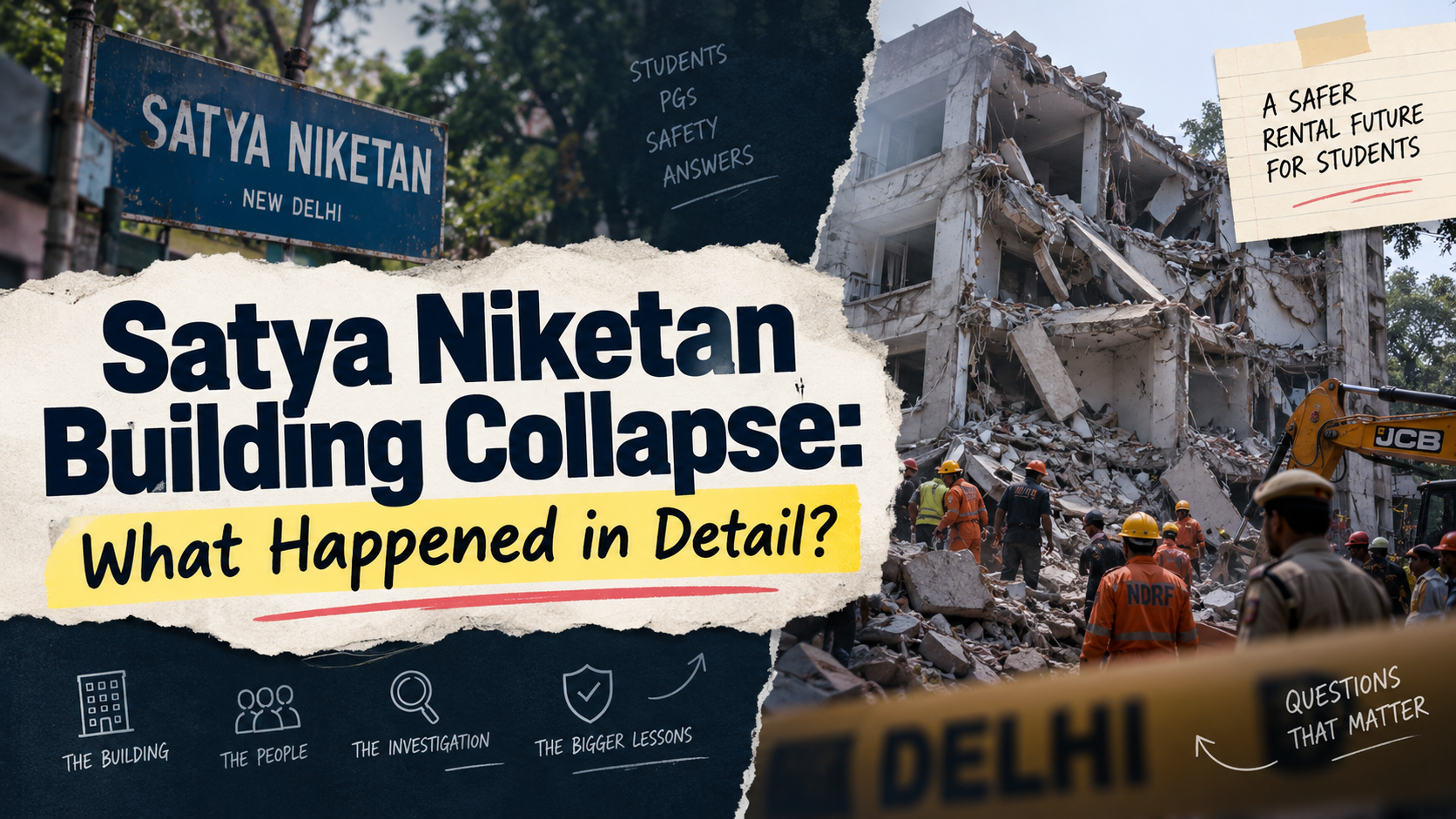
Satya Niketan Building Collapse: What Happened in Detail?
If you’ve ever searched for a PG in Delhi, chances are you’ve come across Satya Niketan. It’s close to Delhi University’s South Campus, packed with PGs, cafés, students and young professionals, and is one of those areas where location is a huge part of the appeal.
But on September 6, 2026, Satya Niketan made headlines for a very different reason.
A five-storey building being used as a boys’ PG collapsed, trapping people under the debris. The incident eventually claimed seven lives and led to a major investigation into the building, its ownership, the PG operators, construction and repair work, and the safety of similar properties in the area.
And naturally, a lot of questions followed.
Was the building old? Who owned it? Was it legally approved? Why did it collapse? Was the PG operator responsible? Is Satya Niketan safe for students?
Here’s what we know so far.
What happened in Satya Niketan?
On September 6, a five-storey building in Satya Niketan, South Delhi, suddenly collapsed. The property was being used as a boys’ PG/private hostel, meaning several students were living inside the building when it came down.
Rescue teams were sent in immediately, and people were pulled out from the debris. The rescue operation continued into the following day as teams searched for survivors and victims.
The death toll eventually reached seven, while several people were rescued.
The incident quickly became bigger than one building. Questions started being raised about the condition of older properties in Satya Niketan, the way PGs are operated, whether buildings are being modified without proper checks, and how often rental properties are actually inspected.
How old was the Satya Niketan building?
The building was reportedly around 50 years old, with some reports putting its age closer to 55 years.
But there’s an important point here: an old building is not automatically an unsafe building.
Buildings can remain safe for decades when they are properly constructed, maintained and regularly inspected. The bigger concern in this case is what happened to this particular building over the years — including its condition, modifications and repair work.
Investigators are looking into whether construction or repair activity may have affected the structural stability of the building.
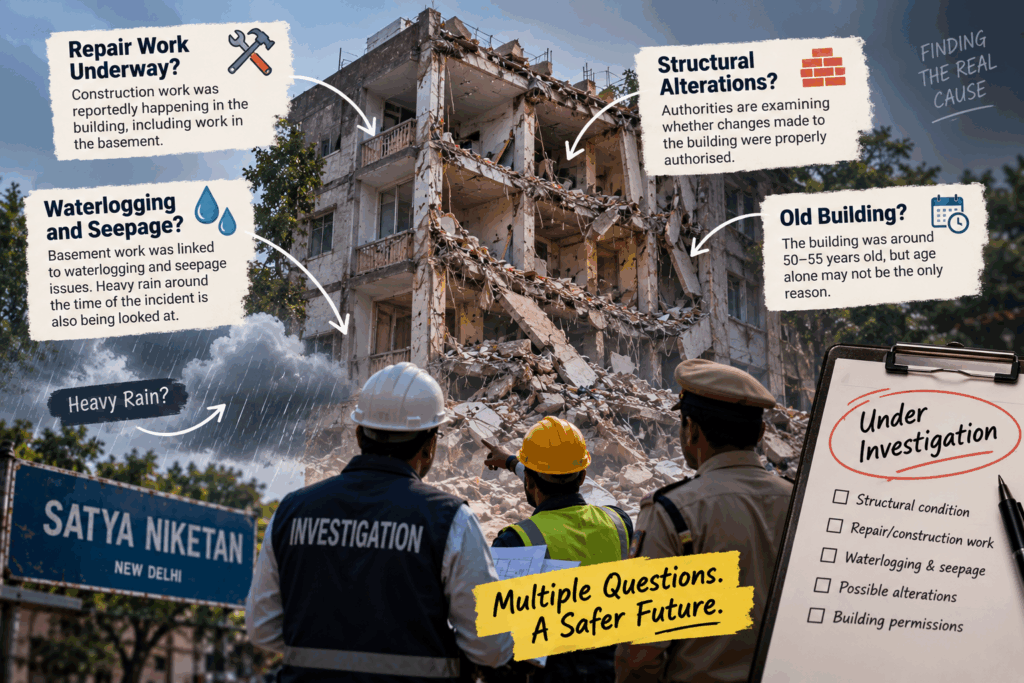
What caused the Satya Niketan building to collapse?
This is probably the biggest question — and there isn’t a final answer yet.
Investigators are looking at several possible factors rather than pointing to one confirmed cause.
One area of investigation is repair work that was reportedly happening in the building, including work in the basement related to waterlogging and seepage. The heavy rain around the time of the incident has also become part of the wider discussion.
Authorities are also examining possible structural alterations and whether changes made to the property were properly authorised.
So, saying “the building collapsed because of rain” or “the building collapsed because it was old” would be an oversimplification.
The more accurate answer is that investigators are examining the building’s structural condition, alterations and ongoing repair/construction work to understand what actually caused the collapse.
Who owned the Satya Niketan building?
This is where things can get a little confusing because the property owner and the PG operator were not the same thing.
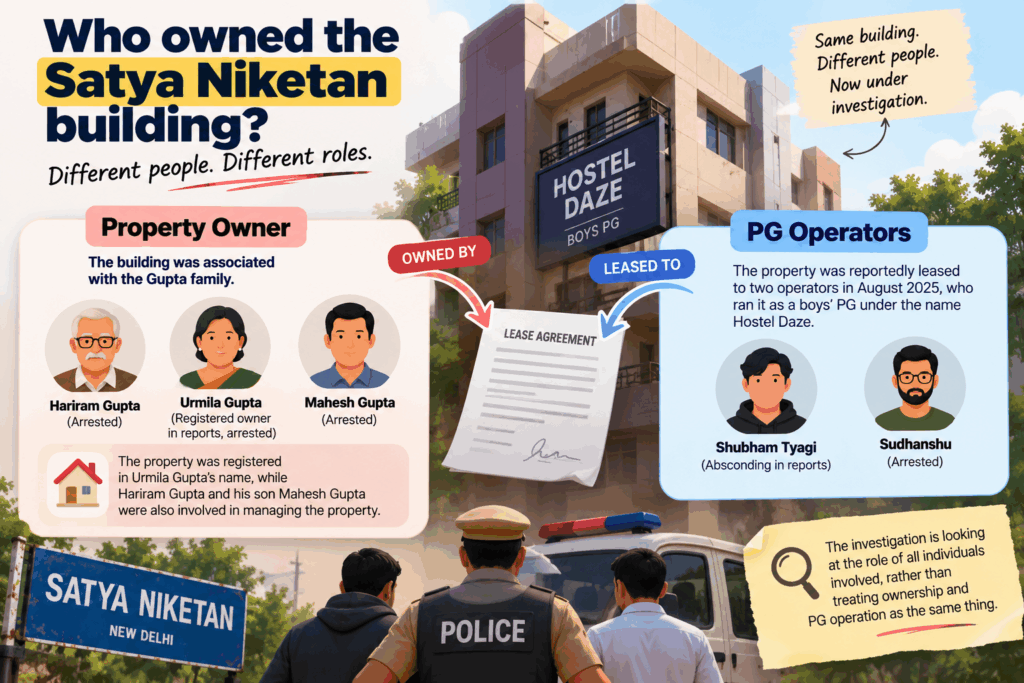
The property was associated with the Gupta family. Reports identify Urmila Gupta as the registered owner, while Hariram Gupta and his son Mahesh Gupta were also involved in managing the property.
All three were arrested as part of the investigation.
The property was reportedly leased to two PG operators, Shubham Tyagi and Sudhanshu, in August 2025. The operators then ran the property as a boys’ PG under the name Hostel Daze.
So if you’re searching for “Satya Niketan building owner”, “Satya Niketan PG owner” or “who operated the Satya Niketan hostel”, these are actually different questions.
Property owner: Gupta family / Urmila Gupta named as registered owner in reports.
PG operators: Shubham Tyagi and Sudhanshu.
The investigation is looking at the role of different people involved with the property rather than treating ownership and PG operation as the same thing.
Who was arrested in the Satya Niketan case?
The investigation has resulted in multiple arrests.
Hariram Gupta, Urmila Gupta and Mahesh Gupta — associated with ownership and management of the property — were arrested.
One of the PG operators, Sudhanshu, was also arrested. His business partner, Shubham Tyagi, was reported to be absconding at the time of the latest reports.
Police have also questioned or apprehended people involved in the construction and repair work connected with the property.
Exactly who is ultimately responsible is something that will be determined through the investigation and legal process. An arrest, by itself, should not be treated as a final finding of guilt.
Is Satya Niketan a posh area?
“Posh” is subjective, but Satya Niketan is definitely one of the popular and sought-after student neighbourhoods in South Delhi.
And there’s a pretty obvious reason for that: Delhi University South Campus is right there.
The area has become a major student-housing hub, with PGs, private hostels, rental flats, cafés, restaurants and plenty of everyday conveniences.
For students, living here can mean being much closer to college while also having access to a very active social and commercial area.
So yes, you’ll often see Satya Niketan described as a premium or popular locality.
But there’s an important distinction:
A popular neighbourhood does not mean every building in that neighbourhood is safe.
That’s one of the biggest things this incident has brought into focus.
What is Satya Niketan known for?
Satya Niketan is best known for being a student and PG hub near Delhi University’s South Campus.
Over the years, the locality has changed significantly. What was originally a residential neighbourhood has increasingly become a high-demand student accommodation market.
And when thousands of students are looking for rooms close to their colleges, properties naturally start adapting to that demand.
Small houses become PGs. Buildings get renovated. Additional rooms are created. Spaces get repurposed.
That isn’t necessarily a problem.
The problem begins when the way a building is being used changes faster than the safety checks around it.
Why do so many students live in Satya Niketan?
For most students, it comes down to three things:
Location. Price. Convenience.
Delhi University has a huge student population, but university hostel capacity is limited. That means a large number of students depend on private PGs, hostels and rental properties.
Satya Niketan happens to be extremely convenient for students studying around South Campus.
You can be close to college, find food easily, meet other students and have access to a huge rental market.
The downside is that when accommodation is in high demand, students may have to make quick decisions.
And sometimes, that means asking “Is there a room available?” before asking “Is this building actually safe?”
Was the collapsed building being used as a PG?
Yes.
The building was being used as a boys’ PG/private hostel and housed students at the time of the collapse.
According to reports, the property had been leased to PG operators in 2025 and was being operated as Hostel Daze.
This is particularly important because the building wasn’t simply a private residence. It was being used to house multiple people, which makes questions around occupancy, maintenance, emergency exits, fire safety and structural condition even more important.
Was the Satya Niketan building legally approved?
That is still part of the investigation.
Authorities and the courts are examining questions around the building’s sanctioned plans, construction, structural alterations and whether the property was being used in accordance with applicable permissions.
There have also been questions about modifications made to the building over time.
But these are areas under investigation, so they shouldn’t be presented as established facts unless confirmed by the relevant authorities or courts.
In simple terms:
The question isn’t just “Was the building old?”
It is also:
“Was it being used, modified and maintained in a way that kept it structurally safe?”
What happened to other PGs in Satya Niketan after the collapse?
The collapse triggered a wider safety concern in the neighbourhood.
Authorities began inspecting other buildings and PGs, and action was initiated against structures considered dangerous.
Some students and residents also began leaving properties because of concerns about the safety of the buildings they were living in.
And this is where the Satya Niketan story becomes much bigger than one tragic incident.
Students aren’t just asking “What happened to that building?”
They’re asking:
“Could something like this happen where I live?”
Is Satya Niketan safe for students?
It’s not accurate to label an entire locality as either “safe” or “unsafe” based on one building collapse.
The real question should be:
Is the specific building you’re living in safe?
Two buildings can be next to each other and have completely different construction histories, maintenance standards and safety conditions.
So if you’re renting a PG in Satya Niketan — or anywhere else — don’t judge the property only by its Google rating, Instagram photos or how close it is to your college.
Look at the building itself.
Check for obvious cracks, severe dampness, water seepage, damaged ceilings, exposed electrical wiring and blocked exits. Ask how maintenance complaints are handled. Find out who is responsible when something goes wrong.
You don’t need to be a civil engineer.
You just need to pay attention.
What should students check before taking a PG?
Before signing up for a PG, most students check the room, Wi-Fi, food, AC and rent.
Add a few more things to that list.
Look around the building and common areas. Check whether emergency exits and staircases are accessible. Notice signs of serious water seepage or structural damage. Ask what happens when there is an electrical, plumbing or maintenance problem.
And don’t be afraid to ask the uncomfortable questions.
Who owns the property?
Who operates the PG?
What happens during an emergency, and who handles repairs?
If the answers are vague, that’s information too.
What does the Satya Niketan collapse mean for PG owners?
For property owners and PG operators, this incident is a reminder that property management is much more than collecting rent every month.
A building needs ongoing attention.
A water seepage complaint shouldn’t disappear into a WhatsApp chat. A damaged staircase shouldn’t become a “we’ll fix it later” issue. A recurring electrical problem shouldn’t be treated as just another tenant complaint.
Every issue needs to be reported, assigned, acted on and closed properly.
This is especially important when you’re managing multiple properties or hundreds of tenants.
Because when complaints are scattered across calls, WhatsApp messages and notebooks, it’s incredibly easy for important issues to get missed.
A proper property-management system gives owners and operators visibility into what’s happening across their properties — from tenant complaints and maintenance requests to assigned staff, updates, photographs and resolution history.
The bigger lesson from Satya Niketan
The Satya Niketan collapse has raised questions about building age, construction, repairs, PG regulation and accountability.
But for students and property managers, there’s one simple takeaway:
Don’t wait for a disaster to find out whether a property is being managed properly.
For students, safety should be part of the PG search — not an afterthought.
For owners and PG operators, maintenance should be an ongoing process — not something that happens only after tenants complain.
Because a property doesn’t become safe just because it looks good from the outside.
It becomes safer when problems are noticed early, reported properly, fixed on time and documented.
And that’s ultimately the lesson Satya Niketan leaves behind: good property management isn’t just about managing properties. It’s about managing the responsibility that comes with people living inside them.
Frequently Asked Questions
Find answers to common questions about this topic
About the Author
Shivanshi Dheer
Shivanshi Dheer sharing actionable strategies and information on PG/hostel management to help simplify renting and scale with RentOk.
You may also like these
Related Articles

1 min read
Why Your Rent Agreement Must Be Registered – And How to Do It
Written by
Posted on
Shivanshi Dheer
Aug 21, 2026

1 min read
How to Invest in Property for Rental Income in India
Written by
Posted on
Shivanshi Dheer
Aug 20, 2026
1 min read
Semi-Furnished vs Fully Furnished: Which is Better for Renters?
Written by
Posted on
Shivanshi Dheer
Aug 20, 2026
1 min read
What is the Model Tenancy Act and How Does It Protect Landlords?
Written by
Posted on
Ishika Pannu
Aug 19, 2026
1 min read
RentOk vs TrackMyPG: An Honest Comparison for Indian PG Owners
Written by
Posted on
Ishika Pannu
Aug 12, 2026
1 min read
Pune Police Crackdown: What PG Owners Need to Know
Written by
Posted on
Ishika Pannu
Aug 10, 2026
1 min read
Why Occupancy Alone Doesn’t Explain Rental Success
Written by
Posted on
Ishika Pannu
Aug 7, 2026

1 min read
What Does RentOk Cost? A Plain-English Pricing Breakdown
Written by
Posted on
Ishika Pannu
Jul 29, 2026
1 min read
PG in Lucknow: Growth, Demand, and How to Run One Profitably
Written by
Posted on
Ishika Pannu
Jul 27, 2026

1 min read
Tax on Selling a Rental Property in India (2026 Guide)
Written by
Posted on
Shivanshi Dheer
Jul 23, 2026
Stay ahead in property management with expert insights
Join thousands of property managers receiving exclusive tips delivered straight to your inbox.
Browse posts by category
Case Study
Cost of Living
Growth
Legal
Market Trends
News
Pg owner app
Property Management
Property Tax
Tech
RentOk
The easiest way to rent and manage your PGs and hostels.
Get the app


Contact us
hello@eazyapp.tech
HQ Office
COGROW, BASEMENT F-12/8A
BESIDE HOUSE OF STYLE SALON, SECTOR 28, DLF PHASE 1
GURUGRAM, HARYANA - 122002
South India Office
LUMIODESK COWORKING, 2ND FLOOR, 40, 14TH MAIN RD
BESIDE MC DONALD, 7TH SECTOR, HSR LAYOUT
BENGALURU, KARNATAKA - 560102
©️ 2026 EazyApp Tech Pvt Ltd. All rights reserved


