Market Trends
How to Digitise a Traditional PG Business


Written by
Ishika Pannu
Read Time
6 min read
Posted on
February 23, 2026
Overview
Overview
How to Digitise a Traditional PG Business (Without Disrupting Operations)
For years, your PG may have functioned smoothly without any “technology layer.” But the moment you decide to digitise a traditional PG business, everything starts to feel different.
Rent was collected via cash or transfer.
Entries were updated in Excel.
Tenant documents were stored in physical files.
Reminders were sent manually.
And for a while, that system felt sufficient.
The real strain begins when occupancy increases. More tenants mean more transactions, more documentation, and more follow-ups. What once felt manageable slowly turns into operational fatigue.
Digitising a PG business is not about appearing modern. It’s about building consistency, reducing dependency on memory, and creating visibility into your own operations.
If you’re looking for a practical PG automation guide in India, this article walks you through what to digitise first, how to transition gradually, and how to structure the first 30 days without disrupting your property.
Where Do Manual Systems Start Breaking Down?
Traditional PG setups rarely collapse overnight. Instead, inefficiencies accumulate quietly.
A missed rent entry here.
An inconsistent late fee there.
An electricity adjustment was forgotten.
A KYC document is misplaced.
Individually, none of these seems alarming. Over time, however, they create friction in cash flow and reporting clarity.
Manual systems rely heavily on human consistency. The moment the workload increases or staff changes, accuracy begins to fluctuate.
Digitisation replaces dependency with structure.

Moving Rent Collection Online: The First Practical Step
Rent collection sits at the center of PG operations. When this process remains manual, every downstream activity becomes reactive.
Under a traditional setup, a tenant transfers money, you check your bank statement, update the sheet, and follow up with those who haven’t paid. The cycle repeats monthly.
A digitised rent cycle operates differently. The system triggers rent generation automatically. Reminders go out on schedule. Payment status updates in real time. Dues become instantly visible.
This shift delivers three immediate improvements:
- Reduced follow-up effort
- Improved payment discipline
- Clear visibility of pending amounts
Digital payments are already mainstream in India. UPI adoption has eliminated the tenant-side barrier. What remains is structuring the backend properly.
When rent reminders are automated instead of manually sent, the conversation changes. Payment becomes part of a defined system rather than a personal request.
Digitising Tenant KYC: From Folders to Structured Records
KYC documentation is another area where traditional PGs remain heavily manual.
Physical photocopies.
Loose files.
Scattered digital images on WhatsApp.
Retrieving documents during emergencies or compliance checks often becomes unnecessarily stressful.
A digital KYC process centralises tenant information and secures documentation in one place. Instead of relying on physical storage, details are structured and searchable.
This transition improves:
- Admission efficiency
- Record accuracy
- Regulatory preparedness
- Onboarding speed
As tenant turnover increases, structured documentation prevents administrative overload.
Automation: Turning Repetition Into Process
Recurring processes define PG operations. Rent cycles, reminder schedules, late fee calculations, electricity adjustments, and deposit tracking all repeat monthly.
Handling these tasks manually introduces inconsistency. Human variation affects enforcement.
Automation removes that variation.
Once due dates, grace periods, and late fee rules are defined within a system, execution becomes uniform. No emotional decision-making. No selective enforcement.
RentOK’s Automation setup, for instance, allows PG operators to configure rent cycles and reminder logic once. From there, the process repeats without requiring monthly manual input.
Control does not decrease. It becomes structured.
Real-Time Reporting Changes Decision-Making
Financial clarity often arrives too late in manual setups.
Month-end calculations require sitting with spreadsheets, reconciling bank entries, and compiling numbers. By the time the summary is ready, the opportunity to act has passed.
Digital reporting shifts timing.
Instead of reviewing revenue retrospectively, operators gain ongoing visibility. Dues, occupancy levels, and revenue trends are accessible without manual compilation.
Better visibility leads to faster decisions, whether adjusting pricing, enforcing policies, or planning expansion.
Digitisation improves timing as much as it improves accuracy.
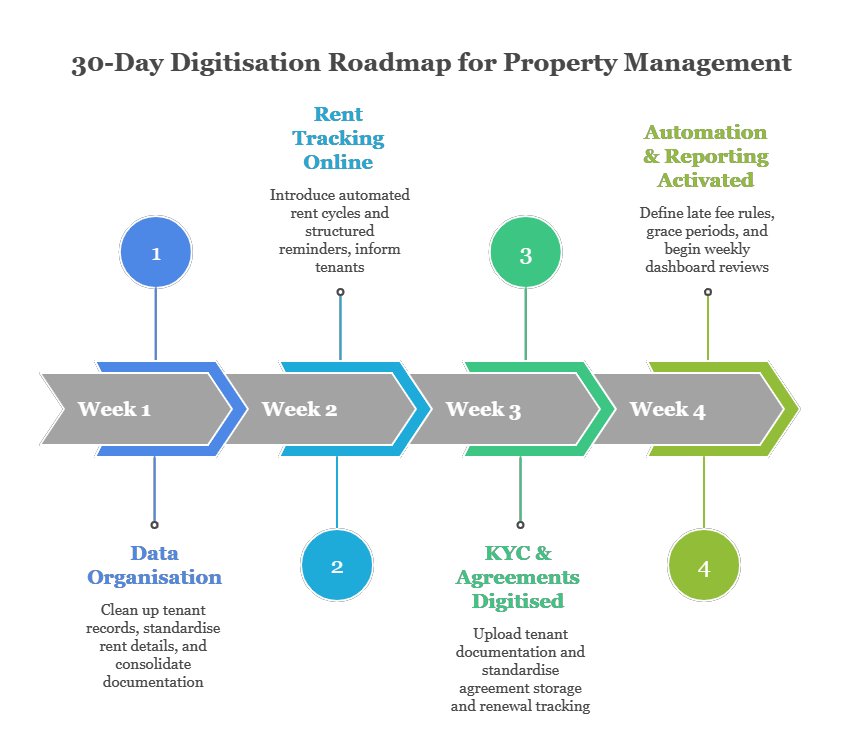
A 30-Day Digitisation Roadmap
Overhauling operations overnight usually creates confusion. A phased approach works better.
Week 1 – Clean and Organise Your Data
Before introducing any software or automation, fix your foundation.
Most traditional PGs operate with scattered records, different Excel sheets, unclear deposit entries, inconsistent due dates, and missing KYC documents. If this data is messy, digitisation will only carry that mess forward.
Use this week to:
- Verify rent amounts and due dates
- Recheck security deposit balances
- Match room numbers correctly with tenants
- Identify missing documentation
The goal isn’t automation yet.
It’s clarity.
Clean data makes the next steps smooth.
Week 2 – Shift Rent Tracking Online
Once your records are organised, move rent tracking into a structured digital flow.
Start by defining:
- A fixed rent due date
- A clear grace period
- A consistent late fee rule
Then inform tenants that reminders and tracking will now be system-based.
This shift reduces manual follow-ups and creates payment discipline. You’ll likely notice fewer “I forgot” cases within the first cycle itself.
Week 2 is where you start feeling operational relief.
Week 3 – Digitise KYC & Agreements
Now focus on documentation.
Physical files and scattered PDFs create long-term inefficiency. Centralising tenant KYC and agreements improves both compliance and visibility.
During this week:
- Upload tenant documents into a central system
- Standardise agreement formats
- Record agreement start and end dates
- Track lock-in and notice periods
Once this is structured, onboarding becomes smoother and exit disputes reduce significantly.
Week 4 – Activate Automation & Reporting
With rent tracking and documentation structured, activate automation rules.
Define:
- Reminder schedules
- Late fee triggers
- Weekly review routines
Instead of waiting until month-end to check numbers, start reviewing dashboards weekly.
This helps you identify:
- Rising pending dues
- Delayed payments
- Revenue inconsistencies
By the end of 30 days, your PG will look the same externally.
But internally, operations will feel far more controlled, predictable, and scalable.
That’s what real digitisation looks like.
Will Digitisation Disrupt Your PG?
The fear of disruption often delays adoption.
In reality, disruption depends on execution.
Attempting to switch everything at once creates confusion. Transitioning process by process keeps operations stable.
Tenants are already comfortable with digital payments. Staff already operate via smartphones. Infrastructure readiness is rarely the issue.
What changes is workflow structure.
How RentOK Supports PG Digitisation
Digitising a PG requires more than enabling online payments. It requires integrating rent cycles, KYC management, automation, and reporting into one system.
RentOK is built specifically for PG and hostel operators transitioning from manual systems.
Through its Automation Page, operators can configure:
- Rent due schedules
- Reminder timing
- Late fee enforcement
Through its KYC Page, tenant documentation becomes centralised and structured rather than scattered.
The result is not complexity, it’s clarity.
Instead of juggling Excel sheets, WhatsApp reminders, and physical files, everything operates within one connected workflow.
The Bigger Transition: From Effort to Infrastructure
Manual PG operations depend on constant supervision.
Digitised operations rely on predefined systems.
When processes are structured, growth does not automatically increase stress. New tenants integrate into the existing workflow instead of adding administrative burden.
Digitisation is less about technology and more about maturity.
Final Thoughts
Transforming a traditional PG business does not require dramatic change.
Start with rent automation.
Centralise tenant documentation.
Introduce structured reporting.
Gradually reduce manual dependency.
Within 30 days, the shift becomes visible, not in how your PG looks, but in how smoothly it operates.
If you’re evaluating how to digitise your PG business without disrupting daily operations, booking a Demo with RentOK can help you understand how automation, KYC management, and centralised dashboards work together in a real-world setup.
Growth should create opportunity, not administrative overload.
About the Author
Ishika Pannu
Ishika Pannu brings you the latest insights and easy-to-apply strategies in property management—helping you simplify renting and grow with RentOk.