Market Trends
How to Manage Multiple Properties from One App

Written by
Ishika Pannu
Read Time
5 min read
Posted on
February 23, 2026
Overview
Overview
How to Manage Multiple Properties from One App (Without Losing Control)
When you begin to manage multiple properties, the transition feels gradual at first. The first property seems manageable, you know every tenant, remember who has paid, approve expenses personally, and can almost operate from memory. Expanding to a second property feels exciting, like growth is under control. But by the time you add a third, the operational pressure becomes visible.
You’re no longer just managing rooms, you’re coordinating systems across locations. Each property brings its own tenants, staff dynamics, cash flow cycles, and operational issues. What once felt simple starts turning fragmented.
As spreadsheets multiply, phone calls increase, and WhatsApp groups become active around the clock, overall visibility begins to slip. Important details get buried in conversations. Payment tracking becomes reactive. Decision-making slows down.
If you truly want to manage multiple properties efficiently, the answer isn’t tighter supervision or longer working hours.
It’s centralization.
When Growth Starts Creating Operational Chaos
Scaling from one property to multiple doesn’t just increase revenue.
It multiplies complexity.
You start dealing with:
- Separate Excel sheets per property
- Different rent cycles and reminder habits
- Staff updating things differently
- No consolidated dues visibility
- Delayed financial clarity
Individually, these don’t look dangerous.
But collectively, they create fragmentation.
The more properties you add without a unified system, the harder it becomes to answer basic business questions quickly.
The Hidden Risk: Decentralized Visibility
When each property runs independently, you lose the big picture.
You may not immediately know:
- Which property has the highest pending dues
- Where late payments are increasing
- Which property is underperforming
- Whether cash flow is improving month-on-month
Instead, you rely on staff updates or manual reporting.
And manual reporting always carries risk.
Multi-property chaos isn’t caused by scale itself.
It’s caused by lack of centralized visibility.
Staff Access Control: The Most Ignored Scaling Problem
Once you manage multiple locations, you can’t operate alone.
You need property managers, accounts staff, maintenance coordinators.
But here’s the dilemma:
If everyone has access to everything, you lose control.
If no one has access, you become the bottleneck.
Without structured access control, you risk:
- Unauthorized data edits
- Financial misreporting
- Accidental data overwrites
- Confusion over responsibility
Managing multiple properties requires clear role-based access:
- Property managers see only their location
- Accounts team handles financial updates
- Owners retain centralized oversight
Growth without defined access levels leads to operational vulnerability.
Why Separate Tools Don’t Solve the Problem
Some operators try to “organize” chaos by using:
- One spreadsheet per property
- One WhatsApp group per building
- Separate accounting files
- Different reporting styles
This doesn’t create structure.
It creates silos.
The issue isn’t that you lack tools.
The issue is that your tools aren’t connected.
If you can’t see:
- Total revenue across all properties
- Combined pending dues
- Consolidated occupancy
- Property-wise performance comparison
Then you’re not managing a portfolio, you’re managing isolated units.
The Advantage of a Central Dashboard
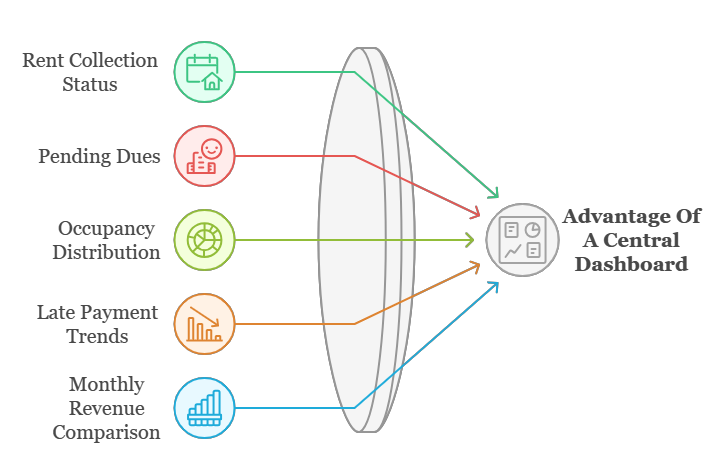
A centralized dashboard changes the decision-making process completely.
Instead of opening multiple sheets or calling managers, you see:
- Property-wise rent collection status
- Overall pending dues
- Occupancy distribution
- Late payment trends
- Monthly revenue comparison
This doesn’t just save time.
It improves strategic clarity.
When you can view everything in one place, expansion decisions become data-driven, not intuition-driven.
Unified Financial Reports: The Real Growth Enabler
Scaling without unified reporting is risky.
You might add properties but lose track of profitability.
A proper multi-property management setup should allow you to:
- View consolidated income reports
- Compare property-wise performance
- Track late payment patterns
- Monitor revenue trends
- Identify weak-performing assets
Without unified financial visibility, you grow in size, but not in control.
With centralized reporting, you grow intelligently.

Scaling Strategy: System First, Property Second
Many owners think scaling means acquiring more buildings.
In reality, scaling means standardizing systems first.
Before adding a third or fourth property, ask:
- Are rent cycles consistent across properties?
- Are reminder systems standardized?
- Are late fee rules uniform?
- Is reporting centralized?
- Are staff roles clearly defined?
If the answer is no, expansion increases stress.
If the answer is yes, expansion increases efficiency.
Operational maturity determines whether growth feels heavy or manageable.
How RentOK Helps You Manage Multiple Properties from One App
This is exactly where structured multi-property management software becomes essential.
RentOK is built specifically for PGs, hostels, and rental businesses handling multiple properties.
Instead of juggling disconnected systems, you manage everything from a centralized platform.
Here’s how it supports multi-property operators:
Centralized Dashboard
View all properties in one interface. Track dues, occupancy, and payment trends without switching tabs or sheets.
Property-Level Segmentation
Each property remains individually structured, but controlled centrally. You can view both micro and macro performance.
Role-Based Team Access
Assign staff access based on property and responsibility. Managers see their building. Owners retain full oversight.
Unified Financial Reports
Generate consolidated revenue insights while maintaining property-wise breakdowns.
Standardized Rent Cycles
Apply consistent reminder systems, late fee structures, and rent tracking across all properties.
Instead of managing properties separately, you manage them strategically.
From Operator to Portfolio Manager
When you run one property, you’re hands-on.
When you manage multiple efficiently, you become a portfolio manager.
The difference lies in system architecture.
If adding a new property increases your daily involvement, your system isn’t scalable yet.
If adding a new property simply plugs into your existing dashboard, you’ve built infrastructure correctly.
When Should You Centralize?
Consider moving to a multi-property system if:
- You manage more than one property
- You maintain separate spreadsheets for each
- You struggle to get consolidated financial clarity
- You depend heavily on staff reports
- You plan to expand further
The earlier you centralize, the smoother your scaling journey becomes.
Final Perspective
Managing multiple rental properties isn’t about working harder.
It’s about seeing everything clearly, from one place.
Centralized visibility.
Controlled staff access.
Unified financial reporting.
Standardized operations.
That’s what transforms growth into stability.
If your current setup requires switching between sheets, calls, and messages just to understand your business status, it may be time to centralize.
Book A Demo with RentOK and see how managing multiple properties from one app can simplify control, improve reporting clarity, and support long-term scaling, without increasing operational complexity.
Because when your system is unified, growth stops feeling chaotic and starts feeling strategic.
About the Author
Ishika Pannu
Ishika Pannu brings you the latest insights and easy-to-apply strategies in property management—helping you simplify renting and grow with RentOk.