Market Trends
How to Track Security Deposits in PG


Written by
Ishika Pannu
Read Time
5 min read
Posted on
February 24, 2026
Overview
Overview
How to Track Security Deposits in PG: The Complete Guide for Owners
Running a PG (Paying Guest) or hostel is like running a big family, but with a lot more paperwork. One of the biggest headaches for any owner is the Security Deposit.
In theory, it’s simple: you take money at the start and give it back at the end. But in reality, this is where 90% of fights with tenants happen. If you want to track security deposits without losing your mind (or your reputation), this guide is for you.
What is a Security Deposit and why do we take it?
A security deposit is “advance money” a tenant gives you before moving in.
Think of it as a Guarantee. * It protects you if the tenant leaves without paying rent.
- It covers the cost if they break a fan, a bed, or a geyser.
- It ensures they pay their final electricity bill before leaving.
If everything is fine when they move out, you give the money back. If there is damage or pending dues, you cut that amount and return the rest.
Why do fights happen during the Security Deposit refund?
Most PG owners in India use a simple notebook (register) or just try to remember everything. This is where the “lafda” (trouble) starts.
Common reasons for disputes:
- Memory Loss: The tenant says they gave ₹10,000, but you wrote ₹8,000 in your diary.
- Electricity Bills: You want to cut money for the last month’s bill, but the tenant says, “I already paid it!”
- Notice Period: You have a rule for a 30-day notice. The tenant leaves in 10 days and wants a full refund.
- Damages: You see a crack in the wall. The tenant says, “It was already there when I moved in!”
Without a way to track security deposits properly, it’s your word against theirs. Usually, the owner looks like the “bad guy” even if they are right.
How do most PG owners track deposits manually? (And why it fails)
Many owners use these three old methods:
- The Register (Diary): You write the name and amount. But what if you lose the diary? What if water spills on it?
- WhatsApp Chats: You scroll for 20 minutes to find the message from 6 months ago.
- Excel Sheets: Good, but hard to update every time a small repair happens.
The Problem: These methods are “fragmented.” The deposit is in one place, the rent is in another, and the electricity bill is on a piece of paper. When the tenant stands in front of you asking for their money, you get confused and make mistakes.
How can I track security deposits correctly? (Step-by-Step)
To avoid any confusion, you must record the Full Lifecycle of the money. You need to know:
- The Starting Point: Exactly how much was received and on which date? (Cash/GPay/PhonePe?)
- The Middle Part: Did you adjust any rent from the deposit during their stay?
- The Ending Point: What are the final deductions? (Cleaning charges, broken items, pending bills).
Pro Tip: Always take a photo of the room when the tenant moves in. This is your “proof” if they damage something later.
What should be included in a Tenant Ledger?
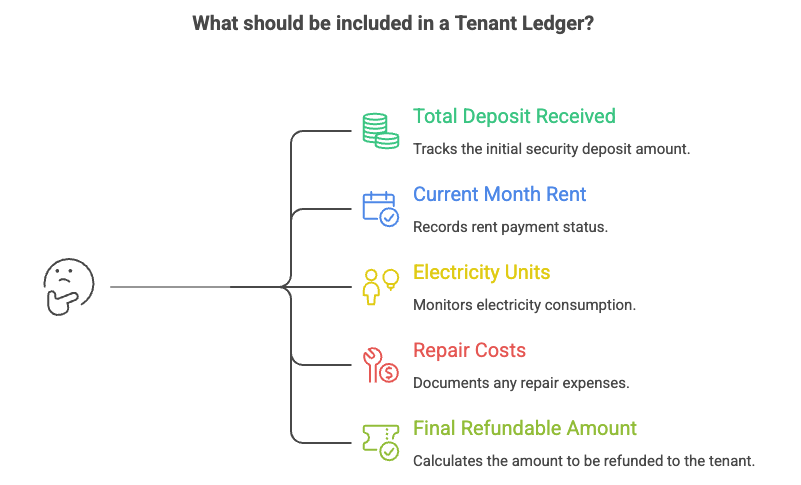
A Tenant Ledger is just a fancy name for a “Hisaab Kitaab” (Account Book) for one person. To track security deposits professionally, every tenant should have a page that shows:
- Total Deposit Received: ₹XXXX
- Current Month Rent: Paid or Pending?
- Electricity Units: Starting reading vs. Ending reading.
- Repair Costs: If they broke something.
- Final Refundable Amount: (Deposit minus Dues).
When you show this “Hisaab” clearly to a tenant, they won’t argue because the numbers speak for themselves.
How does “Notice Period” affect the deposit?
This is the most searched question!
If your rule says “1-month notice” and the tenant tells you today they are leaving tomorrow, you have the right to deduct one month’s rent from the deposit.
- To track this: You must record the Date of Notice given by the tenant. If you don’t write it down, they will claim they told you “long ago.”
What are the common mistakes in calculating the refund?
Don’t do the math in your head!
- Mistake 1: Forgetting the final electricity reading.
- Mistake 2: Not checking for “hidden” damages (like a broken bucket or a stained mattress).
- Mistake 3: Not recording the “Refund Date.” Sometimes owners pay half now and half later, then forget if they paid the second half.
Can I use technology to make this easier?
Yes! In 2026, you don’t need to be a math expert. Digital systems do the work for you. They link the deposit to the tenant’s profile. When they pay rent, it updates. When they break a chair, you add a “penalty,” and it automatically deducts from their final balance.
How RentOk helps you manage deposits without the headache
If you are tired of arguments and manual calculations, RentOk is built exactly for Indian PG owners. It handles the “dirty work” so you can relax.
Here is how RentOk solves your problems:
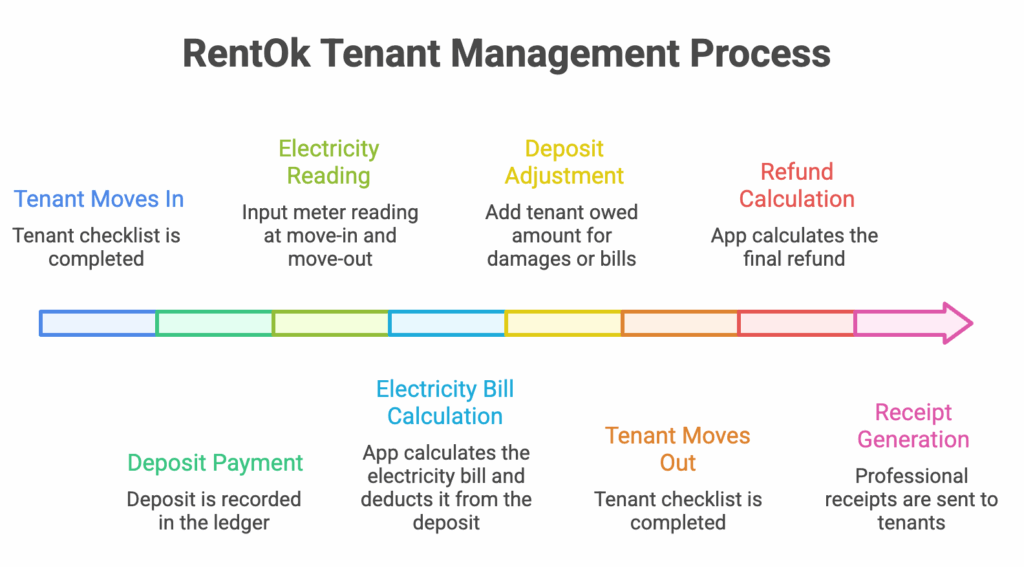
- Digital Move-In/Move-Out Checklist: When a tenant moves in, you can tick off items (Fan working? Geyser working? Walls clean?). When they move out, you check the same list. No more “it was already broken” excuses!
- Automatic Deposit Tracking: The moment a tenant pays the security deposit, it is locked in their digital ledger. You can see your total “Deposit Liability” (how much total money you owe to all tenants) in one click.
- Easy Adjustments: like If a tenant owes ₹500 for a broken window, you just add it to the app. It automatically calculates the final refund.
- Electricity Management: Input the meter reading at move-in and move-out. The app calculates the bill and deducts it from the deposit automatically.
- Clear Receipts: The tenant gets a professional receipt on WhatsApp for every payment. When they see a professional system, they trust you more and argue less.
Conclusion: Stop Guessing, Start Tracking
Security deposits are the tenant’s money held in your trust. If you track them poorly, you lose trust, get bad reviews, and waste hours in arguments.
By using a structured system like a Tenant Ledger, you make your PG business professional. You save time, keep your tenants happy, and ensure your own pocket is protected from unpaid bills.
Ready to see it in action? Try RentOk now!
Don’t wait for the next move-out fight.
About the Author
Ishika Pannu
Ishika Pannu brings you the latest insights and easy-to-apply strategies in property management—helping you simplify renting and grow with RentOk.