Market Trends
Handling Security Deposits: Legal Norms and Best Practices


Written by
Ishika Pannu
Read Time
9 min read
Posted on
May 13, 2026
Overview
Overview
Handling Security Deposits: Legal Norms and Best Practices
Security deposits are one of the most sensitive aspects of rental housing operations, yet they are often handled with the least amount of structure. In many PGs, co-living spaces, and rental properties, the deposit conversation begins casually during move-in and becomes stressful during move-out. That transition usually happens because expectations were never aligned properly from the beginning.
For tenants, the deposit is not just another payment. It is money they expect to receive back fairly and on time. For operators, however, deposits act as financial protection against unpaid dues, property damage, maintenance costs, and operational losses created by abrupt exits. The challenge is that both sides usually approach the process with different assumptions, and when there is no system connecting those expectations, disputes become almost inevitable.
This is why professionally managed rental businesses no longer treat deposit handling as a side process. They treat it as a core operational function that directly affects:
- tenant trust,
- online reputation,
- occupancy retention,
- and the overall professionalism of the property.
A poorly managed refund process can damage months of good tenant experience in just a few days. Meanwhile, properties that maintain transparent and predictable systems often build stronger long-term credibility even in highly competitive rental markets.
Why Security Deposits Have Become More Important in Modern Rentals
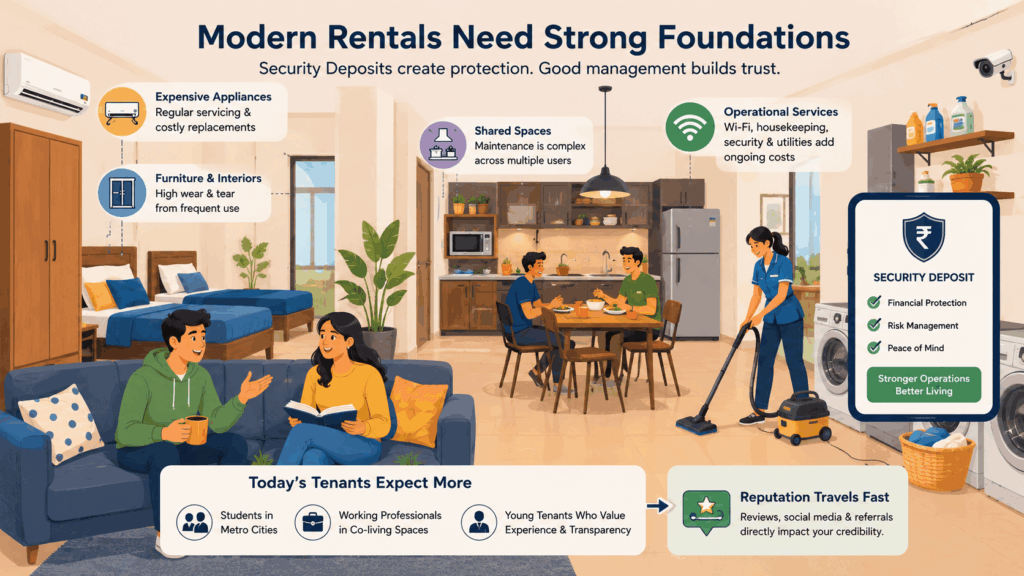
The importance of deposits has increased significantly because rental housing itself has evolved. Earlier, many landlords simply rented out empty apartments with limited involvement after move-in. But modern PGs and co-living spaces operate very differently. Operators are now managing complete living ecosystems filled with furniture, appliances, common-area infrastructure, and recurring maintenance responsibilities.
A single furnished property today may include:
- expensive appliances like air conditioners, geysers, washing machines, and refrigerators that require regular servicing and are costly to replace,
- furniture such as wardrobes, study tables, beds, and mattresses that experience continuous wear because of high occupancy turnover,
- shared kitchens and common areas where maintenance accountability becomes difficult to track across multiple residents,
- and operational services like Wi-Fi, housekeeping, security, and utility management that create ongoing operational expenses.
Because of this, deposits have become operationally necessary. They create a financial buffer that allows operators to manage risks more sustainably. However, the expectation from tenants has also changed equally fast. Residents today expect professionalism, transparency, and clarity from the properties they choose.
This shift is especially visible among:
- students relocating to metro cities,
- working professionals staying in co-living spaces,
- and younger tenants who compare properties based not only on amenities but also on management quality.
A property’s refund reputation now spreads quickly through reviews, social media discussions, and local referral networks. That means deposit handling directly impacts business credibility.
Why Most Deposit Disputes Are Actually Process Failures
Interestingly, most conflicts around deposits are not caused by deductions themselves. They happen because the process feels unclear. In many properties, onboarding conversations focus heavily on room availability, rent, and move-in logistics, while important operational details are communicated vaguely or skipped entirely.
As a result, tenants often remain unsure about:
- what counts as normal wear and tear,
- whether repainting or cleaning costs are deductible,
- how electricity adjustments are calculated,
- what the refund timeline usually looks like,
- or how room inspections are conducted during move-out.
At the same time, operators internally assume these things are “already understood.”
This disconnect creates friction later because the move-out stage is already financially and emotionally sensitive for tenants. If communication suddenly becomes inconsistent or deductions appear unexpected, trust breaks down very quickly.
Professionally managed properties avoid this by creating structured onboarding systems. Instead of relying on memory or verbal conversations, they establish clear operational workflows from the beginning. That single difference changes the entire tenant experience because disputes become evidence-based rather than emotionally driven.
What a Professionally Managed Deposit Policy Looks Like
A strong deposit policy does not need to feel overly legal or rigid. In fact, the best policies are usually simple, practical, and operationally transparent. The goal is not to overwhelm tenants with rules but to create predictability for both sides.
A professionally managed deposit framework should clearly explain:
- how much deposit is being collected and under what payment structure,
- what timelines tenants can realistically expect for refund processing,
- what types of damages may lead to deductions,
- how utility dues and maintenance adjustments are calculated,
- how inspections are conducted during move-in and move-out,
- and what conditions apply if a tenant exits before the agreed notice period.
When these expectations are communicated early, tenant cooperation improves significantly. People are generally more comfortable with structured systems, even when deductions exist, because the process feels transparent instead of arbitrary.
The difference between organized and unorganized rental operations often becomes visible through how consistently these policies are applied.
Understanding the Difference Between Wear & Tear and Actual Damage
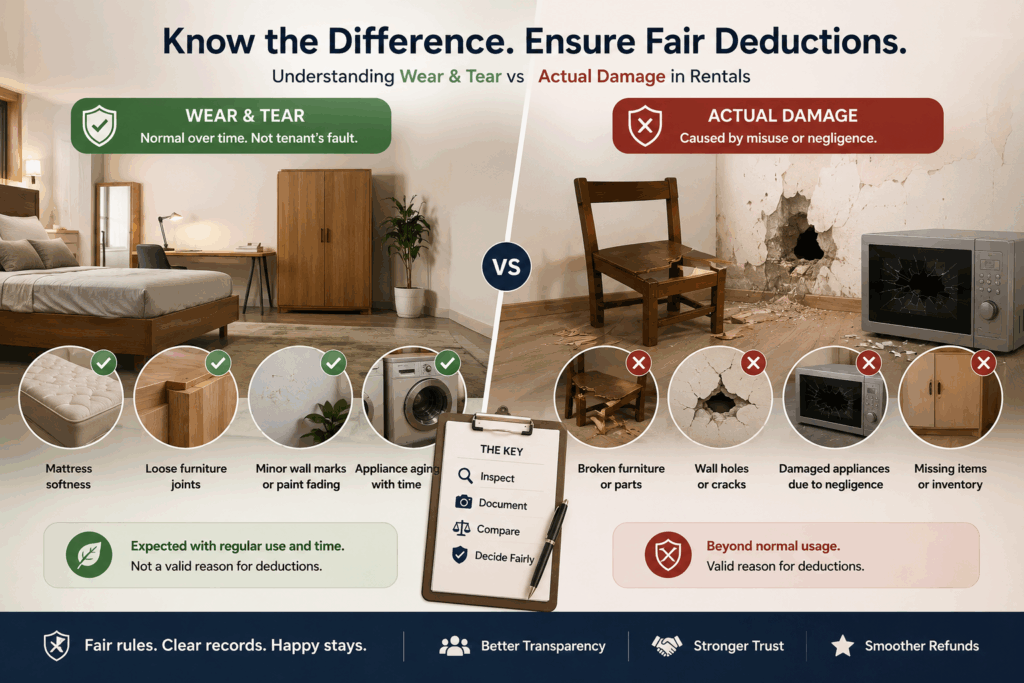
One of the biggest operational mistakes property owners make is treating all deterioration as tenant-caused damage. In furnished rental housing, some level of wear is inevitable because assets are continuously occupied and reused.
For example, a mattress becoming softer over time or furniture joints loosening after multiple occupancy cycles are operational realities. Similarly, small wall marks, slight paint fading, or gradual appliance aging may occur naturally even when tenants use the property responsibly.
These are not necessarily damages that justify aggressive deductions.
At the same time, operators also face situations where deductions are genuinely reasonable. Broken furniture caused by forceful usage, appliances damaged through negligence, missing inventory items, or severe structural damage clearly go beyond normal occupancy conditions.
The real issue is not whether deductions happen. The issue is whether operators can explain them transparently and support them with proper documentation.
This is exactly why move-in inspections and inventory tracking matter so much. Without records, every discussion later becomes dependent on assumptions instead of evidence.
Why Documentation Is the Backbone of Smooth Deposit Management
Experienced property managers understand that move-out conflicts are usually prevented during move-in itself. The moment a tenant enters the property, the operator should ideally establish clear visual and operational records.
This includes:
- room photographs before handover,
- inventory checklists documenting furniture and appliance conditions,
- written acknowledgment of pre-existing issues if any,
- and maintenance tracking throughout the occupancy period.
These systems may seem operationally small in the beginning, but they become extremely important later. Imagine a situation where a tenant claims:
- an appliance was already malfunctioning,
- furniture damage existed before occupancy,
- or wall stains were pre-existing conditions.
Without documentation, there is no objective reference point.
Properties that maintain structured records usually handle disputes far more smoothly because the conversation remains factual. Tenants also tend to trust operators more when processes feel systematic rather than improvised.
In many ways, documentation does not just protect the operator financially. It also protects the tenant experience.
Why Refund Delays Damage Reputation Faster Than Deductions
One major operational insight that many property owners underestimate is this: tenants are often more frustrated by uncertainty than by deductions themselves.
If communication remains transparent, many residents are willing to cooperate even when adjustments are necessary. Problems usually begin when operators:
- stop responding after move-out,
- avoid giving timelines,
- or delay updates without proper explanation.
At that stage, tenants quickly assume the process is intentionally unfair.
This damages trust rapidly because refund-related conversations already involve financial stress. A professionally managed move-out process therefore depends heavily on communication quality.
Tenants should clearly understand:
- what inspections are pending,
- how dues are being calculated,
- whether deductions are applicable,
- and when the final settlement can realistically be expected.
Even when delays occur because of utility calculations or maintenance verification, proactive communication significantly reduces conflict.
Properties that communicate well during move-out often maintain stronger tenant relationships even after residents leave.
The Operational Mistakes That Usually Create Deposit Chaos
As occupancy grows, deposit management becomes increasingly difficult without structured systems. Many rental businesses still rely on fragmented workflows that become impossible to scale efficiently.
Some of the most common operational mistakes include relying heavily on verbal communication, maintaining scattered payment records, delaying utility calculations until move-out, and using deposits for daily operational cash flow. These practices may appear manageable at small scale, but once occupancy increases, they create confusion very quickly.
Another major issue is inconsistency. Tenants notice very quickly when different residents experience different deduction standards or communication quality. That inconsistency weakens trust because the property begins feeling reactive instead of professionally managed.
Modern rental operations require:
- centralized records,
- predictable workflows,
- documented processes,
- and structured communication.
Without these systems, even good properties struggle operationally during high turnover periods.
Why Deposit Handling Directly Affects Occupancy and Referrals
Today’s rental market is deeply reputation-driven. Students and young professionals actively discuss their move-out experiences within:
- WhatsApp communities,
- Reddit forums,
- local student groups,
- and online review platforms.
A property known for delayed refunds or unclear deductions eventually develops trust issues during onboarding itself. Future tenants begin asking more questions, negotiations become harder, and referral quality weakens gradually.
On the other hand, professionally managed operators often benefit from stronger word-of-mouth credibility because residents remember transparent systems. In highly competitive rental markets, professionalism itself becomes a differentiator.
Tenants increasingly prefer properties where:
- communication feels organized,
- processes feel predictable,
- and management appears accountable.
That shift is pushing the entire industry toward more structured operational models.

How RentOk Helps Operators Manage Deposits More Professionally
Security deposit management becomes significantly easier when the entire property operation is organized within a centralized system. One of the biggest reasons disputes escalate is because operators struggle with fragmented information spread across spreadsheets, payment screenshots, notebooks, and disconnected communication channels.
RentOk helps simplify these operational workflows by bringing tenant management, occupancy tracking, payment visibility, and communication into one connected platform. Instead of depending on scattered records, operators can manage onboarding, move-outs, dues, and tenant coordination more systematically.
This helps property managers:
- maintain clearer visibility across occupancy cycles and pending settlements,
- reduce confusion during move-outs through organized operational tracking,
- improve communication consistency with tenants during onboarding and exits,
- and create more structured workflows that reduce delays and misunderstandings during deposit settlement.
The biggest advantage is not just automation. It is operational clarity.
When records and workflows are centralized properly, deposit handling naturally becomes more transparent, easier to track, and significantly less stressful for both tenants and operators.
Final Thoughts
Security deposits are no longer just financial safeguards. They have become operational trust indicators that influence tenant satisfaction, online reputation, and long-term business credibility.
As rental housing becomes more organized and experience-driven, tenants increasingly expect:
- transparent communication,
- documented systems,
- predictable processes,
- and professional operational standards
as part of the overall living experience.
Operators who invest in structured workflows, better documentation, and centralized management systems are the ones who build stronger tenant relationships and smoother rental operations over time.
If you want to improve operational transparency, simplify tenant management, and create a more professional rental experience, explore RentOk and discover how modern property management systems can help reduce friction across your rental business.
About the Author
Ishika Pannu
Ishika Pannu brings you the latest insights and easy-to-apply strategies in property management—helping you simplify renting and grow with RentOk.