Legal
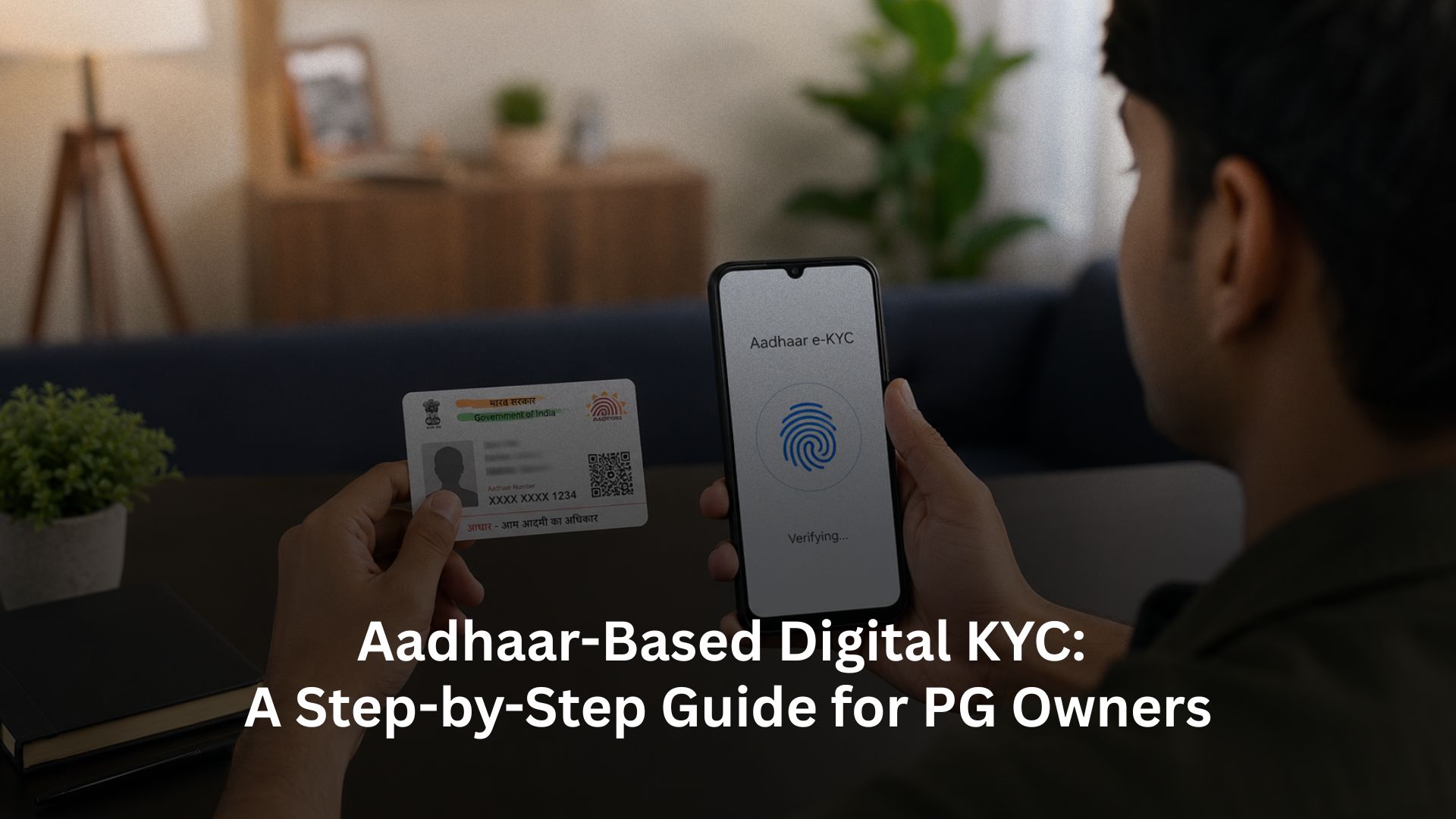
Aadhaar-Based Digital KYC: A Step-by-Step Guide for PG Owners

Written by
Ishika Pannu
Read Time
13 min read
Posted on
June 30, 2026
Overview
Overview
Aadhaar-Based Digital KYC: A Step-by-Step Guide for PG Owners
Finding the right tenant has never been the difficult part of running a PG. The real challenge begins after someone decides to move in.
Before handing over the keys, every property owner has one responsibility that cannot be overlooked, verifying the identity of the person who will be living on the premises. This isn’t just about following regulations; it’s about protecting your property, your existing tenants, and your business from avoidable risks.
For years, tenant verification meant collecting photocopies of Aadhaar cards, PAN cards, passport-sized photographs, manually filling out forms, and maintaining thick files of paperwork. While this process worked, it was slow, difficult to manage at scale, and often resulted in incomplete records. As PGs and co-living businesses have become more organized, manual verification has started showing its limitations.
Today, digital verification has changed how modern rental businesses onboard tenants. Aadhaar-based Digital KYC has become one of the fastest and most reliable ways to verify identities, reduce paperwork, and create a smoother move-in experience for both landlords and tenants.
If you’re a PG owner wondering how Aadhaar e-KYC works, whether it’s legally valid, and how you can incorporate it into your tenant onboarding process, this guide covers everything you need to know.
Why Tenant Verification Matters More Than Ever
Tenant verification is no longer just a legal formality, it has become a critical part of running a secure and well-managed PG or co-living business. Every tenant you onboard becomes part of your daily operations, from rent collection and maintenance requests to visitor management and compliance. If their records are incomplete or inaccurate, even routine administrative tasks can become time-consuming and difficult to manage.
The need for proper verification has also grown as the rental market has become increasingly dynamic. Students relocate every academic session, working professionals frequently change cities, and managed rental properties experience higher tenant turnover than ever before. As occupancy changes more frequently, relying on manual paperwork or scattered records increases the chances of errors and operational delays.
Poor verification practices often create avoidable challenges, such as:
- Incomplete tenant records, making it difficult to retrieve documents during police verification, agreement renewals, or emergency situations.
- Manual data entry errors, where incorrect names, addresses, or identification details create inconsistencies across agreements and internal records.
- Slower onboarding, particularly during peak admission or relocation seasons when multiple tenants need to be verified within a short period.
- Difficulty managing records across multiple properties, especially when documents are stored in physical files or maintained separately by different property managers.
Experienced PG operators understand that tenant verification is much more than a compliance requirement. It establishes a reliable foundation for secure onboarding, organized record management, and smoother day-to-day operations, while reducing the risk of disputes and administrative challenges in the future.

What Is Aadhaar-Based Digital KYC?
KYC, or Know Your Customer, is the process of verifying an individual’s identity using officially accepted documents before providing a service.
In the rental industry, this means confirming that the person moving into your property is who they claim to be.
Traditionally, this involved collecting physical copies of identity documents, checking them manually, and storing them in files. Digital KYC modernizes this entire process by allowing identity verification to happen electronically, making it significantly faster and more accurate.
Aadhaar-based Digital KYC uses the information linked to a tenant’s Aadhaar to verify their identity after obtaining their explicit consent. Depending on the verification method being used, the process may involve OTP authentication, document validation, or secure identity verification through authorized systems.
For PG owners, this offers several practical advantages:
- Verification becomes much faster, allowing move-ins to be completed without unnecessary delays while maintaining proper documentation.
- Manual paperwork reduces significantly, making it easier to organize tenant records without depending on physical files.
- Digital records remain accessible, helping operators retrieve information quickly whenever agreements need renewal or compliance documents are required.
- The onboarding experience improves because tenants no longer need to repeatedly submit photocopies of the same documents or visit the property multiple times for verification.
Digital KYC doesn’t replace responsible tenant verification, it makes the process more efficient, consistent, and easier to manage.
How Aadhaar e-KYC Works: A Step-by-Step Process
Although the technology behind Aadhaar e-KYC may sound complex, the actual process is designed to be straightforward for both tenants and property owners.
Understanding each step helps ensure that the verification process remains smooth while meeting compliance requirements.
Step 1: Obtain the Tenant’s Consent
The first and most important step is obtaining the tenant’s permission.
Aadhaar-based verification cannot be carried out without the individual’s consent. Before initiating the process, tenants should clearly understand why their identity is being verified, how their information will be used, and how it will be stored.
Being transparent at this stage also builds trust and reassures tenants that their personal information is being handled responsibly.
Step 2: Collect Basic Information
Once consent has been obtained, the onboarding process begins with collecting essential tenant details.
These generally include:
- Full name
- Mobile number
- Permanent address
- Email address
- Aadhaar details (where applicable)
- Emergency contact information
Many professional operators also collect employment or educational details at this stage to maintain complete tenant profiles.
Capturing all necessary information during onboarding prevents repeated follow-ups later and keeps tenant records consistent across agreements and operational systems.
Step 3: Identity Verification
The next stage involves verifying the tenant’s identity using Aadhaar-based authentication.
Depending on the verification method being used, the tenant may receive a One-Time Password (OTP) on the mobile number linked to their Aadhaar, or the verification may happen through an authorized digital identity verification workflow.
The objective isn’t simply to collect an Aadhaar number, it is to confirm that the identity information provided matches authentic records while ensuring that the process follows applicable privacy and consent requirements.
Step 4: Validate Supporting Documents
While Aadhaar is an important identity document, it should rarely be the only document collected during onboarding.
Most professionally managed PGs continue to verify supporting documents based on the tenant’s profile.
For example:
- Students may be asked to provide a college ID or admission letter.
- Working professionals may submit an employee ID or company offer letter.
- International tenants may require passport and visa verification.
- Additional address or emergency contact proof may also be collected where necessary.
Looking at verification holistically helps create stronger tenant records instead of relying on a single document alone.
Step 5: Securely Store the Records
Verification is only valuable if the information can be accessed when needed.
One of the biggest drawbacks of manual documentation is that physical files often become misplaced, damaged, or difficult to retrieve over time.
Digital record management solves this problem by allowing operators to maintain organized tenant profiles that can be accessed whenever required.
Whether you’re managing one property or multiple PGs across different cities, centralized digital records make everyday operations significantly more efficient.
Is Aadhaar Alone Enough for Tenant Verification?
One common misconception among first-time landlords is that collecting an Aadhaar card completes the verification process.
In reality, Aadhaar is only one part of a comprehensive tenant verification workflow.
Professional property managers typically combine Aadhaar verification with additional operational checks depending on the type of tenant and property.
This may include:
- Police verification wherever applicable.
- Signed rental or PG agreements.
- Emergency contact details.
- Employment or educational verification.
- Security deposit documentation.
- Move-in inventory records.
Looking at verification as a complete onboarding system rather than a single compliance task helps reduce future disputes while creating better operational visibility across the property.

Common Mistakes PG Owners Make During Aadhaar-Based KYC
As digital verification becomes more common, many PG owners assume that simply collecting an Aadhaar card is enough to complete the onboarding process. In reality, most compliance issues don’t arise because verification wasn’t attempted—they happen because the process wasn’t followed correctly.
Professional operators treat Aadhaar-based Digital KYC as part of a structured onboarding workflow rather than an isolated task. This ensures every tenant is verified consistently, records are properly maintained, and important details don’t get overlooked during busy move-in periods.
Here are some of the most common mistakes property owners should avoid.
Collecting Aadhaar Without Proper Consent
One of the biggest misconceptions is that a tenant’s Aadhaar details can be collected and stored without clearly informing them about the purpose.
Before initiating Aadhaar-based verification, tenants should know:
- Why their identity is being verified, whether it’s for onboarding, agreement creation, or maintaining accurate tenant records as part of the property’s operational process.
- How their information will be used and stored, helping build trust while ensuring transparency throughout the verification process.
- Who can access the information, especially when multiple staff members are involved in tenant onboarding and property management.
Clear communication at the beginning creates a smoother onboarding experience and reduces concerns about data privacy later.
Depending Only on Aadhaar Verification
While Aadhaar is an important identity document, relying on it alone rarely provides a complete tenant profile.
Experienced operators usually combine Aadhaar verification with supporting documentation depending on the tenant category. This creates stronger records and helps resolve future disputes more efficiently.
For instance, a comprehensive tenant file may also include:
- Employment or educational proof, helping establish the tenant’s background and making records more complete for long-term management.
- Signed rental agreements that clearly define notice periods, deposits, occupancy terms, and responsibilities for both parties.
- Emergency contact details and local references wherever applicable, ensuring quicker coordination during emergencies or unexpected situations.
A structured onboarding process always performs better than collecting individual documents without an organized system.
Continuing to Store Everything Manually
Many PG owners complete digital verification but still print documents and maintain physical files for every resident.
While maintaining backup records can be useful, relying entirely on paper defeats one of the biggest advantages of Digital KYC.
As occupancy grows, manual documentation often leads to:
- Files being misplaced or difficult to retrieve when agreements need renewal or tenants move out after several months.
- Duplicate records being created because different staff members maintain separate documentation systems.
- Additional administrative work every time tenant information needs to be updated across multiple registers or spreadsheets.
Digital record management allows operators to access verified tenant information within seconds instead of searching through physical folders.
Aadhaar-Based Digital KYC vs Traditional Manual Verification
The difference between traditional verification and Aadhaar-based Digital KYC isn’t simply about replacing paper with technology. It represents a shift towards more organized and scalable property management.
| Traditional Verification | Aadhaar-Based Digital KYC |
|---|---|
| Requires physical document collection and manual record keeping. | Streamlines identity verification through digital workflows. |
| Staff spend significant time collecting, organizing, and retrieving paperwork. | Faster onboarding with centralized digital records. |
| Higher chances of missing documents or inconsistent records. | Better documentation consistency across multiple tenants. |
| Difficult to manage across several properties. | Easier to scale as occupancy and property count increase. |
| Updating tenant information often requires manual changes in multiple places. | Digital records can be managed more efficiently from a centralized system. |
The biggest advantage isn’t just speed.
It’s operational consistency.
When every tenant follows the same verification workflow, property managers spend less time handling documentation and more time focusing on day-to-day operations.
How Digital KYC Supports Better Property Management
For small PGs with only a handful of tenants, manual verification might still seem manageable. However, once occupancy begins to grow, documentation quickly becomes one of the most time-consuming administrative responsibilities.
Every new tenant brings another agreement, another identity proof, another emergency contact, another payment record, and another set of compliance documents.
Without standardized systems, these records eventually become scattered across:
- physical files,
- Excel sheets,
- WhatsApp conversations,
- email attachments,
- and multiple staff members’ devices.
Over time, this creates operational inefficiencies that affect much more than documentation alone.
Digital KYC helps property owners build a more structured onboarding process by improving several aspects of property management.
Faster Move-ins During Peak Seasons
Admission seasons and corporate relocation periods often bring multiple move-ins within a short timeframe.
Instead of spending hours collecting and organizing paperwork for each tenant, digital verification helps standardize the onboarding process, allowing staff to focus on preparing rooms and coordinating arrivals.
Better Record Management
As properties expand, finding documents becomes just as important as collecting them.
Organized digital records allow operators to quickly retrieve tenant information whenever required for:
- agreement renewals,
- police verification support,
- payment disputes,
- tenant transfers,
- or compliance-related documentation.
This improves both operational efficiency and response time.
Reduced Administrative Work
Property managers already juggle rent collection, maintenance coordination, complaint resolution, housekeeping, and occupancy management.
Reducing repetitive paperwork allows teams to dedicate more time to tasks that directly improve the tenant experience.
Automation doesn’t replace good management, it supports it by eliminating routine administrative effort.
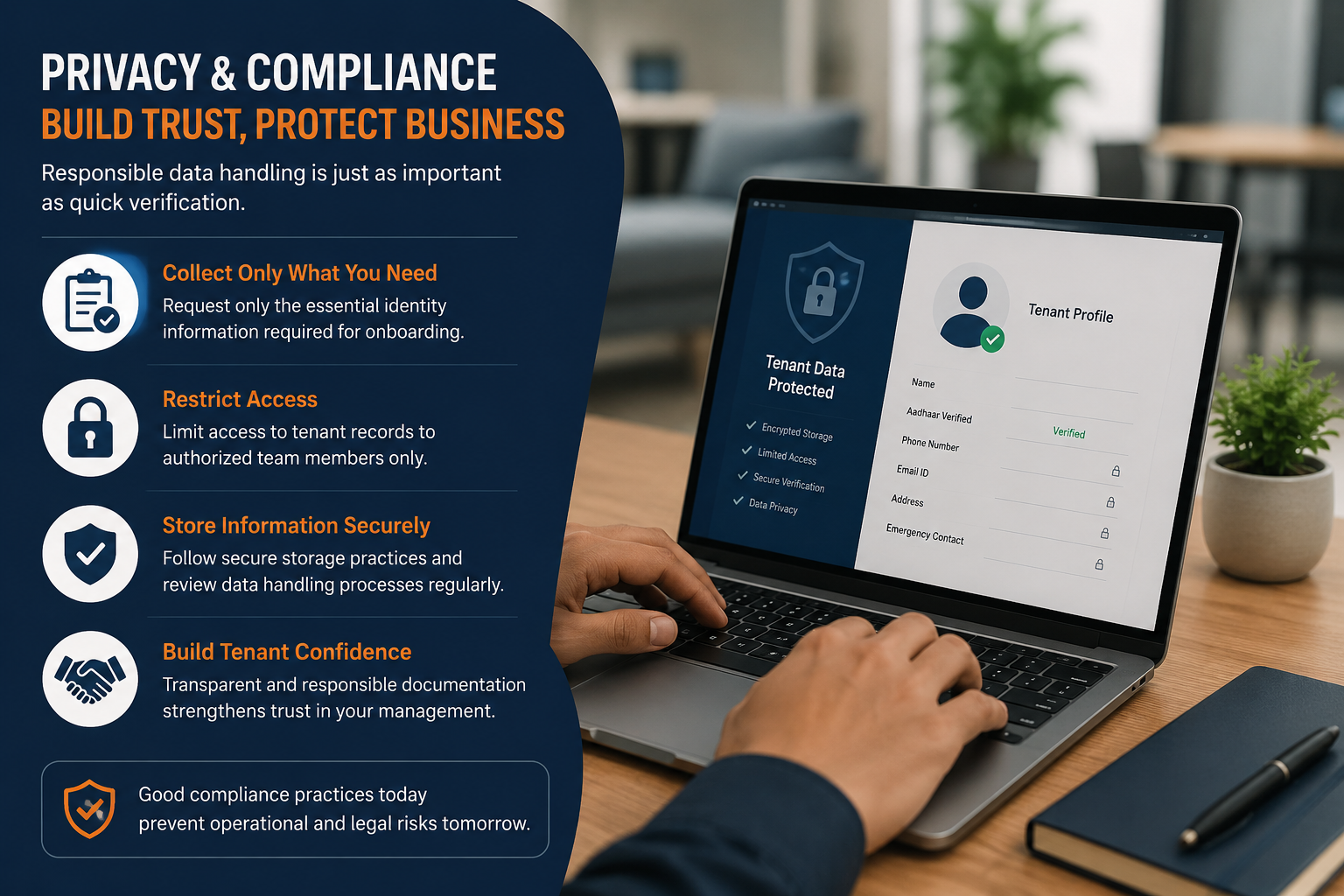
Privacy and Compliance Should Always Be a Priority
As more rental businesses adopt digital onboarding, responsible handling of tenant information becomes increasingly important.
Regardless of the verification method being used, PG owners should always ensure that identity information is handled carefully and only for legitimate operational purposes.
Some recommended practices include:
- Collect only the information genuinely required for tenant onboarding rather than requesting unnecessary personal details.
- Restrict access to tenant records so that sensitive information is available only to authorized staff members involved in property operations.
- Maintain secure storage practices for digital documents and regularly review internal processes for handling tenant information.
Professional documentation not only improves operational efficiency but also strengthens tenant confidence in your management practices.
How RentOk Simplifies Tenant Verification
Managing tenant verification manually becomes increasingly challenging as occupancy grows. Property owners often find themselves switching between spreadsheets, printed agreements, WhatsApp chats, scanned documents, and multiple folders just to complete a single tenant’s onboarding.
RentOk’s Tenant Verification feature brings the entire process together in one centralized platform.
Instead of managing documentation across disconnected systems, property owners can streamline the onboarding journey by organizing:
- tenant identity verification,
- digital document collection,
- agreement management,
- occupancy records,
- payment information,
- and complete tenant profiles from a single dashboard.
This not only reduces administrative effort but also creates greater consistency across every move-in. Whether you’re managing one PG or multiple co-living properties, having organized digital verification records makes daily operations significantly easier.
As your business scales, standardized verification workflows help reduce documentation errors, improve record accessibility, and create a more professional onboarding experience for every new resident.
Conclusion
Tenant verification is no longer just a compliance requirement, it has become an essential part of running a well-organized rental business.
Aadhaar-based Digital KYC enables PG owners to simplify identity verification, reduce paperwork, improve documentation, and create a smoother onboarding experience for both staff and tenants. When combined with proper agreements, supporting documents, and structured record management, it forms the foundation of a reliable tenant verification process.
As rental businesses continue adopting digital operations, operators who invest in organized verification systems will be better equipped to manage higher occupancy, maintain accurate records, and scale confidently.
If you’re looking to simplify tenant onboarding and build a more efficient verification workflow, explore RentOk’s Tenant Verification feature to digitize your KYC process, centralize tenant records, and make every move-in faster, safer, and more organized.
About the Author
Ishika Pannu
Ishika Pannu brings you the latest insights and easy-to-apply strategies in property management—helping you simplify renting and grow with RentOk.