
Legal
Managing Rental Property in India as an NRI Landlord

Written by
Ishika Pannu
Read Time
14 min read
Posted on
October 1, 2026
Overview
Overview
Managing Rental Property in India as an NRI Landlord
Owning a rental property in India while living abroad can seem fairly straightforward when everything is working as expected. The rent arrives on time, the tenant takes care of the property, and a family member or local contact handles the occasional repair. From a distance, the property can feel almost self-managing.
The situation changes quickly when something goes wrong.
A tenant stops paying rent. A maintenance complaint remains unresolved. The tenant wants to leave before the agreed period. A security deposit becomes a point of disagreement. Or, in a more serious situation, the landlord needs to deal with a tenant who refuses to vacate the property.
For an NRI landlord, these situations have one additional complication that local landlords may not face to the same extent: physical distance.
A landlord living in the same city can visit the property, speak to the tenant, inspect the premises, meet a lawyer, or coordinate with a local service provider. An NRI landlord may need to manage all of these activities through a combination of phone calls, emails, WhatsApp messages, relatives, property managers, and local professionals.
That does not mean rental property cannot be managed successfully from abroad. It means the management system needs to be more organised.
Documentation, local representation, payment visibility, tenant records, and digital access become particularly important because the owner cannot rely on physical presence to fill operational gaps.
If you are an NRI landlord, the question is therefore not simply, “What happens if my tenant stops paying rent?”
The more useful question is: “How prepared is my property to handle a problem when I am not physically there?”
Why Are NRIs Especially Exposed to Rental Problems?
Distance changes the way rental problems develop.
A tenant who delays rent by a few days may not seem like a serious concern when the owner can speak to them directly. But when the owner lives abroad, information often passes through several people before reaching them. A local manager may update a family member, who then informs the owner, while the payment remains pending and the next follow-up is unclear.
The same applies to maintenance. A tenant may report a leakage, a local contact may arrange a plumber, and the repair may be completed. But without a central record of the complaint, expense, and resolution, the owner may have limited visibility into what actually happened.
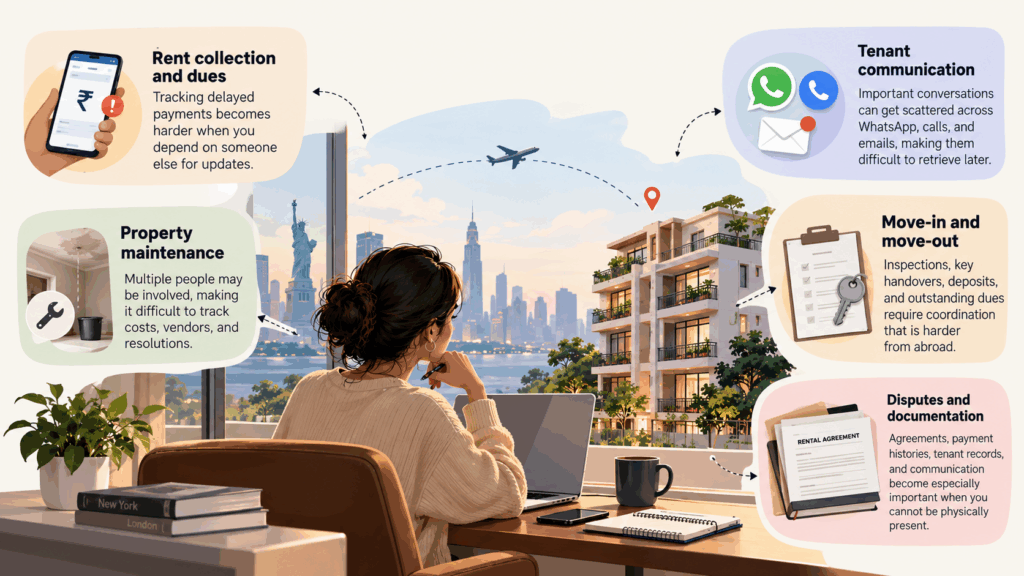
Some common challenges for NRI landlords include:
- Rent collection and dues: Tracking delayed payments becomes harder when the owner depends on someone else for updates.
- Property maintenance: Multiple people may be involved in repairs, making it difficult to track costs, vendors, and resolutions.
- Tenant communication: Important conversations can get scattered across WhatsApp, calls, and emails, making them difficult to retrieve later.
- Move-in and move-out: Inspections, key handovers, deposits, and outstanding dues require coordination that is harder from abroad.
- Disputes and documentation: Agreements, payment histories, tenant records, and communication become especially important when the owner cannot be physically present.
This makes organised property management increasingly important as the distance between an owner and their property grows. RentOk’s Landlord-Tenant Management Software guide explains how centralising tenant information, payments, documentation, and communication can simplify rental operations.
For an NRI landlord, having everything in one place can provide much-needed visibility without requiring constant physical presence.
Why Does a Written Agreement Matter Even More When You Are Abroad?
A written rental agreement is important for every landlord, but it becomes especially valuable when the owner is managing the property remotely.
When everything is going smoothly, verbal understandings may appear sufficient. A tenant pays the agreed rent, the landlord handles repairs, and both parties move forward. The problem begins when their understanding of an arrangement is no longer the same.
Was the notice period one month or two? Was the security deposit supposed to be adjusted against the final month’s rent? Who was responsible for a particular repair? What happens if the tenant wants to leave early?
A written agreement gives both parties a common reference point.
A properly drafted agreement can establish the important commercial and operational terms of the tenancy, including rent, deposit, tenancy duration, notice requirements, maintenance responsibilities, permitted use, and exit conditions. For PGs and co-living properties, it may also need to address additional services, utilities, food, housekeeping, shared facilities, and property-specific rules.
RentOk’s recent guide on creating a legally valid rent agreement in India explains why an agreement should be treated as an important operational record rather than a document that is simply signed at move-in and forgotten.
However, an agreement does not eliminate the need to understand the law applicable to the property.
Tenancy rules and documentation requirements can vary between states, and the appropriate process can depend on the nature and duration of the tenancy. RentOk’s article on why rent agreement rules differ across Indian states is useful for understanding why landlords should not rely on a single nationwide assumption when dealing with rental documentation.
For NRI landlords, this distinction matters even more. A well-written agreement can document the relationship clearly, but serious disputes may still require advice from a qualified professional familiar with the property’s location and applicable law.
What Should You Do Before You Leave India?
The easiest time to prepare for remote property management is before you actually need it.
If you plan to live abroad for an extended period, start by organising the property’s essential information digitally. The goal is to understand the property’s status without depending on one person’s memory or searching through scattered conversations.
Your property file should include the rental agreement, tenant contact details, relevant identification records, payment history, security deposit details, property bills, maintenance records, and move-in documentation.
Next, decide who will handle matters locally. This could be a professional property manager, authorised representative, or another trusted person. Their responsibilities should be clearly defined rather than assumed.
For example, someone may be authorised to arrange routine repairs but not handle tenancy disputes or change agreement terms.
Before leaving, establish a clear process for:
- Property access: Decide who can enter the property for inspections, repairs, or emergencies.
- Tenant records: Keep agreements, contact details, payment history, and other records updated and accessible.
- Financial tracking: Create a consistent system for monitoring rent, dues, deposits, expenses, and other transactions.
- Maintenance: Keep reliable vendors or service providers available for routine and urgent repairs.
- Escalation: Define which issues can be handled locally and which require your approval.
- Legal support: Identify a suitable local professional before a serious dispute arises.
The goal is not to predict every problem. It is to create a system where routine issues can be handled without unnecessary delays, while important decisions still reach you when your approval is needed.
Can a Local Point of Contact Actually Solve the Problem?
Having someone reliable on the ground can make remote ownership much easier, but a local contact should not become the property’s only source of information.
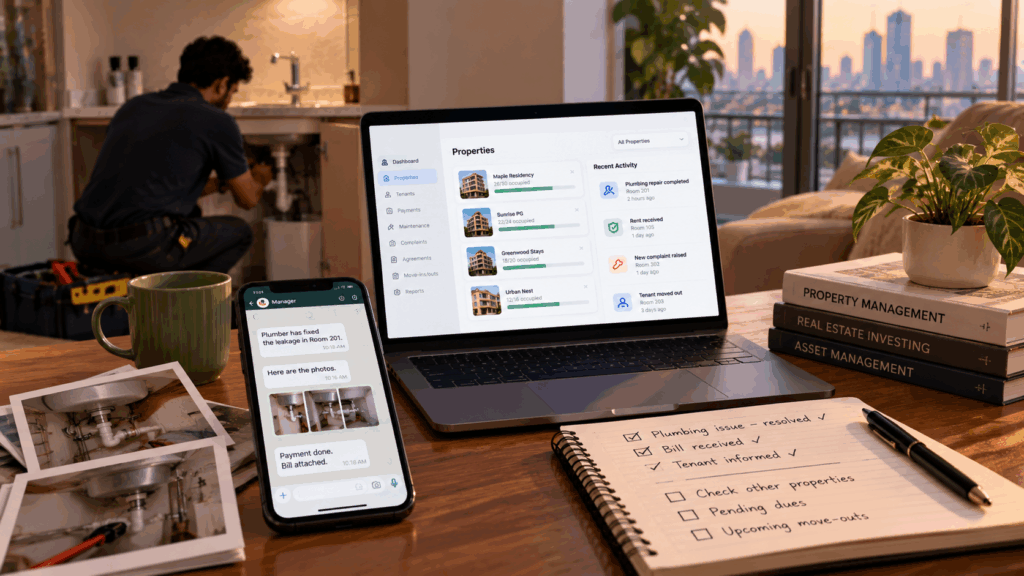
Consider a simple maintenance example. A tenant reports a plumbing issue. The local manager contacts a technician, the repair is completed, and the tenant is satisfied. From the property’s perspective, the immediate issue is resolved.
But suppose the owner later wants to know what happened.
If the only information is stored in the manager’s WhatsApp conversation, the owner may have to ask for screenshots, payment details, photographs, and an explanation of the work. That may not matter for one repair, but it becomes increasingly inefficient when similar situations occur across several properties.
A local manager and a digital system therefore serve different purposes.
The manager provides physical presence. The system provides operational visibility.
This distinction becomes particularly important when an NRI owns multiple rental properties. One person may be able to manage several routine tasks, but the owner still needs a reliable way to see what is happening without calling that person for every update.
The strongest setup is usually one where local people can handle what requires physical presence while the owner retains visibility over important property activity.
That also creates continuity.
If the local manager changes, the property’s payment history should not disappear. When a tenant raises a complaint, the owner should not have to reconstruct the entire issue from memory. Any pending payment should remain visible without waiting for the next monthly update.
Remote management becomes much easier when the owner is not dependent on a single person for basic information.
What If My Tenant Stops Paying Rent While I Am Abroad?
This is one of the most concerning situations for an NRI landlord, but it is also one where reacting too quickly can create additional problems.
The first step should be establishing exactly what has happened.
Check the rental agreement, payment history, dates, outstanding amount, and communication with the tenant. If the tenant says the payment was already made, verify the transaction rather than relying on an informal confirmation.
The distinction between a delayed payment and a serious tenancy dispute matters. So does the distinction between sending a payment reminder and taking formal action against a tenant.
RentOk’s guide on what to do when a tenant stops paying rent provides a useful framework around documentation, communication, and understanding the appropriate legal route before escalating the matter.
A clear record should establish:
- What was due: Record the original rent amount, payment date, and any applicable additional charges so there is no confusion about the starting point.
- What was received: Account for full or partial payments already made rather than treating the entire amount as unpaid.
- What remains outstanding: Calculate the current dues clearly so both the landlord and tenant are working with the same information.
- What has been communicated: Maintain written records of reminders, explanations, responses, and any commitments made by either party.
- What the agreement says: Review the clauses dealing with payment, notice, default, termination, and other relevant tenancy conditions before deciding what comes next.
If the issue continues, the landlord can seek appropriate professional advice based on the property’s location and circumstances.
An NRI landlord should be particularly careful about assuming that ownership alone allows them to take immediate action against a tenant. Where formal recovery of possession or eviction becomes necessary, the applicable legal process should be followed.
What If the Tenant Refuses to Leave?
A tenant refusing to vacate can turn a routine rental problem into a much more serious dispute, particularly when the owner is not in India.
The first mistake to avoid is treating the situation as something that can simply be solved by changing the locks, removing belongings, disconnecting essential services, or using pressure to force the tenant out.
The appropriate process depends on the tenancy agreement and the law applicable to the property. Different states can have different tenancy frameworks, and the circumstances surrounding the tenancy can also affect the available legal route.
An NRI landlord should therefore start by establishing the facts.
Review the agreement and identify the tenancy duration, notice requirements, termination clauses, and any relevant conditions. Then document the tenant’s conduct, outstanding payments, communication, and previous notices.
If the dispute has moved beyond routine communication, a qualified local lawyer can help determine the appropriate next step.
This is also where having a local point of contact becomes valuable. The owner may be abroad, but an authorised person can coordinate with the lawyer, attend meetings where appropriate, arrange property inspections, or handle other activities that require someone to be physically present.
The owner’s distance should not mean the property’s records are inaccessible.
A well-organised system can give the owner access to the information needed to understand the situation and make informed decisions without trying to personally manage every local activity.
How Can You Manage the Property Digitally From Anywhere?
Remote property management becomes much easier when routine information is not spread across notebooks, spreadsheets, WhatsApp chats, emails, and individual staff members.
Think about the questions an NRI landlord may need answered during an ordinary month.
Has this month’s rent been collected?
Which tenant still has pending dues?
Is there an unresolved complaint?
What maintenance expense was incurred?
When does the current tenancy end?
Has a tenant moved out, and has the property been prepared for the next occupant?
If every answer requires a separate call, the owner remains dependent on other people for basic visibility.
A digital property management system changes that relationship by bringing operational information into a more structured environment.
RentOk’s rental management guide explains how rental management increasingly involves much more than collecting rent. Tenant records, maintenance, communication, payments, occupancy, and other operational responsibilities all become interconnected as a property grows.
For an NRI owner, this is particularly relevant.
Digital management does not mean the landlord needs to personally perform every task from abroad. It means the owner can maintain visibility while local teams or representatives handle activities that require physical presence.
That creates a more sustainable operating model.
Instead of asking a manager to explain everything every month, the owner can focus on exceptions: overdue payments, unresolved complaints, upcoming move-outs, unusual expenses, or other matters that genuinely require attention.
This is the difference between being physically absent and being operationally disconnected.
An owner can live in another country and still have a structured view of what is happening at the property.
How RentOk Helps NRI Landlords Manage Property Remotely
For an NRI landlord, the biggest advantage of structured property management is not simply being able to perform tasks online. It is being able to maintain visibility over the property without depending entirely on phone calls, scattered records, or one local contact.
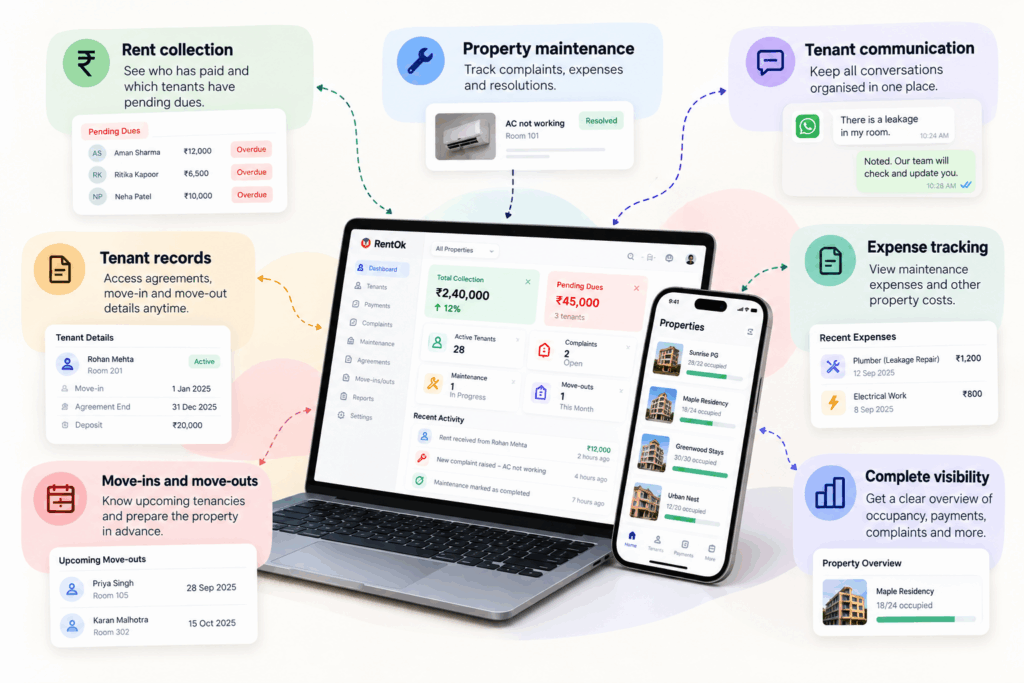
RentOk brings important rental operations together in one platform, helping property owners and managers organise tenant information, payments, dues, complaints, occupancy, expenses, communication, and other day-to-day workflows. This can give remote landlords a clearer view of what is happening at their property while allowing local teams to continue handling activities that require physical presence.
The same principle applies when managing multiple properties. Instead of maintaining separate spreadsheets or asking different people for different updates, the owner can work with a more centralised operating system.
That can make it easier to identify pending dues, follow tenant activity, understand property-level operations, and maintain continuity when staff or local representatives change.
RentOk does not replace legal advice or the need for appropriate local representation during a serious tenancy dispute. What it can do is reduce the operational gap between owning a property in India and living somewhere else.
Conclusion
An NRI landlord cannot control every situation that happens inside a rental property. A tenant may delay rent, a repair may suddenly be required, or a disagreement may develop despite having a clear agreement.
What can be controlled is how prepared the property is to deal with those situations.
A properly documented tenancy creates clarity. A reliable local point of contact provides physical support. Consistent records make it easier to understand what happened. Digital property management keeps the owner connected even when they are thousands of kilometres away.
The real objective of remote property management is therefore not to remove the owner from the process. It is to make the process organised enough that the owner does not have to be physically present for every decision, update, or routine task.
For NRI landlords, that difference matters.
Manage Your Property Remotely with RentOk and keep your tenants, payments, dues, complaints, and property operations organised from wherever you are.
Frequently Asked Questions
Find answers to common questions about this topic
About the Author
Ishika Pannu
Ishika Pannu brings you the latest insights and easy-to-apply strategies in property management—helping you simplify renting and grow with RentOk.
You may also like these
Related Articles
1 min read
What Documents Do I Actually Need Before Handing Over My Rental Property?
Written by
Posted on
Ishika Pannu
Sep 30, 2026
1 min read
Is a Verbal Rental Agreement Legally Valid in India?
Written by
Posted on
Ishika Pannu
Sep 24, 2026
1 min read
What Can I Do If My Tenant Stops Paying Rent?
Written by
Posted on
Ishika Pannu
Sep 23, 2026
1 min read
How to Check If Your PG or Hostel is Legally Registered in India
Written by
Posted on
Ishika Pannu
Sep 20, 2026
1 min read
How to Negotiate Rent and Maintenance Terms Before Signing
Written by
Posted on
Ishika Pannu
Sep 19, 2026
1 min read
What Your Landlord Can and Cannot Store From Your KYC Documents
Written by
Posted on
Ishika Pannu
Sep 19, 2026
1 min read
Why a Digital Rent Agreement Is Just as Legally Valid as a Paper One
Written by
Posted on
Ishika Pannu
Sep 18, 2026

1 min read
What Is Rent Control Law in India, and Which Cities Are Still Covered?
Written by
Posted on
Ishika Pannu
Sep 18, 2026

1 min read
Why Rent Agreement Rules Are Different in Every Indian State
Written by
Posted on
Ishika Pannu
Sep 17, 2026
1 min read
How Working Professionals Can Complete Tenant Verification Quickly
Written by
Posted on
Ishika Pannu
Sep 17, 2026
Stay ahead in property management with expert insights
Join thousands of property managers receiving exclusive tips delivered straight to your inbox.
Browse posts by category
Case Study
Cost of Living
Growth
Legal
Market Trends
News
Pg owner app
Property Management
Property Tax
Tech
RentOk
The easiest way to rent and manage your PGs and hostels.
Grievance Officer
Get the app


Contact us
hello@eazyapp.tech
HQ Office
COGROW, BASEMENT F-12/8A
BESIDE HOUSE OF STYLE SALON, SECTOR 28, DLF PHASE 1
GURUGRAM, HARYANA - 122002
South India Office
LUMIODESK COWORKING, 2ND FLOOR, 40, 14TH MAIN RD
BESIDE MC DONALD, 7TH SECTOR, HSR LAYOUT
BENGALURU, KARNATAKA - 560102
©️ 2026 EazyApp Tech Pvt Ltd. All rights reserved


