
Legal
Which Indian Cities Still Fall Under Old Rent Control Laws?

Written by
Ishika Pannu
Read Time
13 min read
Posted on
October 3, 2026
Overview
Overview
Which Indian Cities Still Fall Under Old Rent Control Laws?
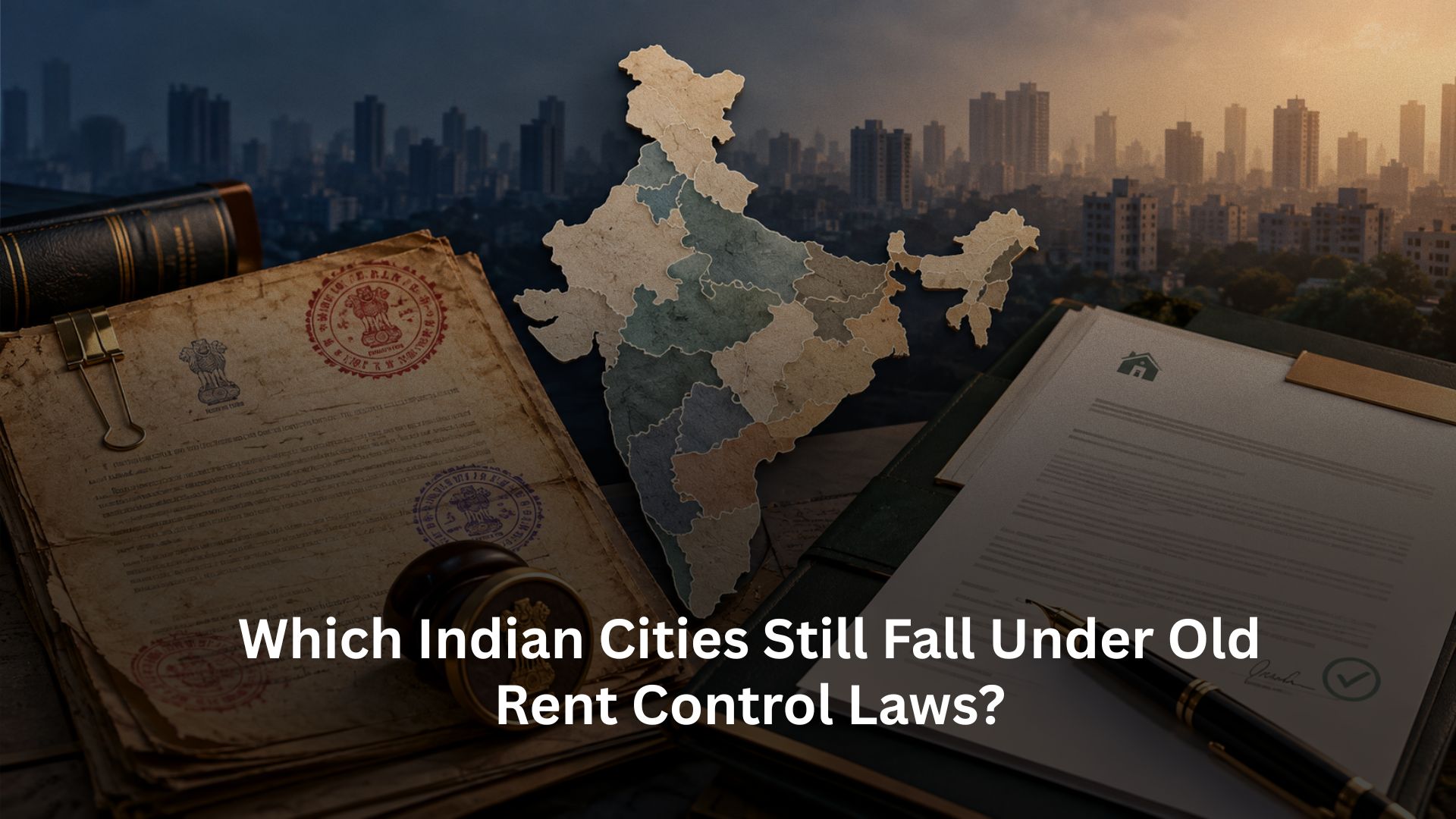
India does not have one rent-control law that applies to every rental property. Instead, rental relationships are shaped by state-specific laws, local rules, the nature of the property, and the type of tenancy.
This is why the question “Which Indian cities still fall under old Rent Control Acts?” is not as straightforward as it sounds.
Delhi, Mumbai, Bengaluru, and Kolkata all have long histories of rent-control legislation. Yet, that does not mean every property in these cities is automatically governed by an old rent-control law. The actual position can depend on the applicable legislation, the location of the premises, the type of property, and any exemptions provided under the law.
At the same time, India has been moving towards newer tenancy frameworks. The Model Tenancy Act, 2021 was designed to modernise rental relationships and improve dispute resolution. However, it was circulated to States and Union Territories for adoption. It did not automatically replace every existing Rent Control Act across India.
For landlords and property managers, this distinction matters. The law that applies to one property may not apply to another property in the same city.
What Do Old Rent Control Acts Actually Restrict?
India’s older rent-control laws were introduced to address specific housing conditions. They generally aimed to protect tenants from excessive rent increases and arbitrary eviction while establishing rules for landlord-tenant relationships.
Over the years, these laws developed differently across states. Some regulate rent fixation. Others contain provisions around eviction, rent increases, deposits, repairs, or tenancy rights.
The important point is that rent control does not mean the same thing everywhere.
For example, Section 6A of the Delhi Rent Control Act, 1958 provides for a 10% increase in standard rent every three years in the circumstances covered by the provision. This is very different from saying that every landlord in Delhi can increase rent by 10% every three years. The Act has its own scope and exemptions.
The same principle applies when looking at other states.
Depending on the applicable law, rent-control legislation may affect:
- Rent revisions: Some covered properties may be subject to statutory rules on rent increases rather than relying only on a privately agreed escalation clause.
- Eviction: Certain rent-control frameworks specify grounds and procedures for recovering possession from a tenant.
- Tenancy rights: Older legislation may provide protections that continue to operate alongside the rental agreement.
- Rent fixation: Some laws provide mechanisms for determining or regulating the rent payable for covered premises.
- Property exemptions: A law may exclude certain buildings, newer properties, categories of premises, or specific situations from some or all of its provisions.
This is why landlords should not treat a rent-control law as a simple city-wide label.
If you want to understand another important part of this issue, RentOk’s guide on How Rent Increases Work in India and When They’re Illegal explains why the legality of a rent increase depends on more than the percentage being charged.
Which Indian Cities Still Have Older Rent-Control Frameworks?
Several major Indian rental markets continue to have state or local legislation rooted in older rent-control frameworks.
However, it is more accurate to identify the applicable law and its scope than to label an entire city as “rent controlled.”
Delhi
Delhi remains one of the most frequently discussed examples.
The Delhi Rent Control Act, 1958 continues to form part of Delhi’s rental-law framework. Its territorial provisions specify the areas to which the Act extends. The legislation also contains provisions dealing with standard rent, rent revision, eviction, and other aspects of the landlord-tenant relationship.
That does not mean every rental property in Delhi is governed by every provision of the Act.
A property manager must first determine whether the particular premises falls within the Act’s scope and whether an exemption applies.
This distinction becomes particularly important in a city where rental properties range from older residential units to newer apartments, PGs, hostels, and managed accommodation.
RentOk has already explored this subject in greater detail in its article on What Is Rent Control Law in India, and Which Cities Are Still Covered?. It provides useful background on how India’s rent-control framework developed and why applicability cannot be determined by city name alone.
Mumbai and Maharashtra
Maharashtra is another major rental market where older rent-control principles continue to matter.
The state has the Maharashtra Rent Control Act, 1999, which remains listed by the Maharashtra Housing Department as a state housing law.
The Act consolidated earlier rent-control legislation and continues to form part of the legal framework governing covered rental premises in Maharashtra.
For property owners in Mumbai, this means that relying only on general rental practices can be risky. The specific property and tenancy need to be examined against the applicable provisions.
This is particularly relevant for owners managing several units. Different properties may have different agreements, histories, and legal characteristics.
Bengaluru and Karnataka
Karnataka also has its own rental legislation in the form of the Karnataka Rent Act, 1999. The Act contains provisions relating to tenancy agreements, rent regulation, and tenant rights.
One notable feature is that Section 4 requires tenancy agreements covered by the Act to be in writing.
That is a useful reminder that rental compliance is not limited to rent increases or eviction. Documentation itself can be part of the legal framework.
For operators managing PGs, hostels, or co-living properties in Bengaluru, this makes it especially important to maintain accurate agreements and tenant records.
Kolkata and West Bengal
West Bengal has also maintained its own statutory tenancy framework through the West Bengal Premises Tenancy Act, 1997.
The Act contains provisions dealing with matters such as fair rent and restrictions on certain payments connected with tenancies.
Again, the existence of this legislation does not mean every property in Kolkata is treated identically.
The relevant question is whether the specific premises and tenancy fall within the Act’s scope.
Other Rental Markets
These examples are not an exhaustive list of every state with rent-related legislation.
Several states have developed their own tenancy frameworks over the years. Some have older rent-control laws. Others have introduced newer legislation. Some have amended existing laws to reflect changing rental-market conditions.
This creates a rental landscape where the same clause can have different implications in different states.
For this reason, property operators should avoid using a single agreement template for every location without checking the applicable legal requirements.
RentOk’s article on Why Rent Agreement Rules Are Different in Every Indian State explores this issue in more detail.

Does the Model Tenancy Act Replace Old Rent Control Laws?
This is one of the biggest areas of confusion in India’s rental market.
The Model Tenancy Act, 2021 is not a nationwide replacement for every Rent Control Act.
The Union Cabinet approved the Model Tenancy Act in June 2021. It was then circulated to States and Union Territories for adoption. States could enact a new law or amend their existing rental legislation along the lines of the Model Tenancy Act.
This means the Model Tenancy Act is better understood as a model framework, not an automatically applicable central tenancy law.
Its approach focuses on creating a more structured rental relationship. It covers areas such as written tenancy agreements, rent authorities, responsibilities of landlords and tenants, and dispute resolution.
But the legal position still depends on what the relevant State or Union Territory has actually adopted.
For a landlord or property manager, there are therefore several possible situations:
- Existing rent-control framework: An older state law may continue to apply to certain properties or tenancies, subject to its scope and exemptions.
- Newer tenancy legislation: A state may enact legislation based on the Model Tenancy Act and create a different framework for applicable rental arrangements.
- Different rules for different properties: Even within one state, exemptions and property-specific provisions can mean that not every tenancy is treated in exactly the same way.
This is why comparing the Model Tenancy Act vs Rent Control Act as though one automatically replaced the other can lead to incorrect conclusions.
RentOk’s article on What Are Your Rights as a Tenant Under the Model Tenancy Act? provides additional context on the model framework and its approach to rental relationships.
What Does This Mean for New Rental Agreements?
A new rental agreement does not automatically escape older rent-control legislation simply because it has been signed recently.
The first question is always whether the property and tenancy fall within the applicable legal framework.
This becomes especially important for PGs, hostels, and co-living businesses. Their agreements often cover more than monthly rent. They may also include food, housekeeping, utilities, maintenance, internet access, shared facilities, deposits, notice periods, and lock-in conditions.
A properly prepared agreement should reflect the actual arrangement.
Before finalising a new agreement, landlords and property managers should review:
- The applicable law: Identify the state and local jurisdiction first. Then determine which tenancy or rent-control legislation applies to the particular premises.
- Property-specific exemptions: Check whether the property falls under any exemption based on factors such as its type, age, location, rent, or other statutory conditions.
- Financial terms: Clearly document rent, deposits, maintenance charges, utilities, escalation provisions, and payment dates.
- Tenancy and exit terms: Specify the duration, renewal process, lock-in period, notice period, and conditions for termination.
- Documentation requirements: Check whether the agreement needs stamping, registration, verification, or other formalities under the applicable state framework.
RentOk’s Rent Agreement Checklist: 15 Things Every Owner Should Include is also useful when reviewing the basic information that should be captured in an agreement.
The goal is not to create a longer agreement for the sake of it.
The goal is to create an agreement that accurately records the arrangement and follows the rules applicable to that property.
Why Does the 11-Month Agreement Still Cause Confusion?
The 11-month agreement is one of the most common examples of rental practices being treated as universal legal rules.
An agreement lasting 11 months is not automatically governed by one standard set of rules across India.
Registration and stamping requirements can vary based on the state, the nature of the arrangement, and the applicable legislation. A landlord should therefore avoid assuming that an 11-month agreement is automatically exempt from every registration or documentation requirement.
This becomes even more important for property managers operating across cities.
The same agreement duration can have different compliance implications in different states. A process that works for one property may not be sufficient for another.
RentOk’s How to Create a Legally Valid Rent Agreement in India explains why agreement validity depends on the actual terms and applicable requirements rather than simply choosing a commonly used duration.
Digital documentation does not remove these requirements either. RentOk’s guide on What Is E-Stamping for Rent Agreements and Is It Legally Valid? explains why e-stamping, execution, and registration should be treated as separate compliance considerations.
How Can You Check Which Rent Law Applies to Your Property?
The safest approach is to start with the property, not the city.
A city name can tell you which state framework to investigate. It cannot, by itself, establish that every property is covered by a particular Rent Control Act.
Start by identifying the property’s location and type. Then review the tenancy arrangement and the relevant state legislation. Finally, check whether any exemption changes the position.
For property managers, a practical compliance review should cover:
- Property information: Keep the full property address, property type, and relevant location details properly recorded for each unit or building.
- Agreement information: Maintain the tenancy agreement, renewal history, deposit details, rent terms, and important clauses in an organised record.
- Legal applicability: Identify the legislation relevant to that property and verify whether its provisions actually apply to the tenancy.
- Operational records: Keep payment records, notices, tenant information, and important communications accessible. These records can become important when a disagreement arises.
- Periodic checks: Do not treat compliance as a one-time exercise. State rules and tenancy frameworks can change, so rental businesses should periodically review their processes.
This approach becomes even more important when a business operates across several cities. A centralised record can help the team identify which properties need which documentation and reduce the chance of applying the wrong process.
For landlords and property managers, the aim is simple: know the law that applies to the property, document the tenancy correctly, and keep the relevant records organised.

How RentOk Helps With Rental Compliance
Rental compliance becomes harder to manage when tenant information, agreements, payments, notices, and property records are spread across different files and communication channels.
RentOk helps property operators bring key rental workflows into one connected system. Tenant information, payment records, dues, agreements, and day-to-day property operations can be managed with better visibility.
For PGs, hostels, co-living businesses, and landlords managing multiple properties, this structure can make routine documentation easier to organise. It can also reduce the operational gaps that appear when teams rely heavily on spreadsheets, physical records, and scattered conversations.
The benefit is not simply having more digital records. It is having a more organised view of the tenancy lifecycle. That becomes increasingly valuable as the number of tenants and properties grows.
Conclusion
India’s rental market is governed by a mix of older rent-control laws, state-specific tenancy legislation, and newer frameworks influenced by the Model Tenancy Act.
That is why there is no reliable one-line answer to the question of which Indian cities are “under rent control.”
Delhi continues to have the Delhi Rent Control Act. Maharashtra has the Maharashtra Rent Control Act. Karnataka has the Karnataka Rent Act. West Bengal has its own premises-tenancy legislation. But the existence of these laws does not automatically mean that every property in those cities is covered by every provision.
For landlords and property managers, the better approach is to look beyond the city name.
Check the property. Review the tenancy. Identify the applicable legislation. Confirm exemptions. Then make sure the agreement and operational records reflect those requirements.
If you are managing rental properties and want a more organised way to handle tenant records, agreements, payments, and property operations, check compliance requirements with RentOk and explore how structured property management can simplify rental operations.
Frequently Asked Questions
Find answers to common questions about this topic
About the Author
Ishika Pannu
Ishika Pannu brings you the latest insights and easy-to-apply strategies in property management—helping you simplify renting and grow with RentOk.
You may also like these
Related Articles

1 min read
Managing Rental Property in India as an NRI Landlord
Written by
Posted on
Ishika Pannu
Oct 1, 2026
1 min read
What Documents Do I Actually Need Before Handing Over My Rental Property?
Written by
Posted on
Ishika Pannu
Sep 30, 2026

1 min read
Is a Verbal Rental Agreement Legally Valid in India?
Written by
Posted on
Ishika Pannu
Sep 24, 2026
1 min read
What Can I Do If My Tenant Stops Paying Rent?
Written by
Posted on
Ishika Pannu
Sep 23, 2026

1 min read
How to Check If Your PG or Hostel is Legally Registered in India
Written by
Posted on
Ishika Pannu
Sep 20, 2026
1 min read
How to Negotiate Rent and Maintenance Terms Before Signing
Written by
Posted on
Ishika Pannu
Sep 19, 2026

1 min read
What Your Landlord Can and Cannot Store From Your KYC Documents
Written by
Posted on
Ishika Pannu
Sep 19, 2026

1 min read
Why a Digital Rent Agreement Is Just as Legally Valid as a Paper One
Written by
Posted on
Ishika Pannu
Sep 18, 2026

1 min read
What Is Rent Control Law in India, and Which Cities Are Still Covered?
Written by
Posted on
Ishika Pannu
Sep 18, 2026

1 min read
Why Rent Agreement Rules Are Different in Every Indian State
Written by
Posted on
Ishika Pannu
Sep 17, 2026
Stay ahead in property management with expert insights
Join thousands of property managers receiving exclusive tips delivered straight to your inbox.
Browse posts by category
Case Study
Cost of Living
Growth
Legal
Market Trends
News
Pg owner app
Property Management
Property Tax
Tech
RentOk
The easiest way to rent and manage your PGs and hostels.
Grievance Officer
Get the app


Contact us
hello@eazyapp.tech
HQ Office
COGROW, BASEMENT F-12/8A
BESIDE HOUSE OF STYLE SALON, SECTOR 28, DLF PHASE 1
GURUGRAM, HARYANA - 122002
South India Office
LUMIODESK COWORKING, 2ND FLOOR, 40, 14TH MAIN RD
BESIDE MC DONALD, 7TH SECTOR, HSR LAYOUT
BENGALURU, KARNATAKA - 560102
©️ 2026 EazyApp Tech Pvt Ltd. All rights reserved


