
Legal
What Can I Do If My Tenant Stops Paying Rent?

Written by
Ishika Pannu
Read Time
15 min read
Posted on
September 23, 2026
Overview
Overview
What Can I Do If My Tenant Stops Paying Rent?
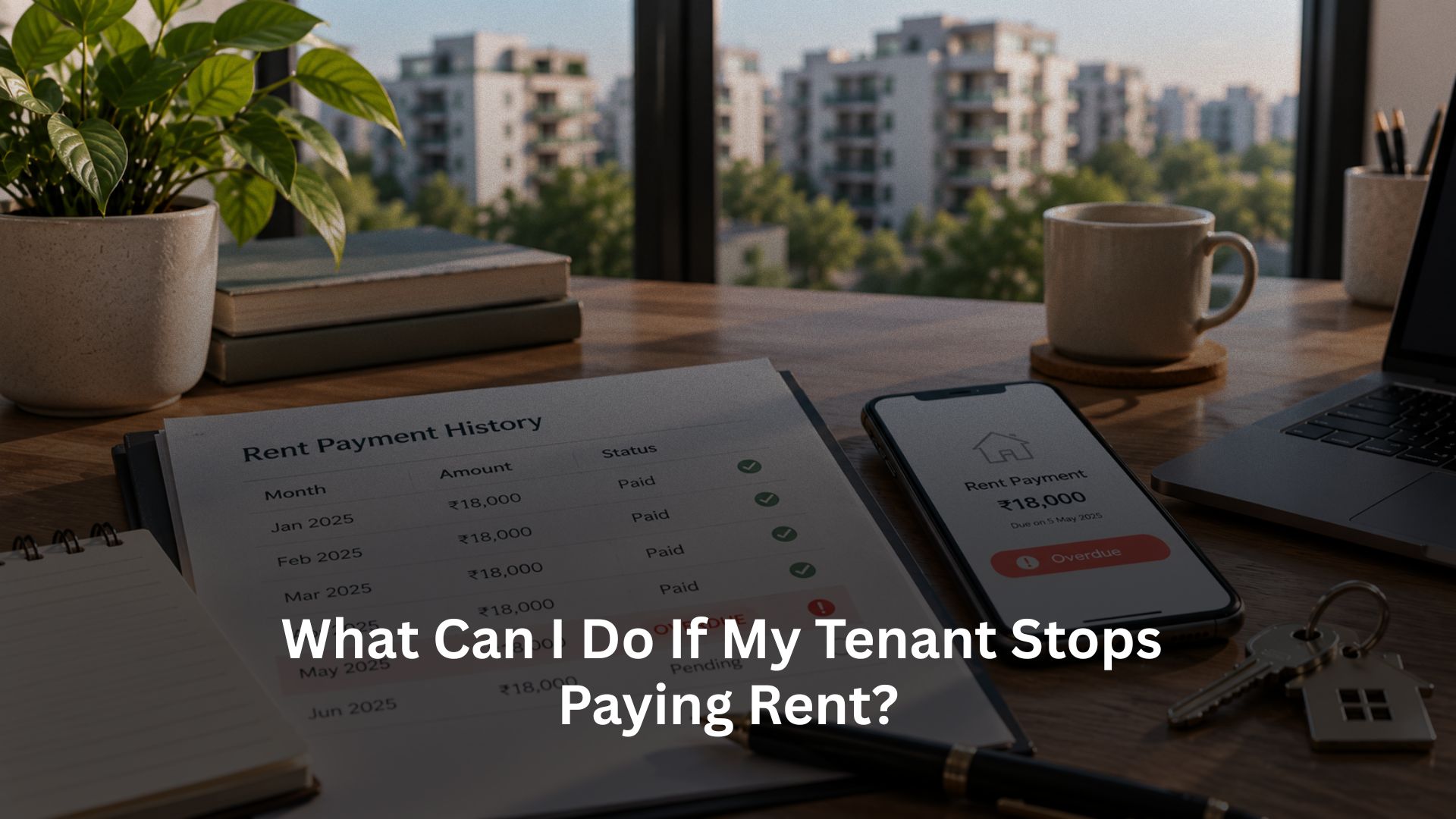
Rent collection is one of the most important parts of managing a rental property. When a tenant misses one payment, the issue may seem temporary. They may have forgotten the due date or faced a short-term cash flow problem.
The situation becomes more serious when the payment remains overdue. Repeated follow-ups can consume time. Larger arrears can also affect the landlord’s own finances and property expenses.
This often leads to a difficult question: What can a landlord do when a tenant stops paying rent?
The answer is not simply to ask the tenant to leave. Rental disputes in India are governed by the tenancy agreement and the laws applicable to the property. These rules can differ across states and property types.
For landlords, the safest approach is to document the default first. The next step may involve a formal demand or legal notice. If the issue remains unresolved, the landlord may need to approach the appropriate legal forum.
The process should remain structured from the beginning. A missed payment is a financial issue. An unresolved default can become a legal issue.
This guide explains the practical steps landlords can take when rent remains unpaid. It also covers legal notices, eviction proceedings, and the risks of using informal or forceful methods.
First Step: Documenting the Default
Before sending a legal notice, establish exactly what has happened.
A landlord should not rely on memory or scattered WhatsApp conversations. The first step is to calculate the outstanding amount and create a clear record of the default.
Start by checking the tenancy agreement. Look at the agreed payment date, monthly amount, late-payment terms, and any clauses dealing with default or termination.
Then compare those terms with the actual payment history.
A useful default record should include:
- Amount due: Record the agreed monthly amount and any other charges that are legally recoverable under the agreement.
- Payment due date: Note when each unpaid amount became due.
- Payments received: Include full payments, partial payments, and any amounts received after the due date.
- Outstanding balance: Calculate the total amount currently unpaid.
- Communication history: Keep reminders, payment discussions, acknowledgements, and other relevant messages.
- Agreement details: Keep a copy of the signed agreement and any written amendments.
This documentation can become important if the dispute later moves beyond routine collection.
For example, suppose a tenant owes ₹18,000 for two months. They then transfer ₹8,000 without explaining the payment. The landlord should record the part-payment and update the balance rather than treating the entire amount as unpaid.
Clear records prevent confusion over the actual arrears.
They also make communication more professional.
Landlords can also review RentOk’s guide to creating a legally valid rent agreement in India. Clear payment dates, additional charges, tenure, and termination terms can make later disputes easier to understand.
Start With a Payment Reminder
Not every missed payment requires immediate legal action.
A tenant may have a genuine reason for a short delay. A written reminder gives them an opportunity to resolve the issue before the matter escalates.
The reminder should be simple and factual. Mention the amount due, the original due date, and the requested payment date.
Avoid making threats at this stage. The objective is to create a clear communication trail and encourage payment.
If the tenant responds with a reason for the delay, the landlord can decide whether a short extension or payment arrangement is appropriate.
However, repeated delays should not be treated as isolated incidents. A pattern of non-payment needs closer attention.
RentOk’s guide on dealing with tenants who pay late every month explains why recurring delays can become an operational problem even when the tenant eventually pays.

When Should a Landlord Send a Formal Legal Notice?
If informal reminders do not resolve the default, a formal notice may become appropriate.
A legal notice is more than a stronger version of a WhatsApp message. It should clearly establish the tenancy, the payment default, and the action expected from the tenant.
There is no single legal-notice format that applies to every rental dispute in India. The appropriate notice depends on the tenancy agreement, the property, and the law governing the tenancy.
A formal notice may generally identify:
- The landlord and tenant.
- The rented property.
- The tenancy agreement and relevant dates.
- The amount of rent outstanding.
- The dates for which payment remains due.
- Any applicable contractual terms concerning default.
- The action the tenant is required to take.
- The consequences that may follow if the default is not resolved.
The wording should remain precise.
For instance, instead of writing, “You have refused to pay rent and must leave immediately,” a notice should establish the actual payment history and refer to the relevant contractual or legal basis.
This distinction matters.
A landlord should not make legal claims that are not supported by the agreement or applicable law.
RentOk’s step-by-step guide to filing a rental dispute complaint in India also explains why a formal dispute communication should establish the facts, identify the issue, and state the resolution being sought.
What Should Be Included in the Notice?
A well-prepared notice should make it difficult to misunderstand the issue.
The tenant should be able to identify the property, the alleged default, the amount claimed, and the action expected.
The landlord should also retain proof of service. This can become important if the dispute later reaches a court or other legal authority.
The method of serving the notice can depend on the applicable law. Section 106 of the Transfer of Property Act, 1882 contains rules for certain leases. It also provides notice requirements where its provisions apply. However, it should not be treated as a universal eviction rule for every tenancy in India.
State-specific rent-control laws and the tenancy agreement may provide different requirements.
Legal Grounds and Process for Eviction
Non-payment of rent can be a ground for seeking eviction. However, a landlord cannot simply remove a tenant because one payment has been missed.
The legal process depends on the applicable tenancy framework.
The Model Tenancy Act, 2021 provides one example of a structured approach. Under its framework, eviction can be sought where a tenant has failed to pay rent and other charges for two consecutive months, subject to the notice and payment provisions in the model framework. It also provides an opportunity for the tenant to clear the arrears within the prescribed period after a demand notice.
The important point is that the Model Tenancy Act is a model framework. It does not automatically apply to every rental property across India. The actual law applicable to a property depends on the state or Union Territory framework and the nature of the tenancy.
This is why landlords should avoid using a single “two months of unpaid rent” rule for every property.
The Eviction Process Can Involve Several Stages
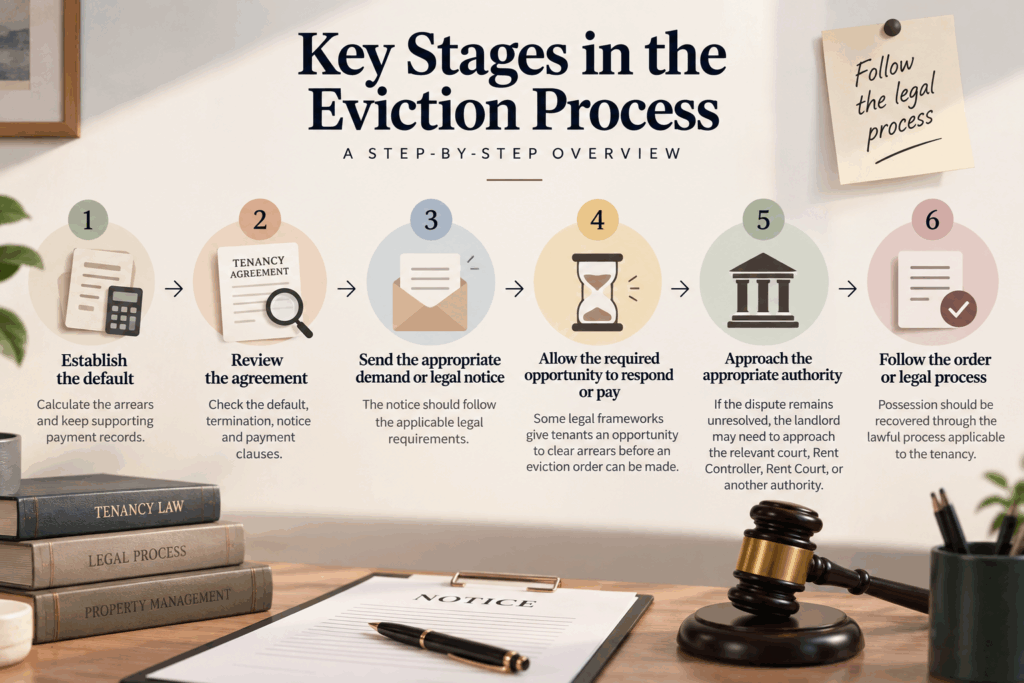
Although the exact process varies, a landlord may need to move through several stages:
1. Establish the default
Calculate the arrears and maintain supporting payment records.
2. Review the agreement
Check the default, termination, notice, and payment clauses.
3. Send the appropriate demand or legal notice
The notice should follow the applicable legal requirements.
4. Allow the required opportunity to respond or pay
Some legal frameworks give tenants an opportunity to clear arrears before an eviction order can be made.
5. Approach the appropriate authority
If the dispute remains unresolved, the landlord may need to approach the relevant court, Rent Controller, Rent Court, or another authority.
6. Follow the order or legal process
Possession should be recovered through the lawful process applicable to the tenancy.
The Model Tenancy Act, for example, provides for Rent Authorities, Rent Courts, and Rent Tribunals within its proposed framework. Its structure is designed to provide a formal dispute-resolution route rather than relying on unilateral action by either party.
State Laws Can Work Differently
The difference between states is important.
For example, the Delhi Rent Control Act, 1958 contains a specific provision concerning eviction for non-payment of legally recoverable rent. Section 14(1)(a) refers to arrears that remain unpaid after a notice of demand and provides a two-month period under that provision.
This does not mean the same process applies to every property in India.
A landlord in another state may be governed by a different rent-control statute or tenancy framework. Some properties may also fall outside particular rent-control protections.
Therefore, the correct legal question is not simply, “How many months of rent can remain unpaid?”
It is:
What agreement and law govern this specific tenancy, and what process do they require?
That distinction can prevent landlords from taking the wrong legal step.
Avoiding Illegal “Self-Help” Measures
When rent remains unpaid for several months, frustration can build quickly.
A landlord may feel that changing the locks, removing the tenant’s belongings, or cutting off services will force payment. These actions can create additional legal problems instead of resolving the original dispute.
The safer approach is to use the appropriate legal process.
A landlord should avoid treating property ownership as permission to bypass tenancy protections. If the tenant is still in lawful possession, the landlord should not assume that they can simply take possession back without following the applicable procedure.
Common Actions Landlords Should Avoid
- Changing the locks: Do not assume that changing access to the property is a substitute for an eviction order or lawful recovery process.
- Removing the tenant’s belongings: Personal property should not be removed simply because rent is overdue.
- Using threats or intimidation: Aggressive communication can escalate the dispute and create additional issues.
- Cutting essential services as pressure: Utilities or services should not be manipulated as an informal eviction method.
- Entering the property without proper authority: Ownership does not automatically eliminate the tenant’s rights to lawful possession during the tenancy.
- Ignoring the agreement: The landlord should follow the contractual and legal framework rather than relying on personal assumptions.
The goal should be lawful recovery of possession, not forced removal.
This is particularly important for landlords managing multiple units. A rushed action against one tenant can create a dispute that takes more time and money to resolve.
RentOk’s guide to legal eviction of a non-paying tenant in India provides a more detailed look at the distinction between rent recovery, notices, and formal eviction proceedings.
What If the Tenant Claims They Have Already Paid?
A payment dispute can become more complicated when the tenant says the amount has already been paid.
This is where proper records become valuable.
Ask for the payment reference or transaction details. Then compare them with the landlord’s bank statement, payment dashboard, receipt, or other records.
Partial payments should also be recorded accurately.
For example, if ₹25,000 is due and the tenant pays ₹10,000, the outstanding balance should reflect ₹15,000. The landlord should not continue sending a demand for the full ₹25,000 without accounting for the payment.
The same principle applies to disputed charges.
If the tenant challenges a maintenance fee or utility amount, separate that dispute from the undisputed rent wherever possible. A clear ledger makes it easier to identify exactly what remains unpaid.
A proper payment trail can include:
- Due amount.
- Amount received.
- Date of payment.
- Payment method.
- Transaction reference.
- Outstanding balance.
- Late-payment charges, if contractually and legally applicable.
This is another reason digital rent collection can be useful. It creates a consistent record instead of leaving the landlord to reconstruct months of payments from different sources.
How Can Landlords Prevent Rent Defaults?
The best time to address payment problems is before they become arrears.
A strong rent-collection process starts with clear terms. The tenant should know the payment date, amount, accepted payment method, and consequences of late payment.
The landlord should also have a consistent reminder system.
Manual reminders often depend on memory. One tenant may receive a reminder three days before the due date. Another may only receive a message after the payment is already late.
Automation creates a more consistent process.
A simple reminder cycle can include:
- Pre-due reminder: Give tenants advance notice that the payment date is approaching.
- Due-date reminder: Notify tenants when payment becomes due.
- Pending-payment reminder: Follow up with tenants whose payment has not been recorded.
- Late-payment communication: Send a further notification when the amount remains outstanding.
The objective is not to bombard tenants with messages.
It is to make the payment expectation predictable.
RentOk’s guide to automatic rent reminders on WhatsApp explains how a structured reminder cycle can reduce manual follow-ups. It also discusses pre-due, due-date, and post-due reminders.
Why Documentation Matters in a Rent Default
Documentation is not only useful when a dispute reaches court.
It also improves everyday property management.
Consider two landlords.
The first keeps the agreement in one folder, payment records in a bank statement, reminders in WhatsApp, and partial-payment details in a notebook.
The second maintains a central record of the tenant, payment status, outstanding balance, and communication history.
If both face the same default, the second landlord can identify the issue much faster.
Good records also help identify patterns.
Perhaps a tenant is always late after the 10th of the month. In some properties, several tenants may miss payments because the due date does not align with their salary cycle. Late reminders could also be contributing to the problem.
These patterns can help landlords improve their collection process.
RentOk’s guide to tracking rent collection performance looks at payment data beyond simply checking who has paid. Tracking delays and collection patterns can help property operators build a more predictable payment cycle.
When Should a Landlord Consider Legal Advice?
Not every delayed payment requires a lawyer.
A short delay may be resolved through a reminder and a clear conversation. The situation becomes more serious when arrears continue to accumulate, the tenant disputes the amount, or the tenant refuses to respond.
Legal advice can be particularly useful when:
- The tenant has accumulated significant arrears.
- The tenancy agreement contains unclear or conflicting terms.
- The tenant disputes the validity of the payment demand.
- The property falls under a rent-control law.
- The landlord wants to terminate the tenancy.
- A formal legal notice needs to be served.
- The tenant refuses to vacate after the tenancy is lawfully terminated.
- Court or Rent Authority proceedings may be required.
The legal route should be based on the actual tenancy.
A notice template found online may not account for the property’s location, agreement terms, or applicable statute. For that reason, landlords should have a qualified legal professional review the situation when the dispute becomes complex.

How RentOk Helps Landlords Automate Rent Reminders
RentOk helps property operators move rent collection from manual follow-ups to a more structured workflow. Instead of remembering which tenant needs a reminder, landlords and property managers can use automated communication around the payment cycle. This helps keep pre-due, due-date, and pending-payment reminders consistent. Payment information can also be tracked centrally, making it easier to identify outstanding amounts and follow up when required. The aim is not to replace the legal process when a default occurs. It is to reduce avoidable payment delays before they become larger collection or compliance problems.
Conclusion
A tenant who stops paying rent can create both a cash-flow problem and a legal challenge. The right response is to act systematically rather than react emotionally.
Start by documenting the default. Check the agreement and calculate the exact outstanding amount. Send a clear reminder and escalate to a formal notice when appropriate.
If the tenant still does not resolve the default, understand the legal grounds and procedure that apply to the property. State laws and tenancy frameworks can differ, so a rule that applies in one location may not apply elsewhere.
Most importantly, avoid self-help measures such as forced removal or other attempts to bypass the legal process. Lawful recovery of possession is the safer approach.
The best solution is often prevention. Clear agreements, consistent payment records, and timely reminders can reduce the chances of small delays becoming serious defaults.
Automate Rent Reminders on RentOk and build a more consistent rent-collection process before overdue payments become a bigger problem.
Legal note: Rental and eviction laws vary by state, property type, and tenancy arrangement. This article provides general information and should not be treated as legal advice for a specific dispute.
Frequently Asked Questions
Find answers to common questions about this topic
About the Author
Ishika Pannu
Ishika Pannu brings you the latest insights and easy-to-apply strategies in property management—helping you simplify renting and grow with RentOk.
You may also like these
Related Articles

1 min read
How to Check If Your PG or Hostel is Legally Registered in India
Written by
Posted on
Ishika Pannu
Sep 20, 2026
1 min read
How to Negotiate Rent and Maintenance Terms Before Signing
Written by
Posted on
Ishika Pannu
Sep 19, 2026

1 min read
What Your Landlord Can and Cannot Store From Your KYC Documents
Written by
Posted on
Ishika Pannu
Sep 19, 2026

1 min read
Why a Digital Rent Agreement Is Just as Legally Valid as a Paper One
Written by
Posted on
Ishika Pannu
Sep 18, 2026

1 min read
What Is Rent Control Law in India, and Which Cities Are Still Covered?
Written by
Posted on
Ishika Pannu
Sep 18, 2026

1 min read
Why Rent Agreement Rules Are Different in Every Indian State
Written by
Posted on
Ishika Pannu
Sep 17, 2026

1 min read
How Working Professionals Can Complete Tenant Verification Quickly
Written by
Posted on
Ishika Pannu
Sep 17, 2026

1 min read
Student Tenant Verification: A Guide Before Moving Into a PG
Written by
Posted on
Ishika Pannu
Sep 16, 2026

1 min read
New UPI MDR Rule: What It Means for Rent Payments
Written by
Posted on
Ishika Pannu
Sep 16, 2026

1 min read
What Happens If You Break Your Rent Agreement Before the Lock-In Period?
Written by
Posted on
Ishika Pannu
Sep 14, 2026
Stay ahead in property management with expert insights
Join thousands of property managers receiving exclusive tips delivered straight to your inbox.
Browse posts by category
Case Study
Cost of Living
Growth
Legal
Market Trends
News
Pg owner app
Property Management
Property Tax
Tech
RentOk
The easiest way to rent and manage your PGs and hostels.
Get the app


Contact us
hello@eazyapp.tech
HQ Office
COGROW, BASEMENT F-12/8A
BESIDE HOUSE OF STYLE SALON, SECTOR 28, DLF PHASE 1
GURUGRAM, HARYANA - 122002
South India Office
LUMIODESK COWORKING, 2ND FLOOR, 40, 14TH MAIN RD
BESIDE MC DONALD, 7TH SECTOR, HSR LAYOUT
BENGALURU, KARNATAKA - 560102
©️ 2026 EazyApp Tech Pvt Ltd. All rights reserved


