Legal
Aadhaar vs Police Verification: A Security Guide for Indian Landlords

Written by
Ishika Pannu
Read Time
9 min read
Posted on
June 2, 2026
Overview
Overview
Aadhaar vs Police Verification: A Security Guide for Indian Landlords
Tenant verification is one of those tasks that most landlords know is important, yet many still approach it as a paperwork exercise rather than a security process.
A tenant moves in, a photocopy of their Aadhaar card is collected, an agreement is signed, and operations move forward. For a while, everything seems fine. But when a dispute arises, a payment issue occurs, authorities request information, or an unexpected occupancy problem emerges, landlords often discover that simply collecting documents and properly verifying tenants are two very different things.
This becomes even more important for PGs, co-living spaces, hostels, and rental properties with frequent tenant movement. When dozens of residents move in and out throughout the year, maintaining accurate records and verified occupancy becomes an operational necessity rather than just a legal formality.
That is why two terms frequently come up during tenant onboarding: Aadhaar verification and police verification. While they are often used interchangeably, they serve different purposes and help landlords manage different types of risks.
Understanding where each fits into your tenant onboarding process can help create a safer, more organized, and professionally managed rental business.
Why Tenant Verification Matters More Than Most Landlords Realize
Many operators view verification as something that protects them only during legal disputes. In reality, its impact extends much further into daily operations.
When tenant information is incomplete, outdated, or difficult to access, even routine management tasks become harder. Property managers spend extra time locating documents, confirming occupant details, or verifying information that should have been organized during onboarding.
As occupancy grows, weak verification processes often create challenges such as:
- Missing tenant records that make it difficult to retrieve important information during move-outs, deposit settlements, or agreement renewals.
- Unclear occupancy data where management is no longer fully aware of who is currently staying in the property and whether records remain updated.
- Delays in responding to authority requests because documents are scattered across physical files, WhatsApp chats, spreadsheets, and email attachments.
- Increased risk during disputes because identity documents, agreements, and payment records are not stored in a structured manner.
Professional rental businesses understand that verification is not simply about checking identities. It is about maintaining visibility across the entire tenant lifecycle.
The stronger the onboarding process, the easier it becomes to manage everything that follows.
Aadhaar Verification vs Police Verification: What Is the Difference?
One of the most common misconceptions among landlords is that collecting an Aadhaar card automatically completes tenant verification.
It does not.
Aadhaar verification and police verification solve different problems, which is why experienced operators often view them as complementary rather than competing processes.
Identity Validation Through Aadhaar Verification
The primary purpose of Aadhaar verification is to confirm that a resident’s identity details match official records.
It allows landlords to establish who the tenant is and maintain a reliable record of their basic information from the very beginning of the relationship.
Operationally, Aadhaar verification helps by:
- Creating a documented identity trail that reduces the chances of incomplete or inaccurate tenant information entering the system.
- Making tenant onboarding faster because identity records can be collected and stored in a standardized format.
- Improving documentation quality by ensuring that records remain linked to verified personal information rather than manually entered details alone.
- Simplifying future record management because identity information becomes easier to retrieve during renewals, disputes, or move-outs.
For most PGs and rental properties, Aadhaar verification serves as the first layer of tenant screening.
Police Verification Adds an Additional Security Layer
Police verification serves a different purpose.
Instead of simply confirming identity, it helps create an official verification process linked to local authorities. Depending on local regulations, this may involve registering tenant information or completing additional verification requirements.
For landlords, police verification can provide benefits such as:
- Stronger occupancy visibility because tenant information is formally documented through recognized procedures.
- Better compliance with local verification requirements where tenant registration is encouraged or required.
- Additional confidence that tenant information has been reviewed through a structured process rather than relying solely on self-submitted documents.
- Improved property security by making verification a formal part of onboarding instead of an informal administrative task.
Think of it this way:
Aadhaar verification tells you who the tenant is.
Police verification helps strengthen the overall security framework around occupancy.
What Are the Legal Requirements for Landlords in India?
One reason landlords often feel confused about verification is that there is no single process that applies uniformly across the country.
Requirements can vary depending on:
- The city where the property is located.
- Local police department procedures.
- The type of rental property being managed.
- State-specific administrative guidelines.
Because of this, landlords should always stay updated with the latest local requirements instead of relying on assumptions or outdated practices.
However, regardless of jurisdiction, every rental business should maintain a basic documentation framework.
At a minimum, operators should have access to:
- Identity documents that clearly establish who is occupying the property and when onboarding was completed.
- Signed agreements that outline responsibilities, notice periods, deposits, and occupancy terms.
- Emergency contact information that can be accessed quickly if required.
- Move-in records that help create a complete occupancy history for every resident.
These records not only improve compliance but also make day-to-day management significantly easier.
Why Aadhaar-Based KYC Has Become the Industry Standard
The biggest reason Aadhaar verification has become so widely adopted is efficiency.
Traditional verification processes often involved extensive paperwork and manual record-keeping. As rental operations became more organized, landlords needed faster ways to onboard tenants while maintaining proper documentation.
Aadhaar-based KYC helps solve this challenge.
Instead of spending excessive time collecting and organizing identity information, operators can create a more streamlined onboarding process while still maintaining accurate records.
Some of the biggest operational advantages include:
- Faster onboarding workflows that reduce administrative effort while improving documentation quality.
- Better consistency across tenant records because information is captured using a standardized process.
- Reduced dependence on paper files that become difficult to manage as occupancy grows.
- Easier retrieval of information whenever records need to be reviewed or updated.
For a landlord managing a handful of tenants, these benefits may seem modest.
For a PG operator managing hundreds of residents, they become extremely valuable.

The Hidden Risk of Poor Documentation
Interestingly, many landlords collect documents correctly but manage them poorly afterward.
This creates a different type of risk.
The issue is not that records are missing. The issue is that nobody can find them when needed.
A surprisingly large number of rental businesses still store information across multiple locations:
- Aadhaar copies inside physical folders.
- Agreements inside email attachments.
- Payment screenshots inside WhatsApp chats.
- Tenant details inside spreadsheets.
- Occupancy records inside registers.
Initially, this may seem manageable.
But once occupancy grows, locating a specific document can become a frustrating process that wastes significant time.
Over time, poor document management affects:
- Operational efficiency because staff spend more time searching for information.
- Tenant experience because requests take longer to process.
- Dispute resolution because records are difficult to retrieve quickly.
- Compliance visibility because documentation becomes fragmented.
The strongest operators understand that collecting documents is only half the job. Organizing them is equally important.
Why Digital Document Storage Is Becoming Essential
As rental businesses become more technology-driven, digital document storage is increasingly replacing traditional filing systems.
The reason is simple: physical records do not scale well.
A property with ten tenants may still manage paperwork manually. A property with one hundred tenants cannot operate efficiently the same way.
Digital storage offers several advantages:
- Documents remain accessible from anywhere instead of being tied to a physical office or storage cabinet.
- Information becomes searchable, reducing the time required to locate agreements, KYC records, and onboarding documents.
- Records stay organized even as occupancy grows and tenant movement increases.
- Property managers gain better visibility across documentation without depending on individual staff members.
Perhaps most importantly, digital systems reduce the risk of documents being misplaced, damaged, or forgotten over time.
How Proper Verification Helps Prevent Occupancy Issues
One of the biggest operational benefits of verification is improved occupancy control.
Many landlords focus on verification from a compliance perspective, but its practical value often lies in maintaining accurate occupancy records.
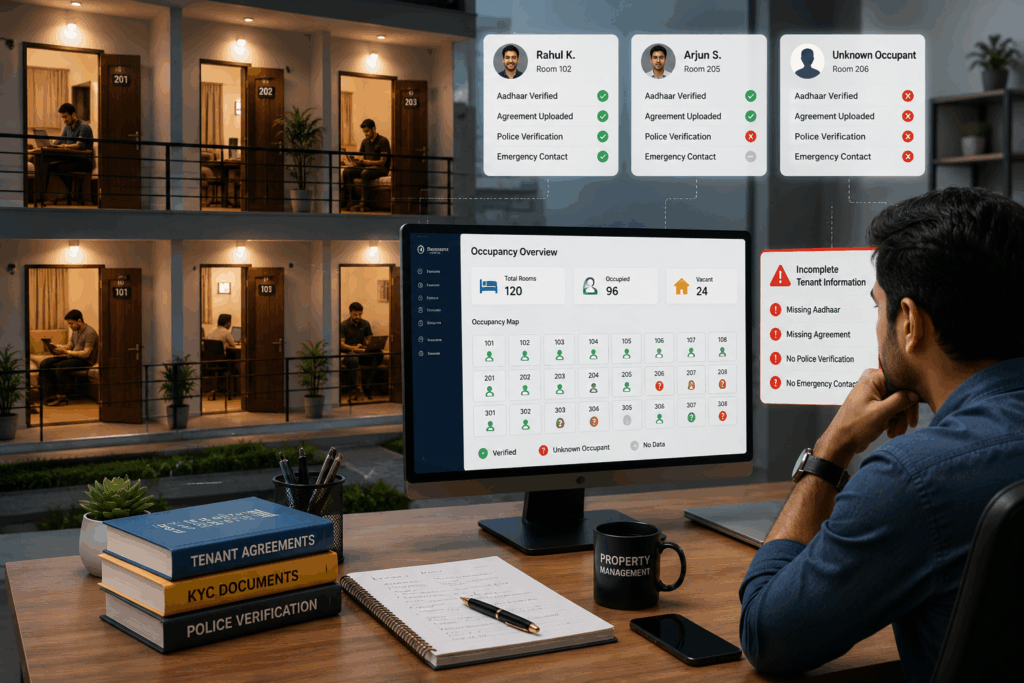
Without structured verification, operators may struggle with:
- Outdated records where former tenants are still listed because documentation was never updated.
- Unrecorded occupant changes that happen informally without management visibility.
- Missing agreements that create uncertainty around responsibilities and timelines.
- Incomplete documentation that makes it difficult to verify who is currently residing in the property.
When verification becomes part of a structured onboarding workflow, these issues become far easier to manage.
The goal is not simply to collect documents.
The goal is to maintain an accurate picture of occupancy at all times.
Building a Simple Tenant Verification Workflow
The best verification systems are not necessarily the most complicated.
In fact, the most effective operators usually rely on simple, repeatable processes that every tenant follows.
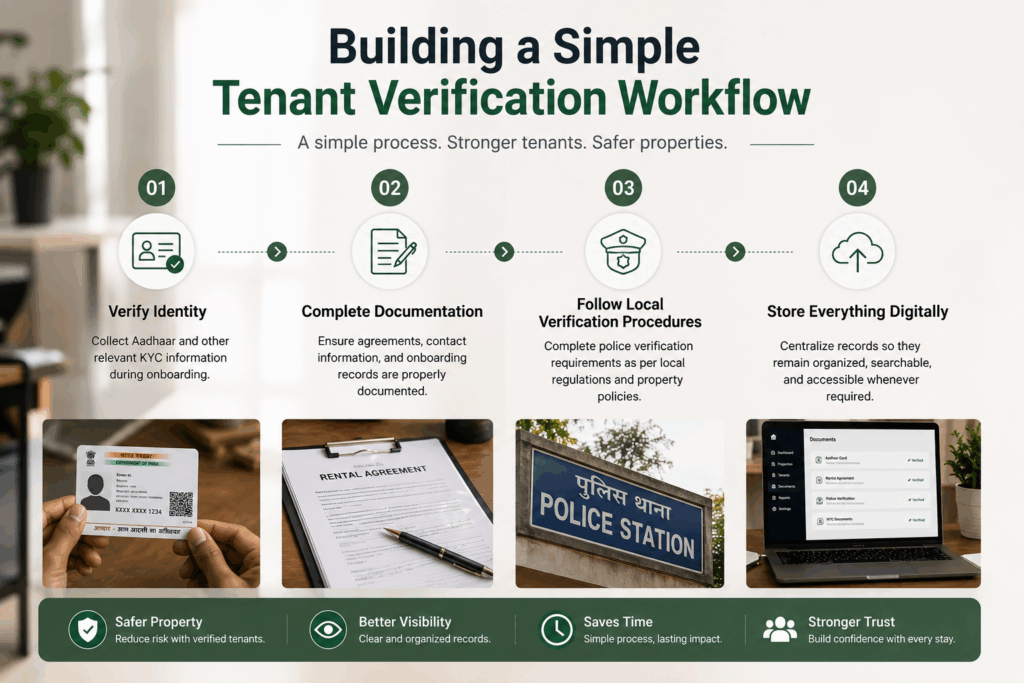
A practical workflow typically includes:
Step 1: Verify Identity
Collect Aadhaar and other relevant KYC information during onboarding so that identity records are established before occupancy begins.
Step 2: Complete Documentation
Ensure agreements, contact information, and onboarding records are properly documented and stored in a structured format.
Step 3: Follow Local Verification Procedures
Where applicable, complete police verification requirements according to local regulations and property policies.
Step 4: Store Everything Digitally
Centralize records so they remain organized, searchable, and accessible whenever required.
A simple process like this creates far better operational visibility than relying on scattered documentation systems.
How RentOk Helps Simplify Tenant Verification and Documentation
As occupancy grows, managing Aadhaar records, agreements, police verification documents, payment history, and tenant records manually becomes increasingly difficult. Information often ends up spread across registers, spreadsheets, folders, and WhatsApp conversations, making it harder to maintain accurate occupancy visibility.
RentOk helps landlords and property managers centralize tenant onboarding by bringing together KYC records, tenant documentation, agreement management, occupancy tracking, payment visibility, and property operations within a single platform. Instead of searching through multiple systems to find information, operators can maintain organized records and access important tenant data whenever it is needed.
For PGs, co-living spaces, hostels, and rental properties, this creates a more structured approach to tenant management while reducing administrative effort and improving operational control.
Conclusion
Aadhaar verification and police verification serve different but equally important roles within tenant onboarding. Aadhaar helps establish identity quickly and efficiently, while police verification can add an additional layer of security and compliance depending on local requirements.
The most successful landlords understand that verification is not just about collecting documents. It is about creating a structured onboarding system that improves occupancy visibility, strengthens record management, and reduces operational risks over time.
As rental businesses continue becoming more organized and technology-driven, strong tenant verification processes will play an increasingly important role in property security and operational efficiency. Explore RentOk to streamline tenant verification, centralize documentation, and manage your rental operations through a more organized property management system.
About the Author
Ishika Pannu
Ishika Pannu brings you the latest insights and easy-to-apply strategies in property management—helping you simplify renting and grow with RentOk.