
Legal
What Happens If You Don’t Register Your PG Rental Agreement?

Written by
Ishika Pannu
Read Time
13 min read
Posted on
July 11, 2026
Overview
Overview
What Happens If You Don’t Register Your PG Rental Agreement?
Running a PG or co-living business involves far more than filling rooms and collecting rent. Every tenant who moves into your property brings along a legal relationship that needs to be clearly defined, documented, and protected. Yet, many property owners still consider rental agreements to be just another piece of paperwork, something that can be drafted casually, signed later, or in some cases, skipped altogether.
This approach may seem harmless when everything is running smoothly. Rent is coming in on time, tenants are cooperative, and there are no disputes to deal with. However, the moment a disagreement arises over unpaid rent, security deposits, property damage, or early move-outs, the absence of a properly executed and registered rental agreement can quickly become one of the biggest liabilities for your business.
An unregistered rental agreement risk goes beyond legal technicalities. It can impact your ability to enforce agreed terms, defend your interests during disputes, and even affect your property’s operational stability. As the rental market becomes increasingly regulated and tenant awareness grows, relying on informal agreements is no longer a sustainable way to manage a professional PG.
In this guide, we’ll explore what can happen if you don’t register your PG rental agreement, the risks involved, and the steps every landlord should take to protect their rental business.
Is Registration of a PG Rental Agreement Always Necessary?
One of the most common misconceptions among PG owners is that simply printing an agreement on stamp paper is enough to make it legally secure. While a written agreement is always better than a verbal understanding, registration requirements depend on the duration and nature of the tenancy.
In many cases, rental agreements exceeding the prescribed tenure under applicable state laws require registration. Even where registration may not be mandatory, having a properly drafted and executed agreement significantly strengthens your legal position if disputes arise.
Instead of asking, “Can I skip registration?”, landlords should ask:
“Will my agreement adequately protect my business if something goes wrong?”
That’s a far more practical question because legal issues rarely appear when everything is going well, they emerge when expectations between the landlord and tenant begin to differ.
A professionally managed rental business treats documentation as a preventive measure rather than a last-minute solution.
If you’re unsure about what clauses a legally structured PG agreement should include, our guide on PG Rental Agreement Format (Free Template) walks you through the essential sections, helping you prepare an agreement that protects both landlords and tenants.

Why Do So Many PG Owners Still Operate Without Registered Agreements?
For many small and medium-sized PG operators, the decision isn’t intentional. It usually happens because of convenience, misinformation, or the belief that legal documentation only matters for large properties.
Some of the most common reasons include:
- Assuming long-term tenants won’t create disputes, which often leads owners to postpone agreement formalities until they are eventually forgotten.
- Depending on downloadable agreement templates that may not accurately reflect the property’s policies, local legal requirements, or operational terms.
- Trying to save time during onboarding, especially during peak admission seasons when multiple tenants are moving in every day.
- Believing that verbal commitments are sufficient because the tenant was introduced through a broker, friend, or existing resident.
While these shortcuts may appear to simplify operations initially, they often create far more complicated situations later. A single disagreement over deposits or notice periods can consume far more time and money than preparing proper documentation in the first place.
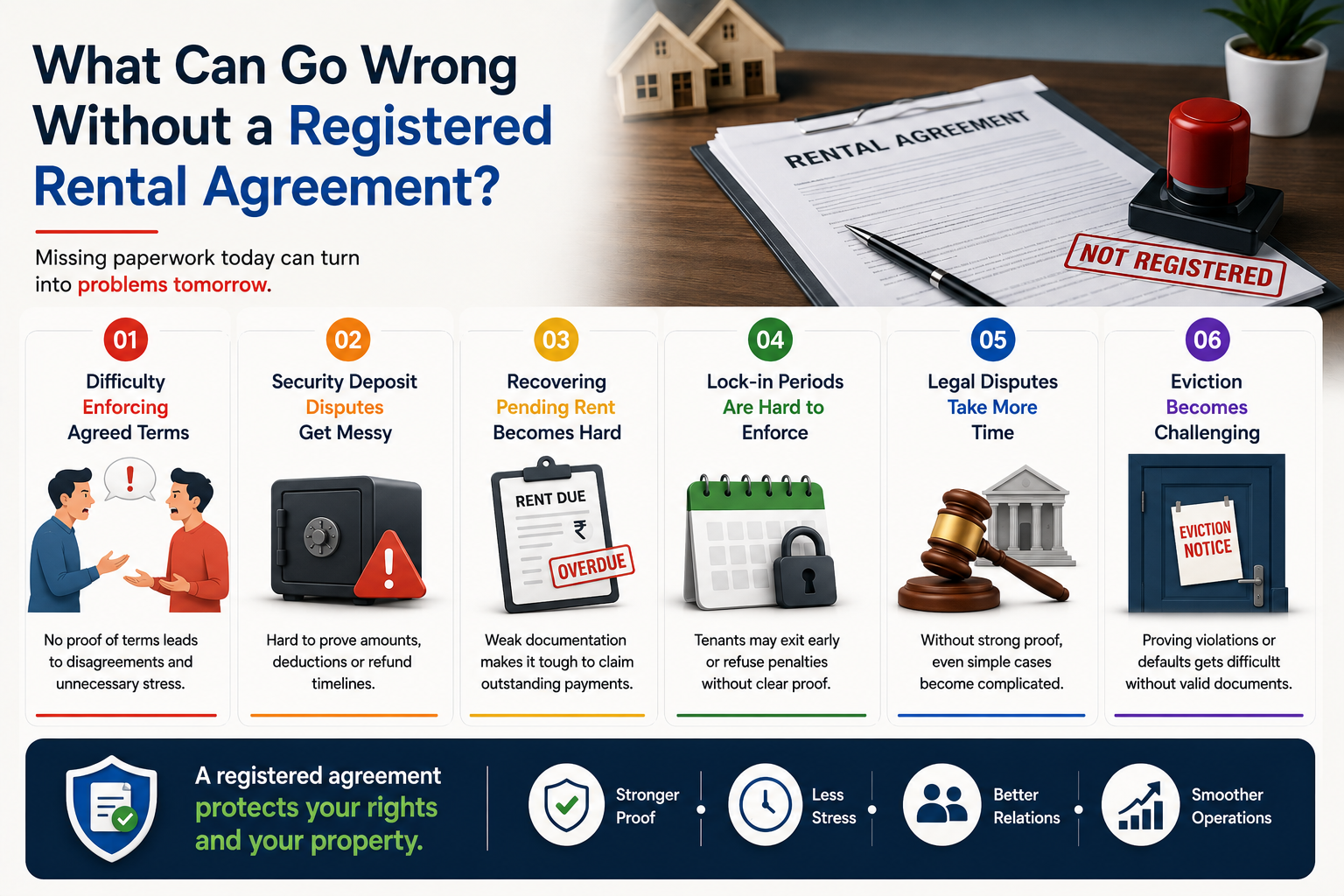
What Can Go Wrong Without a Registered Rental Agreement?
Many landlords only realise the importance of proper documentation after facing a dispute. By then, recovering rent, enforcing agreed conditions, or proving the original understanding becomes considerably more difficult.
Here are some of the biggest operational and legal challenges associated with an unregistered rental agreement risk.
1. Difficulty Enforcing Agreed Terms
Every rental agreement establishes expectations for both parties. It covers aspects such as rent amount, payment dates, security deposits, lock-in periods, maintenance responsibilities, notice periods, and house rules.
Without proper documentation, proving these agreed conditions becomes significantly harder.
For example, imagine a tenant suddenly refuses to pay the final month’s rent, claiming the security deposit should be adjusted against it. If your agreement clearly specifies otherwise, resolving the issue becomes much simpler. Without documented evidence, however, the discussion often turns into one person’s word against another’s.
Over time, these situations can create unnecessary operational stress, especially for landlords managing multiple tenants across different properties.
2. Security Deposit Disputes Become More Complicated
Security deposits are among the most common causes of disagreements in rental businesses.
When agreements aren’t properly documented or registered where required, disputes may arise regarding:
- The exact amount collected, particularly if payments were made in multiple instalments or through different methods.
- Permissible deductions, including repair costs, unpaid utility bills, damages, or professional cleaning charges after move-out.
- Refund timelines, where tenants may expect immediate repayment while landlords require time to inspect the room and calculate pending adjustments.
Instead of having a clear document that both parties agreed to at the start of the tenancy, owners often find themselves negotiating terms that should have already been settled.
This not only delays move-out processes but can also negatively affect tenant relationships and online reviews.
3. Recovering Pending Rent Can Become Difficult
Late payments and rent defaults are unfortunate realities in rental management. While most issues can be resolved through communication, some cases eventually require formal legal intervention.
Without a strong agreement supporting your claim, recovering outstanding rent becomes far more challenging.
Landlords may struggle to establish:
- The agreed monthly rent, particularly if payments changed during the tenancy without proper documentation.
- Due dates and late payment clauses, making it difficult to justify penalties or interest for delayed payments.
- Additional financial obligations, such as electricity charges, maintenance fees, or shared utility expenses that were verbally discussed but never formally documented.
For growing PG businesses, even a few unresolved payment disputes can affect monthly cash flow and create avoidable operational pressure.
4. Lock-in Periods May Become Difficult to Enforce
Many professionally managed PGs include lock-in clauses to maintain occupancy stability and reduce frequent turnover.
However, simply telling tenants about a lock-in period isn’t enough.
If the agreement is incomplete, poorly drafted, or lacks proper legal standing where registration is required, enforcing early exit conditions becomes much more difficult.
This can lead to situations where tenants:
- Leave without serving the agreed notice period, forcing owners to find replacements on short notice.
- Refuse to pay agreed penalties, arguing they were never clearly informed about the conditions.
- Dispute deposit deductions linked to early termination because the applicable clauses were not properly documented.
If you’re planning lock-in policies for your property, you may also find our guide on Managing Tenant Lock-in Periods Without Conflict helpful, as it explains how clear documentation and communication reduce disputes long before move-out.
5. Legal Disputes Become More Time-Consuming
No landlord expects to end up in a legal dispute when welcoming a new tenant. However, disagreements can arise over unpaid rent, property damage, unauthorised occupancy, or breach of agreed conditions.
When these matters reach legal authorities, documentation becomes one of your strongest assets.
A properly prepared agreement helps establish:
- The identity of both parties and the agreed tenancy terms.
- The financial commitments accepted by the tenant before moving in.
- The responsibilities each party agreed to during the tenancy.
Without that clarity, even straightforward disputes can become significantly more complex to resolve.
6. Eviction Proceedings May Become More Challenging
Every landlord hopes that tenants respect the agreed terms throughout their stay. Unfortunately, situations such as continuous rent defaults, property misuse, illegal activities, or repeated violations of house rules sometimes make eviction unavoidable.
When that happens, your rental agreement becomes one of the first documents relied upon to establish the relationship between the landlord and tenant. If the agreement is incomplete, poorly drafted, or lacks the required legal formalities, the eviction process can become significantly more complicated.
Instead of focusing on the tenant’s breach of terms, landlords often find themselves trying to prove what those terms actually were.
This creates unnecessary delays and uncertainty, especially when issues involve:
- Repeated non-payment of rent, where proving agreed payment schedules and defaults becomes difficult without properly documented terms.
- Violation of property policies, such as unauthorized occupants, damage to common areas, or activities prohibited within the premises that were never clearly recorded in writing.
- Refusal to vacate the property, where owners struggle to demonstrate notice requirements, occupancy duration, or contractual obligations because the documentation lacks legal strength.
For professionally managed PGs, legal documentation isn’t just about avoiding disputes, it’s about ensuring that operational decisions can be supported whenever required.
Can an Unregistered Agreement Affect Your Property’s Credibility?
Beyond legal implications, documentation also shapes how professionally your business is perceived.
Today’s tenants are more informed than ever. Before moving into a PG, they often compare multiple properties, check Google reviews, speak to existing residents, and evaluate how organized the management appears.
A landlord who provides a structured agreement during onboarding immediately creates confidence that the property follows professional processes.
On the other hand, informal documentation can raise concerns about:
- Whether deposits will actually be refunded fairly.
- How disputes will be handled if problems arise.
- Whether house rules are applied consistently to every resident.
- The overall professionalism of the property’s operations.
Over time, these small impressions influence your reputation just as much as amenities or pricing.
A professionally documented onboarding process signals that your business values transparency, compliance, and long-term tenant relationships.
Professional documentation is only one part of a smooth tenant experience. Clear communication during onboarding, renewals, and move-outs is equally important. Our guide on Best Communication Channels for Property Management explains how structured communication reduces misunderstandings and improves tenant relationships throughout the rental lifecycle.
The Financial Cost of Poor Documentation Is Often Higher Than Expected
Many landlords avoid formal documentation because they want to save a little time or money during onboarding. Ironically, this decision often results in much larger financial losses later.
An unresolved dispute doesn’t just affect one tenant, it also consumes management bandwidth, delays room turnover, and creates uncertainty that impacts overall operations.
Some of the hidden costs include:
- Lost rental income when disputes delay move-outs or prevent rooms from being occupied quickly by new tenants.
- Legal consultation expenses, which often exceed the cost of preparing a proper agreement at the beginning of the tenancy.
- Administrative effort, as owners spend hours collecting payment records, WhatsApp conversations, screenshots, and informal evidence to support their claims.
- Reputational damage, especially when dissatisfied tenants leave negative reviews or share their experiences across social media and relocation communities.
For growing rental businesses, these costs accumulate over time and directly affect profitability.
What Should Every PG Rental Agreement Clearly Include?
A good rental agreement doesn’t exist simply to satisfy legal requirements, it establishes operational clarity for both landlords and tenants from day one.
While every property may have slightly different policies, a professionally drafted agreement should clearly define:
- Complete tenant and landlord details, along with identity verification records that remove ambiguity about the parties involved.
- Rent amount, payment schedule, and accepted payment methods, ensuring financial expectations are documented before occupancy begins.
- Security deposit amount and refund conditions, including situations where deductions may apply due to damages, unpaid dues, or policy violations.
- Notice period and lock-in clauses, explaining how early exits, occupancy timelines, and move-outs will be managed.
- Maintenance responsibilities and house rules, helping prevent disputes related to repairs, common areas, visitors, curfews, or shared facilities.
- Duration of tenancy and renewal terms, so both parties understand how extensions or agreement renewals will be handled.
The more clearly expectations are documented during onboarding, the fewer misunderstandings you’ll need to resolve later.
Documentation Alone Isn’t Enough, Verification Matters Too
A rental agreement is only as reliable as the information recorded within it.
Before preparing any agreement, landlords should verify the identity and documentation submitted by prospective tenants. Incomplete or fraudulent identification can create legal complications regardless of how well the agreement is drafted.
This is why professional onboarding should always combine documentation with proper verification.
If you’re looking to strengthen your tenant screening process, you can also read our guide on How to Spot a Fake ID During Tenant Verification, where we discuss practical ways to identify suspicious documents before completing the onboarding process.
Together, proper verification and well-drafted agreements create a much stronger legal foundation for your property.
Common Mistakes PG Owners Should Avoid
After working with thousands of rental businesses, one pattern becomes clear, most documentation issues aren’t caused by the agreement itself but by avoidable mistakes during onboarding.
Some of the most common ones include:
- Using the same agreement template for every tenant, even though different occupancy models, lock-in periods, or payment structures may require customized clauses.
- Making handwritten changes after signing, which can create confusion if both parties don’t formally acknowledge the modifications.
- Failing to update agreements during renewals, leaving outdated rent amounts, notice periods, or occupancy terms in official records.
- Delaying documentation until after move-in, when tenants have already occupied the room and administrative formalities become easier to postpone.
- Relying entirely on verbal communication for important operational policies instead of recording them within the agreement itself.
Professional operators don’t view agreements as paperwork, they view them as operational safeguards.

How RentOk Helps Simplify Rental Agreement Management
Managing rental agreements manually becomes increasingly difficult as your occupancy grows. Preparing agreements from scratch, maintaining separate records, tracking renewals, and ensuring documentation stays consistent across multiple tenants can quickly become time-consuming.
RentOk simplifies this entire process by helping property owners create structured rental agreements while keeping essential tenant information organized in one place. Instead of relying on scattered templates or manually editing documents every time a new tenant moves in, landlords can streamline their onboarding workflow with professionally structured documentation.
Beyond agreements, RentOk also helps centralize tenant records, payment tracking, occupancy management, and operational workflows, making it easier to run a compliant and organized rental business as your property scales.
Conclusion
A rental agreement is much more than a legal document, it is the foundation of a professionally managed PG. When agreements are incomplete, poorly drafted, or left unregistered where required, the risks extend beyond legal compliance. They can affect rent recovery, deposit settlements, tenant exits, dispute resolution, and even your property’s reputation.
The good news is that these problems are entirely preventable with the right documentation process. Investing a little time in creating a legally structured agreement today can save countless hours of conflict, uncertainty, and financial loss in the future.
Looking to create a professionally structured PG rental agreement? Use RentOk’s Rent Agreement Generator to prepare legally organized agreements, simplify tenant onboarding, and build a stronger foundation for your rental business.
Frequently Asked Questions
Find answers to common questions about this topic
About the Author
Ishika Pannu
Ishika Pannu brings you the latest insights and easy-to-apply strategies in property management—helping you simplify renting and grow with RentOk.
You may also like these
Related Articles
1 min read
Is a Verbal Rental Agreement Legally Valid in India?
Written by
Posted on
Ishika Pannu
Sep 24, 2026
1 min read
What Can I Do If My Tenant Stops Paying Rent?
Written by
Posted on
Ishika Pannu
Sep 23, 2026

1 min read
How to Check If Your PG or Hostel is Legally Registered in India
Written by
Posted on
Ishika Pannu
Sep 20, 2026
1 min read
How to Negotiate Rent and Maintenance Terms Before Signing
Written by
Posted on
Ishika Pannu
Sep 19, 2026
1 min read
What Your Landlord Can and Cannot Store From Your KYC Documents
Written by
Posted on
Ishika Pannu
Sep 19, 2026
1 min read
Why a Digital Rent Agreement Is Just as Legally Valid as a Paper One
Written by
Posted on
Ishika Pannu
Sep 18, 2026

1 min read
What Is Rent Control Law in India, and Which Cities Are Still Covered?
Written by
Posted on
Ishika Pannu
Sep 18, 2026

1 min read
Why Rent Agreement Rules Are Different in Every Indian State
Written by
Posted on
Ishika Pannu
Sep 17, 2026

1 min read
How Working Professionals Can Complete Tenant Verification Quickly
Written by
Posted on
Ishika Pannu
Sep 17, 2026
1 min read
Student Tenant Verification: A Guide Before Moving Into a PG
Written by
Posted on
Ishika Pannu
Sep 16, 2026
Stay ahead in property management with expert insights
Join thousands of property managers receiving exclusive tips delivered straight to your inbox.
Browse posts by category
Case Study
Cost of Living
Growth
Legal
Market Trends
News
Pg owner app
Property Management
Property Tax
Tech
RentOk
The easiest way to rent and manage your PGs and hostels.
Grievance Officer
Get the app


Contact us
hello@eazyapp.tech
HQ Office
COGROW, BASEMENT F-12/8A
BESIDE HOUSE OF STYLE SALON, SECTOR 28, DLF PHASE 1
GURUGRAM, HARYANA - 122002
South India Office
LUMIODESK COWORKING, 2ND FLOOR, 40, 14TH MAIN RD
BESIDE MC DONALD, 7TH SECTOR, HSR LAYOUT
BENGALURU, KARNATAKA - 560102
©️ 2026 EazyApp Tech Pvt Ltd. All rights reserved


