
Legal
Rent Agreement Renewal: When and How to Update Terms

Written by
Ishika Pannu
Read Time
13 min read
Posted on
July 14, 2026
Overview
Overview
Rent Agreement Renewal: When and How to Update Terms
A rent agreement is more than a document signed at the beginning of a tenancy. It defines the rights, responsibilities, financial terms, and expectations between a landlord and a tenant. However, many property owners make the mistake of treating it as a one-time formality. Once the agreement expires, they simply allow the tenancy to continue without reviewing or updating the terms.
While this may seem convenient, it often creates avoidable legal and operational challenges. Rental amounts change, maintenance responsibilities evolve, notice periods may need revision, and new regulations can impact existing agreements. Continuing with an outdated contract leaves room for misunderstandings and disputes that could have been prevented with a timely renewal.
Whether you manage a single rental property, multiple PGs, or a growing co-living business, rent agreement renewal should be viewed as an opportunity to strengthen your documentation, improve transparency, and ensure both parties remain aligned.
If you’re creating a new rental agreement instead of renewing an existing one, our guide on How to Create Rent Agreement Online in India walks you through the complete process, from drafting the agreement to completing the required documentation.
What Does Rent Agreement Renewal Actually Mean?
Rent agreement renewal is the process of extending an existing tenancy by updating and signing a fresh agreement or renewal document before the current one expires. Instead of allowing an old agreement to continue indefinitely, both parties review the existing terms and make changes wherever required.
A renewal isn’t limited to extending the duration alone. It gives landlords and tenants the opportunity to revisit every important clause and ensure the agreement reflects the current rental arrangement.
Typically, a renewal may include updates such as:
- Revised rent amount based on annual increments, market conditions, or mutual agreement, ensuring the agreement accurately reflects the current financial arrangement.
- Updated security deposit terms if the deposit has been increased, partially adjusted, or modified due to changes in the tenancy.
- Changes in maintenance responsibilities, utility payments, or additional services that may have been introduced during the previous rental period.
- Modified notice period or lock-in clauses to better suit the requirements of both parties and reduce confusion during future move-outs.
- Updated tenant or landlord information, including address, contact details, or identification documents that may have changed since the original agreement.
Rather than viewing renewal as repetitive paperwork, experienced landlords use it to eliminate outdated clauses and create a legally stronger agreement for the next rental cycle.

Why Renewing Your Rent Agreement on Time Matters
Many landlords assume that if the tenant continues paying rent, there is no immediate need to renew the agreement. While the tenancy may continue in practice, relying on an expired agreement often creates unnecessary complications when disagreements arise.
A timely renewal benefits both landlords and tenants in several ways.
- It keeps the tenancy legally documented. An updated agreement serves as current evidence of the rental relationship, making it easier to resolve disputes or meet documentation requirements whenever necessary.
- It creates complete transparency. Renewing the agreement allows both parties to review every important clause together instead of relying on verbal discussions or assumptions.
- It prevents future disagreements. Rent revisions, maintenance responsibilities, parking rules, visitor policies, and notice periods are documented clearly, reducing the possibility of conflicting interpretations later.
- It reflects the current rental arrangement. Properties evolve over time. Amenities, services, occupancy rules, and operational policies often change, and the agreement should reflect those updates accurately.
For professional landlords and property managers, renewal is less about compliance and more about maintaining operational clarity throughout the tenant lifecycle.
When Should You Renew a Rent Agreement?
One of the most common questions landlords ask is, “How early should I begin the renewal process?”
The ideal answer is simple, don’t wait until the agreement expires.
Starting the renewal process a few weeks in advance gives both parties enough time to review the document, discuss any proposed changes, complete the required paperwork, and register the agreement if applicable.
A practical timeline looks like this:
- 45–60 days before expiry: Review the existing agreement and evaluate whether any rental terms need to be updated.
- 30 days before expiry: Initiate the discussion with the tenant regarding rent revisions, agreement duration, or policy changes.
- 15–20 days before expiry: Finalize the revised clauses, prepare the updated agreement, and complete the necessary documentation.
- Before the agreement expires: Execute the renewed agreement to ensure there is no gap between the previous and the new contract.
This structured approach avoids last-minute confusion while giving both landlords and tenants sufficient time to understand and agree on the revised terms.
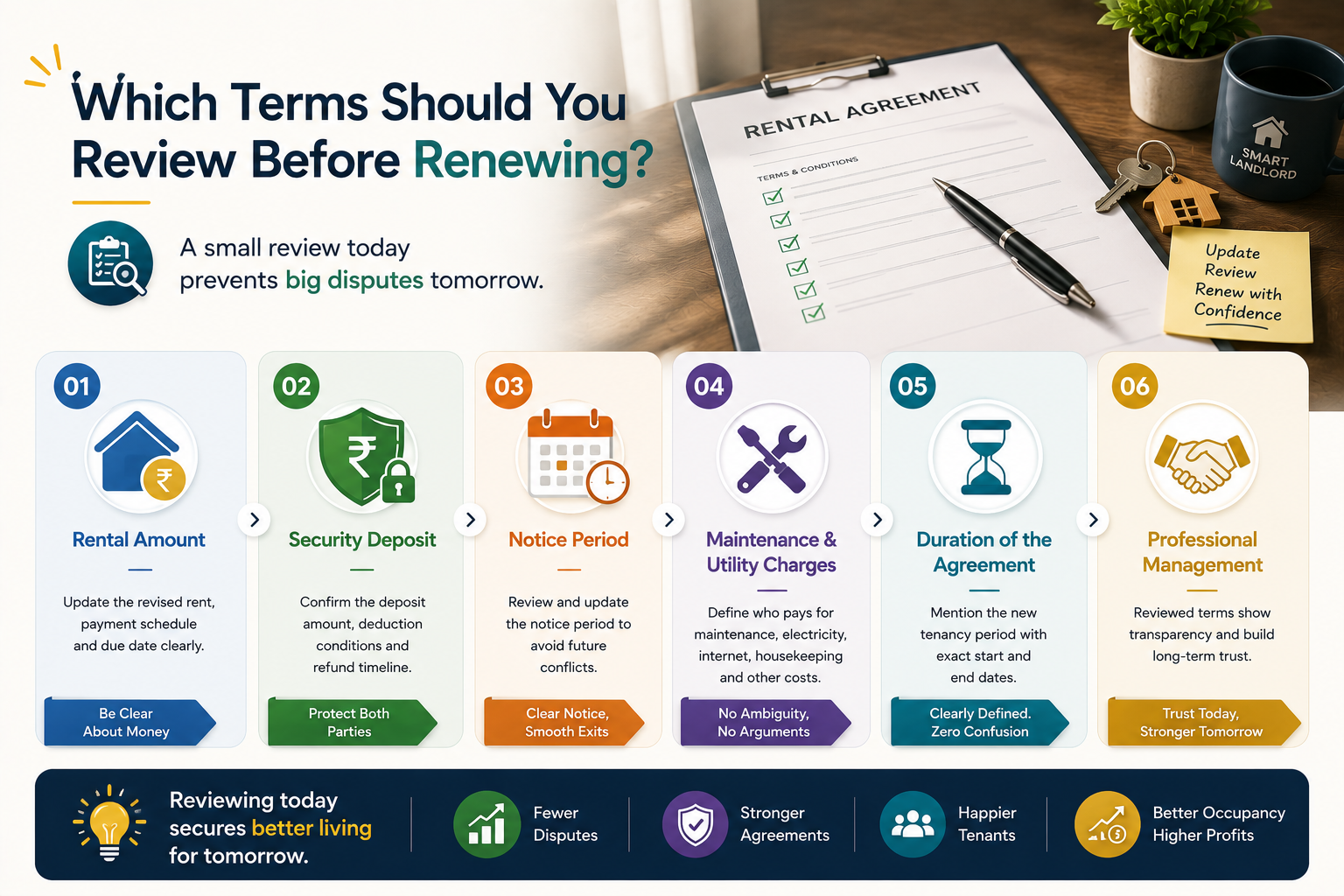
Which Terms Should You Review Before Renewing?
Every renewal presents an opportunity to assess whether the original agreement still reflects the current tenancy. Instead of copying the previous document, review each clause carefully and update it wherever required.
Some of the most important sections to revisit include:
Rental Amount
Annual rent revisions are common in residential and commercial rentals. If the rent is being increased, the revised amount should be clearly mentioned along with the applicable payment schedule and due date.
Security Deposit
Confirm whether the existing deposit remains unchanged or needs revision. The agreement should also specify the conditions under which deductions may be made and the timeline for refund after move-out.
Notice Period
If both parties wish to change the notice period, this should be updated before signing the renewed agreement. A clearly defined notice clause helps avoid unnecessary disputes during future exits.
A well-defined notice period works best when it’s backed by clear exit policies. Learn how to structure tenant exits fairly in our guide on Managing Tenant Lock-in Periods Without Conflict.
Maintenance and Utility Charges
Operational costs often change over time. Clearly defining who is responsible for maintenance expenses, electricity bills, internet charges, housekeeping, or other recurring costs helps eliminate ambiguity later.
Duration of the Renewed Agreement
Specify the new tenancy period along with the exact commencement and expiry dates to avoid confusion regarding validity.
Taking time to review these clauses not only strengthens the agreement but also demonstrates professionalism in the way the property is managed.
Common Mistakes to Avoid During Rent Agreement Renewal
Renewing a rent agreement isn’t complicated, but overlooking small details can create legal and operational problems later. Many landlords treat renewal as a routine task, copy the previous agreement, change the dates, and move on. While that may save time initially, it often results in outdated clauses, unclear responsibilities, and unnecessary disputes.
Professional property managers approach renewals differently. They use every renewal cycle to verify that the agreement still reflects the actual tenancy and complies with current regulations.
Some of the most common mistakes include:
- Copying the old agreement without reviewing its clauses. Rental arrangements rarely remain unchanged over an entire year. Rent revisions, maintenance responsibilities, utility charges, or occupancy rules often evolve over time. Reviewing every clause ensures the renewed agreement accurately reflects the current arrangement.
- Depending on verbal discussions instead of written updates. Landlords and tenants may mutually agree to changes regarding rent, deposits, or notice periods, but those discussions hold little value if the renewed agreement doesn’t record them. Every agreed change should become part of the new document.
- Starting the renewal process too late. Waiting until the agreement has already expired creates unnecessary pressure on both parties. It leaves little time to negotiate revised terms, arrange documentation, or complete registration formalities where applicable.
- Ignoring changes in rental regulations. Rental laws and documentation requirements continue to evolve across different states. Before renewing an agreement, landlords should ensure the document complies with the latest legal requirements instead of relying on an outdated template.
Taking a structured approach reduces confusion and helps both parties begin the next tenancy period with complete clarity.
Should You Renew the Existing Agreement or Draft a Fresh One?
One question landlords frequently ask is whether they should simply renew the existing agreement or prepare a completely new one. The answer depends on how much has changed since the original agreement was signed.
If the tenancy continues under the same conditions and only the duration changes, renewing the agreement may be sufficient. However, if several clauses need revision, drafting a fresh agreement usually makes more sense.
A new agreement becomes the better option when:
- The monthly rent has changed. Instead of relying on handwritten changes or separate written communications, include the revised rent amount in a new agreement that clearly records the updated payment terms.
- Security deposit terms have changed. Whether the deposit amount has increased, decreased, or new deduction policies have been introduced, documenting these changes in a fresh agreement avoids future misunderstandings.
- Property rules have evolved. Visitor policies, parking rules, maintenance responsibilities, common area usage, or amenity access often change as properties grow. A fresh agreement allows landlords to consolidate every updated clause into one legally valid document.
- The tenancy itself has changed significantly. If additional occupants have joined, furnished amenities have been upgraded, or operational policies have been revised, preparing a new agreement provides much better legal clarity than modifying an old one repeatedly.
Instead of maintaining multiple amendments over several years, a fresh agreement creates one comprehensive document that accurately represents the current tenancy.
What Happens If You Don’t Renew Your Rent Agreement?
Many rental arrangements continue long after the original agreement expires. While the landlord and tenant may continue the relationship without immediate issues, an expired agreement often creates uncertainty whenever disagreements arise.
Without a renewed agreement, both parties may struggle to establish which terms currently apply. Questions around rent revisions, security deposits, maintenance responsibilities, or notice periods become much harder to resolve because the written documentation no longer reflects the actual arrangement.
Allowing agreements to remain outdated can also lead to:
- Unclear financial records, especially when landlords revise rent amounts informally without updating the agreement.
- Difficulty enforcing revised policies, since newly introduced rules regarding maintenance, utilities, or occupancy may not appear in the original document.
- Confusion during tenant exits, particularly when notice periods, security deposit deductions, or settlement timelines become disputed.
- Poor documentation practices, making it harder to organise tenancy records, complete compliance requirements, or manage multiple rental properties efficiently.
For landlords managing several properties or a growing PG business, delayed renewals eventually create operational complexity that could have been avoided with a structured renewal process.
A Simple Checklist Before Renewing Your Rent Agreement
Before sending the agreement for signatures, review every important detail carefully. A few extra minutes during the renewal process can prevent much larger problems later.
Use this checklist before finalising the agreement:
- Verify tenant details including names, addresses, identification documents, and contact information to ensure every record remains accurate.
- Review all financial terms, including monthly rent, security deposit, maintenance charges, and utility responsibilities, so both parties clearly understand the revised payment structure.
- Confirm the tenancy period by mentioning the exact commencement and expiry dates instead of relying on general renewal references.
- Review operational clauses such as visitor policies, notice periods, maintenance responsibilities, and any new rules introduced during the previous tenancy.
- Complete registration formalities, wherever applicable, before both parties begin the renewed tenancy under the updated agreement.
Following a consistent checklist not only improves compliance but also makes renewals far more professional and organised.

How RentOk Helps Simplify Rent Agreement Renewals
Managing agreement renewals manually becomes increasingly difficult as your tenant base grows. Tracking expiry dates through spreadsheets, searching for previous agreements across multiple folders, and updating clauses individually can quickly consume valuable time.
RentOk simplifies this process by helping landlords and property managers centralise tenant records, agreement details, occupancy information, and rental operations on a single platform. Instead of reacting to expired agreements, operators can proactively manage the entire tenant lifecycle from one place.
With RentOk, you can:
- Maintain organised tenant records, making it easier to access existing agreements, review tenancy history, and prepare renewals without searching through scattered documents.
- Track tenancy and occupancy timelines, helping you identify upcoming agreement expiries and renew them before they disrupt operations.
- Manage rent collection alongside agreement records, ensuring revised rental terms remain aligned with payment tracking and financial reporting.
- Improve operational visibility, allowing landlords, PG operators, and property managers to manage documentation, occupancy, communication, and tenant information through a connected workflow instead of multiple disconnected systems.
If you’re creating a fresh agreement during renewal, you may also find our Rent Agreement Format guide useful for understanding the key clauses every rental agreement should include.
Conclusion
A rent agreement renewal is more than an administrative formality, it is an opportunity to ensure your tenancy reflects the current rental arrangement, protects both parties, and supports smoother property management. Reviewing terms periodically, documenting changes clearly, and renewing agreements before they expire helps minimise disputes while creating greater operational clarity.
Whether you’re renewing an agreement for a single rental property or managing hundreds of tenants across multiple locations, having the right documentation process in place makes every renewal simpler and more reliable.
Need to renew or create a legally structured rental agreement? Use RentOk’s Rent Agreement Generator to prepare professional rent agreements quickly, keep your documentation organised, and simplify every stage of the tenant lifecycle.
Frequently Asked Questions
Find answers to common questions about this topic
About the Author
Ishika Pannu
Ishika Pannu brings you the latest insights and easy-to-apply strategies in property management—helping you simplify renting and grow with RentOk.
You may also like these
Related Articles
1 min read
Is a Verbal Rental Agreement Legally Valid in India?
Written by
Posted on
Ishika Pannu
Sep 24, 2026
1 min read
What Can I Do If My Tenant Stops Paying Rent?
Written by
Posted on
Ishika Pannu
Sep 23, 2026

1 min read
How to Check If Your PG or Hostel is Legally Registered in India
Written by
Posted on
Ishika Pannu
Sep 20, 2026
1 min read
How to Negotiate Rent and Maintenance Terms Before Signing
Written by
Posted on
Ishika Pannu
Sep 19, 2026

1 min read
What Your Landlord Can and Cannot Store From Your KYC Documents
Written by
Posted on
Ishika Pannu
Sep 19, 2026
1 min read
Why a Digital Rent Agreement Is Just as Legally Valid as a Paper One
Written by
Posted on
Ishika Pannu
Sep 18, 2026

1 min read
What Is Rent Control Law in India, and Which Cities Are Still Covered?
Written by
Posted on
Ishika Pannu
Sep 18, 2026

1 min read
Why Rent Agreement Rules Are Different in Every Indian State
Written by
Posted on
Ishika Pannu
Sep 17, 2026

1 min read
How Working Professionals Can Complete Tenant Verification Quickly
Written by
Posted on
Ishika Pannu
Sep 17, 2026
1 min read
Student Tenant Verification: A Guide Before Moving Into a PG
Written by
Posted on
Ishika Pannu
Sep 16, 2026
Stay ahead in property management with expert insights
Join thousands of property managers receiving exclusive tips delivered straight to your inbox.
Browse posts by category
Case Study
Cost of Living
Growth
Legal
Market Trends
News
Pg owner app
Property Management
Property Tax
Tech
RentOk
The easiest way to rent and manage your PGs and hostels.
Grievance Officer
Get the app


Contact us
hello@eazyapp.tech
HQ Office
COGROW, BASEMENT F-12/8A
BESIDE HOUSE OF STYLE SALON, SECTOR 28, DLF PHASE 1
GURUGRAM, HARYANA - 122002
South India Office
LUMIODESK COWORKING, 2ND FLOOR, 40, 14TH MAIN RD
BESIDE MC DONALD, 7TH SECTOR, HSR LAYOUT
BENGALURU, KARNATAKA - 560102
©️ 2026 EazyApp Tech Pvt Ltd. All rights reserved


