Market Trends
7 AI Property Management Tasks That No Longer Need Manual Work

Written by
Ishika Pannu
Read Time
13 min read
Posted on
June 11, 2026
Overview
Overview
7 AI Property Management Tasks That No Longer Need Manual Work
Property management has always been a people-intensive business. Whether you’re managing a single PG, a co-living space, or a growing rental portfolio, a significant portion of the day is spent coordinating activities that keep operations running smoothly. Rent needs to be collected, complaints need to be tracked, tenants need updates, and occupancy records need constant monitoring.
For years, these responsibilities have been handled through spreadsheets, phone calls, WhatsApp messages, registers, and manual follow-ups. While this approach may work when occupancy is low, it becomes increasingly difficult to sustain as properties scale. More tenants mean more communication, more maintenance requests, more payment tracking, and more administrative work competing for the team’s attention.
The challenge for modern property managers is not a lack of effort. Most teams are already working hard. The real challenge is that a growing percentage of their time is spent on repetitive operational tasks that add little strategic value but still require constant attention.
This is where AI property management solutions are beginning to make a measurable impact. Rather than replacing staff, AI helps eliminate repetitive coordination work, allowing teams to focus on tenant experience, occupancy growth, and operational improvement.
Why Manual Processes Are Costing Property Managers More Than They Realize
Many operational inefficiencies remain hidden because they rarely appear as a single major problem. Instead, they accumulate gradually through dozens of small tasks that consume staff time every day.
A property manager may spend thirty minutes following up on pending rent payments. Another hour might go toward answering repetitive tenant questions. Maintenance requests require updates, occupancy records need revisions, and operational reports have to be compiled manually. Individually, these activities seem manageable. Collectively, they create a significant operational burden.
The consequences extend beyond productivity. As teams become occupied with administrative coordination, other areas of the business often receive less attention. Tenant communication becomes slower, complaint resolution timelines stretch, and managers have less time to focus on occupancy growth or service improvements.
Some of the most common operational challenges created by manual workflows include:
- Staff spending valuable hours on repetitive administrative activities that could otherwise be automated, reducing the time available for tenant engagement and strategic decision-making.
- Communication delays caused by fragmented systems where information is scattered across spreadsheets, messaging apps, emails, and verbal conversations.
- Increased risk of human error when payment records, maintenance logs, and occupancy data are updated manually across multiple platforms.
- Limited operational visibility because managers often lack real-time insights into collections, vacancies, complaint status, and team performance.
As portfolios grow, these inefficiencies become increasingly difficult to manage. What works for a twenty-room property rarely works for a two-hundred-room operation.

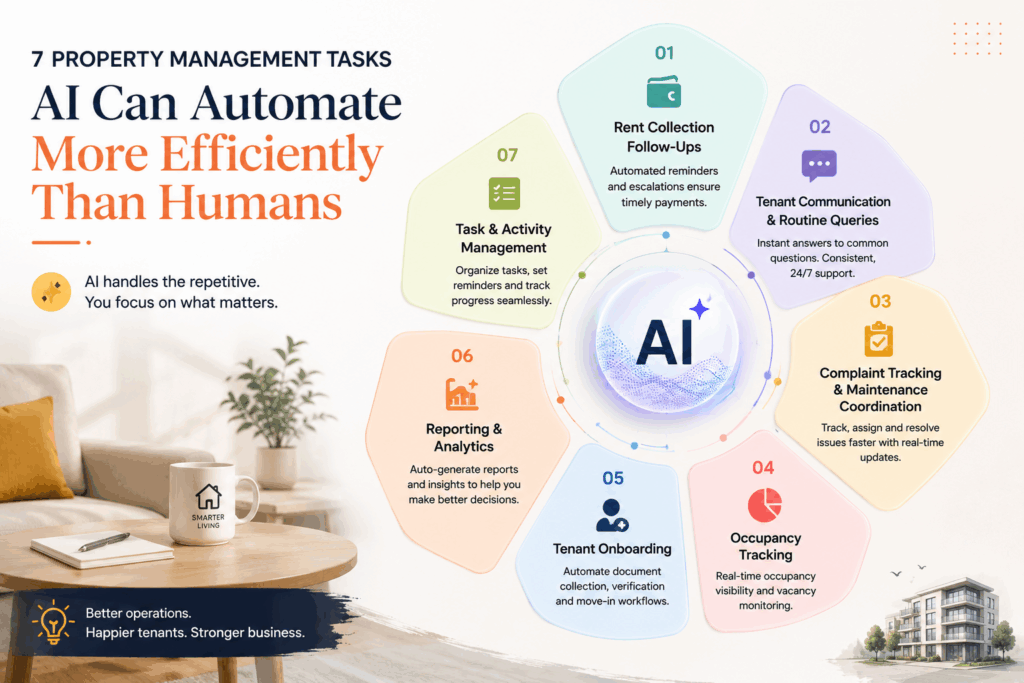
The Seven Tasks AI Can Automate More Efficiently Than Humans
1. Rent Collection Follow-Ups
Rent collection remains one of the most operationally intensive activities in property management. While collecting rent itself is straightforward, the follow-up process surrounding collections often consumes a surprising amount of staff bandwidth. Teams spend hours every month sending reminders, tracking pending dues, confirming transactions, and escalating overdue accounts.
The problem becomes even more visible as occupancy grows. A process that feels manageable with a small tenant base can quickly become overwhelming when hundreds of residents need to be monitored simultaneously. At that stage, collection efficiency starts depending less on policy and more on how consistently staff members can execute repetitive follow-up tasks.
AI-driven collection workflows help remove this dependency by automating several stages of the process.
- Automated reminder sequences can be scheduled before, on, and after due dates, ensuring tenants receive timely communication without requiring manual intervention from staff.
- Escalation workflows can identify overdue accounts and increase communication frequency automatically, helping managers focus only on cases that genuinely require attention.
- Integrated payment visibility allows both management teams and tenants to track payment status in real time, reducing confusion and minimizing repetitive payment-related queries.
The biggest advantage is not simply faster reminders. It is the creation of a structured collection process that performs consistently regardless of occupancy levels, staffing changes, or operational workload.
2. Tenant Communication and Routine Queries
One of the most underestimated drains on operational productivity is repetitive tenant communication. Every property receives a steady stream of questions related to payments, visitor policies, onboarding procedures, maintenance timelines, Wi-Fi access, move-in requirements, and general property guidelines.
Most of these questions are legitimate. However, they are also highly repetitive. Over time, answering the same inquiries repeatedly consumes a substantial amount of staff bandwidth.
AI-powered communication systems help address this challenge by providing instant responses to routine requests while maintaining consistency across interactions.
This approach creates several operational benefits:
- Tenants receive faster responses because common questions can be addressed immediately without waiting for staff availability.
- Communication remains consistent across all residents, reducing the risk of conflicting information being shared by different team members.
- Property staff spend less time handling repetitive queries and more time addressing situations that genuinely require human involvement.
More importantly, communication quality becomes less dependent on individual staff members and more dependent on structured operational systems.
3. Complaint Tracking and Maintenance Coordination
Maintenance management is one of the areas where operational inefficiencies become visible very quickly. A delayed rent reminder might go unnoticed for a day or two, but a leaking tap, a faulty AC, or an internet outage immediately affects the tenant experience.
The challenge is not usually the complaint itself. The challenge is managing everything that happens after the complaint is raised.
In many properties, maintenance workflows are spread across WhatsApp chats, phone calls, verbal instructions, and handwritten notes. A tenant reports an issue, staff forwards it to a technician, updates are shared informally, and eventually someone has to manually check whether the problem was resolved.
As occupancy increases, this process becomes difficult to track consistently.
AI-powered maintenance workflows help create a more structured system by automating several stages of complaint management:
- Complaints can be categorized automatically based on urgency, helping teams prioritize issues that have the biggest impact on tenant comfort and property operations.
- Maintenance requests can be assigned instantly to the appropriate staff member or vendor, reducing delays caused by manual coordination.
- Automated status updates keep tenants informed throughout the resolution process, minimizing follow-up calls and reducing frustration.
The operational benefit extends beyond faster resolution times. Structured maintenance workflows improve accountability because every request, update, and completion timeline becomes visible within a centralized system.
4. Occupancy and Vacancy Monitoring
Occupancy is one of the most important metrics in any rental business, yet many operators still manage it through spreadsheets that require constant manual updates.
This approach works when managing a limited number of rooms. However, as portfolios expand, tracking occupancy manually becomes increasingly difficult. Property managers need visibility into current occupancy levels, upcoming move-outs, notice periods, lease expirations, and vacant inventory.
Without a structured system, important signals are often missed.
A tenant submits a move-out notice, but the vacancy isn’t communicated to the marketing team in time. A lease is approaching renewal, but nobody follows up. A room remains vacant longer than necessary because visibility across teams is limited.
AI helps solve this problem by continuously monitoring occupancy-related data and identifying patterns that require attention.
Some key advantages include:
- Early visibility into upcoming vacancies, allowing teams to begin marketing efforts before revenue gaps appear.
- Automated tracking of lease expirations and notice periods, reducing the likelihood of missed renewals or unexpected move-outs.
- Centralized occupancy dashboards that provide management with a clear understanding of inventory performance across properties.
Instead of reacting to vacancies after they occur, operators gain the ability to plan proactively and improve occupancy stability over time.
5. Tenant Onboarding Workflows
The tenant onboarding process often determines a resident’s first impression of the property. A smooth onboarding experience creates confidence, while a disorganized process immediately raises concerns about operational quality.
Yet onboarding involves a surprising number of moving parts. Documentation needs to be collected, agreements need to be shared, payments need verification, room allocations need confirmation, and tenants need information about property policies and procedures.
When managed manually, inconsistencies are common because different staff members may follow different processes.
AI-powered onboarding workflows help standardize the experience while reducing administrative effort.
For example:
- New tenants can receive automated onboarding instructions, ensuring every resident receives the same information before move-in.
- Documentation requests and verification processes can be tracked systematically, reducing delays and minimizing paperwork-related confusion.
- Property rules, visitor guidelines, payment procedures, and operational information can be shared automatically, reducing repetitive staff coordination.
A structured onboarding process benefits both management and tenants. Staff spend less time handling routine coordination, while residents experience a smoother and more professional transition into the property.
6. Operational Reporting and Performance Analysis
One of the biggest challenges in property management is making decisions without complete visibility.
Most operators have access to data. The problem is that the information often exists across multiple systems. Payment records may be stored in one place, occupancy data in another, complaint logs elsewhere, and operational updates scattered across communication channels.
As a result, generating meaningful reports becomes a manual and time-consuming exercise.
Managers frequently spend hours compiling information simply to understand:
- How collections are performing this month.
- Which properties have the highest vacancy rates.
- Whether complaint resolution timelines are improving.
- Which operational issues require immediate attention.
AI-powered reporting transforms this process by continuously collecting and analyzing operational data.
Rather than waiting for monthly reviews, managers gain access to real-time insights that support faster decision-making. This includes:
- Collection trends that highlight payment behavior and overdue account patterns.
- Occupancy analytics that reveal vacancy risks before they impact revenue.
- Complaint-resolution metrics that help identify operational bottlenecks.
- Performance visibility across teams, properties, and workflows.
The result is a more proactive management approach where decisions are based on current operational realities rather than historical assumptions.
7. Follow-Ups and Task Management
Many operational problems do not occur because teams are incapable. They occur because people are busy.
A maintenance update gets delayed. A tenant request slips through the cracks. A renewal conversation is forgotten. A pending document remains unresolved longer than intended.
Manual systems rely heavily on memory, and memory becomes less reliable as operational complexity increases.
This is where AI-powered task management creates significant value.
Rather than depending on individuals to remember every pending activity, automated workflows continuously monitor operational tasks and trigger actions when required.
This helps teams by:
- Keeping important tasks visible until they are completed, reducing the likelihood of overlooked responsibilities.
- Creating automated reminders and escalation workflows that ensure deadlines receive attention before they become problems.
- Providing managers with visibility into pending actions, helping them identify bottlenecks and allocate resources more effectively.
The advantage is not simply better organization. It is the creation of a system where operational consistency becomes less dependent on individual effort and more dependent on structured workflows.
How Automation Reduces Errors and Operational Bottlenecks
One of the most overlooked advantages of AI property management automation is consistency.
Human performance naturally fluctuates based on workload, staffing levels, experience, and operational pressure. Even highly capable teams struggle to maintain the same level of consistency when repetitive tasks continue increasing.
Automation helps eliminate this variability.
When reminders, complaint tracking, onboarding workflows, occupancy monitoring, and reporting processes are automated, every tenant receives the same level of operational attention regardless of how busy the team happens to be.
This creates several important business advantages:
- Communication becomes more predictable because updates are delivered systematically instead of depending on manual follow-ups.
- Data accuracy improves because information is captured through structured workflows rather than being transferred manually across multiple systems.
- Operational visibility increases because managers gain access to centralized information instead of relying on fragmented records.
Over time, these improvements reduce operational bottlenecks and create a more scalable foundation for growth.
The Impact on Staff Productivity and Tenant Satisfaction
There is a common misconception that automation primarily benefits management teams. In reality, the biggest advantage often comes from improving the experience for both staff and tenants simultaneously.
For property teams, automation removes a significant portion of repetitive administrative work. Instead of spending hours on reminders, follow-ups, manual updates, and routine communication, staff can focus on higher-value activities that contribute directly to business growth.
This includes:
- Building stronger tenant relationships and improving resident retention.
- Resolving complex operational issues that require human judgment and decision-making.
- Supporting occupancy growth initiatives and improving property performance.
- Creating a more proactive service culture instead of constantly reacting to administrative tasks.
Tenants benefit as well because communication becomes faster, complaint tracking becomes more transparent, and service delivery becomes more consistent.
The result is a property operation that feels more organized, responsive, and professional from the resident’s perspective.
Building an AI-First Property Management Workflow
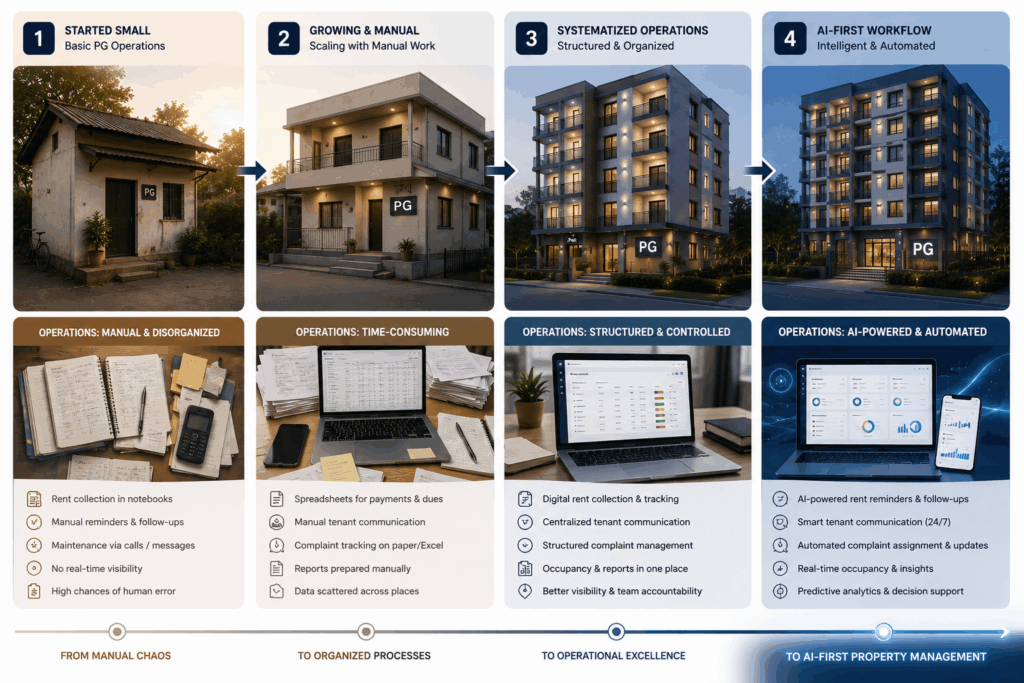
The transition toward AI-powered property management does not need to happen all at once. In fact, the most successful operators typically begin with the workflows that create the greatest operational burden.
For most rental businesses, this means starting with:
- Rent collection and payment reminders, where automation can immediately reduce repetitive follow-up work.
- Tenant communication systems that improve response times while maintaining consistency across interactions.
- Complaint management workflows that increase accountability and provide better visibility into maintenance operations.
- Occupancy tracking and reporting systems that help management make faster and more informed decisions.
As these processes become more structured, additional automation opportunities emerge naturally.
The objective is not to remove people from property management. It is to allow people to focus on the areas where they create the most value while technology handles repetitive coordination work behind the scenes.
How RentOk Helps Property Managers Automate Daily Operations
As rental businesses grow, managing collections, occupancy, tenant communication, maintenance coordination, and reporting manually becomes increasingly difficult. Processes that once felt manageable often become fragmented across spreadsheets, WhatsApp groups, registers, and disconnected software tools.
RentOk helps property managers bring these workflows together through a centralized property management platform designed specifically for rental operations.
By streamlining critical processes such as:
- Automated rent reminders and payment tracking that improve collection consistency.
- Complaint management systems that provide better visibility into maintenance workflows.
- Occupancy monitoring tools that help operators manage vacancies and tenant movement more effectively.
- Centralized communication and operational reporting that improve decision-making across properties.
RentOk enables property managers to reduce administrative workload while improving operational visibility and service quality.
This allows teams to spend less time coordinating repetitive tasks and more time focusing on occupancy growth, tenant satisfaction, and long-term business performance.
Conclusion
Property management will always remain a people-driven business. Relationships, service quality, and operational decision-making will continue to play a critical role in long-term success.
However, many of the activities that consume the majority of a property’s operational bandwidth today are repetitive, administrative, and highly process-oriented. Tasks such as rent collection follow-ups, complaint tracking, occupancy monitoring, onboarding coordination, reporting, and task management are essential to operations, but they are also areas where AI can deliver greater consistency, speed, and accuracy than manual processes.
As rental businesses continue to grow and tenant expectations continue to evolve, operators who embrace property management automation will be better positioned to scale efficiently, improve service quality, and maintain stronger operational control.
Explore RentOk to discover how AI-powered property management workflows can simplify operations, improve visibility, and help build a more scalable rental business.
About the Author
Ishika Pannu
Ishika Pannu brings you the latest insights and easy-to-apply strategies in property management—helping you simplify renting and grow with RentOk.