Market Trends
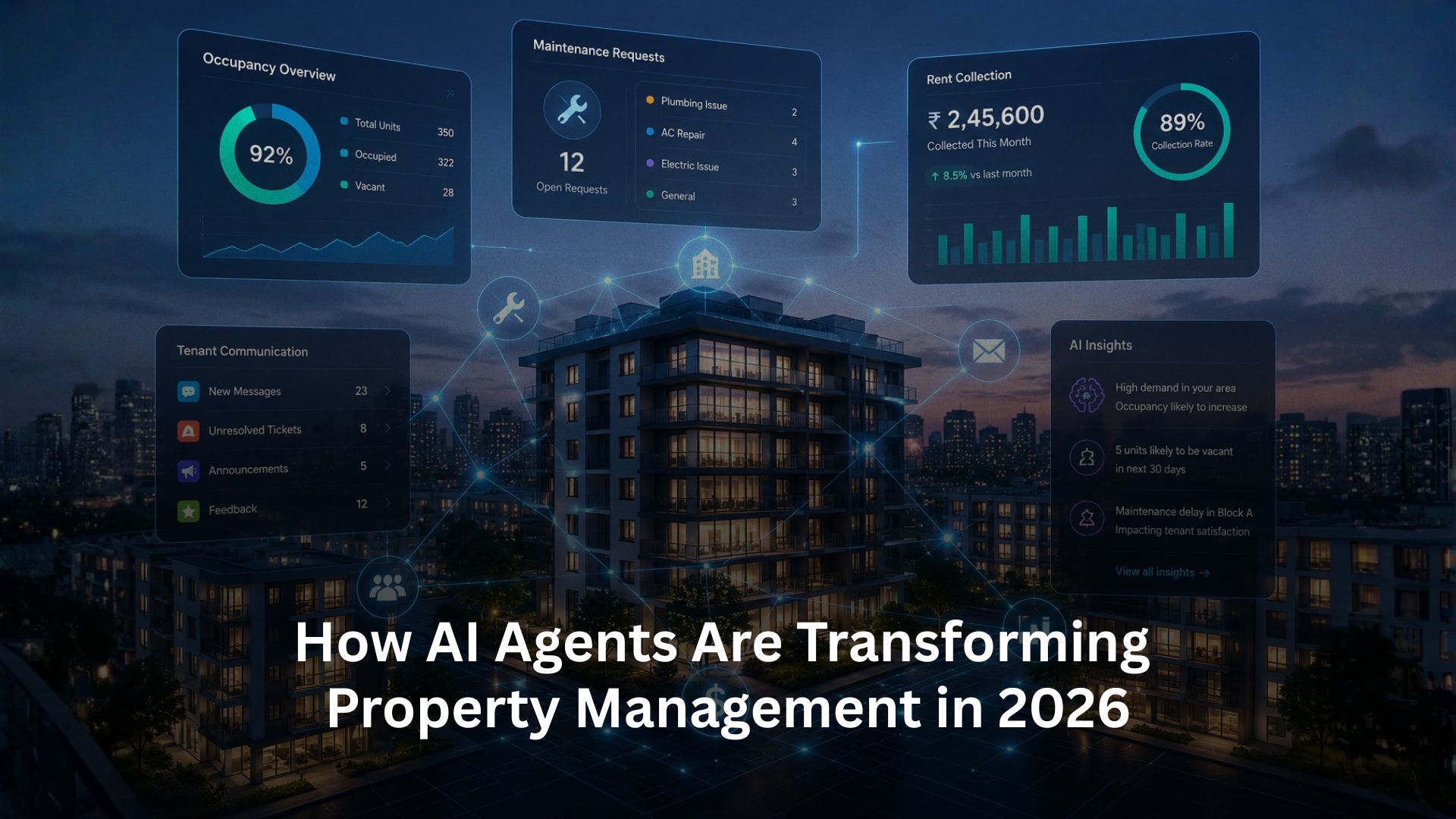
How AI Agents Are Transforming Property Management in 2026

Written by
Ishika Pannu
Read Time
11 min read
Posted on
June 9, 2026
Overview
Overview
How AI Agents Are Transforming Property Management in 2026
Property management has always involved balancing dozens of moving parts at the same time. A typical day may involve handling rent collections, responding to tenant concerns, coordinating maintenance teams, tracking occupancy, managing documentation, and ensuring that staff members stay aligned across operations.
For years, technology helped simplify some of this complexity. Cloud-based property management software replaced spreadsheets, digital records reduced paperwork, and automated reminders removed some of the repetitive administrative workload.
However, a new shift is now taking place.
In 2026, the conversation is no longer just about digitizing operations. Property managers are increasingly looking for ways to make operations more intelligent, proactive, and scalable. This is where AI agents are beginning to make a meaningful impact.
Unlike traditional software that waits for users to take action, AI agents can monitor information, identify patterns, make recommendations, and even execute certain tasks automatically. For growing PGs, co-living spaces, rental portfolios, and property management companies, this opens up opportunities to reduce manual effort while improving operational consistency.
The result is not a future where property managers are replaced. Instead, it is a future where managers spend less time chasing routine tasks and more time focusing on resident experience, business growth, and strategic decision-making.
Why Traditional Property Management Is Reaching Its Limits
The operational demands placed on property managers have changed significantly over the last decade.
Tenant expectations are higher, communication is faster, occupancy levels are growing, and businesses are managing larger portfolios than ever before. While these changes create opportunities, they also introduce operational complexity that many traditional management processes struggle to handle efficiently.
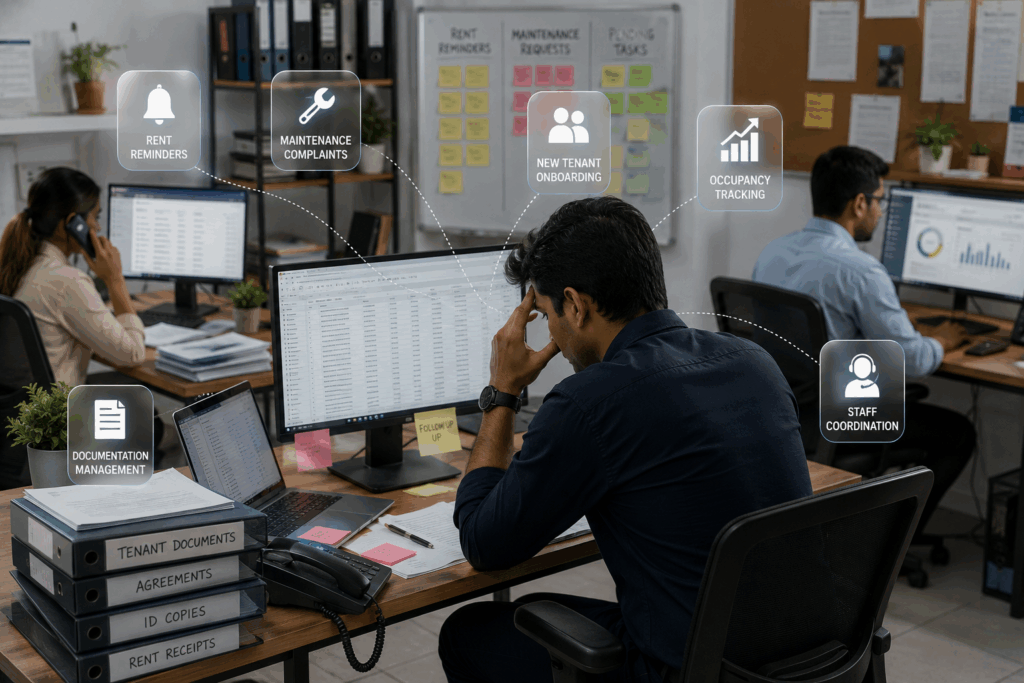
Consider some of the activities that take place inside a property every single day:
- Rent reminders need to be sent and tracked.
- Maintenance complaints require follow-ups and status updates.
- New tenants need onboarding support.
- Vacancies must be monitored and filled quickly.
- Documentation needs to remain accurate and accessible.
- Staff members need visibility into ongoing operations.
None of these tasks are particularly difficult on their own. The challenge emerges when they all happen simultaneously across dozens or hundreds of residents.
Many operators eventually find themselves spending more time coordinating tasks than improving the property itself. Important decisions become delayed because managers are busy handling routine administrative work, and operational visibility becomes harder to maintain as occupancy increases.
This is one reason why many property businesses are exploring AI-driven workflows. The goal is not simply to automate tasks. The goal is to create systems that can support decision-making, identify operational bottlenecks early, and reduce the amount of manual intervention required to keep properties running smoothly.
What AI Agents Actually Do for Property Managers
The term “AI agent” is often used broadly, which can make it difficult to understand what these systems actually do in a property management environment.
An AI agent is not just a chatbot answering questions. It is a system designed to observe information, understand context, make decisions based on predefined objectives, and take action when required.
Think of it as a digital operations assistant that works continuously in the background.
For example, imagine a tenant submits a maintenance request regarding an air-conditioning issue. In a traditional workflow, the request may need to be reviewed by staff, assigned to a vendor, tracked manually, and followed up multiple times before completion.
An AI-powered workflow can streamline much of this process by:
- Categorizing the issue automatically.
- Routing the request to the appropriate vendor.
- Informing the tenant about expected timelines.
- Monitoring progress in real time.
- Escalating delays if service levels are not met.
Similarly, AI agents can assist with rent collection by identifying overdue payments, sending reminders, tracking responses, and highlighting accounts that may require human intervention.
The value comes from reducing repetitive coordination work while ensuring operational processes remain consistent and visible.
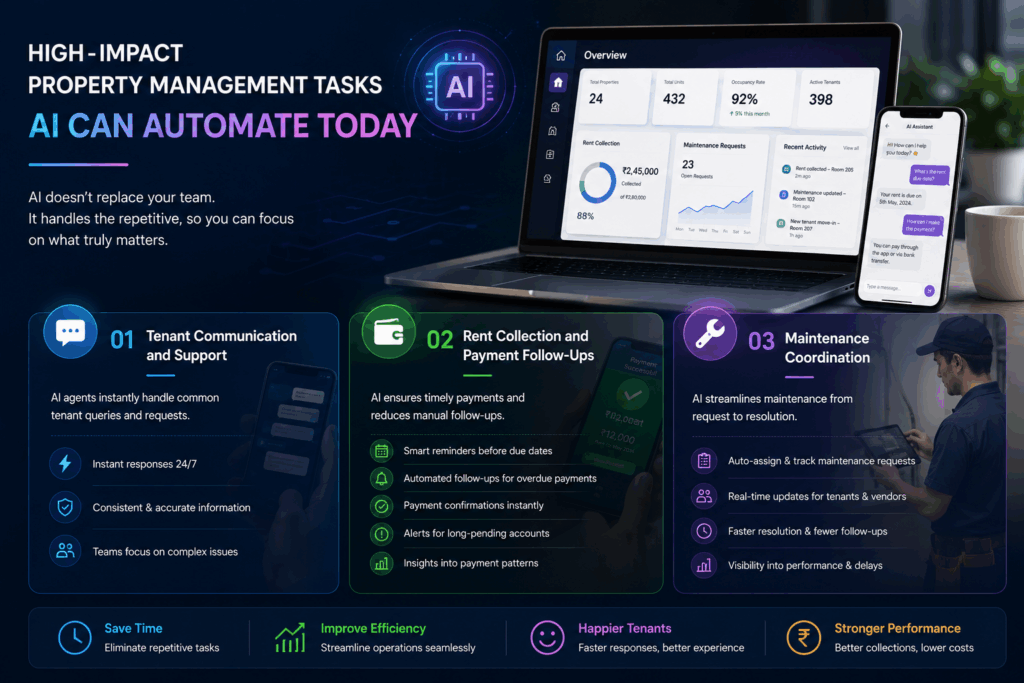
High-Impact Property Management Tasks AI Can Automate Today
Fully autonomous properties may still be evolving, but AI is already delivering measurable benefits across several operational areas.
Rather than replacing property teams, these systems are helping managers eliminate repetitive work that consumes valuable time every day.
Tenant Communication and Support
Communication remains one of the largest operational challenges for growing properties. As occupancy increases, teams often find themselves answering the same questions repeatedly regarding rent payments, visitor policies, onboarding requirements, utility bills, and maintenance updates.
AI agents can handle many of these routine interactions instantly, allowing tenants to receive support without waiting for staff availability.
This creates benefits for both sides. Residents receive faster responses, while property teams can focus on issues that genuinely require human attention.
Over time, this also improves consistency because every tenant receives the same accurate information regardless of who is managing operations on a given day.
Rent Collection and Payment Follow-Ups
Late payments are rarely caused by a single issue. In many cases, they occur because reminders are inconsistent, communication happens too late, or managers simply do not have enough time to follow up effectively across every account.
AI agents can support collections by continuously monitoring payment activity and triggering actions when required.
Some of the tasks that can be automated include:
- Scheduled rent reminders before due dates.
- Follow-ups for overdue payments.
- Payment confirmation notifications.
- Escalation alerts for long-pending accounts.
- Identification of recurring payment patterns.
By reducing manual tracking, property teams gain better visibility into collections while maintaining a more consistent communication process.
Maintenance Coordination
Maintenance management is often where operational inefficiencies become most visible.
A tenant raises a complaint. A vendor is contacted. Updates are shared through calls or messages. Someone forgets to follow up. The issue takes longer than expected to resolve.
Individually, these delays may seem small. Across hundreds of maintenance requests, however, they create significant operational friction.
AI-driven workflows help standardize this process by ensuring that requests are tracked from start to finish. Instead of relying entirely on manual coordination, managers gain a clearer view of pending issues, vendor performance, and resolution timelines.
For tenants, this translates into better communication and greater transparency throughout the process.
How AI Agents Improve Efficiency, Accuracy, and Tenant Experience
The discussion around AI often focuses on automation, but automation is only part of the story. The bigger advantage lies in how AI helps properties operate more consistently.
In property management, small inefficiencies tend to compound over time. A missed follow-up becomes an unresolved complaint. An overlooked vacancy extends room downtime. A delayed response creates tenant frustration. When these situations occur repeatedly, they begin affecting both operational performance and resident satisfaction.
AI agents help reduce these gaps by ensuring routine workflows continue running even when teams are busy handling other responsibilities.
Faster Response Times Without Expanding Teams
One of the biggest pressures on property teams today is the expectation of immediate communication.
Tenants are accustomed to receiving instant updates from delivery apps, banks, and service providers. Naturally, they expect a similar level of responsiveness from their accommodation providers.
While hiring additional staff can improve response times, it is not always the most scalable solution.
AI agents help bridge this gap by providing:
- Instant acknowledgment of complaints and requests.
- Real-time status updates.
- Automated responses to common questions.
- Proactive reminders and notifications.
This ensures tenants remain informed while allowing staff to focus on more complex situations that require personal attention.
Improved Accuracy Across Daily Operations
Many operational mistakes are not caused by negligence. They happen because teams are managing too many moving parts simultaneously.
As occupancy grows, managers may struggle to keep track of every payment follow-up, maintenance request, or documentation requirement.
This is where AI-powered workflows create value.
By automating routine actions, operators can reduce the likelihood of:
- Missed reminders.
- Forgotten follow-ups.
- Incomplete records.
- Delayed escalations.
- Inconsistent communication.
The result is not just greater efficiency, but greater reliability across the entire property operation.
Better Visibility for Property Managers
One challenge many operators face is information overload.
Data exists across multiple systems, conversations, spreadsheets, and reports. Managers often spend significant time gathering information before they can make decisions.
AI agents can continuously monitor operational activity and surface the insights that matter most.
For example, instead of manually reviewing reports, managers may receive alerts highlighting:
- Properties with rising vacancy risks.
- Unusual maintenance trends.
- Recurring tenant complaints.
- Delayed rent collections.
- Vendor performance concerns.
This shifts management attention away from data collection and toward decision-making.
A More Consistent Tenant Experience
Most tenants do not judge a property based on one major interaction. Their perception is shaped by dozens of smaller experiences over time.
A quick maintenance update. A timely payment reminder. A smooth onboarding process. A clear response to a question.
Individually, these moments seem minor. Together, they define the overall resident experience.
AI agents help ensure these interactions remain consistent regardless of occupancy levels or staff workload, creating a more professional and predictable experience for residents.
Risks, Limitations, and What Managers Should Know
While AI is becoming increasingly capable, successful adoption requires realistic expectations.
The strongest operators view AI as a tool that enhances property management rather than a solution that replaces it entirely.
Human Judgment Still Matters
Property management involves people, emotions, negotiations, and unique situations.
A late rent payment may have a simple explanation. A tenant complaint may require empathy rather than automation. A dispute may involve circumstances that no system can fully understand.
These situations require human judgment.
AI performs best when handling structured, repetitive tasks while allowing managers to focus on relationship-building, problem-solving, and decision-making.
The future of property management is likely to be collaborative rather than fully autonomous.
Good Data Creates Better Results
An AI system is only as effective as the information available to it.
If records are incomplete, communication histories are fragmented, or workflows are poorly documented, the quality of AI-driven recommendations will suffer.
Before implementing advanced AI capabilities, operators should ensure they have strong operational foundations in place.
This includes:
- Centralized tenant records.
- Accurate occupancy data.
- Organized communication workflows.
- Reliable payment tracking.
- Structured complaint management.
Properties that invest in operational discipline today will be better positioned to benefit from AI tomorrow.
Privacy and Security Cannot Be Overlooked
Property managers handle sensitive information every day.
Tenant identities, payment records, agreements, communication history, and occupancy data all require responsible management.
As AI adoption grows, operators must ensure that:
- Data remains secure.
- Access controls are properly managed.
- Compliance requirements are followed.
- Resident privacy is protected.
Technology should strengthen trust, not compromise it.
The Future of Autonomous Property Operations
The property management industry is still in the early stages of AI adoption, but the direction is becoming increasingly clear.
Today’s AI agents primarily assist with individual tasks. Tomorrow’s systems will likely coordinate entire workflows across properties, vendors, tenants, and management teams.
Imagine a property operation where:
- Upcoming vacancies automatically trigger marketing workflows.
- Pricing recommendations adjust based on demand patterns.
- Maintenance schedules adapt using historical usage data.
- Tenant communication changes based on engagement behavior.
- Potential payment delays are identified before they happen.
- Operational reports update continuously without manual effort.
Many of these capabilities are already beginning to emerge.
The biggest shift will not be technological. It will be operational.
Property managers will spend less time coordinating routine activities and more time focusing on growth, resident retention, community building, and long-term strategy.
Just as cloud software transformed property management over the last decade, AI agents are likely to shape the next phase of operational evolution.
The businesses that embrace these tools early will be better positioned to scale without proportionally increasing administrative complexity.

How RentOk Helps Property Managers Build Smarter Operations
AI works best when it has access to structured workflows and reliable operational data.
Without centralized systems, even the most advanced automation struggles to deliver meaningful value.
This is why many growing property businesses first focus on creating a strong digital foundation before expanding into more intelligent automation.
RentOk helps operators centralize key property management functions including:
- Tenant management.
- Occupancy tracking.
- Rent collection monitoring.
- Complaint resolution workflows.
- Communication records.
- Documentation management.
- Operational reporting.
By bringing these activities into a single platform, property managers gain better visibility into daily operations while reducing reliance on disconnected tools and manual processes.
As AI continues becoming more integrated into the industry, businesses with organized systems and structured data will be in the strongest position to take advantage of future innovations.
Conclusion
Property management is entering a new era where operational success will depend not only on technology adoption, but on how intelligently that technology is used.
AI agents are helping property businesses automate repetitive tasks, improve communication, reduce operational inefficiencies, and create better experiences for both managers and residents. From rent collection and maintenance coordination to tenant support and operational monitoring, their impact is already becoming visible across the industry.
However, the most successful operators will not be the ones that automate everything.
They will be the ones that combine human expertise with intelligent systems, allowing technology to handle routine coordination while people focus on decisions, relationships, and growth.
As property operations become increasingly data-driven, the ability to manage properties proactively rather than reactively will become a significant competitive advantage.
If you’re looking to build a more efficient, scalable, and future-ready property operation, now is the time to start strengthening the systems behind your business. Explore RentOk to centralize operations, improve visibility, and create the foundation needed for the next generation of AI-powered property management.
About the Author
Ishika Pannu
Ishika Pannu brings you the latest insights and easy-to-apply strategies in property management—helping you simplify renting and grow with RentOk.