Market Trends
How to Increase PG Profit by 20% Without Raising Rent

Written by
Ishika Pannu
Read Time
7 min read
Posted on
April 24, 2026
Overview
Overview
How to Increase PG Profit by 20% Without Raising Rent
At a certain stage, most PG operators begin to feel a ceiling forming around their business. Occupancy is stable, pricing is competitive, and demand exists, yet profitability refuses to scale at the same pace. The instinctive reaction is to look at rent as the only lever left to pull. However, in high-density housing, rent is not just a number; it is a sensitivity trigger. Even a marginal increase can quietly affect retention, push tenants to compare alternatives, and disrupt the balance you’ve already built.
The more experienced operators understand something different. Profitability in a PG is rarely limited by pricing. It is limited by how narrowly the business is structured. When revenue depends only on rent, growth will always feel constrained. But when the same property is viewed as a system of services rather than just accommodation, new layers of income begin to emerge without disturbing the core pricing.
The Revenue Gap Most PGs Don’t Recognize
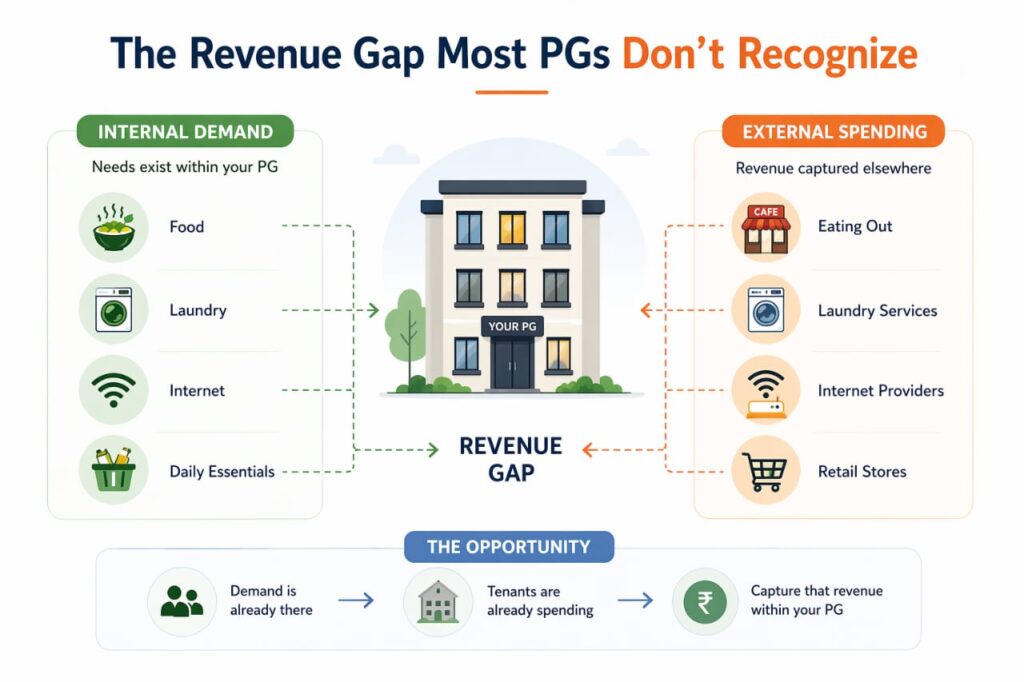
If you observe tenant behavior closely, it becomes clear that rent is only one part of their monthly spending. A resident living in your PG is already paying for multiple recurring needs, food upgrades, laundry, daily essentials, better internet, convenience services, and these expenses are not occasional. They are habitual and predictable.
The issue is not that tenants are unwilling to spend. The issue is that most of that spending happens outside your property. From a business standpoint, this creates a structural gap where demand exists within your ecosystem, but revenue is captured elsewhere.
This gap typically shows up in subtle ways:
- Tenants stepping out multiple times a week for basic necessities, even when those needs could have been fulfilled within the property itself with minimal setup.
- Regular spending on third-party services such as laundry or food upgrades, which indicates clear willingness to pay but no internal channel to capture it.
- Time and effort being spent by tenants to access services externally, which often goes unnoticed but directly reflects an opportunity for internal monetization.
The opportunity, therefore, is not about creating new demand. It is about structuring and capturing the demand that already exists inside your PG.
Moving from Rent Collection to Revenue Design
A high-performing PG is not defined by how many beds it fills, but by how effectively it monetizes each occupied bed. This requires a shift in thinking — from a linear income model to a layered one.
Instead of operating with:
Occupancy → Rent → Profit
The model evolves into:
Occupancy → Experience → Services → Revenue
In this structure, rent becomes the foundation, not the ceiling. The focus moves toward increasing the value extracted from each tenant interaction, without making that interaction feel transactional.
This is where many operators get it wrong. They attempt to “add charges” instead of designing systems that tenants naturally adopt. The difference is subtle but critical. One creates resistance, the other creates acceptance.
Everyday Services as Reliable Revenue Drivers
Some of the most effective revenue streams are not built on innovation, but on frequency. Services that tenants already depend on daily tend to generate the most consistent returns because they require no behavioral change.
Consider vending and laundry, both are routine needs, not optional luxuries. When these are not available within the property, tenants step outside, creating both inconvenience for them and lost revenue for you.
A structured approach to these services typically includes:
- Installing vending solutions in high-traffic areas, ensuring easy access to snacks, beverages, and small essentials that tenants frequently consume without planning.
- Setting up laundry systems, either through self-service machines or reliable vendor partnerships, so tenants don’t need to depend on external providers.
- Maintaining clear and consistent pricing so tenants understand the value and don’t perceive the service as overpriced compared to external alternatives.
Over time, these services do more than generate revenue. They create behavioral anchoring, where tenants begin to rely on in-property solutions by default. This is what turns small services into stable income streams.
Reworking Food into a Flexible Revenue Layer
Food is one of the most underutilized components in PG monetization, largely because it is treated as a fixed offering. In many setups, meals are bundled into rent, leaving no room for variation, upgrades, or additional revenue.
However, tenant expectations around food are rarely uniform. While some are comfortable with basic meals, others are willing to pay for better quality, variety, or flexibility. Ignoring this difference results in lost opportunity.
A more structured model introduces layers instead of a single offering:
- A base meal plan that covers essential requirements and ensures that standard expectations are met consistently.
- An upgraded plan that offers improved quality, better variety, or additional meal options for tenants who value a higher standard.
- Add-on options such as extra meals, customized diets, or special menus that cater to specific preferences and create additional revenue channels.
This approach does not complicate operations as much as it appears. Instead, it aligns pricing with value and gives tenants the freedom to choose, which naturally increases adoption.
Subscription Services: Small Additions That Scale Quietly
One-time charges often feel significant to tenants, even when they are small. Subscriptions, on the other hand, feel manageable because they are spread over time and tied to ongoing value.
This makes them one of the most effective tools for increasing per-tenant revenue.
Examples of well-structured subscription services include:
- Housekeeping upgrades where tenants can opt for more frequent cleaning instead of relying on a basic schedule that may not suit everyone.
- Premium internet plans that cater to tenants with higher usage needs, such as remote workers or students attending online classes.
- Maintenance or convenience packages that ensure quicker service response or access to additional facilities.
While each subscription may contribute a modest amount individually, their combined impact across a fully occupied PG is substantial. More importantly, they introduce predictable monthly income, reducing dependence on variable or inconsistent revenue sources.
Partnership Models: Expanding Without Increasing Complexity
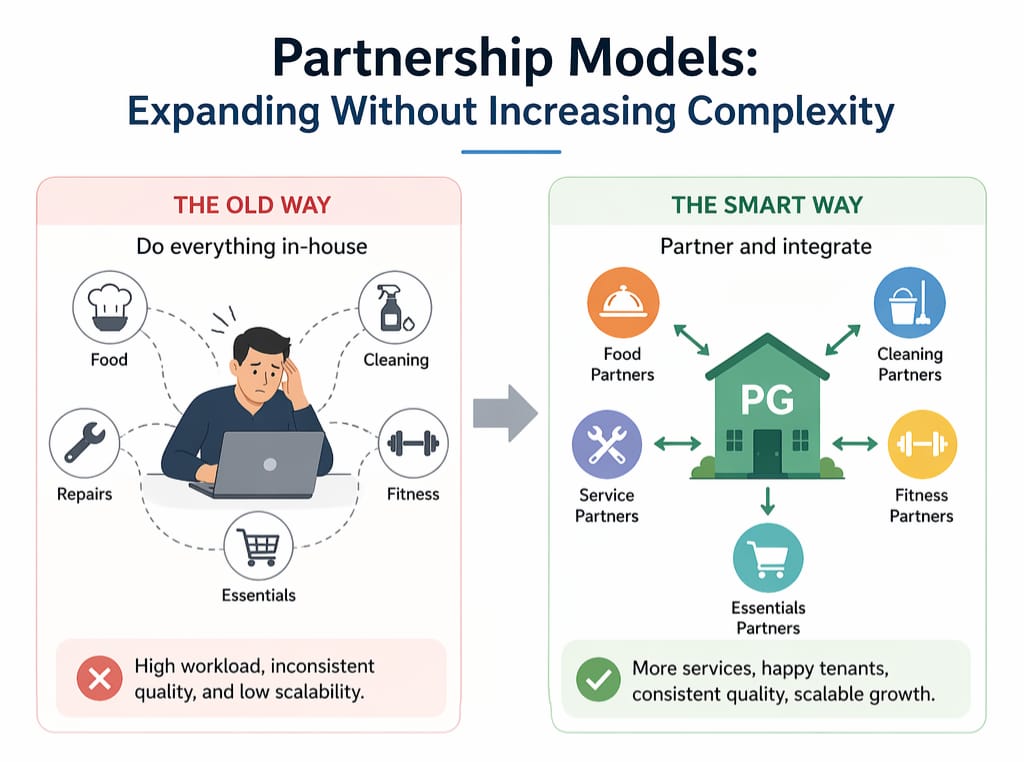
A common operational mistake is trying to manage every service internally. This often leads to inefficiencies, inconsistent service quality, and unnecessary workload.
Partnership-based models provide a more scalable alternative. Instead of building services from scratch, you collaborate with external providers and integrate their offerings into your PG ecosystem.
This can include:
- Food delivery or tiffin providers who handle preparation and logistics while you facilitate access and earn a margin.
- Local service vendors for cleaning, repairs, or essentials, allowing you to expand offerings without managing execution.
- Fitness or lifestyle partnerships that enhance tenant experience while generating additional revenue through commissions.
This model allows you to expand your revenue streams while keeping your operations focused and manageable.
Why Execution Fails Without Structure
Despite understanding these opportunities, many operators fail to scale them effectively. The issue is not demand, it is the lack of structure.
Without proper systems, you often see:
- Services being offered but not tracked properly, leading to missed revenue and confusion.
- Payments being collected inconsistently, which creates gaps in cash flow and accountability.
- No clear visibility into who is using what, making it difficult to optimize or expand services.
Over time, these gaps reduce the effectiveness of even well-designed revenue strategies.
How Rentok Helps Turn Revenue into a System
As soon as multiple revenue streams are introduced, managing them manually becomes increasingly difficult. This is where a structured system becomes essential.
Rentok helps bring clarity and control into this complexity by:
- Organizing tenant data in a way that connects services, payments, and interactions into a single view.
- Tracking not just rent, but all additional charges, ensuring nothing is missed or mismanaged.
- Providing clear visibility into payment status, reducing dependence on manual follow-ups.
- Maintaining consistent communication so tenants are always aware of their dues and services.
This ensures that as your revenue grows, your operations remain stable and controlled.
Final Perspective
Increasing PG profit isn’t about charging more, it’s about structuring better. Most of the value you need already exists in tenant behavior, daily needs, and recurring spending. The key is whether you capture it.
If your setup depends only on rent, you’re limiting your potential. Additional demand is already there, it just needs to be structured and managed.
Smart operators don’t just expand, they optimize. They shift from a single-income model to a layered system where revenue grows naturally without disrupting the tenant experience.
Rentok helps you build that system, keeping operations organized and scalable.
A well-structured PG doesn’t just function better, it earns better.
Book a demo and see how your PG can unlock additional profit without changing rent.
About the Author
Ishika Pannu
Ishika Pannu brings you the latest insights and easy-to-apply strategies in property management—helping you simplify renting and grow with RentOk.