Market Trends
Beyond WhatsApp: Why Professional PGs Need a Centralized Communication Hub

Written by
Ishika Pannu
Read Time
8 min read
Posted on
April 23, 2026
Overview
Overview
Beyond WhatsApp: Why Professional PGs Need a Centralized Communication Hub
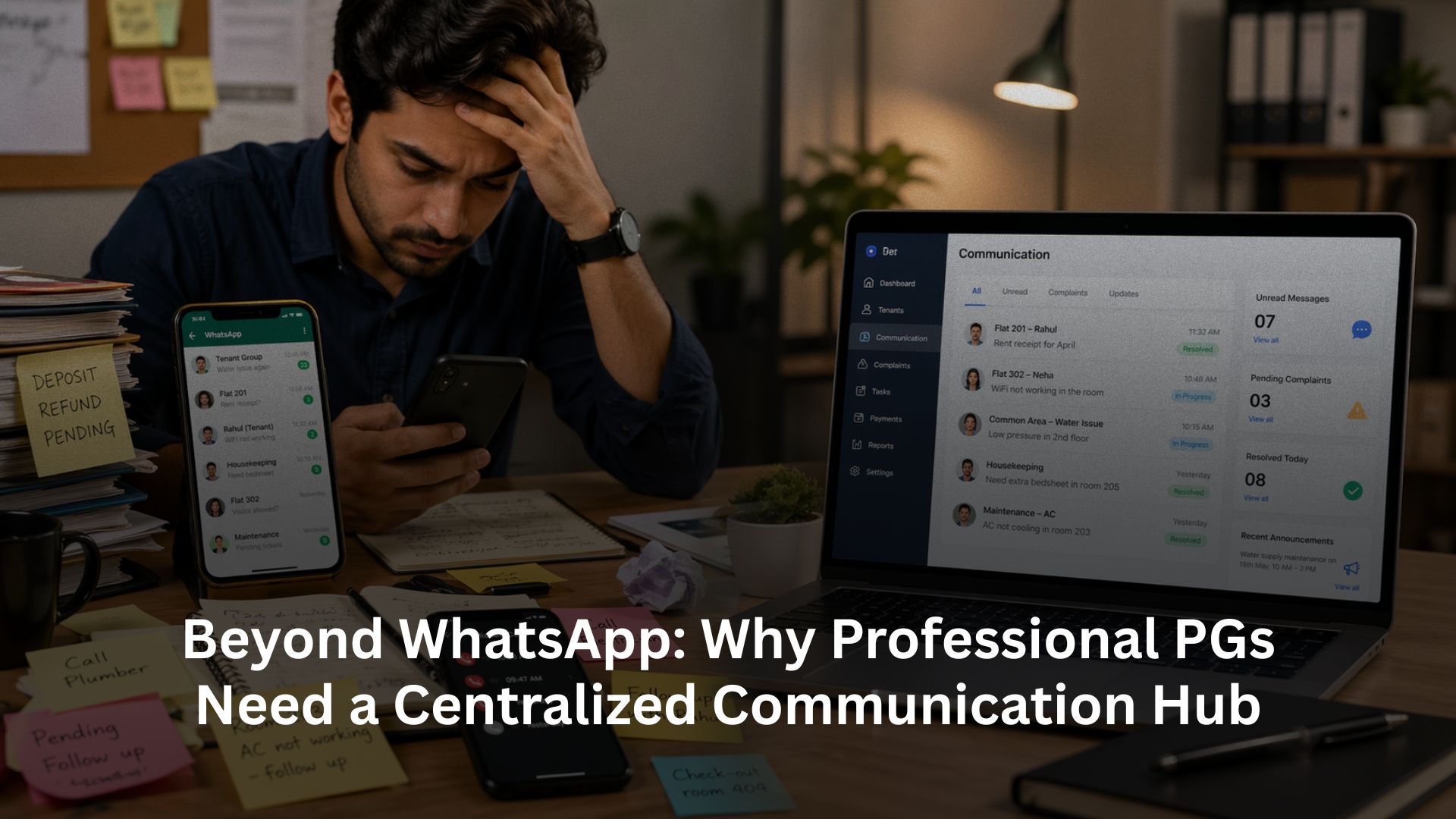
At a smaller scale, communication rarely feels like a problem. A few tenants, limited interactions, and everything seems manageable through quick messages and informal follow-ups. That’s why most PG operators naturally rely on WhatsApp in the early stages, it’s fast, familiar, and requires no setup.
But communication in a growing PG is not just about sending messages. To centralize PG communication, it must evolve into a system that holds together payments, complaints, updates, and expectations. And when that system isn’t structured, things don’t break instantly, they begin to slip in ways that are difficult to notice at first, but hard to recover from later.
When Communication Starts Becoming an Operational Problem
The shift doesn’t happen overnight. It begins with small inefficiencies that feel manageable in isolation but start compounding as tenant volume increases.
You might notice that:
- Messages that require follow-up get buried under newer conversations, forcing tenants to repeat themselves just to get attention
- Staff members respond based on partial context because they don’t have access to the full communication history with that tenant
- Issues that were acknowledged earlier resurface because there was no clear tracking of whether they were actually resolved
None of these feel like major failures individually. But together, they create a pattern where communication becomes reactive instead of controlled.
At that point, the problem is no longer about responsiveness, it’s about visibility.
The Real Risk: Fragmented Communication Data
Most PG operators don’t lack communication, they lack structured communication.
When interactions are spread across chats, calls, and memory, the bigger issue is not missing messages. It’s losing continuity.
A typical situation often looks like this:
- A tenant raises a complaint over chat, expecting it to be noted and acted upon
- A staff member discusses it over a call, without recording what was agreed
- The resolution is either delayed or communicated informally, with no clear record
Over time, this creates gaps that are difficult to bridge:
- There is no reliable history of tenant issues, making it hard to understand patterns or recurring problems
- Different staff members provide inconsistent responses because they are working with incomplete information
- Simple disputes become complicated because there is no documented proof of what was communicated
The absence of a single source of truth is what turns everyday communication into operational risk.
Why WhatsApp Falls Short in High-Density Housing
WhatsApp works exceptionally well for conversations. But PG operations are not just conversations, they are ongoing workflows that require structure and traceability.
As your property grows, communication needs to do more than just connect people. It needs to:
- Maintain continuity across multiple interactions with the same tenant over time
- Provide visibility into what has been discussed, promised, and resolved
- Ensure that tasks emerging from conversations are actually tracked and completed
WhatsApp, by design, does not support this level of structure.
It cannot:
- Link conversations to specific operational actions like complaint resolution or payment tracking
- Provide a centralized view of all tenant interactions in one place
- Ensure accountability when multiple people are involved in handling communication
As a result, operators end up compensating manually, scrolling through chats, relying on memory, and piecing together context from fragmented sources.
This approach may hold up temporarily, but it does not scale.
The Overlooked Importance of Proof in Communication
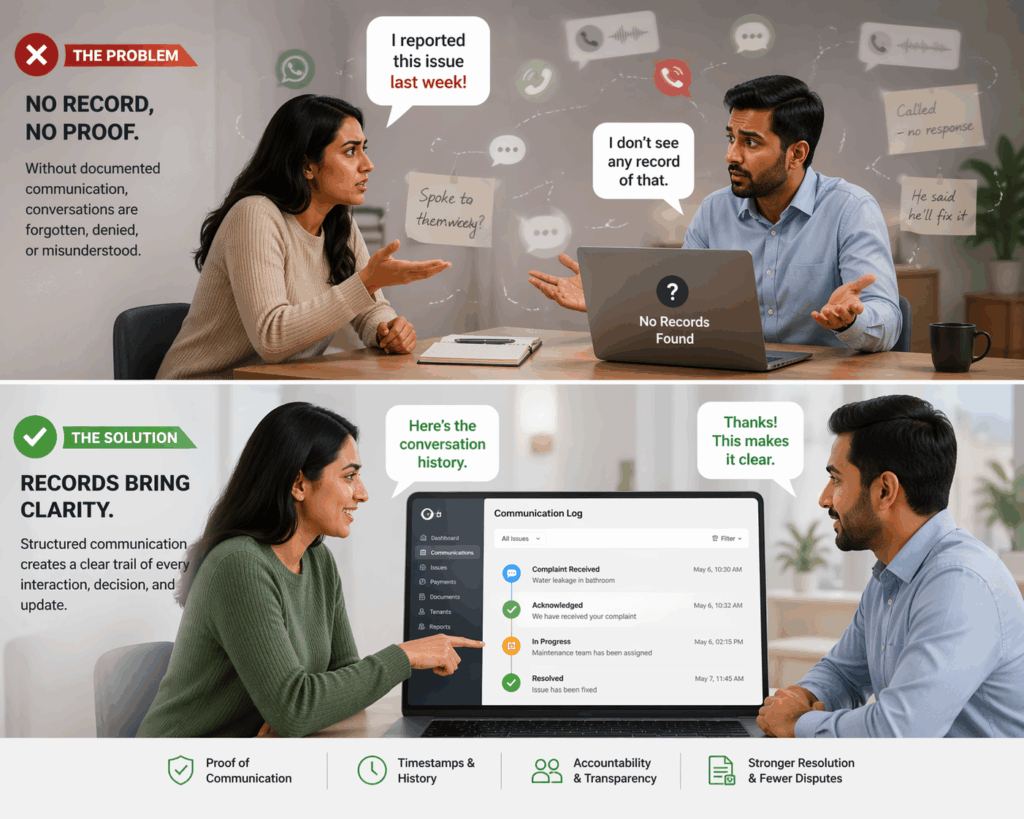
One of the most underestimated aspects of tenant communication is documentation.
When everything happens informally, there is no clear record of:
- What was communicated to the tenant and when
- What commitments were made regarding resolution or timelines
- Whether a particular issue was acknowledged or ignored
This becomes especially critical in situations like:
- Payment disagreements where tenants claim they were not informed about dues or deadlines
- Complaint escalations where tenants feel their concerns were not addressed in time
- Disputes involving damage, deposits, or responsibilities
Without documented communication, even well-managed situations become difficult to defend. The lack of proof shifts the conversation from clarity to confusion.
Structured communication eliminates this uncertainty by ensuring that every interaction leaves a trace.
Moving from Manual Follow-Ups to Automated Consistency
A significant portion of PG communication revolves around repetitive interactions, rent reminders, payment confirmations, complaint updates, and general notifications.
When handled manually, these processes introduce inconsistency:
- Some tenants receive timely reminders, while others are overlooked
- Follow-ups depend on individual memory, leading to uneven communication
- Staff effort gets consumed in repeating the same actions instead of focusing on resolution
A centralized communication system removes this variability by introducing automation where it matters.
Instead of relying on manual effort:
- Rent reminders can be triggered automatically based on due dates, ensuring no tenant is missed
- Payment updates can be communicated instantly, reducing confusion and unnecessary follow-ups
- Alerts can notify operators about pending issues, ensuring that nothing remains unattended
This doesn’t just save time, it standardizes the experience for every tenant.
Tenant Communication Software vs Messaging Apps
The distinction between messaging tools and communication systems becomes clearer as operations grow.
Messaging apps facilitate interaction, but they do not organize it. A structured communication system, on the other hand, transforms interaction into an operational asset.
With a centralized system, you can:
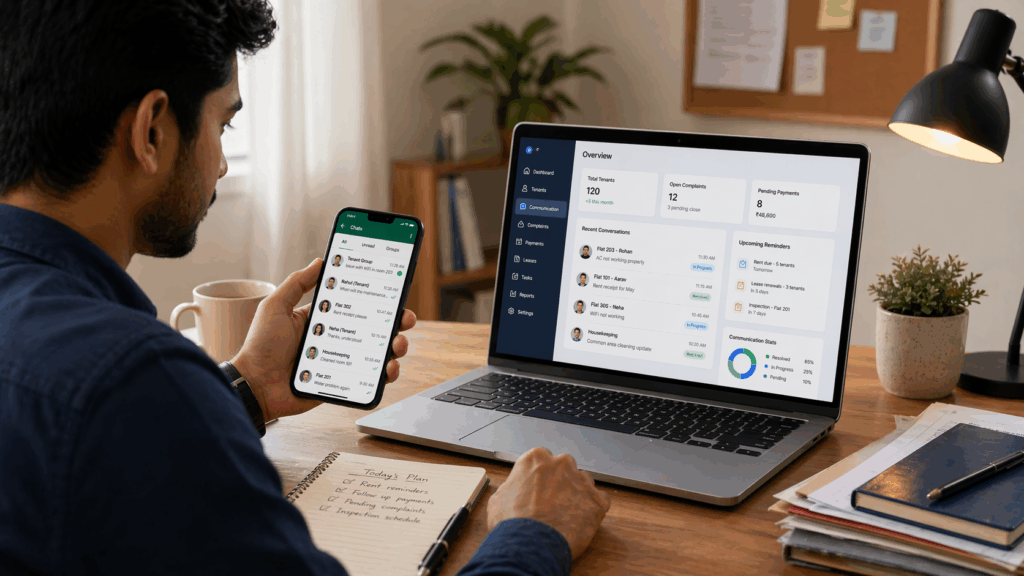
- Maintain a complete and accessible history of interactions for each tenant, without relying on scattered chats
- Track complaints from the moment they are raised to the point they are resolved, ensuring nothing is left incomplete
- Assign responsibility and monitor progress, creating accountability across staff members
- Access all communication from a single interface, eliminating the need to search across platforms
This shift, from fragmented conversations to structured communication, is what enables consistency at scale.
Communication as a Driver of Tenant Experience
Tenant experience is often misunderstood as a function of amenities or pricing. In reality, it is shaped just as much by how communication is handled on a daily basis.
When communication lacks structure:
- Tenants are forced to follow up repeatedly, which creates frustration even for minor issues
- Delays in updates make tenants feel uncertain about whether their concerns are being taken seriously
- Inconsistent responses reduce trust, especially when different staff members provide conflicting information
In contrast, when communication is clear and consistent:
- Tenants feel informed and in control of their interactions with the property
- Issues are resolved without repeated effort, improving overall satisfaction
- Trust builds over time, which directly impacts retention
The difference is not dramatic, but it is decisive.
Building a Communication Framework That Scales
A scalable communication system is not about adding complexity. It is about removing ambiguity.
At a minimum, it should ensure:
- Centralization of interactions, so that all communication is stored and accessible in one place instead of being scattered across channels
- Traceability of actions, allowing you to track what was communicated, what was promised, and what has been completed
- Consistency in responses, so that every tenant receives the same level of clarity and timeliness
- Visibility into status, enabling operators to understand the state of issues without manually digging through conversations
When these elements are in place, communication becomes predictable, and predictability is what reduces operational friction.
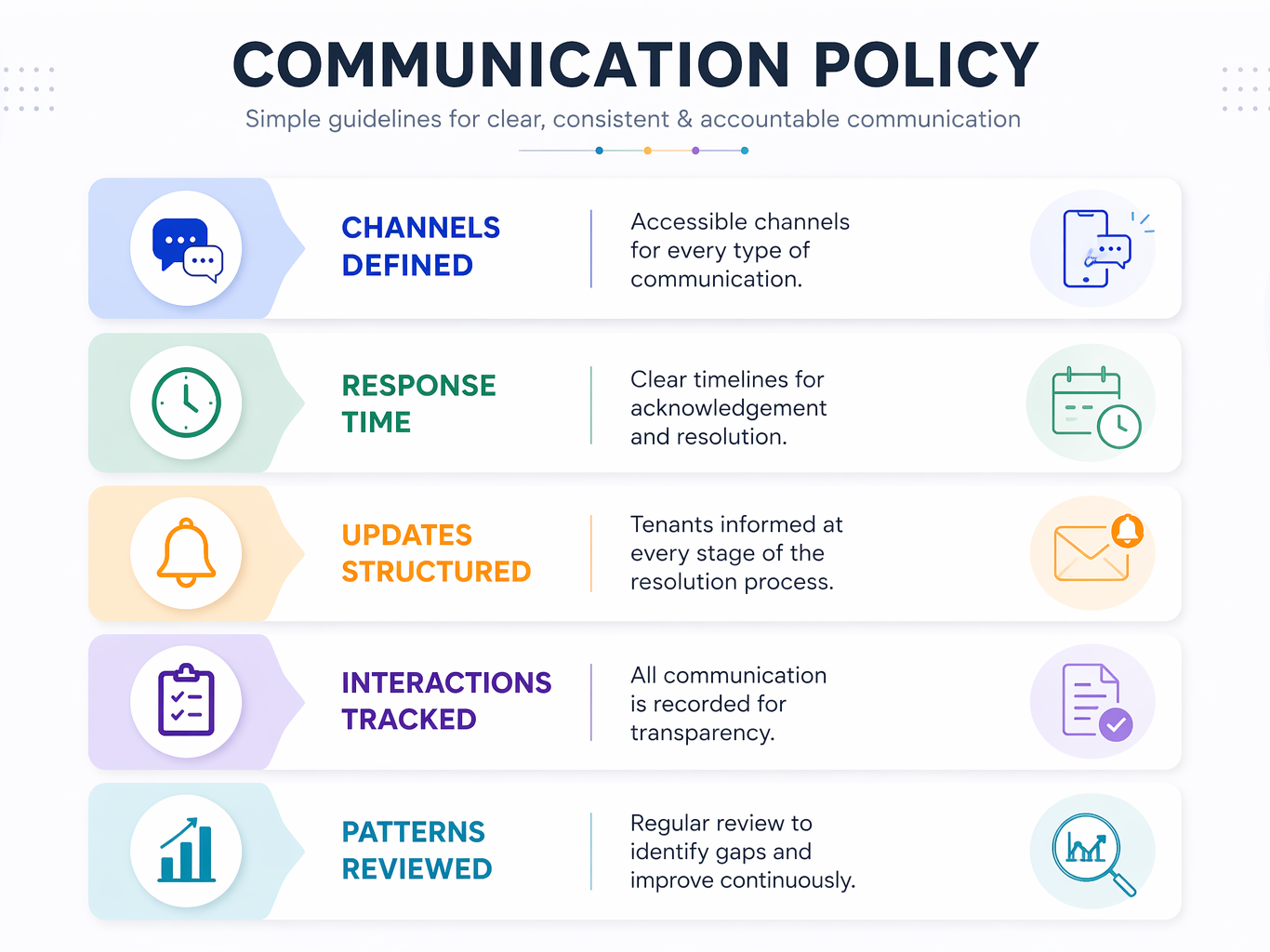
Communication Policy Template (A Practical Starting Point)
Formalizing communication does not require a complex system from day one. It starts with setting clear expectations and ensuring consistency in execution.
A simple communication policy can include:
- Defined communication channels, where tenants know exactly where to raise complaints or queries instead of using multiple informal methods
- Clear response timelines, ensuring that every issue is acknowledged and addressed within a predictable timeframe
- Structured update mechanisms, so tenants are informed at every stage of issue resolution rather than being left to follow up
- Mandatory tracking of interactions, creating a record of all communication for future reference and accountability
- Periodic review of communication patterns, helping identify recurring delays or gaps that need improvement
This framework creates discipline in communication, which directly translates into better operational control.
How Rentok Helps Bring Structure to Communication
As tenant volume increases, maintaining structured communication manually becomes increasingly difficult. This is where Rentok helps by consolidating communication into a single, organized system.
Instead of relying on scattered tools and memory, Rentok enables you to:
- Maintain linked tenant communication records, ensuring every interaction is accessible and contextual
- Track complaints from initiation to resolution, providing complete visibility into issue handling
- Keep payment-related communication clear and updated, reducing confusion around dues and confirmations
- Operate with a centralized view of all interactions, eliminating the need to search across multiple channels
By bringing structure to communication, Rentok reduces the likelihood of missed messages, delayed follow-ups, and inconsistent responses, allowing operations to run with greater clarity and control.
Move from Conversations to a System That Actually Works
If your current communication still depends on chats, calls, and manual tracking, the gaps may not always be visible, but they are present.
And as your PG grows, those gaps don’t stay contained.
They expand, overlap, and eventually begin to affect how efficiently your entire operation runs.
A centralized communication system doesn’t just improve how you interact with tenants. It transforms communication into a structured, reliable part of your operations, one that scales with you instead of slowing you down.
Because beyond a certain point, it’s no longer about how many messages you can manage.
It’s about whether your system can manage them for you.
Explore RentOK and turn everyday communication into a system that scales with your PG.
About the Author
Ishika Pannu
Ishika Pannu brings you the latest insights and easy-to-apply strategies in property management—helping you simplify renting and grow with RentOk.