Market Trends
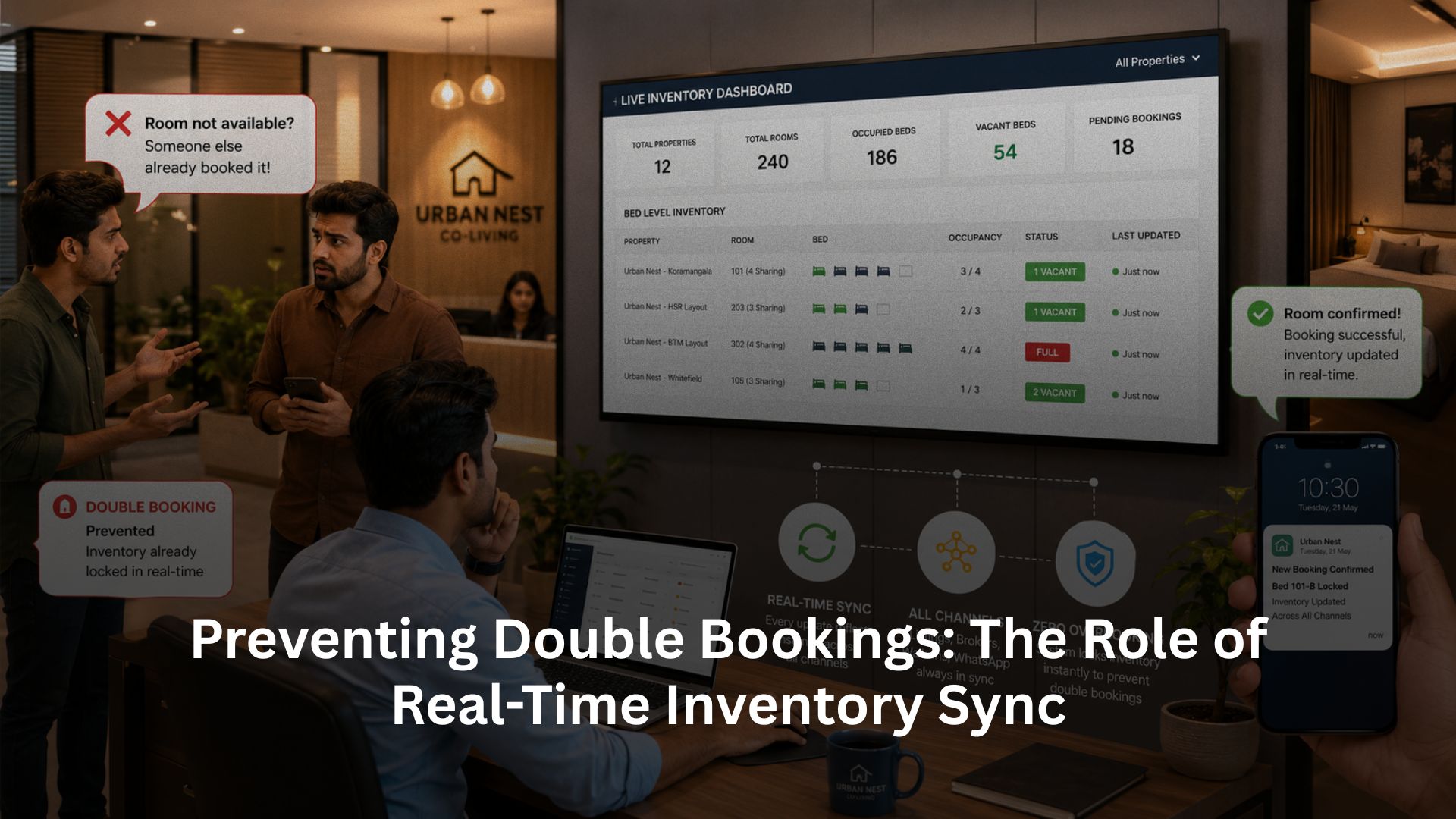
Preventing Double Bookings: The Role of Real-Time Inventory Sync

Written by
Ishika Pannu
Read Time
8 min read
Posted on
May 6, 2026
Overview
Overview
Preventing Double Bookings: The Role of Real-Time Inventory Sync
Double bookings are one of the fastest ways to damage trust in a PG business.
Not because tenants expect perfection, but because booking conflicts immediately create the feeling that operations are disorganized. A tenant who hears, “Actually, that room was already booked,” instantly starts questioning everything else about the property, management quality, communication, responsiveness, and reliability.
This is why overbooking is not just a booking issue.
It is an operational credibility issue.
And as PG businesses scale across multiple channels, properties, brokers, and team members, preventing these conflicts becomes impossible without a centralized inventory system running in real time.
Why Double Bookings Are Becoming More Common in Modern PGs
A few years ago, inventory management was relatively simple. Most PGs operated locally, inquiries came through limited sources, and room allocation was controlled by one person.
Today, the operational environment looks completely different.
A single property may receive leads through:
- Listing platforms where availability changes multiple times a day and inquiries move rapidly during peak seasons
- WhatsApp conversations where rooms are “temporarily held” informally without structured updates
- Brokers handling multiple tenants simultaneously while sharing availability across several PGs
- Instagram campaigns, Google listings, and referrals generating parallel inquiry pipelines
At small scale, these channels feel manageable.
At growth stage, they start colliding with each other.
And the moment inventory is being handled across disconnected systems, booking conflicts become inevitable.
The Real Operational Problem Is Delayed Inventory Visibility
Most operators assume overbooking happens because:
- Staff members forgot to update inventory
- Someone made a communication mistake
- A booking was confirmed too quickly
But operationally, the real issue is deeper than human error.
The actual problem is that inventory visibility is delayed.
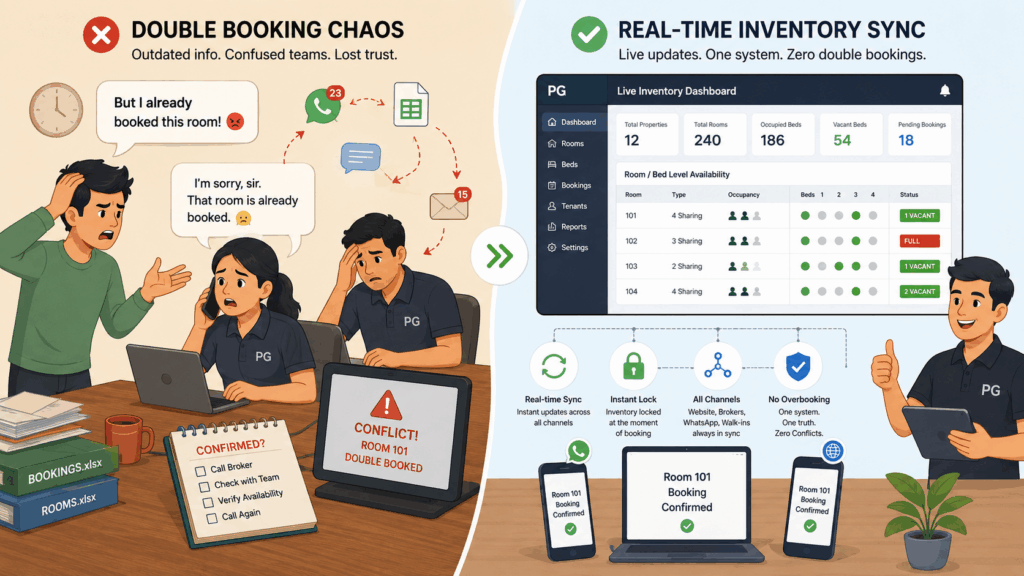
For example, a sales executive confirms a bed during a phone call. Before the information is updated everywhere, another team member receives a walk-in inquiry and offers the same space because it still appears vacant in their records.
Both conversations are technically correct based on the information each person sees.
The issue is:
The system itself is not synchronized.
And when availability updates depend on manual coordination, delays become unavoidable.
Why Manual Inventory Management Quietly Breaks Down
Manual systems usually feel “good enough” in the beginning.
Operators maintain:
- Spreadsheets with occupancy status
- WhatsApp groups for updates
- Notes shared internally between staff members
At low occupancy volume, this works because inventory movement is slower.
But as inquiry flow increases, several hidden problems begin appearing underneath the surface.
Common operational gaps in manual systems include:
- Staff members maintaining separate versions of occupancy data, leading to conflicting room availability information during peak inquiries
- Temporary room holds being communicated verbally without proper tracking, which creates confusion during final confirmations
- Delayed updates after bookings, especially when teams prioritize lead conversion before inventory synchronization
- Vacant beds being blocked accidentally because move-outs and check-outs are not reflected immediately in the system
These issues don’t look dangerous individually.
But together, they create operational instability.
And once instability enters inventory management, every booking starts depending on assumptions rather than clarity.
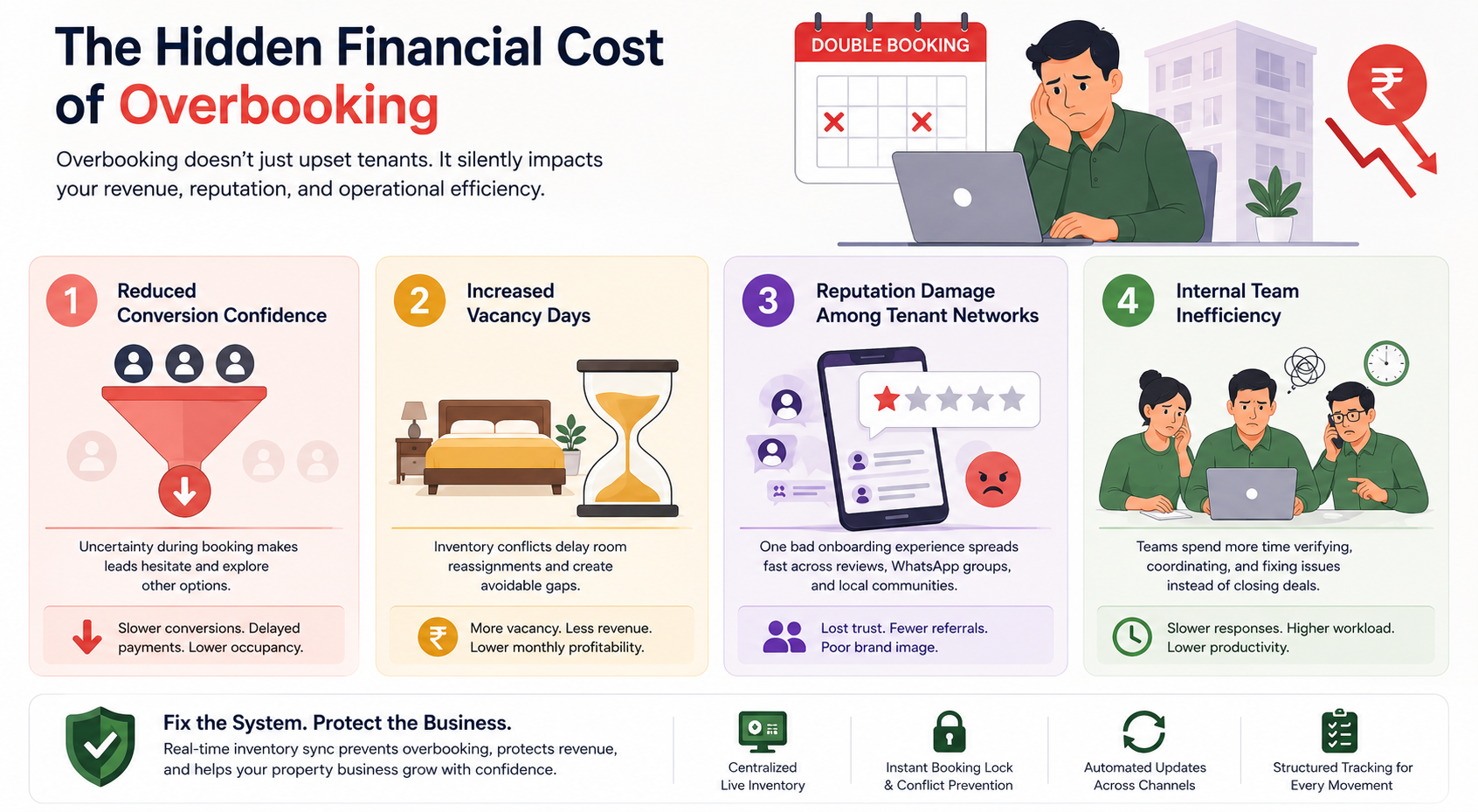
The Hidden Financial Cost of Overbooking
Most landlords calculate the immediate cost of a double booking:
- A tenant gets upset
- Another room must be arranged
- A discount or adjustment is offered
But the actual business impact is much larger.
Overbooking affects profitability in ways most operators don’t track directly.
1. Reduced Conversion Confidence
When leads experience uncertainty during booking, they hesitate. In high-competition rental markets, hesitation usually means the tenant continues exploring alternatives instead of committing immediately.
This slows down:
- Conversion speed
- Advance payment collection
- Occupancy stabilization
2. Increased Vacancy Days
One unresolved inventory conflict can delay occupancy for several days because:
- Rooms need to be reassigned
- Internal coordination increases
- Communication loops become longer
This creates avoidable vacancy gaps that quietly reduce monthly revenue.
3. Reputation Damage Among Tenant Networks
Students and working professionals rely heavily on:
- Google reviews
- Peer recommendations
- WhatsApp groups and social discussions
One negative onboarding experience spreads quickly within local tenant communities.
And unlike operational mistakes inside the property, booking conflicts happen before trust is built, which makes them significantly more damaging.
4. Internal Team Inefficiency
When inventory visibility is unreliable, teams stop trusting the system.
This creates:
- Repeated double-checking before confirmations
- Slower lead responses
- Constant coordination between staff members
Eventually, operations become reactive instead of structured.
Understanding Real-Time Inventory Sync Properly
Many operators assume inventory sync simply means updating room availability online whenever a booking happens. But modern PG operations move much faster than manual coordination can handle. The moment inquiries start coming from brokers, WhatsApp, listing platforms, and walk-ins simultaneously, inventory begins changing continuously throughout the day.
Real-time inventory synchronization ensures that every occupancy-related action reflects instantly across the system. Whether:
- A bed gets booked through a broker and immediately disappears from availability
- A tenant checks out early and the room becomes visible for fresh inquiries
- A cancellation reopens inventory automatically across teams and channels
the information updates in real time for everyone handling bookings.
Without synchronization, teams often end up working with slightly outdated information, which quickly creates booking overlaps and operational confusion.
Why Real-Time Sync Completely Changes Booking Operations
The biggest benefit of synchronized inventory is not automation alone. It is the confidence it creates during the booking process.
In manually managed systems, teams constantly pause before confirming anything because they are unsure whether inventory is fully updated. This slows down conversions and creates hesitation during lead handling.
With synchronized inventory:
- Sales teams can confirm availability instantly without repeated internal coordination
- Brokers receive accurate live updates, reducing conflicts caused by outdated information
- Walk-in leads can be converted faster because room status is always visible in real time
This creates a much smoother operational flow where teams spend less time rechecking inventory and more time converting leads efficiently.
Instead of:
“I think this room is available.”
the conversation becomes:
“Yes, this bed is available right now, and I can confirm it immediately.”
Why Channel Management Is Now a Core Operational Function
Most PG businesses today operate across multiple inquiry channels simultaneously. Leads usually come from:
- Listing platforms generating continuous inquiry flow
- WhatsApp conversations moving rapidly throughout the day
- Brokers handling multiple tenant discussions at once
- Social media campaigns, referrals, and direct calls
The challenge is that each channel slowly starts maintaining its own version of availability unless everything is connected centrally.
This creates issues like:
- Different room status across platforms and internal teams
- Duplicate commitments caused by delayed updates
- Slower booking confirmations due to repeated coordination
As inquiry volume grows, channel management becomes less about lead generation and more about operational control.
Because eventually:
The challenge is not finding tenants. It is managing inventory accurately enough to handle them efficiently.
Bed-Level Tracking vs Room-Level Tracking
One of the most overlooked operational mistakes in PG management is tracking rooms instead of beds. Many operators simply categorize entire rooms as occupied, vacant, or reserved without accounting for how shared accommodations actually function.
But PG operations work at bed level, not room level.
For example, a four-sharing room may still have:
- One vacant bed available despite partial occupancy
- Existing gender restrictions or compatibility considerations
- Allocation limitations that become difficult to manage without detailed visibility
Real-time systems solve this through:
- Bed-level inventory mapping across rooms and properties
- Live occupancy visibility for every allocation
- Accurate tenant assignment tracking that updates continuously
As occupancy scales across multiple properties, this level of visibility becomes essential for maintaining operational accuracy.
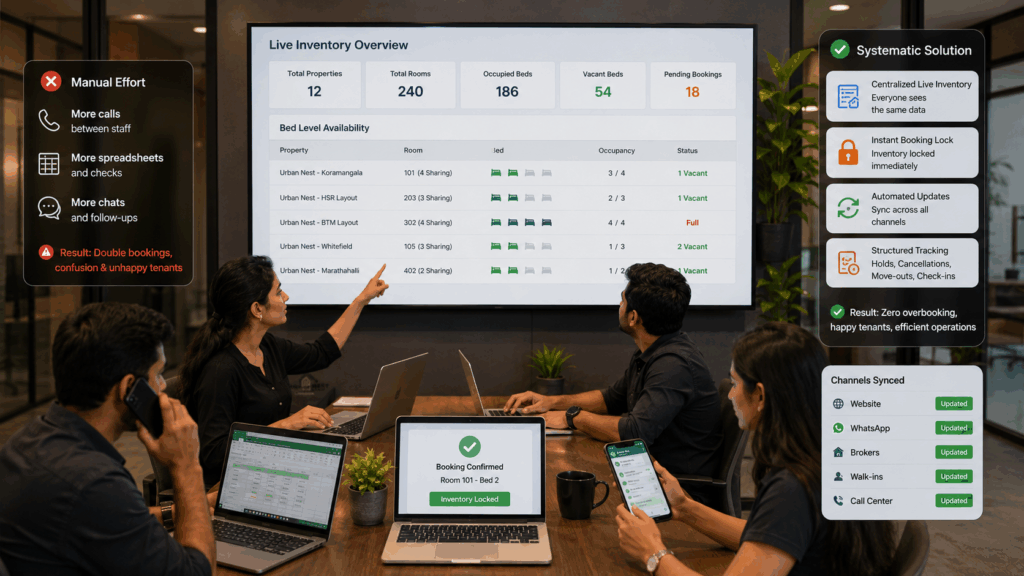
Preventing Overbooking Requires Systems, Not Extra Effort
Most operators try preventing double bookings through increased manual coordination:
- More calls between staff members before confirmations
- More checking across spreadsheets and chats
- More dependency on verbal communication for inventory updates
But overbooking is not caused by lack of effort.
It is caused by lack of synchronized systems.
A scalable inventory structure usually includes:
- Centralized inventory visibility where all team members access the same live data
- Instant booking workflows that lock inventory immediately after confirmation
- Automated updates across channels so availability never depends on manual coordination
- Structured tracking for holds, cancellations, move-outs, and check-ins
When this structure exists, overbooking stops becoming a recurring operational issue because the system itself prevents booking conflicts from happening in the first place.
How Rentok Helps Eliminate Double Bookings at Scale
As PG operations grow, inventory management becomes too dynamic for spreadsheets, WhatsApp updates, or manual coordination. This is where Rentok transforms booking operations from fragmented tracking into a centralized real-time system.
With Rentok, operators can track occupancy at the bed level across properties while maintaining live inventory visibility for the entire team. The moment a room or bed is booked, availability updates instantly across the system, ensuring that no outdated inventory information continues circulating internally or externally.
What makes this especially valuable operationally is that Rentok doesn’t just show occupancy, it creates synchronized booking workflows. Teams handling leads, walk-ins, or broker inquiries all access the same live availability data, reducing dependency on repeated coordination and eliminating booking overlaps before they happen.
Rentok also helps operators improve booking efficiency by:
- Creating structured inventory management across multiple properties without relying on scattered records
- Reducing manual update dependency that usually causes delayed visibility and duplicate confirmations
- Improving occupancy clarity through centralized dashboards where rooms, beds, and tenant movement stay visible in real time
- Supporting faster lead conversion because staff members can confirm availability confidently without operational uncertainty
The result is not just fewer booking mistakes.
It is a smoother, faster, and significantly more scalable occupancy system.
Final Thoughts
Double bookings are not random operational accidents.
They are symptoms of inventory systems that are no longer built for the speed and complexity of modern PG operations.
As inquiry channels expand and occupancy movement becomes faster, manual coordination starts collapsing under pressure. Operators who continue relying on fragmented tracking eventually face slower conversions, lower tenant trust, and increasing operational confusion.
The solution is not more supervision.
It is real-time operational visibility backed by synchronized systems.
Explore RentOk and discover how real-time inventory sync can help you eliminate booking conflicts, improve occupancy management, and scale your PG business with complete operational clarity.
About the Author
Ishika Pannu
Ishika Pannu brings you the latest insights and easy-to-apply strategies in property management—helping you simplify renting and grow with RentOk.