Market Trends
The “Work-from-PG” Infrastructure Guide

Written by
Ishika Pannu
Read Time
8 min read
Posted on
April 28, 2026
Overview
Overview
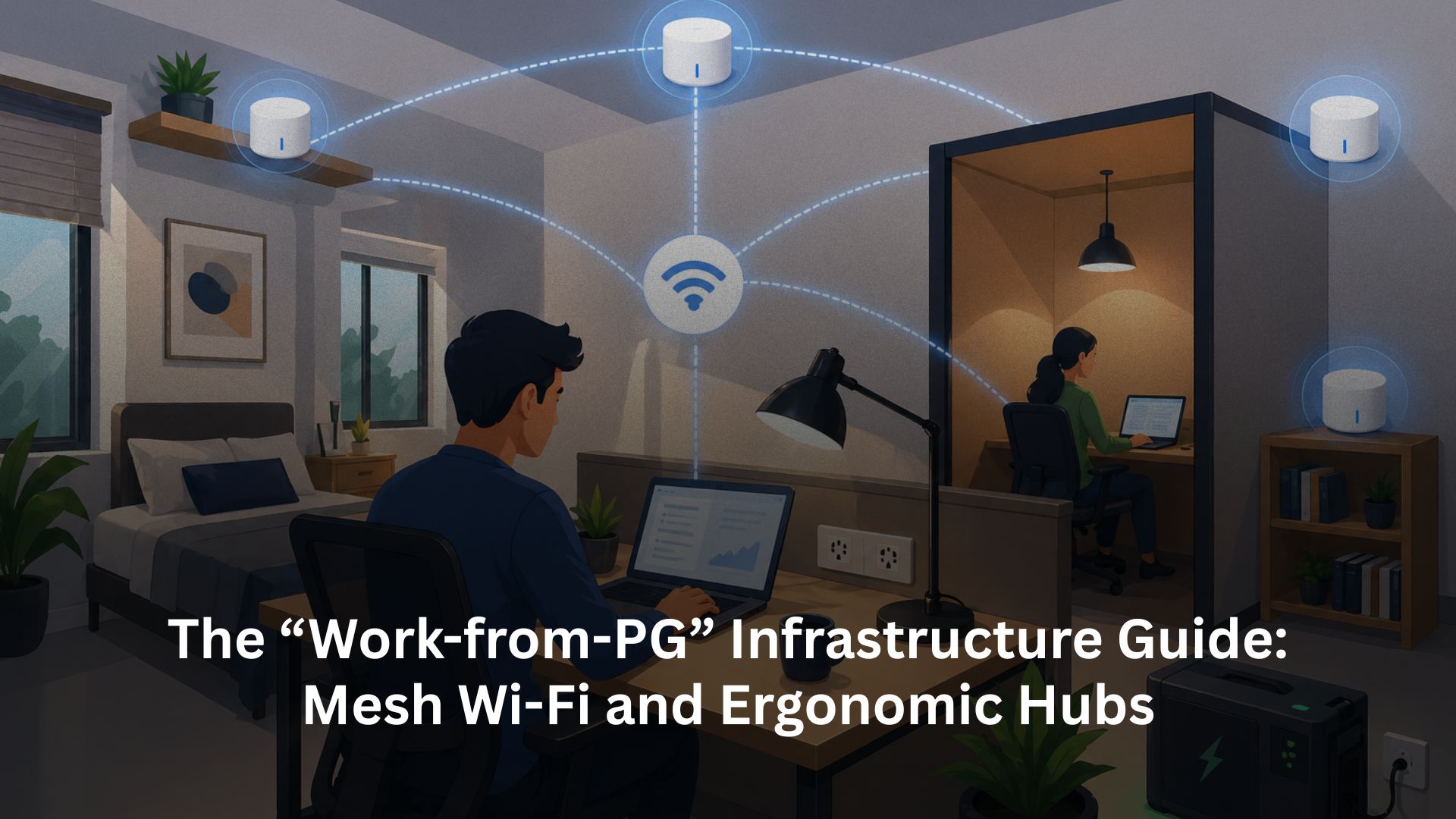
The “Work-from-PG” Infrastructure Guide: Mesh Wi-Fi and Ergonomic Hubs
Remote work didn’t just change offices. It changed housing.
For a growing segment of tenants, students, freelancers, early professionals, the PG is no longer a passive living space. It’s where meetings happen, deadlines are met, interviews are taken, and long hours are spent in front of screens. This shift has quietly redefined what “good accommodation” means.
A PG that functions well for living but poorly for working doesn’t just feel inconvenient, it feels limiting. And when tenants feel limited, they don’t complain loudly. They start looking for alternatives.
This is why work-ready infrastructure is no longer an upgrade. It is a baseline expectation that directly influences occupancy, retention, and positioning.
The Shift From “Stay-Ready” to “Work-Ready”
Most PGs were designed for a different era. The assumption was simple: tenants leave in the morning and return at night. The room is for rest, not productivity.
That assumption no longer holds.
Today’s tenants spend significant time inside the property during working hours. Their expectations are shaped not by traditional housing, but by:
- Co-working spaces that offer reliability and structure
- Cafés and public work zones designed for long stays
- Digital ecosystems where speed and responsiveness are standard
This means your PG is no longer compared only to nearby accommodations. It is being compared to any environment where work feels easier.
And that comparison is where most properties fall short.
Bandwidth Management: Why “High-Speed Internet” Still Fails
A common reaction to remote work demand is upgrading to a faster internet plan. On paper, this seems sufficient. In practice, it rarely solves the problem.
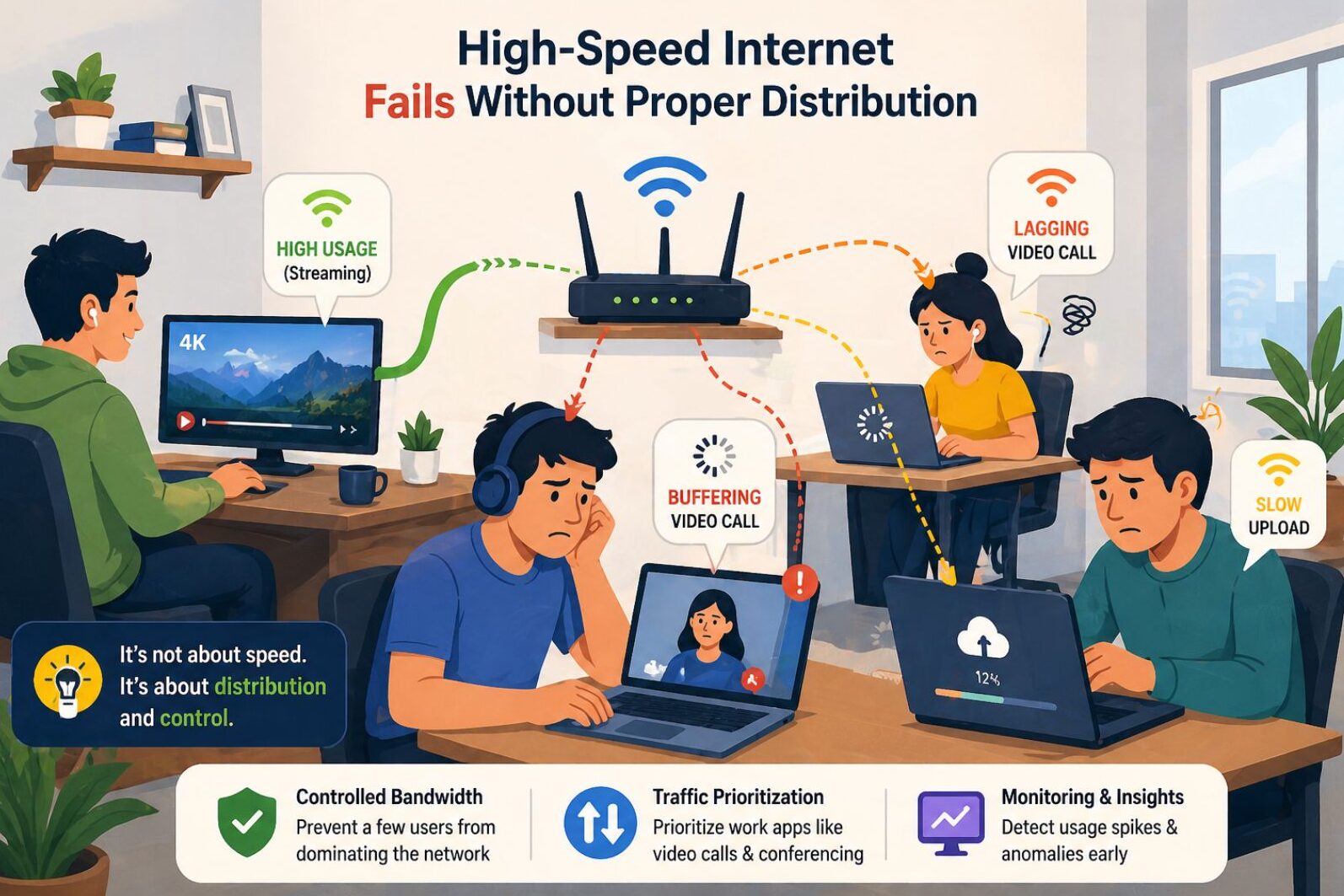
The issue is not speed. It is distribution and control.
When multiple tenants share a network without structure, the result is unpredictable performance. One user streaming or downloading heavily can impact everyone else. Video calls lag, uploads fail, and connectivity becomes inconsistent.
Effective bandwidth management is not about increasing capacity endlessly. It is about allocating it intelligently.
A well-structured system typically includes:
- Controlled bandwidth distribution to prevent a few users from dominating the network
- Traffic prioritization for work-related applications such as video calls and conferencing tools
- Monitoring mechanisms to identify usage spikes and anomalies before they affect others
This creates a shift from “fast internet sometimes” to “stable internet always.” And for tenants working remotely, stability is far more valuable than peak speed.
Mesh Wi-Fi: Eliminating Inconsistency Across the Property
One of the most overlooked issues in PG connectivity is uneven coverage. A single router, no matter how powerful, cannot provide consistent signal strength across multiple rooms, floors, or structural barriers.
This results in a familiar pattern:
- Strong connectivity near the router
- Weak or unstable signals in distant rooms
- Tenants clustering in specific “good spots” for work
Mesh Wi-Fi addresses this by distributing connectivity across multiple nodes placed strategically within the property. Instead of a single source, the network becomes a connected system of access points.
This leads to:
- Uniform signal strength across all rooms and common areas
- Seamless connectivity as tenants move within the property
- Reduced dependency on specific locations for stable internet
From an operational perspective, this removes one of the biggest sources of tenant complaints, unequal access.
From a tenant perspective, it removes friction.
Designing Study Pods: Creating Spaces That Support Focus
Connectivity alone does not create a work-ready environment. Tenants also need physical spaces designed for productivity.
Most PGs already have common areas, but they are rarely structured for focused work. They are either too casual, too noisy, or too unstructured to support long working hours.
As a result, tenants:
- Work from beds, leading to discomfort and reduced productivity
- Take calls in hallways or balconies, creating noise spillover
- Avoid common areas altogether
A well-designed study pod or work zone changes this dynamic.
Key elements that define a functional workspace include:
- Individual seating units that provide a sense of personal space without requiring full isolation
- Desk setups with appropriate height and depth for laptop use over extended periods
- Lighting that reduces strain and supports long sessions without fatigue
- Power access at every workstation to eliminate dependency on room-based charging
These are not luxury additions. They are functional requirements that allow tenants to use the space effectively.
Ergonomics: The Silent Driver of Long-Term Satisfaction
Work infrastructure is not just about enabling tasks. It is about sustaining comfort over time.
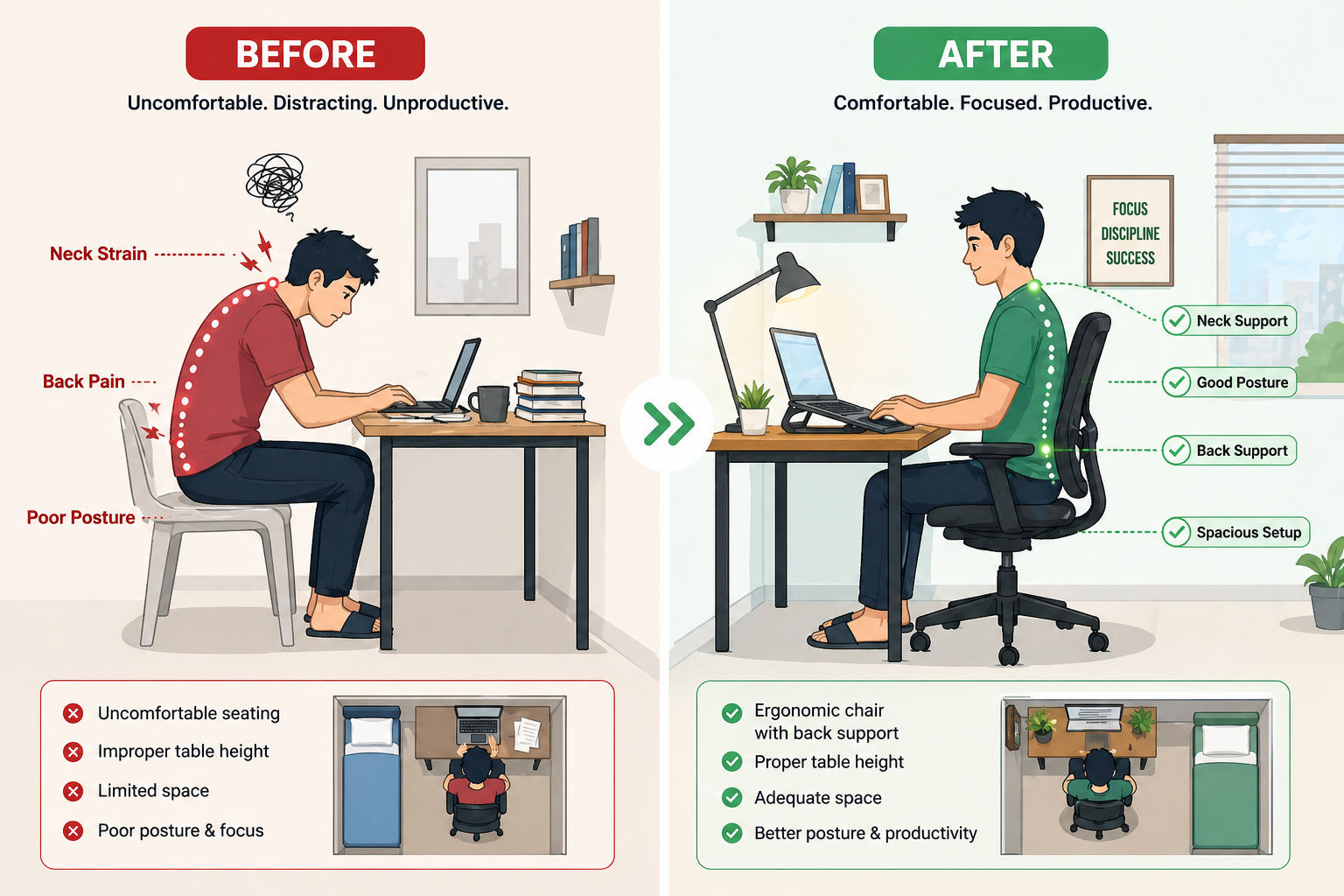
Poor ergonomics is one of the most common yet least discussed issues in PG setups. Basic furniture may suffice for short stays, but it fails under prolonged daily use.
Tenants who spend hours working in uncomfortable setups experience:
- Physical strain, particularly in the back and neck
- Reduced focus and productivity
- A gradual decline in overall satisfaction with the property
Improving ergonomics does not require high-end investments. It requires intentional design.
Simple upgrades can include:
- Chairs with basic back support instead of rigid seating
- Tables positioned at appropriate working height
- Adequate spacing to avoid cramped setups
These changes may seem minor individually, but collectively they transform how the space is experienced daily.
Power Backup: The Layer That Determines Reliability
Even the best internet setup fails without power stability.
Inconsistent electricity supply disrupts:
- Meetings and calls
- Ongoing work sessions
- Tenant confidence in the setup
For remote workers, even short interruptions can have disproportionate impact. A dropped call or lost connection during an important meeting is not just inconvenient, it affects perception of the property.
A reliable setup includes:
- Backup for networking equipment to ensure internet continuity
- Power support in designated work areas to allow uninterrupted usage
- Minimal transition time during outages
This ensures that infrastructure remains functional even under less-than-ideal conditions.
From Accommodation to Work-Ready Ecosystem
When infrastructure is designed intentionally, not just added, the PG shifts in how it is perceived.
It stops being a place that supports living alone and starts functioning as a space that supports daily routines end-to-end.
This shift has clear outcomes:
- Tenants stay longer because both living and working needs are met in one place
- The property becomes relevant to remote professionals, not just traditional PG users
- Pricing becomes more flexible because value is tied to experience, not just space
At this point, the PG is no longer competing only on rent or location. It is competing on how well it supports everyday life, especially work.
Marketing to a New Category of Tenants
Once the infrastructure supports productivity, the type of tenants you attract naturally changes.
You move beyond:
- Students looking for basic accommodation
- Short-term tenants focused only on convenience
And start attracting:
- Remote employees who need reliable setups
- Freelancers and consultants who work long hours
- Professionals relocating temporarily who prioritize functionality
This expands both the quality and stability of your tenant base.
However, this positioning only works when delivery is consistent. If infrastructure does not match what is promised, expectations break quickly, and churn increases faster than before.
Where Most PGs Get It Wrong
The issue is rarely awareness. Most operators understand what needs to improve.
The problem lies in how changes are implemented.
Common gaps include:
- Increasing internet speed without managing how it is shared
- Creating workspaces that look good but are not actually usable
- Adding backup systems without ensuring full coverage
These partial improvements create inconsistency.
And inconsistency is what tenants notice most. A setup that works sometimes but fails unpredictably creates more frustration than one that is simply basic but reliable.
A work-ready PG is not built through individual upgrades. It comes from how well everything works together.
Structuring Infrastructure as an Ongoing System
Work infrastructure cannot be treated as a one-time upgrade.
Without ongoing attention, even good setups start slipping, performance drops, small issues build up, and tenant experience gradually weakens.
A structured approach focuses on consistency:
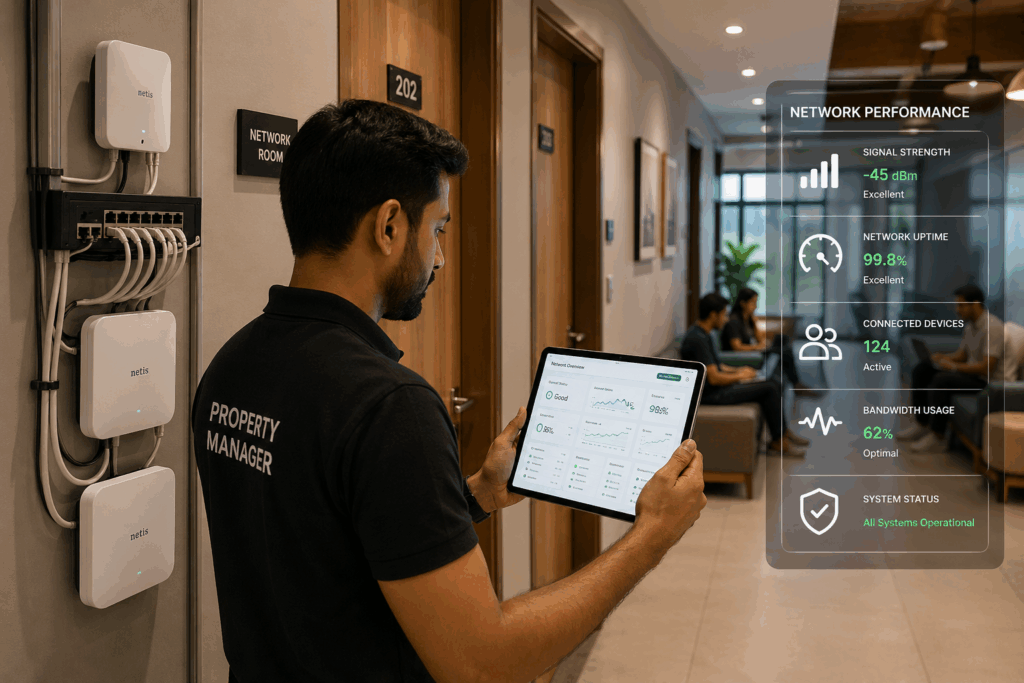
- Monitoring network performance regularly to catch issues early
- Maintaining hardware like routers and nodes to avoid unexpected failures
- Setting clear usage guidelines so performance remains stable for everyone
- Collecting tenant feedback to identify recurring problems
This ensures that infrastructure does not just exist, it continues to perform.
Because over time, unmanaged systems lose their effectiveness. And when that happens, the original investment stops making a difference.
How RentOk Helps You Maintain a Work-Ready PG
As infrastructure improves, operational complexity increases. Managing connectivity issues, tenant complaints, and communication across multiple touchpoints becomes difficult without a structured system.
This is where RentOk plays a critical role. It doesn’t replace infrastructure, it ensures that infrastructure is managed effectively at scale.
With RentOk, you can:
- Track tenant complaints related to connectivity or workspace issues and ensure timely resolution without relying on scattered communication
- Maintain clear communication with tenants regarding outages, maintenance schedules, or upgrades so expectations are managed proactively
- Keep visibility across tenant interactions, ensuring that recurring issues are identified and addressed systematically rather than repeatedly
- Align operational workflows so that infrastructure management is not reactive but structured and consistent
This creates a direct impact on how tenants experience your property. Because even the best infrastructure fails if issues are not tracked, communicated, and resolved efficiently.
Conclusion: Building a PG That Supports How People Work Today
Work-from-PG is not a temporary adjustment. It reflects a deeper shift in how living spaces are used.
Tenants are no longer evaluating properties based only on location and price. They are evaluating whether the space supports their daily routine, especially their ability to work without friction.
The properties that adapt to this shift will not just attract tenants. They will retain them longer and operate with greater stability.
If your current setup still treats internet and workspace as secondary features, it may already be limiting your property’s potential. A more structured approach can help you transform your PG into a space that supports both living and productivity seamlessly.
Explore RentOk to understand how better operational structure can support a work-ready environment, because in today’s market, a PG that enables productivity is no longer a premium offering. It is the standard.
About the Author
Ishika Pannu
Ishika Pannu brings you the latest insights and easy-to-apply strategies in property management—helping you simplify renting and grow with RentOk.