Market Trends
The Rise of Managed PG Franchises: Scale Your Brand Like a Pro

Written by
Ishika Pannu
Read Time
8 min read
Posted on
April 30, 2026
Overview
Overview
The Rise of Managed PG Franchises: Scale Your Brand Like a Pro
For most PG operators, growth follows a familiar path. You set up one property, stabilize operations, build occupancy, and then move to the next. On paper, it looks like expansion. In practice, it becomes increasingly difficult to maintain consistency, control, and efficiency across locations.
The challenge is not demand. The challenge is replication.
What works in one property often doesn’t translate cleanly to another. Staff behave differently, vendors perform inconsistently, and tenant experience starts to vary. Over time, the business becomes harder to manage, not easier to scale.
This is exactly why the managed PG franchise model is gaining traction. It allows operators to move beyond property-by-property growth and instead build something far more valuable, a repeatable, scalable brand system.
Why Traditional PG Expansion Reaches a Ceiling
Most operators assume growth is a function of adding more properties. But the real constraint is operational complexity.
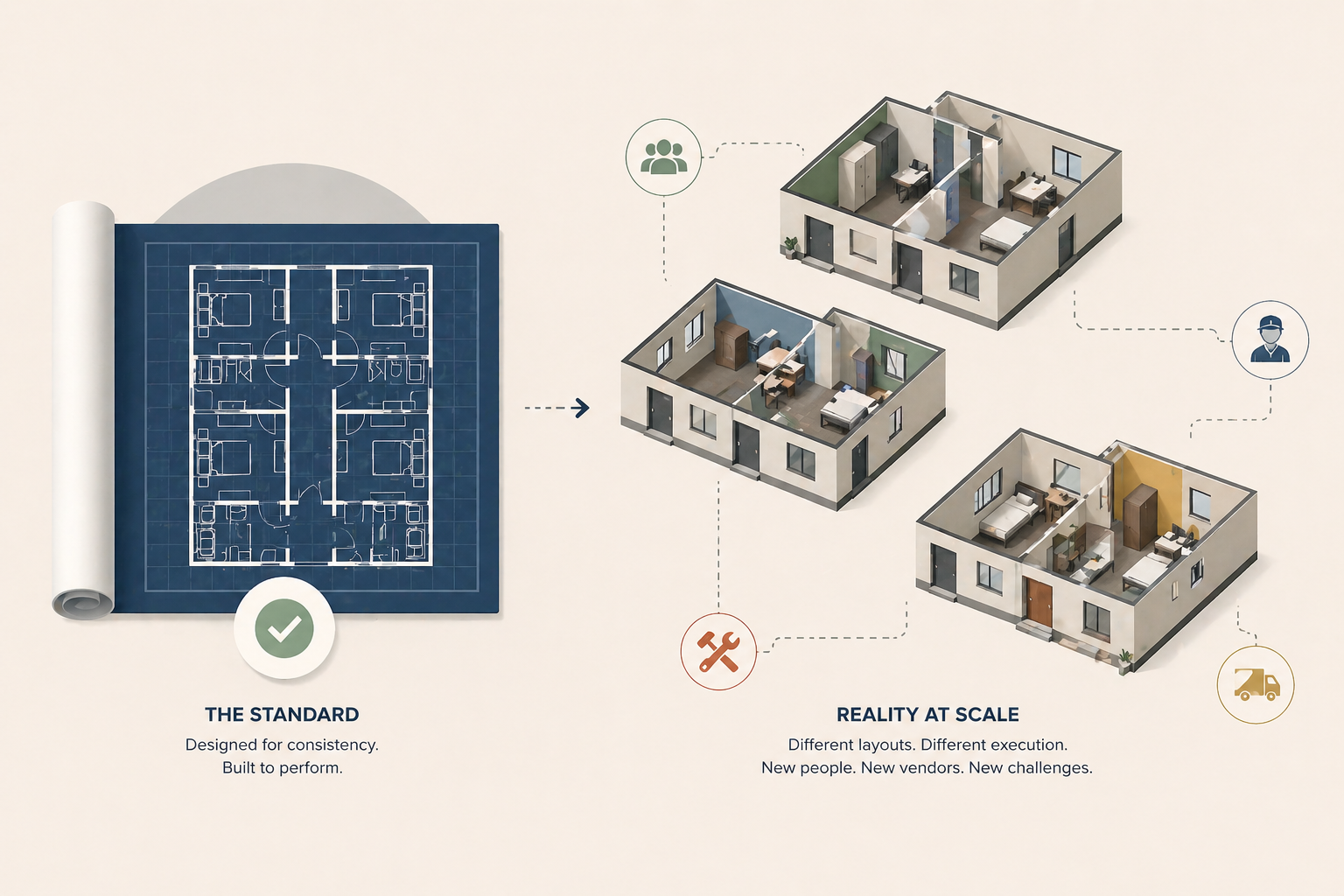
Every new property introduces variability:
- Different layouts and infrastructure, requiring adjustments in design and execution
- New staff who interpret processes differently, leading to inconsistency in service delivery
- Vendor dependencies that vary by location, affecting reliability and cost control
As these layers increase, so does the management burden. Instead of building a scalable system, you end up building multiple versions of the same business, each requiring attention.
Over time, this creates a pattern:
- The first property runs efficiently because it has direct oversight
- The second and third require more coordination and begin to deviate
- Beyond that, maintaining consistency becomes a constant challenge
This is where most PG businesses stall. Not because they lack opportunity, but because they lack standardization that travels.
What a Managed PG Franchise Model Actually Solves
A managed franchise model fundamentally changes how expansion works. Instead of owning and operating every property, you create a system that others can adopt while you control the brand, processes, and experience.
In practical terms, this means:
- Property owners bring the asset (the building and infrastructure)
- You bring the brand, operational framework, and management systems
- Revenue is shared, but control over experience remains centralized
This shifts your role significantly. You are no longer just running a PG. You are designing a platform for PG operations.
The advantage is not just faster expansion. It is controlled expansion.
The Market Shift Driving Franchise Models in India
India’s PG market is still highly fragmented. Thousands of independent operators run properties with varying standards, inconsistent processes, and limited systems. At the same time, tenant expectations have evolved significantly.
Today’s tenants are not just evaluating price or location. They are evaluating:
- Predictability of experience across stays
- Reliability of services such as internet, maintenance, and support
- Ease of communication and issue resolution
This creates a structural gap. A well-managed, branded PG network that delivers consistency across locations immediately stands out.
Franchise models are emerging as the bridge between:
- Unorganized supply
- Increasingly organized demand
And the operators who build strong systems early are the ones who will define how this market matures.
Standardization: The Non-Negotiable Layer of Scale
Scaling without standardization is not growth. It is fragmentation.
Standardization does not mean every property looks identical. It means every property functions in a predictable, controlled manner.
At a minimum, this includes:
- Defined room layouts and furniture configurations that ensure consistent capacity and usability
- Standard pricing structures aligned with location but governed by clear rules
- Uniform onboarding processes so every tenant experiences the same entry journey
- Consistent complaint resolution systems with defined timelines and accountability
When these elements are standardized, expansion becomes operationally manageable.
Instead of reinventing processes for every property, you replicate what already works. That’s what allows scale to move from effort-driven to system-driven.
Building a Brand That Tenants Actually Recognize
A franchise is not built on operations alone. It is built on perception.
Tenants choose brands because they reduce uncertainty. When someone selects your PG brand in a new city, they are not evaluating the property from scratch. They are relying on the expectation that it will deliver a familiar experience.
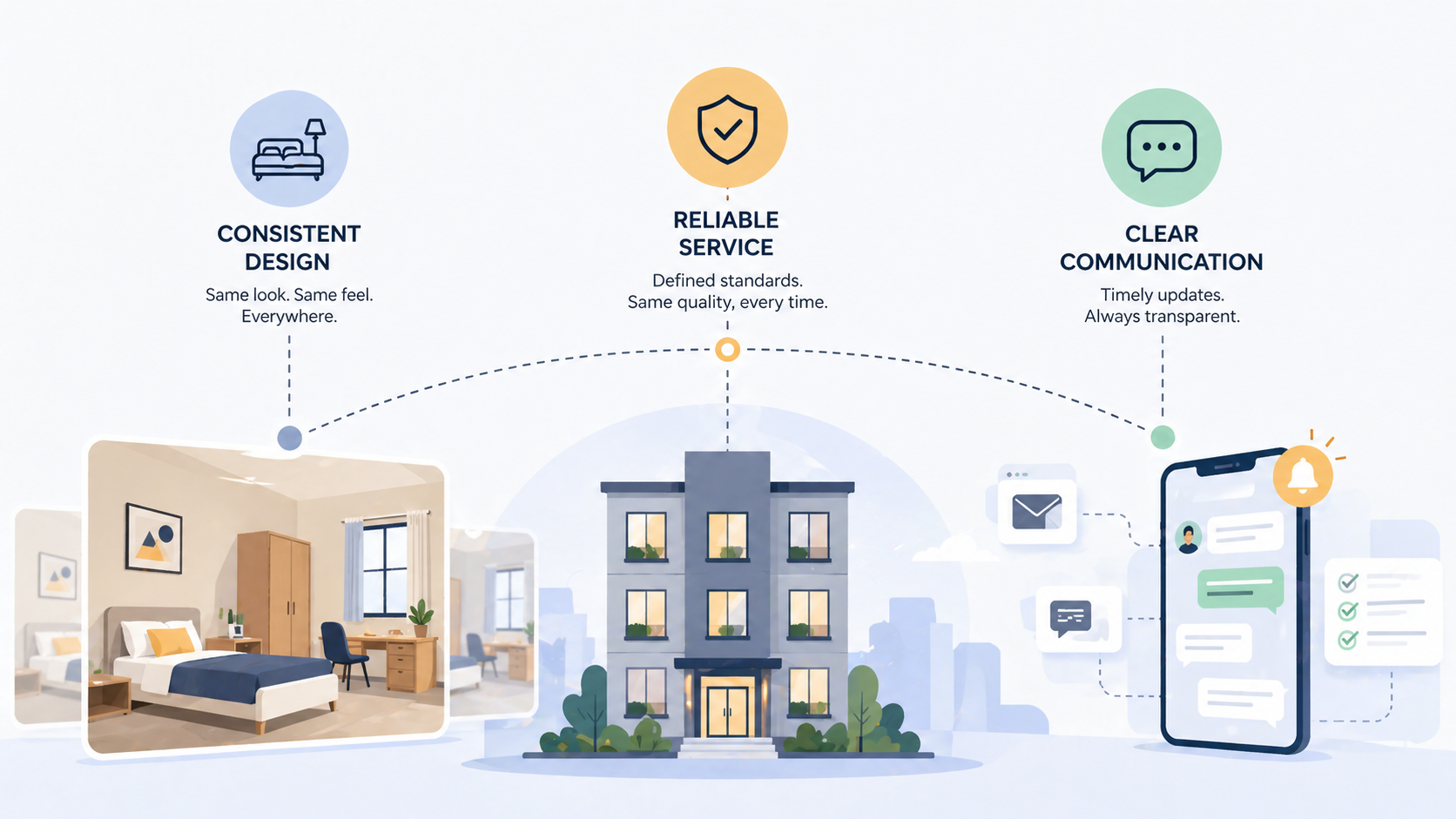
This expectation is shaped by:
- Consistent design elements that make properties feel part of the same ecosystem
- Defined service quality that does not fluctuate across locations
- Clear communication standards that reinforce reliability
A strong brand is not created through marketing alone. It is created through repeatable experience delivery.
And the more consistent that experience is, the stronger the brand becomes.
The Role of Technology in Multi-Property Control
As soon as you move beyond one or two properties, manual systems begin to fail. Spreadsheets, WhatsApp groups, and fragmented tools cannot support multi-location visibility.
A scalable franchise model requires a centralized system that provides:
- Real-time visibility into occupancy across all properties
- Unified tracking of tenant records and interactions
- Clear monitoring of payments, dues, and financial performance
- Standardized communication across locations
Without this, you lose control.
With it, you gain the ability to manage multiple properties as a single system rather than separate units.
Technology is not just an enabler in this model. It is the operational backbone.
Operating as a Brand: The Mindset Shift
The most important change in a franchise model is not structural. It is strategic.
You stop thinking in terms of managing properties and start thinking in terms of building systems that can be replicated.
This changes how you approach decisions:
- Hiring becomes about training people to follow systems, not relying on individual capability
- Operations become process-driven rather than memory-driven
- Expansion becomes about validating systems, not just adding capacity
The question shifts from:
“How do I run this property efficiently?”
to
“How do I ensure this system works across 10 properties without direct oversight?”
That is the difference between operating and scaling.
The Economics of Franchising: Why It Accelerates Growth
Traditional expansion requires significant capital. Each new property involves setup costs, operational investment, and time before stabilization.
Franchise models reduce this dependency.
Instead of investing in every property, you:
- Leverage third-party assets
- Generate revenue through management fees and revenue sharing
- Expand faster without proportional capital increase
This creates a more efficient growth model where:
- Risk is distributed
- Capital requirements are lower
- Speed of expansion increases
More importantly, it allows you to focus on system improvement rather than asset ownership.
Where Most PG Franchise Models Break Down
The idea of franchising is straightforward. Execution is not.
Many operators attempt to scale before building a strong foundation. This leads to:
- Inconsistent service delivery across properties
- Weak brand positioning due to lack of clarity
- Operational confusion because processes are not defined
- Difficulty in maintaining quality control
These issues compound quickly. Instead of strengthening the brand, they dilute it.
The underlying problem is usually the same:
Expansion started before systems were ready
Franchise success depends less on how fast you grow and more on how well your system holds as you grow.
Building a Scalable PG Franchise Model (Step-by-Step Thinking)
Creating a franchise model requires sequencing, not just intent.
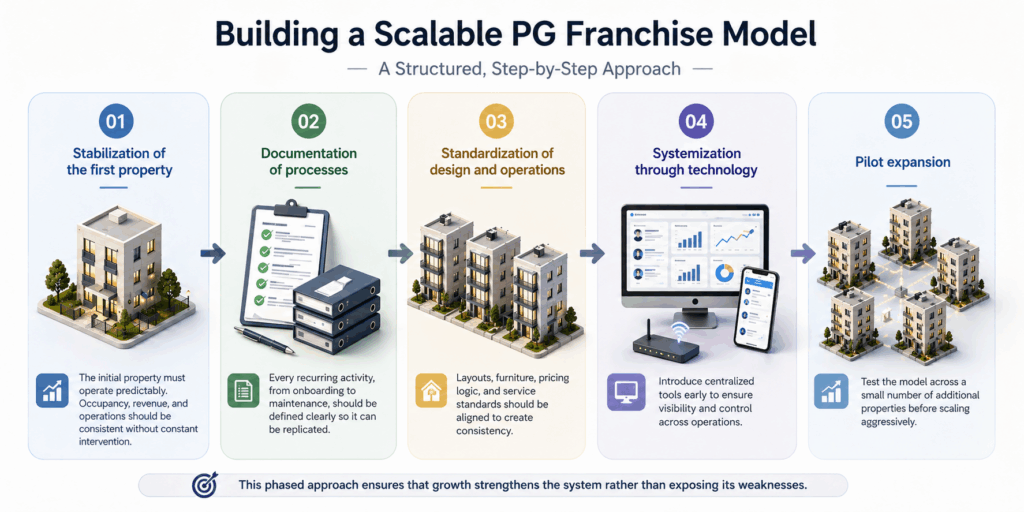
A structured approach typically follows this progression:
- Stabilization of the first property
The initial property must operate predictably. Occupancy, revenue, and operations should be consistent without constant intervention. - Documentation of processes
Every recurring activity, from onboarding to maintenance, should be defined clearly so it can be replicated. - Standardization of design and operations
Layouts, furniture, pricing logic, and service standards should be aligned to create consistency. - Systemization through technology
Introduce centralized tools early to ensure visibility and control across operations. - Pilot expansion
Test the model across a small number of additional properties before scaling aggressively.
This phased approach ensures that growth strengthens the system rather than exposing its weaknesses.
How Rentok Enables Scalable Franchise Operations
As the number of properties increases, the challenge is no longer managing one unit efficiently. It is maintaining consistency across all units without losing control.
This is where Rentok becomes critical to the franchise model.
It provides a centralized operational layer that allows you to:
- Track occupancy and availability across multiple properties in real time, ensuring no gaps in visibility
- Maintain structured tenant records across locations, making data accessible and consistent
- Monitor payments, dues, and financial flows without relying on fragmented systems
- Standardize communication and operational processes, reducing variation between properties
With this level of control, expansion does not lead to chaos. It becomes structured, measurable, and scalable.
Final Thoughts
The rise of managed PG franchises is not just a trend. It is a natural evolution of a market that is moving from fragmented operations to structured systems.
Operators who continue to expand property by property will eventually face limits. Those who invest in building repeatable systems and strong brand frameworks will move beyond those limits.
Scaling a PG business is not about increasing the number of properties. It is about creating a model that works consistently, regardless of location, ownership, or team.
If you’re looking to move from operating individual PGs to building a scalable, multi-location brand, the shift begins with structure. Explore how Rentok helps you standardize operations, maintain control, and scale your PG business with confidence.
Book a demo and see how your PG can grow from a single property into a scalable brand system.
About the Author
Ishika Pannu
Ishika Pannu brings you the latest insights and easy-to-apply strategies in property management—helping you simplify renting and grow with RentOk.