Market Trends
The Landlord’s Monthly Closing Checklist: 10 Steps to Financial Peace


Written by
Ishika Pannu
Read Time
8 min read
Posted on
May 5, 2026
Overview
Overview
The Landlord’s Monthly Closing Checklist: 10 Steps to Financial Peace
For most PG operators, the business feels active every single day, tenants moving in and out, payments coming in, maintenance being handled, calls being answered. There is constant movement, which creates a sense that everything is under control. But when the month ends and you actually try to understand your numbers, things start feeling unclear. Payments don’t fully match expectations, expenses feel higher than they should be, and profit is more of an assumption than a calculated figure.
This is exactly where a structured monthly closing system becomes critical.
Monthly closing is not an accounting exercise meant for accountants. It is a management discipline that determines whether your PG is actually performing well or just appearing to run smoothly. Without it, you are not running a financially controlled business, you are reacting to day-to-day operations without clarity on outcomes.
Why Most PG Operators Never Achieve Financial Clarity
The problem is rarely lack of effort. Most landlords are actively involved in their properties and constantly solving problems. The issue is that financial tracking is fragmented, inconsistent, and often delayed.
In a typical setup, you will notice patterns like:
- Rent is tracked mentally or through partial records, but not reconciled properly against expected collections, leading to gaps that go unnoticed until they become significant.
- Expenses are recorded when they happen, but not reviewed collectively, which means inefficiencies quietly build over time without triggering any corrective action.
- Pending dues are followed up only when they feel urgent, instead of being tracked systematically, causing irregular cash flow and avoidable delays.
- Profit is never clearly separated from operational funds, making it difficult to understand whether the business is actually generating returns.
Over time, this creates a situation where operations feel stable, but finances remain unclear. Monthly closing eliminates this ambiguity by forcing every number into structure.

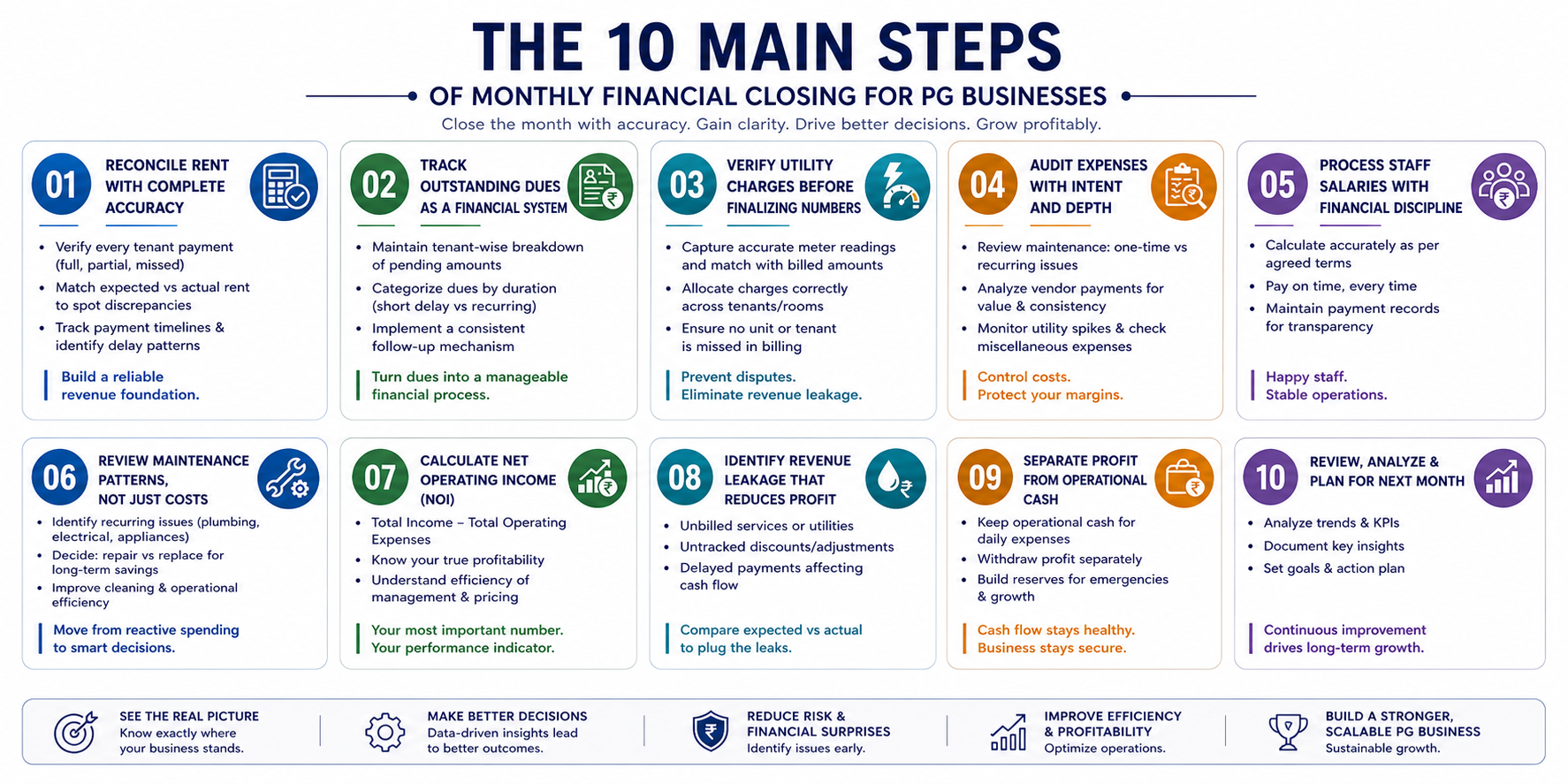
Step 1: Reconcile Rent With Complete Accuracy
Rent is your primary revenue source, but it is also the area where most assumptions exist. Many landlords believe they know who has paid, but rarely verify this against actual data.
A proper reconciliation process should ensure:
- Every tenant is accounted for with a clear status of payment, including full payments, partial payments, and missed payments, rather than relying on general understanding.
- The total expected rent is compared against the actual amount received, so any discrepancy becomes immediately visible instead of being discovered later.
- Payment timelines are tracked, allowing you to identify patterns such as habitual delays or inconsistencies across tenants.
This step is foundational. If your revenue numbers are not accurate, everything that follows, expenses, profit, planning, becomes unreliable.
Step 2: Track Outstanding Dues as a Financial System
Outstanding dues are often treated casually, as something that will eventually be collected. This approach weakens financial control because it ignores the impact of delayed cash flow.
Instead of loosely tracking dues, a structured approach requires:
- Maintaining a tenant-wise breakdown of pending amounts, clearly showing how much is due and from whom, rather than relying on memory or scattered notes.
- Categorizing dues based on duration, so you can distinguish between short delays and recurring non-payment behavior.
- Creating a follow-up mechanism that ensures dues are consistently pursued, instead of being addressed only when they accumulate.
When dues are tracked properly, they stop being a vague problem and become a manageable part of your financial system.
Step 3: Verify Utility Charges Before Finalizing Numbers
Utility billing, especially electricity, is one of the most common sources of financial inaccuracies and tenant disputes. The issue is not the cost itself, but how it is calculated and communicated.
Before closing the month, you need to ensure:
- Consumption data or meter readings are accurately captured and matched with billed amounts, eliminating any possibility of estimation errors.
- Charges are correctly allocated to each tenant or room, ensuring fairness and avoiding disputes later.
- No unit or tenant is missed in the billing process, which often leads to silent revenue leakage.
This step is critical because utility errors don’t just affect finances, they directly impact tenant trust.
Step 4: Audit Expenses With Intent and Depth
Recording expenses is not enough. You need to understand them.
A proper expense audit goes beyond listing costs and focuses on evaluating them:
- Maintenance expenses should be reviewed to identify whether they are one-time or recurring, helping you detect underlying issues that may need long-term solutions.
- Vendor payments should be analyzed for consistency and value, ensuring you are not overpaying simply due to habit or lack of review.
- Utility costs should be monitored for unusual spikes, which may indicate inefficiencies or misuse.
- Miscellaneous expenses should be examined carefully, as they often hide unnecessary spending that accumulates over time.
This step is where you protect your margins. Most PGs don’t lose money because of low rent, they lose it because expenses are not controlled.
Step 5: Process Staff Salaries With Financial Discipline
Staff salaries are a fixed obligation, but the way they are handled reflects your operational discipline. Delays or inconsistencies in salary payments can create instability that affects service quality.
A structured salary process ensures:
- Salaries are calculated correctly and aligned with agreed terms, avoiding confusion or disputes with staff.
- Payments are made on time, maintaining reliability and trust within your team.
- Records are maintained for every payment, ensuring transparency and accountability.
Consistent salary management contributes directly to smoother operations and better tenant experience.
Step 6: Review Maintenance Patterns, Not Just Costs
Maintenance is unavoidable, but recurring maintenance indicates inefficiency. Instead of treating every expense as isolated, use monthly closing to identify patterns.
For example:
- Frequent plumbing or electrical issues may indicate systemic problems that need structural fixes rather than repeated repairs.
- Repeated appliance servicing may suggest that replacement is more cost-effective than continued maintenance.
- High cleaning costs may indicate inefficiencies in process or resource allocation.
This step transforms maintenance from a reactive expense into a strategic insight.
Step 7: Calculate Net Operating Income (NOI)
Once income and expenses are clearly defined, you arrive at your most important number, Net Operating Income.
This is not just a calculation. It is your performance indicator.
It tells you:
- Whether your PG is actually profitable after covering all operational costs.
- How efficiently your property is being managed.
- Whether your pricing and cost structure are aligned.
Without this number, you are operating without clarity. With it, you gain control over your business.
Step 8: Identify Revenue Leakage That Reduces Profit
Revenue leakage is often invisible because it does not appear as a clear loss. It shows up as a gap between expected and actual income.
Common sources include:
- Services or utilities provided but not billed properly, leading to small but consistent losses.
- Informal discounts or adjustments that are not tracked, reducing overall revenue.
- Delayed payments that affect cash flow but are not accounted for in planning.
By comparing expected income with actual collections, you can identify where money is slipping through the system.
Step 9: Separate Profit From Operational Cash
One of the biggest mistakes in PG management is mixing profit with operational funds. This creates confusion and makes it difficult to plan effectively.
A structured approach requires:
- Clearly identifying profit after all expenses are accounted for, rather than assuming available cash equals earnings.
- Allocating funds between personal withdrawals and business reinvestment, ensuring long-term growth.
- Maintaining a reserve for unexpected expenses, reducing financial stress.
This step ensures that your business is not just running, it is financially stable.
Step 10: Document Everything for Future Clarity
Without documentation, every month feels like starting over. You lose visibility into trends and cannot measure improvement.
A proper closing record should include:
- Total income collected during the month
- Complete breakdown of all expenses
- Detailed list of pending dues
- Final profit calculation
This creates a financial history that helps you make better decisions over time.
Why Monthly Closing Feels Difficult Without the Right System
Most landlords don’t avoid monthly closing because they don’t understand it. They avoid it because it feels time-consuming and complicated.
This usually happens because:
- Data is scattered across multiple places, WhatsApp, notebooks, spreadsheets, and memory
- Information is incomplete when needed, forcing you to reconstruct numbers at the end of the month
- There is no single system that connects income, expenses, and tenant data
This turns closing into a stressful activity instead of a simple process.
How RentOK Helps You Close Your Month With Real Clarity
The biggest challenge with monthly closing is not the steps, it’s the scattered data. Payments, dues, and tenant records are often spread across different places, which turns closing into a time-consuming reconstruction process.
RentOK fixes this by keeping everything structured in real time. Rent payments, pending dues, and tenant-wise records are all tracked in one place, so you always have a clear view of your numbers without chasing information.
This means:
- You know exactly who has paid and who hasn’t, without manual checks
- Dues are visible and trackable, not dependent on memory
- Your data is already organized, so closing becomes quick and accurate
Instead of spending hours figuring out your finances at the end of the month, you simply review what’s already structured.
That’s the difference, RentOK doesn’t just help you close faster, it ensures your numbers are always clear.
Conclusion: Financial Peace Comes From Structure, Not Effort
Most PG operators don’t need to work harder to improve their finances. They need to operate with clarity. Monthly closing is what brings that clarity, turning scattered financial activity into structured insight.
When your numbers are clear, your decisions become stronger. You know where you are earning, where you are losing, and where you can improve.
If your current system still feels uncertain or manual, it may be time to move toward a more structured approach.
Explore RentOk and discover how organized financial tracking can turn monthly closing into a simple, consistent process, one that gives you complete control over your PG business.
About the Author
Ishika Pannu
Ishika Pannu brings you the latest insights and easy-to-apply strategies in property management—helping you simplify renting and grow with RentOk.