
Market Trends
Tax on Selling a Rental Property in India (2026 Guide)


Written by
Shivanshi Dheer
Read Time
14 min read
Posted on
July 23, 2026
Overview
Overview
If you have been renting out a flat for a few years, you may now be thinking of selling it. One question comes up almost immediately. How much tax is there on selling a rental property?
It is a fair worry. Property is usually one of the biggest assets a person owns. Selling it wrong, from a tax point of view, can mean losing lakhs of rupees you did not need to lose.
The good news is that the basic rules are not that complicated. A handful of things decide how much tax you pay. How long you owned the property. What price you sell it for. Whether you reinvest the money. And whether you are a resident or an NRI.
In this blog, we will go through this step by step, the way people actually search it on Google. No heavy tax jargon. Just simple explanations of what applies to you and what you can do about it.
Let’s get into it.
What Tax Do You Pay When You Sell a Rental Property in India?
When you sell any property in India, the profit you make is called a capital gain. This applies to a rental property too. It is taxed under the Income Tax Act.
This is separate from the tax you were already paying on rental income while you owned the property. That falls under a different head, called Income from House Property.
Once you sell, the rental income part is done. What matters now is the profit between what you paid for the property and what you are selling it for. This profit is what gets taxed, not the full sale amount.
Is the Gain Short Term or Long Term? How Is This Decided?
This is the first thing that decides your tax rate. It is worth getting right.
If you have held the property for 24 months or less, the profit is a short-term capital gain. If you have held it for more than 24 months, the profit is a long-term capital gain.
The holding period is counted from the date you bought or got possession of the property. It is not counted from when you started renting it out. If the property came to you through inheritance or as a gift, the earlier owner’s holding period also counts. This often means such properties automatically qualify as long-term.
This 24-month line matters a lot. Short-term and long-term gains are taxed very differently.
How Much Tax Do You Actually Pay on Short-Term Capital Gains?
If you sold the property within 24 months of buying it, the gain is short-term. The profit gets added to your total income for the year. It is then taxed at your normal income tax slab rate.
There is no special lower rate here. If you fall in the 30 percent tax bracket, your profit from the sale is also taxed at 30 percent, on top of whatever else you earn.
This is one of the biggest reasons selling too early can cost you heavily in tax. Waiting a little longer to cross the 24-month mark often saves real money.
How Much Tax Do You Pay on Long-Term Capital Gains?
If you have held the property for more than 24 months, you get a lower, flat tax rate instead of your regular slab rate.
For property bought on or after 23 July 2024, the long-term capital gains rate is a flat 12.5 percent. This is calculated without any indexation benefit. Indexation used to let you adjust your purchase price for inflation before calculating the gain. That benefit no longer applies to property bought after this date.
For property bought before 23 July 2024, you get a choice. You can pay 12.5 percent without indexation or 20 per cent with indexation, whichever works out cheaper. Indexation reduces your taxable gain by accounting for inflation over the years you held the property. Because of this, older properties held for a long time often pay less tax under the 20 per cent option, even though the rate looks higher on paper.
It is worth calculating both ways before you file. The difference can be significant depending on your holding period and how much prices have risen.
How Do You Actually Calculate Your Capital Gain?
The formula is simpler than it sounds.
Capital Gain = Sale price – Selling expenses – Cost of acquisition – Cost of improvement
Sale price is what you actually sold the property for.
Selling expenses include brokerage, legal fees, and transfer charges. These are deducted from your sale price before calculating profit.
Cost of acquisition is what you originally paid to buy the property. It includes the stamp duty and registration charges you paid at that time, since these get added to your original cost.
Cost of improvement includes any major renovation or construction you did over the years. You need proper bills and records for this. Regular repairs and maintenance do not count, only structural improvements.
Whatever is left after subtracting all this from your sale price is your actual taxable gain. It is not the full sale amount. This is why keeping proper records of your purchase cost, renovation bills, and brokerage payments matters so much at the time of sale.
What Is TDS on Sale of Property, and Who Deducts It?
This is something many first-time sellers are not prepared for. When a property sells for 50 lakh rupees or more, the buyer must deduct TDS before paying you the rest. TDS stands for tax deducted at source.
Under Section 194-IA, the buyer deducts 1 per cent of the sale price or the stamp duty value, whichever is higher. This gets deposited directly with the government using Form 26QB. You receive the remaining 99 per cent. The 1 per cent already deducted shows up as credit against your final tax bill when you file your return.
If you do not provide your PAN to the buyer, this rate jumps sharply to 20 percent instead of 1 percent. Sharing your PAN correctly is a small step that avoids a big, unnecessary deduction.
From 1 April 2026, this same rule continues under a renumbered section of the new Income Tax Act, 2025. The old Income Tax Act, 1961 has now been replaced. The rule itself stays the same. Only the section number has changed.
Are the Tax Rules Different If You Are an NRI Selling Property in India?
Yes, quite significantly different. This catches a lot of NRI sellers off guard.
If you are a Non-Resident Indian, the TDS rules fall under Section 195 instead of Section 194-IA. There are two major differences.
First, there is no 50 lakh threshold. TDS applies regardless of the sale value, even on a property worth 20 or 25 lakh rupees.
Second, the TDS rate is much higher. By default, it is calculated on the entire sale value, not just your profit. For long term gains, the rate is 12.5 percent, plus surcharge and cess. For short term gains, it is deducted at your slab rate, which can go up to 30 percent, again plus surcharge and cess.
This default TDS is calculated on the full sale price, not the actual profit. Because of this, many NRIs end up with a much larger deduction than their real tax liability. To avoid this, NRIs can apply for a Lower Deduction Certificate under Section 197 before the sale. This allows TDS on just the estimated gain instead of the full sale value. This step is common for high value property sales. It can make a real difference to how much cash actually reaches your account.
Can You Save Tax on the Sale of Your Rental Property?
Yes, and this is one of the most useful parts of the process. It mainly helps with long term capital gains, since short term gains do not get access to most of these exemptions.
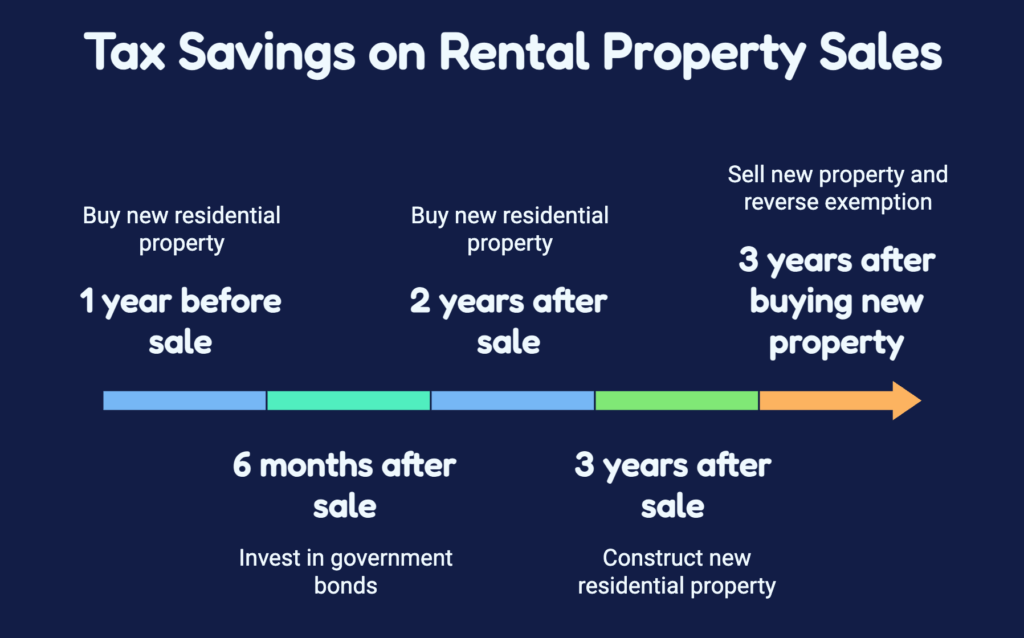
Section 54 lets you claim an exemption if you sell a residential property and reinvest the gain into another residential property. The new property must be bought within 1 year before the sale or 2 years after it, or constructed within 3 years. This exemption is capped at 10 crore rupees.
Section 54EC, now called Section 85 under the new Income Tax Act, lets you invest your long term gains into specific government-backed bonds. These include bonds from NHAI or REC. You must invest within 6 months of the sale. This route is capped at 50 lakh rupees. The bonds come with a 5 year lock-in period, during which they cannot be sold or transferred.
Section 54F applies if you sell a long term asset other than a residential property, such as a plot of land, and use the proceeds to buy a residential house instead.
One important condition applies to Section 54. If you sell the new property within 3 years of buying it, the exemption gets reversed. The earlier tax liability comes back into effect.
What Happens If You Don’t Reinvest Right Away?
Sometimes you cannot reinvest before your income tax return filing deadline. You are not automatically stuck paying tax on the whole amount.
You can deposit the unutilised gain into a Capital Gains Account Scheme, commonly called CGAS, at a bank. This must happen before your ITR filing due date. This lets you claim the exemption for now. It gives you more time to complete the purchase or construction within the allowed period. If you still do not use this money for the intended purpose in time, it becomes taxable at that later point.
What If You Sell the Property at a Loss?
Not every sale results in a profit. If you sell for less than your cost, you have a capital loss instead of a gain. This can actually be useful.
A short term capital loss can be set off against both short term and long term gains in the same year. A long term capital loss can only be set off against long term gains, not short term ones. If you cannot use up the full loss in the same year, it can be carried forward for up to 8 assessment years. You just need to file your return on time each year to keep this benefit active.
Does It Matter That the Property Was Rented Out Before You Sold It?
Not for the capital gains calculation itself. The tax on rental income each year was already settled through your annual filings. When you sell, the calculation only looks at your original cost versus your sale price, along with allowed deductions. The fact that the property earned rent in between does not change how the capital gain is calculated.
That said, a clean rental history helps. Your original purchase papers, renovation bills, and brokerage payments all make the capital gains calculation easier and more accurate at sale time. Landlords who track property expenses properly over the years usually have a smoother tax filing experience. Those who try to reconstruct old bills at the last minute struggle much more.
A Simple Example
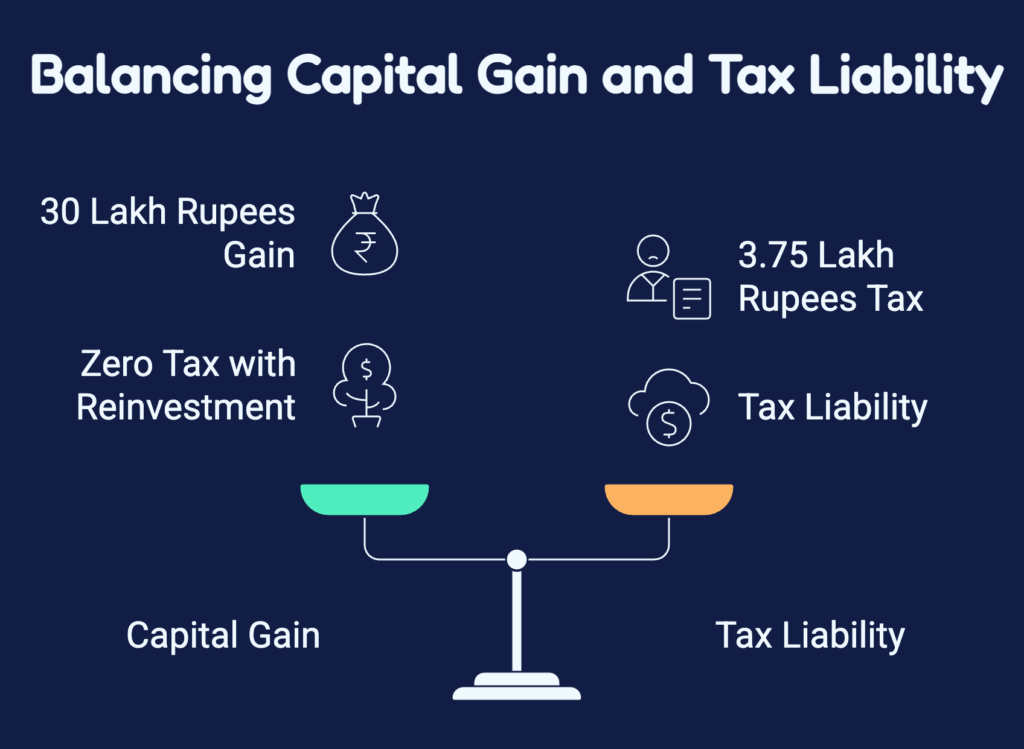
Suppose you bought a flat in 2019 for 60 lakh rupees. You also paid 3 lakh rupees in stamp duty and registration. In 2026, you sell it for 95 lakh rupees, paying 2 lakh rupees in brokerage.
Your cost of acquisition works out to 63 lakh rupees, including stamp duty. Your net sale price, after brokerage, works out to 93 lakh rupees. This gives you a capital gain of 30 lakh rupees.
You held the property for more than 24 months, so this is a long term capital gain. If the property was bought after 23 July 2024, you would pay a flat 12.5 percent on these 30 lakh rupees. That works out to 3.75 lakh rupees in tax, before any exemptions. If you reinvest this gain into another residential property under Section 54, this liability can drop to zero. You just need to meet the timeline and value conditions.
Common Mistakes People Make When Selling a Rental Property
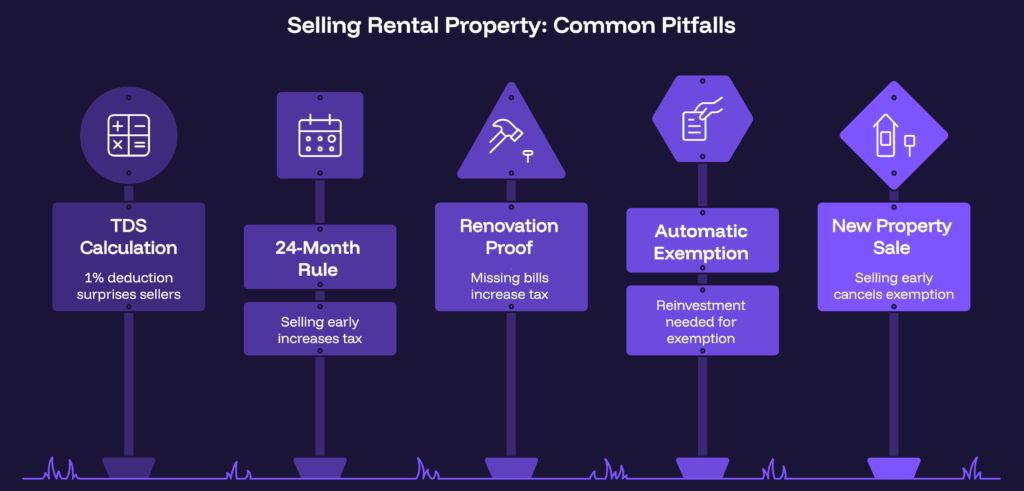
Not accounting for TDS in their cash flow planning. Sellers are often surprised when 1 per cent of the sale value, or much more for NRIs, is deducted before the money reaches their account.
Missing the 24-month line by a few weeks. Selling just a little too early can push a sale from long-term into short-term. This results in a much higher tax bill for the sake of a short wait.
Not keeping proof of renovation costs. Without proper bills, you cannot add these to your cost of acquisition. This means paying tax on a larger gain than you actually made.
Assuming the exemption is automatic. Exemptions under Section 54 or 54EC are not automatic. You need to complete the reinvestment within the timeline or deposit the funds in a capital gains account scheme and claim it correctly while filing.
Selling the new property too early. Buying a new home to claim a Section 54 exemption, then selling it within 3 years, cancels the exemption. The earlier tax liability comes back.
Conclusion
Selling a rental property in India comes with real tax implications. They are predictable once you understand the basic structure. How long you held the property decides your tax rate, slab rate or flat rate. TDS is deducted upfront by the buyer, at a higher rate for NRIs. If you plan to reinvest, Sections 54 and 54EC can reduce or even remove your tax liability, as long as you follow the timelines.
The biggest factor that makes this easier is clean records. Your original purchase cost, renovation bills, and rent history should be ready when you need them.
If you are managing your rental property through registers or scattered files, that is usually where the stress comes from at tax time. You can explore RentOk’s property management app to keep your rent collection, expenses, and property records organised in one place. Your numbers stay ready whenever you decide to sell.
Frequently Asked Questions
Find answers to common questions about this topic
About the Author
Shivanshi Dheer
Shivanshi Dheer sharing actionable strategies and information on PG/hostel management to help simplify renting and scale with RentOk.
You may also like these
Related Articles
1 min read
How to Avoid MDR on Rent Payments: A Guide for PG Owners
Written by
Posted on
Shivanshi Dheer
Oct 6, 2026

1 min read
RentOk AutoPay & e-NACH for Automatic Rent Collection
Written by
Posted on
Shivanshi Dheer
Oct 6, 2026

1 min read
What’s Included in My Rent and What Am I Paying Extra For?
Written by
Posted on
Ishika Pannu
Sep 30, 2026

1 min read
Which Indian City Gives Landlords the Best Rental Yield Right Now?
Written by
Posted on
Ishika Pannu
Sep 28, 2026
1 min read
How Much Can My Landlord Legally Increase My Rent Each Year?
Written by
Posted on
Ishika Pannu
Sep 23, 2026

1 min read
India’s Rental Market Grows 16%: What Owners Should Know
Written by
Posted on
Ishika Pannu
Sep 22, 2026
1 min read
Why Landlords Check CIBIL Scores Before Renting
Written by
Posted on
Ishika Pannu
Sep 21, 2026

1 min read
Why Students Need Tenant Verification Done Before Moving Into a PG
Written by
Posted on
Ishika Pannu
Sep 14, 2026

1 min read
What to Do When Your Landlord Won’t Make Repairs
Written by
Posted on
Ishika Pannu
Sep 12, 2026

1 min read
Satya Niketan Building Collapse: What Happened in Detail?
Written by
Posted on
Shivanshi Dheer
Sep 9, 2026
Stay ahead in property management with expert insights
Join thousands of property managers receiving exclusive tips delivered straight to your inbox.
Browse posts by category
Case Study
Cost of Living
Growth
Legal
Market Trends
News
Pg owner app
Property Management
Property Tax
Tech
RentOk
The easiest way to rent and manage your PGs and hostels.
Grievance Officer
Get the app


Contact us
hello@eazyapp.tech
HQ Office
COGROW, BASEMENT F-12/8A
BESIDE HOUSE OF STYLE SALON, SECTOR 28, DLF PHASE 1
GURUGRAM, HARYANA - 122002
South India Office
LUMIODESK COWORKING, 2ND FLOOR, 40, 14TH MAIN RD
BESIDE MC DONALD, 7TH SECTOR, HSR LAYOUT
BENGALURU, KARNATAKA - 560102
©️ 2026 EazyApp Tech Pvt Ltd. All rights reserved


