Property Tax
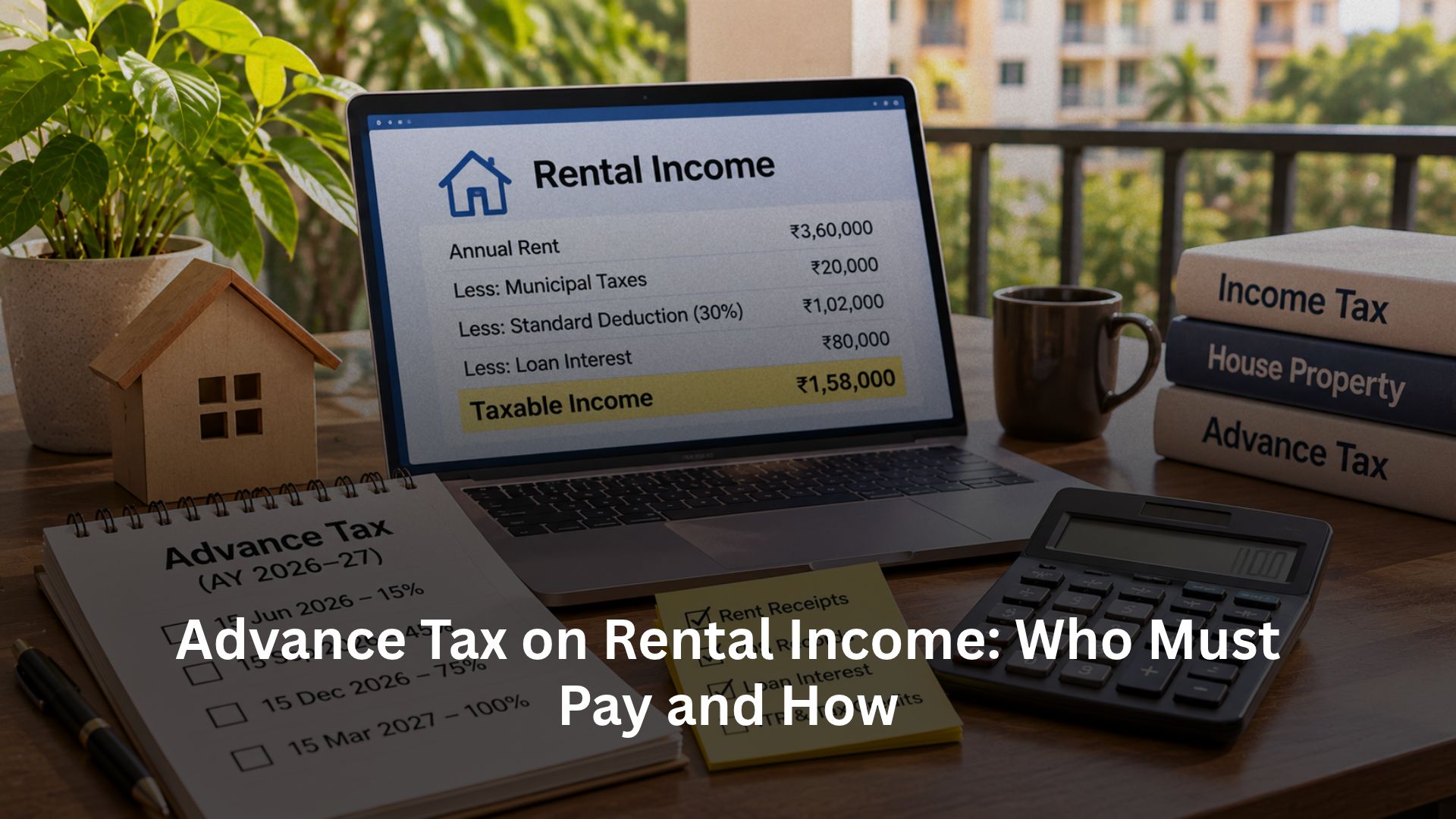
Advance Tax on Rental Income: Who Must Pay and How

Written by
Ishika Pannu
Read Time
10 min read
Posted on
November 20, 2026
Overview
Overview
Advance Tax on Rental Income: Who Must Pay and How
Rent arrives every month, but rental income tax does not always wait until you file your return. If your estimated tax for the year, after eligible tax credits, reaches ₹10,000 or more, you may need to pay advance tax on rental income alongside tax on your other earnings.
For landlords, the challenge usually lies in estimating the right amount. Bank credits, taxable property income and the final tax bill can all differ. This guide explains the threshold, deductions, payment dates and online process for Tax Year 2026–27, covering 1 April 2026 to 31 March 2027.
Do landlords need to pay advance tax?
Yes, when the remaining estimated tax liability reaches ₹10,000, unless an exemption applies. Calculate this across your income sources, including salary, rent, interest and taxable gains. The threshold refers to tax payable after eligible credits, rather than the amount of rent you collect.
A salaried landlord may need advance tax even when the employer deducts salary TDS. That deduction might not cover the additional tax on rent. Conversely, adequate withholding across your income could leave less than ₹10,000 to pay.
The current framework sits in sections 403–405 of the Income-tax Act, 2025. Check the official Act, as amended by the Finance Act, 2026 for the governing provisions.
Does the senior citizen exemption cover rental income?
A resident individual aged 60 or above during the tax year does not need to pay advance tax if they have no income chargeable under business or profession. Rent, pension or interest alone does not remove this exemption.
This exception does not cover every senior citizen automatically. Non-resident individuals and HUFs cannot claim it on the same basis.
PG operators should also establish their income classification first. Running an accommodation business can produce a different result from letting property. RentOk’s guide to PG income under house property or business income explains why ownership, agreements and services matter.
From rental receipts to taxable property income
For income under Income from House Property, start with the property’s annual value. Expected rent, actual rent, vacancy and qualifying unrealised rent can affect that figure; multiplying monthly receipts by twelve is only a simplified starting point.
Next, deduct municipal taxes actually paid by the owner during the year. Apply the 30% standard deduction to the resulting net annual value, then deduct eligible interest on qualifying borrowed capital.
The current provisions appear in sections 21 and 22. RentOk’s explanation of the standard deduction on rental income covers the calculation and the transition from the older Section 24 reference.
Do not subtract every maintenance bill again under this head. Also check the applicable tax regime and loss rules before assuming that a loan-interest deduction will reduce tax on your other income.
A worked example for a let-out property
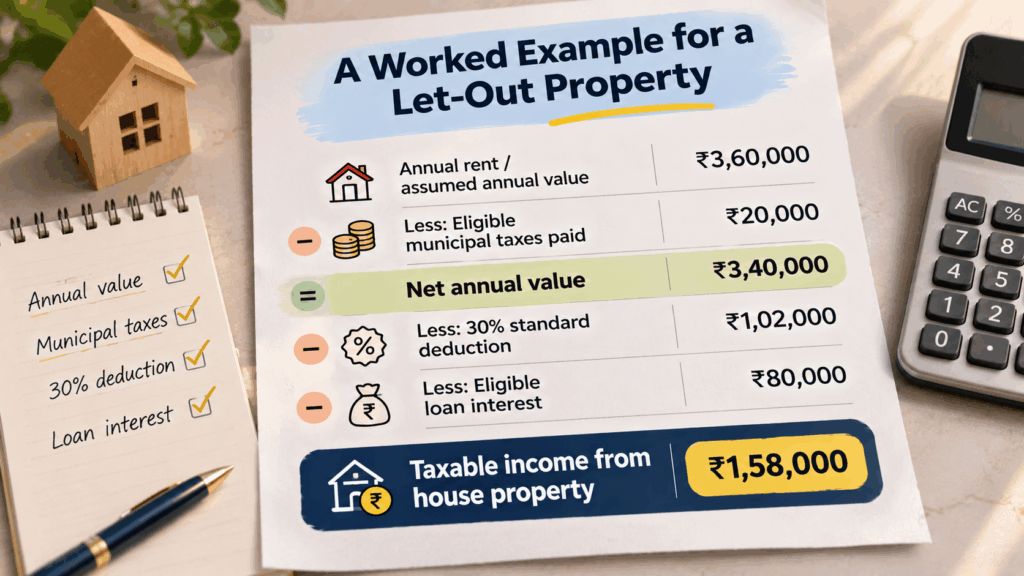
Assume the annual-value rules produce ₹3,60,000, equal to twelve months’ rent of ₹30,000. The owner pays eligible municipal taxes of ₹20,000 and has ₹80,000 of qualifying loan interest.
| Calculation | Amount |
|---|---|
| Annual rent / assumed annual value before municipal taxes | ₹3,60,000 |
| Less: eligible municipal taxes paid by the owner | ₹20,000 |
| Net annual value | ₹3,40,000 |
| Less: 30% standard deduction | ₹1,02,000 |
| Less: eligible loan interest | ₹80,000 |
| Taxable income from house property | ₹1,58,000 |
The result is taxable property income, not the tax bill. You still need to combine it with your other income and apply the relevant tax rules.
Combining rent, other income and tax credits
Estimate your total annual tax, including applicable surcharge and cess, after the deductions and rebate you qualify for. Then account for eligible TDS, TCS and other tax credits to find the remaining advance-tax requirement.
Use gross rental figures where appropriate, rather than treating the smaller bank credit after tenant TDS as your full rent. Reconcile withholding records and follow up on missing entries. Do not reduce your estimate for TDS that a tenant never deducted.
RentOk’s guide to TDS on rent under the new Income-tax Act explains the separate withholding obligation.
An illustrative ₹60,000 advance-tax requirement
Suppose your complete annual tax calculation produces ₹1,00,000, and eligible withholding and other credits total ₹40,000. Your estimated advance tax comes to ₹60,000.
These are assumed tax figures; they do not follow automatically from the ₹1,58,000 property-income example. Your income, tax regime and available reliefs determine your actual liability.
Keep refundable deposits separate when building the estimate. A genuinely refundable deposit does not become rent merely because it enters your account. RentOk’s guide explains why security deposits are not rental income and when later adjustments need closer review.
Advance-tax instalments for Tax Year 2026–27
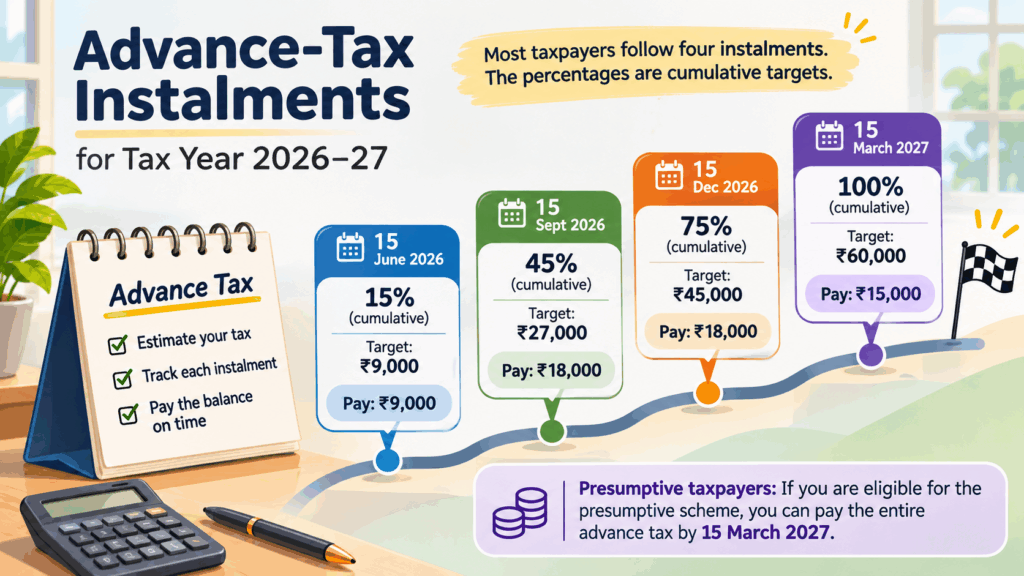
Most taxpayers follow four instalments. The percentages below are cumulative targets, so subtract advance tax you have already paid before calculating the next payment.
| Deadline | Cumulative share of estimated advance tax | Target if annual advance tax is ₹60,000 | Additional payment if earlier targets were met |
|---|---|---|---|
| 15 June 2026 | 15% | ₹9,000 | ₹9,000 |
| 15 September 2026 | 45% | ₹27,000 | ₹18,000 |
| 15 December 2026 | 75% | ₹45,000 | ₹18,000 |
| 15 March 2027 | 100% | ₹60,000 | ₹15,000 |
These are the ordinary statutory dates. Check official notifications for any relief that specifically applies to you. Review your estimate before each deadline when rent, occupancy, interest or other income changes.
Eligible presumptive taxpayers follow a different payment rule: the applicable framework permits payment of the entire advance tax by 15 March. A PG operator cannot use that exception merely because the property collects rent; eligibility for the presumptive scheme matters.
Section 408 sets out the instalment schedule and qualifying presumptive exception.
How do you pay advance tax online?
For Tax Year 2026–27, select the Income-tax Act, 2025 payment flow. The department’s current manual identifies ITNS 280N for this Act. Older Challan 280 instructions relate to the earlier framework, so avoid copying them without checking the year.
Follow the official challan-creation manual:
- Log in to the Income Tax Department’s e-filing portal and open e-Pay Tax.
- Choose the Income-tax Act, 2025 tab and start a new payment.
- Select the appropriate Income Tax payment category.
- Choose Tax Year 2026–27 and Advance Tax, checking your PAN and taxpayer category.
- Enter the payment amount and review the tax breakup and year.
- Pay through an available authorised method, then check the payment status.
Available payment methods depend on the selected channel. Review any transaction charges before proceeding.
Keep the successful payment record
A generated challan reference alone does not prove that payment succeeded. Check the completed transaction in Payment History, download the receipt and keep its payment reference with your tax working.
If money leaves your bank account but the portal shows a pending or failed transaction, verify the status before making another payment.
Keep the same records for return preparation. RentOk’s guide to reporting rental income correctly in your ITR helps connect your property records with the eventual filing.
Interest when advance tax falls short
Two separate tests matter. Paying the balance before filing your return does not necessarily remove interest for an earlier shortfall.
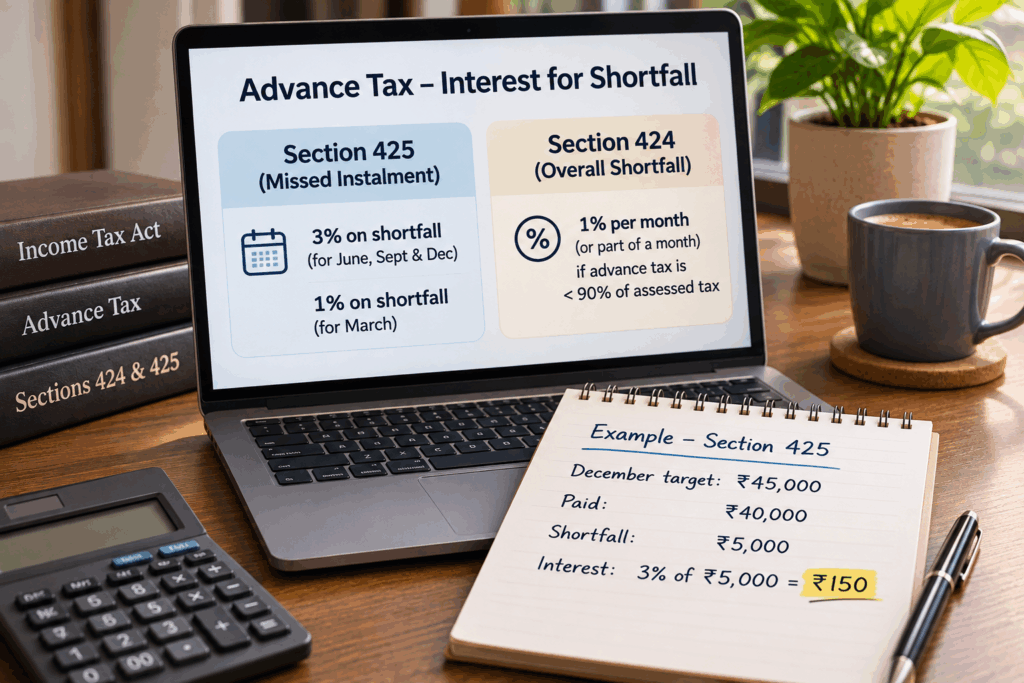
Missing an instalment: section 425
Section 425 covers deferment of advance tax. For ordinary taxpayers, the prescribed calculation generally charges 3% on the relevant shortfall for each of the first three instalments and 1% for the March instalment, subject to statutory tolerances and reliefs.
For example, suppose the December cumulative target is ₹45,000, but you have paid ₹40,000. With no applicable relief, the ₹5,000 shortfall × 3% produces ₹150 of interest for that instalment. This example does not calculate your total interest liability.
June and September tolerances, and relief for specified income that arises unexpectedly, can change the result. Ordinary predictable rent does not create a blanket exception.
Paying too little overall: section 424
Section 424 can apply when advance tax falls below 90% of assessed tax, using the statutory credit adjustments. It generally charges 1% for every month or part of a month, starting from 1 April after the tax year.
This calculation differs from the instalment test and may apply alongside it. The department’s tax-payment FAQs map sections 424 and 425 to the former sections 234B and 234C.
If you discover a shortfall, update the estimate and pay promptly. Ask your tax adviser to calculate the applicable interest and relief rather than applying a percentage to gross rent.
How RentOk helps you prepare yearly rental records
Advance tax becomes easier to estimate when you can explain your collections and expenses throughout the year. RentOk helps organise the property records that feed into that calculation.
- Review income and expenses: Use property-level reports to understand collections, spending and operating results. Keep operational profit separate from taxable income under the applicable tax head.
- Download money reports: The documented route is Money → Report → More → Download money report. Select the relevant property and follow the download prompts.
- Build an April–March summary: Download the available reporting periods and combine monthly exports when necessary. Check the date options in your account before assuming that one export covers the full tax year.
- Prepare records for your accountant: Reconcile reports with bank statements, municipal-tax receipts, loan-interest certificates, withholding records and tax-payment challans. Add records that sit outside the app.
RentOk’s guide to preparing monthly PG financial reports explains how regular reviews support a clearer annual picture. The money-report documentation covers the download workflow.
Your reports support the estimate; your tax classification, deductions and credits determine the final amount.
Conclusion
Advance tax on rental income starts with your overall tax position. Check the ₹10,000 threshold, confirm whether an exemption applies, calculate taxable property income and review your credits before each instalment.
Keep a running estimate instead of waiting for return-filing season. Download yearly rent reports from RentOk by bringing together the relevant April–March reporting periods, then use those records with your accountant to plan the next payment.
Frequently Asked Questions
Find answers to common questions about this topic
About the Author
Ishika Pannu
Ishika Pannu brings you the latest insights and easy-to-apply strategies in property management—helping you simplify renting and grow with RentOk.