Property Tax
Your Tenants Now Need Your PAN: Rent Receipt Rules Under the New Tax Rules


Written by
Ishika Pannu
Read Time
11 min read
Posted on
October 26, 2026
Overview
Overview
Your Tenants Now Need Your PAN: Rent Receipt Rules Under the New Tax Rules
When a tenant asks for your PAN along with their rent receipts, they usually need it for their employer’s House Rent Allowance documentation. For PG owners, these requests can arrive together during payroll proof submission, often with questions about agreements, payment records and the new Form 124. A receipt showing only a name and an amount may leave the tenant chasing missing details.
The important distinction is that landlord PAN for HRA is not a new requirement at the ₹1 lakh threshold. The 2026 changes introduce an updated employee declaration and additional disclosure fields. Owners need to understand what to provide, who should provide it and how to keep the receipt consistent with the actual arrangement. This guide explains the current framework, checked on 26 October 2026, without treating every paperwork problem as tax evasion.
Why tenants are suddenly asking for your PAN
The Income-tax Act, 2025 and Income-tax Rules, 2026 took effect from 1 April 2026. Form 124 replaces the earlier Form 12BB for employees seeking payroll consideration of specified tax claims. That change explains why tenants may now ask you to confirm details in a different format. The Ministry of Finance’s commencement announcement confirms the transition.
For an owner, the practical task remains straightforward: provide accurate rent acknowledgements and the correct landlord details. Your tenant submits the declaration to their employer; you do not file Form 124 on their behalf. Payroll teams may request corrections when the agreement, receipts and payment records describe different names, periods or amounts.
HRA eligibility comes first. The exemption generally concerns salaried employees who receive HRA and genuinely pay for residential accommodation they occupy. The new tax regime excludes this HRA exemption under Section 202 of the Income-tax Act, 2025. A PAN or receipt does not create eligibility where the underlying conditions do not apply.
This also keeps the owner’s responsibility in perspective. Help tenants document real payments, but do not promise a specific exemption or refund. Their employer or tax adviser must assess the claim against their salary, tax regime and circumstances.
The ₹1 lakh a year rule
Calculate the annual total accurately
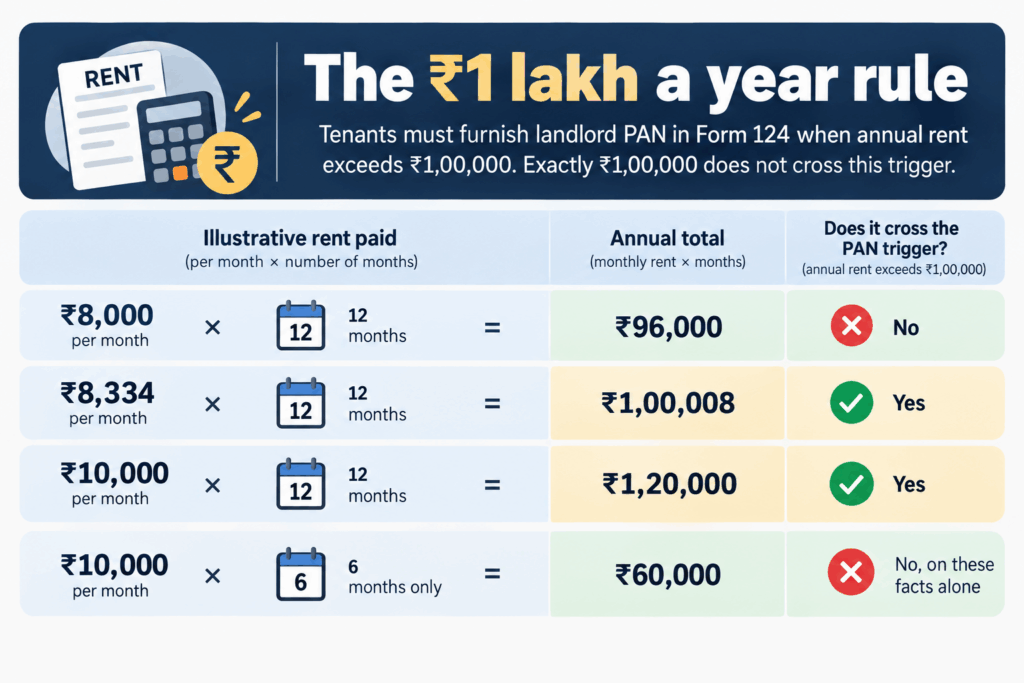
The Income Tax Department’s Form 124 FAQs confirm that tenants must furnish landlord PAN when annual rent exceeds ₹1,00,000. The wording is “exceeds”, so exactly ₹1,00,000 does not cross this particular trigger. Employers may still request supporting information for verification.
| Illustrative rent paid | Annual total | Does it cross the PAN trigger? |
|---|---|---|
| ₹8,000 for 12 months | ₹96,000 | No |
| ₹8,334 for 12 months | ₹1,00,008 | Yes |
| ₹10,000 for 12 months | ₹1,20,000 | Yes |
| ₹10,000 for 6 months only | ₹60,000 | No, on these facts alone |
The often-quoted ₹8,333 per month is only an approximation. Use the actual rent paid during the tax year, including changes in rent or accommodation. If a tenant moves between properties, they should give payroll the complete annual position and details of each landlord rather than check each receipt in isolation.
Avoid the misleading ₹3,000 documentation bands
There is no reliable basis for treating ₹3,001 as the point where a rental agreement first becomes necessary for current Form 124 claims. The notified form lists the house rent agreement as Annexure A-1, independently of the PAN trigger.
Older CBDT salary-TDS guidance mentions a receipt-production concession for employees drawing HRA up to ₹3,000 monthly. It is not a universal rent slab or permission to dispense with genuine payments. Follow the current form and payroll evidence requirements instead of an oversimplified three-band chart.
What Form 124 asks tenants to disclose
For HRA, the official Form 124 asks for the landlord’s name, address, PAN, Aadhaar number, relationship with the employee if any, and rent paid. The employee supplies their own identification and tax-year details separately and certifies that the information is complete and correct.
Two points deserve attention. Relationship disclosure means an employee renting from a parent or another relative should identify that relationship honestly. It does not, by itself, establish that a genuine arrangement is invalid. Also, although the form contains an Aadhaar field, the Department’s FAQs say Aadhaar is not mandatory unless the employer specifically requests it.
Tenants submit the form to their employer, electronically or physically; they do not separately upload it to the Income Tax portal. Ask for the payroll team’s submission deadline so missing details do not become a last-day problem.
Owners should provide a signed agreement that matches the accommodation and contracting parties. RentOK’s guide to reading a rent agreement before signing helps explain why names, rent, tenure and other terms need careful checking.
Keep the roles clear: the agreement records the arrangement, the receipt acknowledges payment, and Form 124 communicates the employee’s claim. One document should not contradict another or substitute for a payment that never happened.
What a valid PG rent receipt must show
Record the payment so someone else can verify it
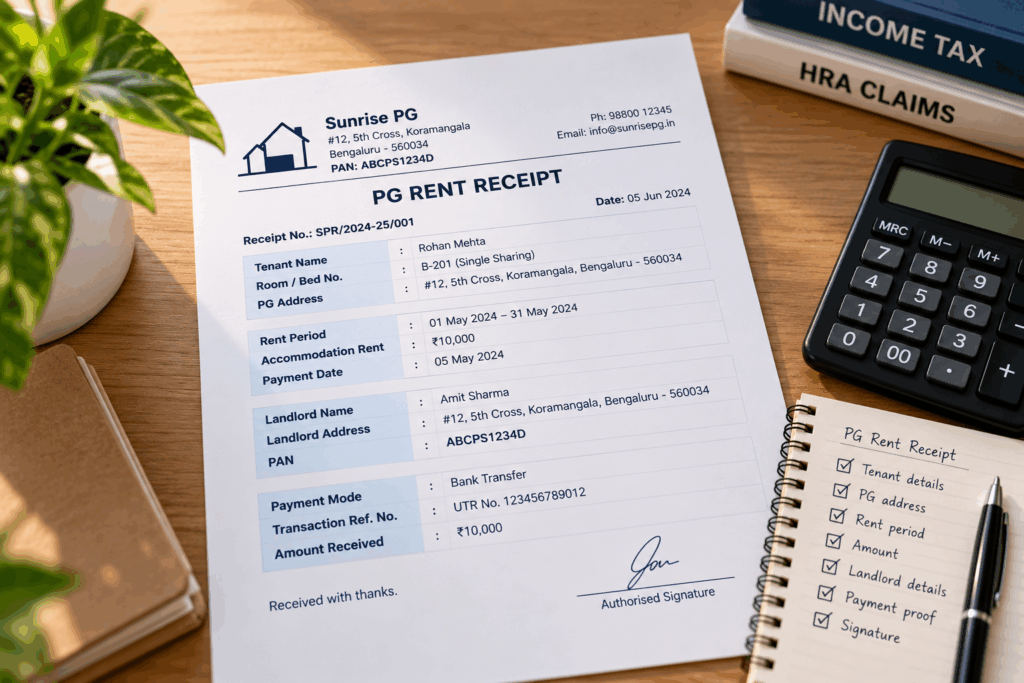
A useful PG rent receipt for HRA identifies the person who paid, the accommodation and the payment it acknowledges. Use a consistent format with these details:
- Tenant and accommodation: Tenant’s full name, complete PG address and room or bed identifier where relevant.
- Rent period and amount: The month or dates covered, accommodation rent received and the actual payment date.
- Landlord details: Correct name and address, plus PAN where required. Payroll may accept the PAN through a separate declaration rather than demand it on every monthly receipt.
- Payment evidence: Cash, bank transfer or other mode, an available transaction reference and a receipt number for tracking.
- Acknowledgement: Signature or appropriate authentication by the landlord or authorised recipient, following the employer’s accepted documentation process.
A receipt cannot guarantee exemption merely because it contains these fields. It must reflect a genuine transaction and fit the tenant’s supporting records. RentOK’s rent receipt generator comparison explains the difference between preparing a receipt and maintaining the payment records behind it.
Separate rent from other PG charges
If a ₹14,000 payment covers ₹10,000 accommodation, ₹3,000 meals and ₹1,000 electricity, show the agreed breakdown. Do not automatically label the entire package “rent” to increase an HRA claim. Ask payroll or a tax adviser to assess bundled arrangements where the accommodation component is unclear.
List refundable deposits separately too. They serve a different purpose from monthly rent. RentOK’s explanation of rent inclusions and extra charges can help owners make the breakdown clear before issuing receipts.
Cash receipts, revenue stamps and rental agreements
Digital payments make the evidence easier to trace, because the date, amount and recipient can support the receipt. That does not mean cash rent automatically fails an HRA claim. For cash payments, obtain a genuine acknowledgement and follow applicable receipt-stamping requirements.
Article 53 of Schedule I to the Indian Stamp Act, 1899 specifies ₹1 duty for receipts exceeding ₹5,000, subject to its exemptions. For a cash rent receipt above that amount, check the applicable stamp-law position and employer instructions; do not assume every payment mode or receipt has identical treatment.
The agreement needs separate attention. A revenue stamp on a receipt does not complete the stamping or registration requirements of the rental agreement. Those depend on applicable law and the arrangement, as RentOK’s guide to registered rent agreements explains. Keep a properly executed agreement and use consistent names, amounts and dates across the documents.
Create a simple monthly routine: confirm payment, issue the receipt, and retain its supporting reference. Correct an error with a traceable replacement rather than quietly changing an old record. This saves both the tenant and owner from reconstructing several months of transactions during payroll proof submission.
Can you refuse to share PAN?
Share accurate details with the right recipient
Refusing to share PAN does not remove the tenant’s disclosure requirement. Where annual rent crosses the threshold, missing information can prevent payroll from considering the claim. Explain the purpose of the request and share the details privately with the tenant or the authorised employer contact.
Provide the PAN of the actual landlord or contracting rent recipient, as appropriate to the documented arrangement. A manager’s personal PAN should not replace the PAN of the entity that receives the rent. If a PG operator leases the building from someone else, clarify the contractual chain rather than automatically supplying the building owner’s PAN.
Limit unnecessary circulation: avoid posting PAN copies in resident groups or publicly accessible folders. Ask whether payroll needs the number, a signed confirmation or a copy, and use a suitable private channel. Accuracy and controlled sharing can address the practical concern together.
What if the landlord genuinely has no PAN?
Older CBDT guidance allowed a landlord’s declaration of non-possession with their name and address. For a current claim, disclose that position truthfully and ask payroll or a tax adviser what evidence they can accept; do not treat a declaration as guaranteed approval under Form 124.
Form 60 is not a universal HRA workaround. The Department’s transition guidance says Form 97 replaces it for specified transactions under the new rules. That mechanism does not automatically override Form 124’s PAN requirement. Refusal to disclose an existing PAN is also different from genuinely not having one.
Missing PAN and false receipts have different consequences
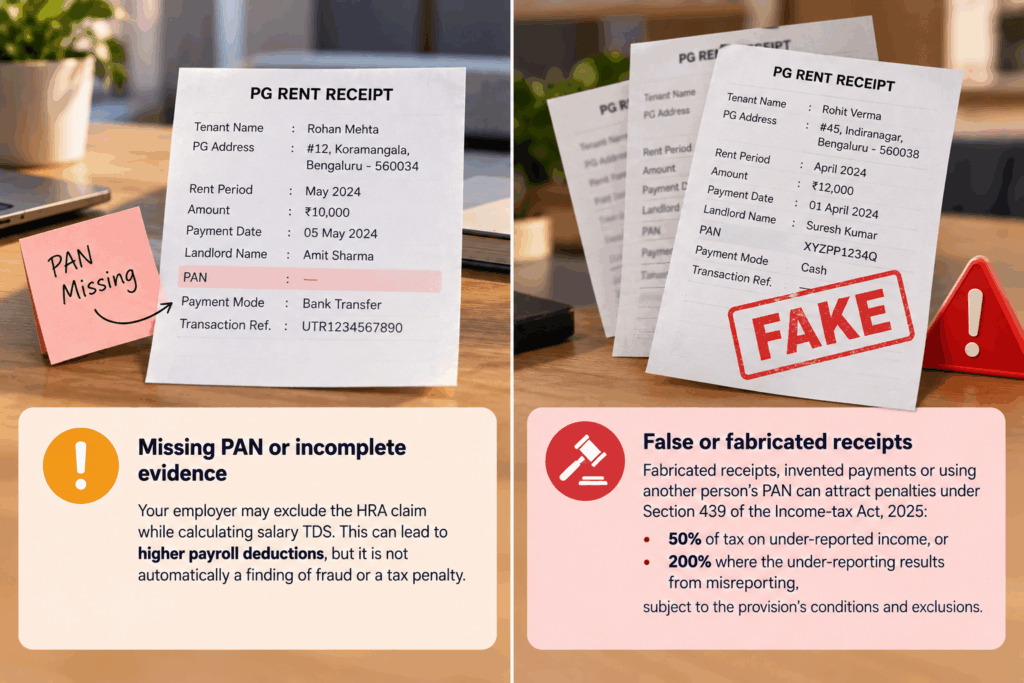
Incomplete evidence may lead an employer to exclude the HRA claim when calculating salary TDS. That can mean higher payroll deductions, but it is not automatically a finding of fraud or a tax penalty.
Fabricated receipts, invented payments or another person’s PAN create a different risk. Under Section 439 of the Income-tax Act, 2025, the statutory rates are 50% of tax on under-reported income, or 200% where the under-reporting results from misreporting, subject to the provision’s conditions and exclusions. These percentages apply to the relevant tax, not automatically to the rent or exemption claimed.
Section 270A belongs to the earlier Act and remains relevant in the applicable earlier-year framework. For current-year documentation, avoid quoting it as though the 2026 transition never happened. Owners should issue receipts only for actual payments; tenants should submit claims they can substantiate.
How RentOK helps you send consistent rent receipts
Repeated HRA requests become easier when your receipt records already match tenant payments. RentOK helps PG owners organise the information behind those requests and reduce repetitive receipt preparation.
- Connect supported payments with receipts: After a tenant authorises the relevant mandate, RentOK AutoPay and e-NACH can record supported processed payments and issue corresponding receipts.
- Keep tenant and payment details together: Tenant records, payment history and ledgers help staff check the resident and period before responding to a receipt request.
- Maintain clearer supporting records: Rental details and transaction records give your team a consistent starting point when tenants ask about amounts or missing months.
Check the correct landlord identity, PAN and package breakdown before sharing documents. Automation supports record-keeping; it does not verify HRA eligibility, submit Form 124 for the employee or guarantee employer acceptance.
Conclusion
A tenant’s PAN request is usually a documentation task that owners can handle with a clear process. Confirm the actual landlord details, calculate the annual rent correctly and keep the agreement, receipt and payment evidence consistent. Form 124 updates how employees present their claims, while the ₹1 lakh PAN trigger continues to require attention.
Treat genuine missing information differently from false paperwork. Share PAN through a private channel, resolve unusual arrangements with payroll or a tax adviser, and issue receipts for payments you can support. Send auto rent receipts with RentOK to reduce repetitive preparation and give tenants a more dependable record when they need it.
Frequently Asked Questions
Find answers to common questions about this topic
About the Author
Ishika Pannu
Ishika Pannu brings you the latest insights and easy-to-apply strategies in property management—helping you simplify renting and grow with RentOk.