Property Tax
Does Your Mess Push Your PG Over the GST Limit? The ₹20,000 Rule Explained

Written by
Ishika Pannu
Read Time
11 min read
Posted on
November 4, 2026
Overview
Overview
Does Your Mess Push Your PG Over the GST Limit? The ₹20,000 Rule Explained
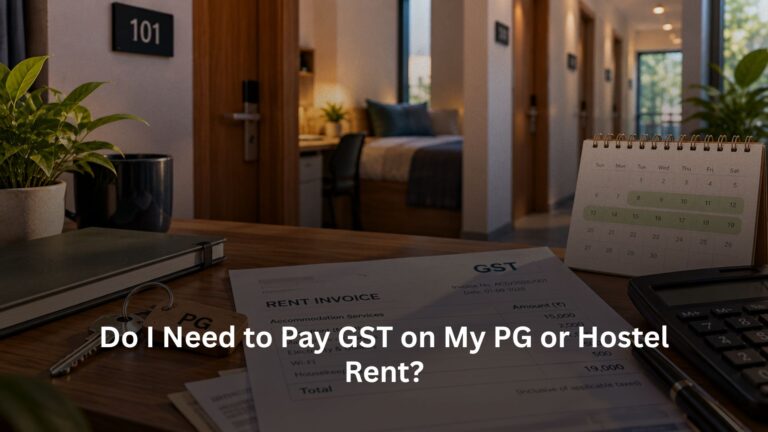
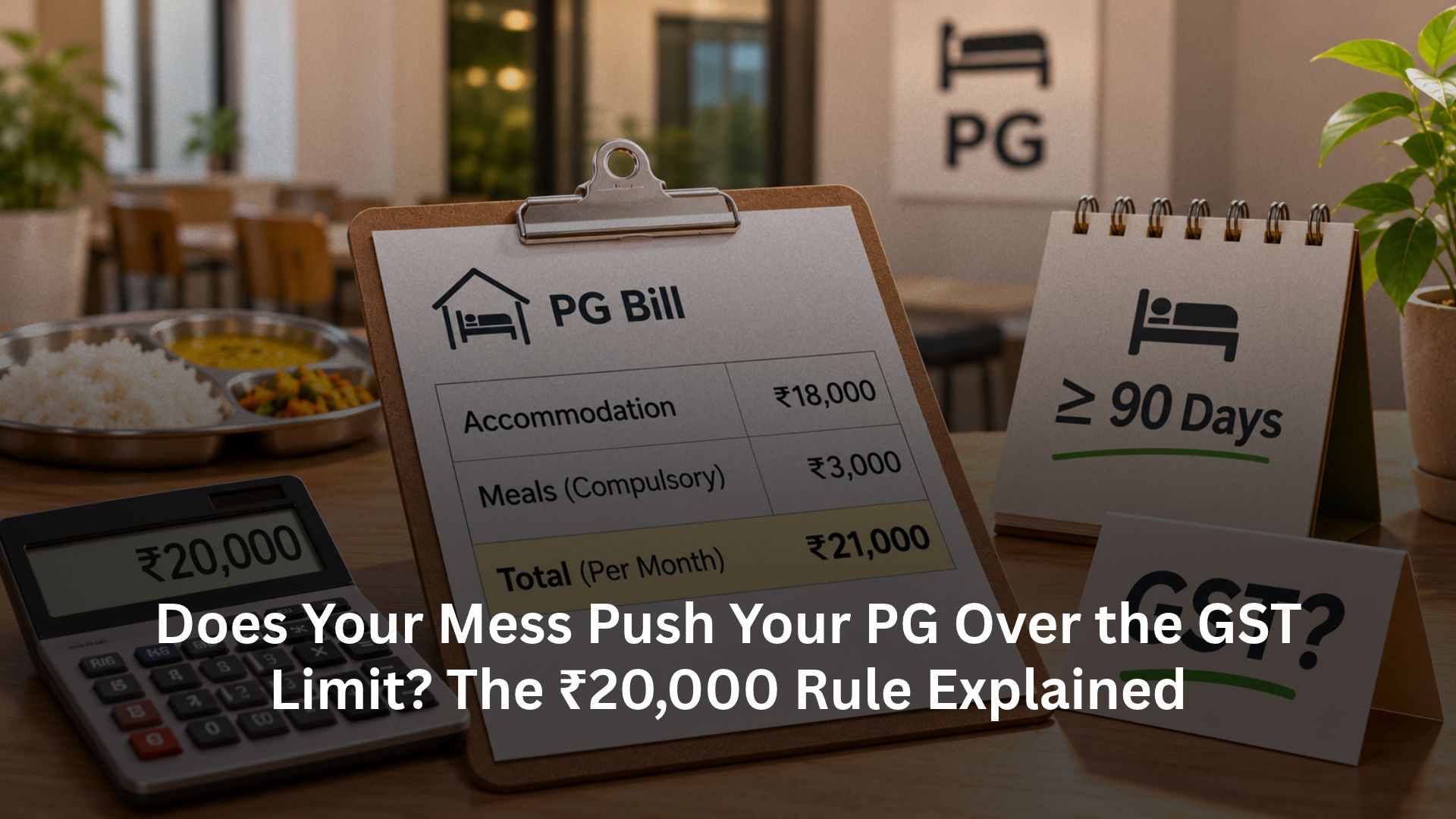
A PG owner quotes ₹18,000 for accommodation and ₹3,000 for compulsory meals. The bill lists them separately, so the owner checks only the accommodation line against the ₹20,000 GST exemption. That approach can produce the wrong result: where the arrangement qualifies as an accommodation-led composite supply, the relevant monthly package value is ₹21,000, including the mandatory food charge.
The exemption also requires a continuous stay of at least 90 days. Price alone does not settle the tax position, and neither does the heading on an invoice. This guide explains how compulsory and optional meals affect the analysis, compares three realistic pricing examples, and separates the per-resident exemption from your business’s GST registration threshold. The rules below reflect the position checked on 3 November 2026.
The ₹20,000 exemption has two conditions
Entry 12A of Notification 12/2017–Central Tax (Rate) covers qualifying accommodation services when their value does not exceed ₹20,000 per person per month and the provider supplies the accommodation for a minimum continuous period of 90 days. Notification 04/2024 introduced this relief from 15 July 2024; CBIC explains it in Circular 228/22/2024-GST.
The wording matters in everyday billing:
- Exactly ₹20,000 qualifies on value. The limit includes that amount; it does not stop at ₹19,999. You must still satisfy the stay and supply conditions.
- The test applies per resident, per month. A shared room’s combined collection does not automatically become one resident’s charge. Keep each occupant’s entitlement and billing identifiable.
- A short stay does not qualify merely because it costs less. Keep actual admission and departure records. If someone leaves before 90 continuous days, ask your accountant to review the exemption and any billing correction.
An annual agreement can support the intended arrangement, but it does not replace evidence of the stay. Record the accommodation period alongside the applicable monthly price, rather than relying only on a payment screenshot.
Why does compulsory food affect the package value?
Suppose residents cannot take a bed without paying for the mess. The commercial offer includes both services, even when your invoice shows two lines or a resident skips dinner. You cannot simply remove the food charge from the exemption calculation by calling it a separate fee.
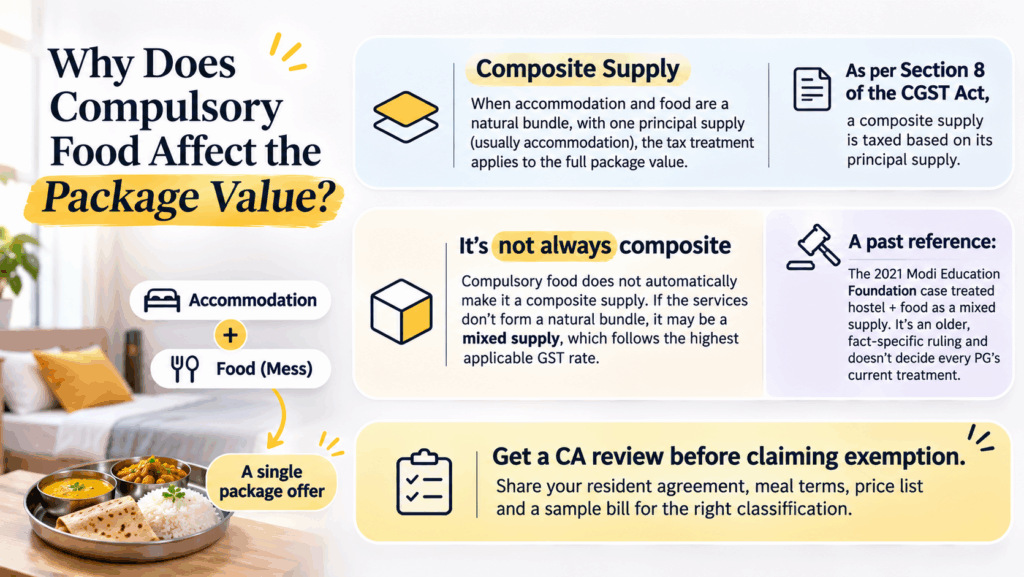
For a composite supply, the services must form a natural bundle in the ordinary course of business, with one principal supply. If accommodation forms that principal supply, its tax treatment governs the bundle and its full value. Section 8 of the CGST Act sets out this principle.
Compulsory does not automatically mean composite
The contract and actual operation determine the classification. A package that fails the natural-bundling test may constitute a mixed supply, which follows the highest applicable rate among its components. A genuinely independent food service requires its own analysis.
The Rajasthan appellate authority treated hostel accommodation with food as a mixed supply in the 2021 Modi Education Foundation case. That older, fact-specific ruling predates Entry 12A; it does not decide every PG’s current treatment. It does show why “all PG packages are composite” is unsafe advice. See the GST Council’s case summary.
Before advertising an exemption, give your CA the resident agreement, meal terms, price list and sample bill. Ask for a classification based on those facts, rather than the invoice labels alone.
Three monthly bills: below, at and above the limit
These illustrative examples assume a 120-day continuous stay and a correctly classified composite supply with accommodation as the principal supply. All figures represent monthly charges per resident before GST. Different classification or stay facts can change the outcome.
| Monthly charge | Below the limit | Exactly at the limit | Above the limit |
|---|---|---|---|
| Accommodation | ₹17,500 | ₹17,500 | ₹18,000 |
| Compulsory meals | ₹2,000 | ₹2,500 | ₹3,000 |
| Package value | ₹19,500 | ₹20,000 | ₹21,000 |
| Entry 12A value condition | Meets it | Meets it | Fails it |
The first two packages meet the stated exemption conditions. The third loses Entry 12A relief even though its accommodation line remains below ₹20,000. The owner must then check the applicable classification, rate and registration position.
Assume the third supplier holds a regular GST registration and the supply falls within the taxable 5% accommodation entry. GST equals ₹21,000 × 5% = ₹1,050, bringing the bill to ₹22,050. The tax applies to the full taxable value, not just the ₹1,000 above the exemption ceiling.
Keep resident charges separate from the cost of providing meals. Paying ₹2,200 to prepare a meal plan that you sell for ₹3,000 does not reduce the package value by that kitchen expense. RentOK’s guide to tracking rental income and expenses explains how separate records help you distinguish collections from operating costs.
Can genuinely optional meals remain separate?
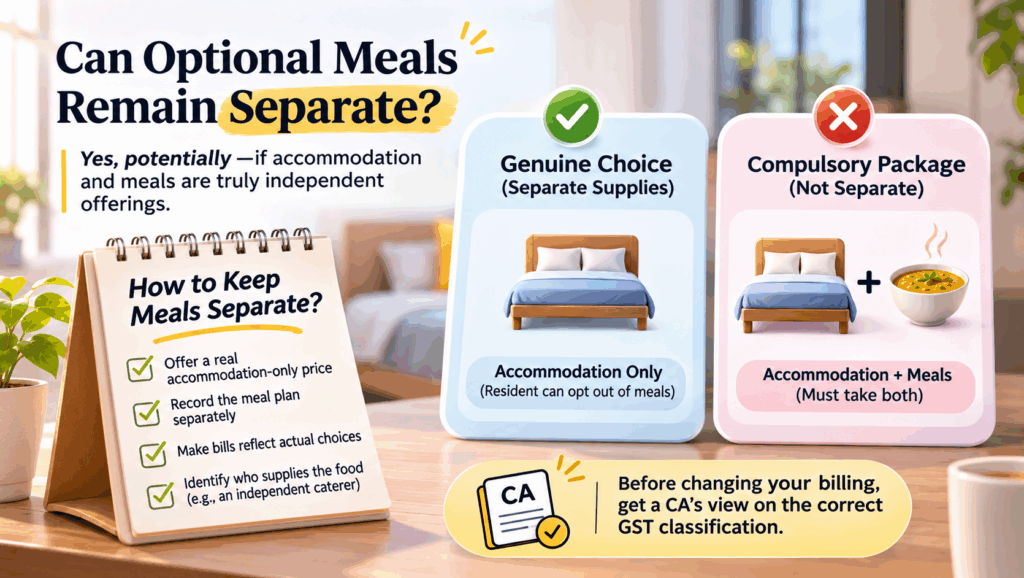
Yes, potentially, when the facts establish independent supplies. A resident who can rent the accommodation without buying meals presents a different arrangement from someone who must pay for both. However, a separate food service does not automatically inherit the accommodation exemption.
Build the choice into the agreement and daily operations:
- Offer a genuine accommodation-only price. Residents must be able to decline the mess without losing the bed or paying an equivalent compulsory charge under another name.
- Record the meal subscription separately. State the price, meals covered, start date and cancellation terms. Apply the agreed terms when a resident joins or leaves the plan.
- Make bills follow actual choices. Do not charge every resident for food while describing it as optional. Retain opt-in records and subscription changes alongside the monthly dues.
- Identify who supplies the food. An independent caterer’s contract may matter, but a second business name or invoice does not, by itself, establish independence.
Use your rent agreement to document the actual arrangement, including whether meals form part of the accommodation package. Match the promised food service to a clear menu and schedule; RentOK’s weekly PG food-menu planner can help describe what a meal subscription includes.
Genuine choice matters more than paperwork designed around a tax result. Have your CA assess the accommodation and independent meal service separately before changing the billing treatment.
The tax rate after the exemption falls away
Crossing ₹20,000 does not create one universal GST rate for every PG arrangement. First identify the supply. For taxable services within the hotel-accommodation entry, the current lower band covers accommodation valued at up to ₹7,500 per unit per day or equivalent, at 5% total GST. Higher-value accommodation falls under the 18% band; mixed packages and independent food supplies need their own rate analysis.
The lower accommodation rate changed from 12% to 5% on 22 September 2025, under Notification 15/2025–Central Tax (Rate). Its daily per-unit rate test differs from Entry 12A’s monthly per-person exemption test. Keep those measures separate.
Input tax credit remains restricted
Avoid treating 5% GST as an entitlement to claim credit on every purchase. From 1 November 2026, Notification 06/2026–Central Tax (Rate) allows a narrow exception for qualifying hotel-accommodation services purchased from another accommodation supplier, subject to a cap where the upstream rate exceeds the permitted level.
That exception does not open general credit on groceries, furniture or building rent under the lower accommodation entry. Ask your CA to review eligible inputs and shared costs before adjusting the GST payable. For an ordinary PG mess calculation, the important point remains the full taxable package value and the correct output rate.
Does one ₹21,000 package require GST registration?
Not automatically. The ₹20,000 monthly exemption ceiling and the annual registration threshold answer different questions. The first concerns a qualifying accommodation supply; the second concerns the supplier’s registration obligations.
Under the CGST Act’s registration provisions, a person supplying exclusively exempt services generally has no registration liability for those supplies. Where taxable supplies arise, the usual service threshold is ₹20 lakh aggregate annual turnover, with a lower ₹10 lakh threshold in specified states and separate compulsory-registration rules.
Aggregate turnover includes exempt supplies and covers the same PAN across India. Therefore, a business with substantial exempt accommodation collections cannot assess registration by counting only a small taxable mess or premium-room segment. Conversely, an unregistered operator who has no registration obligation cannot collect an amount as GST.
For owners with several buildings, property-wise records across the portfolio make the review easier. Give your accountant the consolidated figures as well as each property’s breakdown; separate buildings do not necessarily mean separate turnover limits.
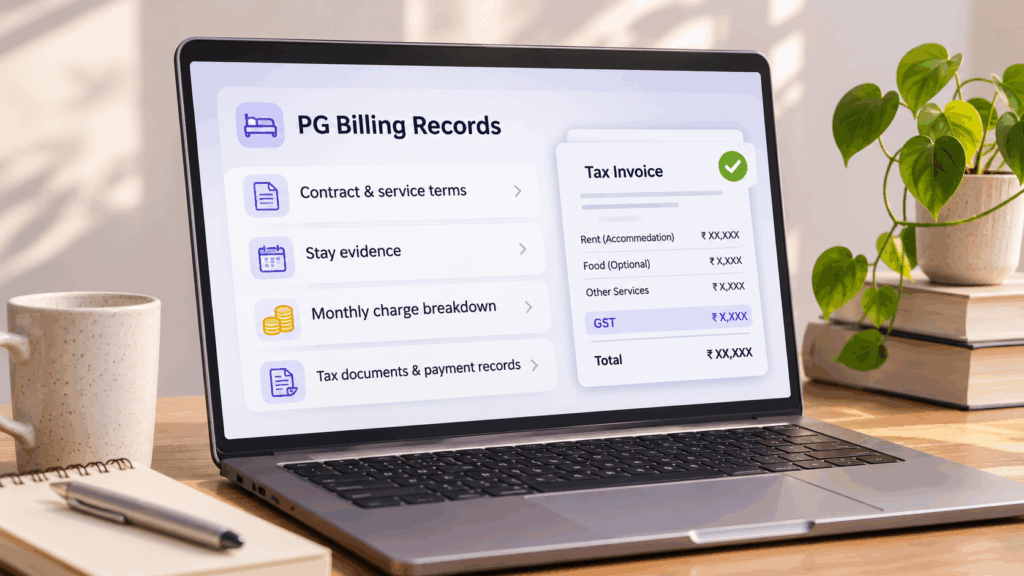
Billing records that support the tax treatment
Your records should connect the resident’s contract to the charge and the payment. A receipt establishes a payment; it does not, by itself, prove that an exemption applies or replace every requirement of a statutory tax invoice.
Keep the following together:
- Contract and service terms: accommodation price, compulsory inclusions, optional subscriptions and whether the quoted price includes GST.
- Stay evidence: admission date, actual departure date, extensions and any early-exit adjustments relevant to the 90-day condition.
- Monthly charge breakdown: rent, food and other services, with the tax classification your adviser has approved for the arrangement.
- Tax documents and payment records: applicable GSTIN, invoice details, tax breakup and receipts. A regular registered supplier generally issues a tax invoice for taxable supplies and a bill of supply for exempt supplies, subject to the applicable document rules.
Track refundable security deposits separately from accommodation charges. A genuine deposit does not become consideration merely because you hold it; applying it against a charge can change that position. RentOK’s guide to tracking PG security deposits explains the operational value of maintaining a separate deposit history.
Before a price increase, check the complete compulsory package again. A higher meal charge can move an otherwise unchanged accommodation offer above the ceiling. Explain the revised total and any applicable GST to residents before the new billing cycle starts.
How RentOK helps keep rent and mess charges clear
PG billing becomes difficult to review when staff combine rent, food subscriptions and adjustments in one unexplained monthly amount. RentOK helps organise the operational records behind that bill, so residents can understand their dues and owners can give their accountant a clearer transaction history.
- Separate rent and meal categories: RentOK’s dues packages support named charge categories. Use distinct accommodation and food categories to show the breakdown while preserving the correct tax treatment of any compulsory bundle.
- Match charges to each resident: Fixed or tenant-specific amounts help reflect different room prices and genuine meal subscriptions. Update the relevant resident’s dues when the agreed service changes, instead of applying one food charge indiscriminately.
- Show what the resident needs to pay: The payment page provides a breakup of dues. Residents can see the charges behind the total, which helps resolve questions about meal additions or revised accommodation prices.
- Keep downloadable payment receipts: Residents can view and download receipts from the payment page. Retain the supporting agreement, stay records and statutory tax documents alongside the collection history for the accountant’s review.
RentOk’s dues-package guide and payment-page documentation explain these workflows. Itemisation improves clarity; it does not create an exemption. Confirm the required GST invoice fields, classification and applicable tax treatment with your CA before using a billing format for statutory compliance.
Conclusion
Your mess can push a PG package above the ₹20,000 per-person monthly ceiling when compulsory meals form part of an accommodation-led composite supply. Check the complete value, the continuous 90-day stay and the actual supply classification together. Then assess registration and the applicable rate; do not assume that separate invoice lines settle those questions.
Keep the contract, service choices and monthly bill consistent. Split rent and food on RentOK invoices to make the charges easier to understand, and have your CA confirm the tax treatment and statutory document requirements. Clear records help you explain the amount residents owe and support the position you take.
Frequently Asked Questions
Find answers to common questions about this topic
About the Author
Ishika Pannu
Ishika Pannu brings you the latest insights and easy-to-apply strategies in property management—helping you simplify renting and grow with RentOk.