Property Tax
Is PG Income ‘House Property’ or ‘Business Income’? How to Pay the Right Tax


Written by
Ishika Pannu
Read Time
13 min read
Posted on
October 28, 2026
Overview
Overview
Is PG Income ‘House Property’ or ‘Business Income’? How to Pay the Right Tax
A PG owner and a PG operator can earn money from the same building and report it differently. The owner may collect a fixed monthly rent, while the operator collects bed charges, serves meals, employs staff and handles daily upkeep. Calling both receipts “PG rent” hides the distinction that matters for PG income tax: what each person actually earns from the arrangement.
Income from house property generally covers an owner’s letting income, while a genuine accommodation business may generate business income. However, meals, Wi-Fi or housekeeping do not automatically move every receipt into the business category. Ownership, the contract and the substance of the operation matter. Getting this right determines your deductions, accounting method and return form, and prevents you from claiming a benefit that belongs to a different income head.
The tax year matters before the tax head
The Income-tax Act, 2025 applies from 1 April 2026. Income earned during FY 2025–26 still falls under the 1961 Act, and its return belongs to AY 2026–27. Income earned from April 2026 falls within Tax Year 2026–27 under the new Act. The Income Tax Department explains this distinction in its transition guidance.
This article uses current provisions and identifies familiar older references where useful. In particular, the house-property deduction now appears in Section 22, formerly Section 24, while the general business presumptive scheme appears in Section 58, succeeding Section 44AD. The ITR table below specifically describes AY 2026–27; always check the forms for the year you are filing.
House property and business income follow different rules
The starting point is ownership and the nature of the receipt, rather than whether your signboard says PG, hostel or co-living. Current Section 26(4) specifically places an owner’s income from letting a residential house, or part of it, under house property. A business label cannot override that rule.
| Point of comparison | Income from house property | Business income, or PGBP |
|---|---|---|
| What generates the receipt | Letting a building owned or deemed owned by the taxpayer | Carrying on a genuine accommodation or service business |
| Typical PG situation | Owner receives rent for premises let to an operator | Operator runs boarding accommodation, employs staff and supplies services |
| Main deduction method | Statutory annual-value calculation and house-property deductions | Allowable actual business expenses, or an eligible presumptive method |
| Role of services | Incidental facilities do not automatically change the rent’s character | Organised services help establish business activity, subject to the full facts |
An operator who leases premises does not ordinarily own the property for this purpose. Their receipts may therefore require a business-income analysis rather than the owner’s house-property treatment; deemed ownership and other-source income can complicate particular arrangements.
Keep agreements and a clear breakdown of receipts alongside your monthly PG financial reports. Those records help your accountant distinguish letting income, service receipts and refundable amounts instead of classifying everything from a bank total. The same analysis applies to hostel income tax; branding alone does not determine the head.

Does serving food remove the 30% deduction?
Food changes your operating model, but it does not answer the tax question by itself. A resident who pays one package price for a bed, daily meals, cleaning and supervision may be purchasing a boarding service. An owner who lets a residential house and arranges occasional cleaning may still earn house-property income. Some arrangements require a defensible separation of rent and service income; invoice labels alone do not establish that separation.
For PG income under house property, calculate annual value under the applicable rules, including expected rent, actual rent and eligible vacancy adjustments. Deduct qualifying local-authority taxes that the owner actually paid. The resulting figure commonly goes by net annual value, or NAV. See Section 21’s annual-value rules.
You then claim the 30% standard deduction under Section 22. It applies to NAV, not automatically to every bank receipt. Qualifying interest on borrowed capital may also qualify, subject to the relevant conditions and tax-regime restrictions.
You cannot add grocery bills, staff salaries and routine repairs to that standard deduction as though the same rent were business turnover. Conversely, normal business accounting does not provide a separate 30% house-property deduction. Classification comes first; the deduction follows it.
Which ITR fits your PG income?
Choose the return after identifying your income heads and legal entity. These are the main routes for AY 2026–27, covering FY 2025–26 income:
| Situation | Return to examine |
|---|---|
| Eligible resident individual, no business income, total income up to ₹50 lakh | ITR-1, subject to all eligibility conditions |
| Individual or HUF without business income who cannot use ITR-1 | ITR-2 |
| Individual or HUF with business income under regular computation | ITR-3 |
| Eligible resident individual, HUF or non-LLP firm using presumptive computation; total income up to ₹50 lakh | ITR-4, subject to its exclusions |
The current ITR-1 guidance allows income from up to two house properties for this assessment year. The older “one property only” shortcut no longer describes these rules. Capital gains, foreign assets, losses and residential status can still make a simpler form unavailable.
Likewise, ITR-4 eligibility involves more than choosing presumptive taxation. Its ₹50 lakh limit concerns total income, not the business turnover ceiling. LLPs, companies and other entities must check their own return requirements, commonly ITR-5 or ITR-6 as applicable.
Business expenses need evidence and the right treatment
For PG business income tax under regular accounting, claim expenses that the law allows for running the business. The expense must relate to the operation, and payment records should support the amount. The Department’s deduction guidance distinguishes running costs, depreciation and personal expenditure.
- Premises and utilities: Rent paid for the PG, electricity, water and internet can form business costs. Separate personal use and check any withholding obligations.
- Meals and staff: Record groceries, kitchen supplies, cooks, housekeeping, wardens and security staff against their actual business purpose. Keep supplier invoices and salary records.
- Repairs and administration: Routine servicing, cleaning materials, accounting fees and relevant operating charges may qualify. Record the work and payment rather than relying on a verbal estimate.
- Furniture and equipment: Beds, appliances and other capital assets generally require capitalisation and eligible depreciation. Buying an asset does not automatically justify deducting its entire price immediately.
Do not claim your own drawings, private groceries or personal travel as PG expenditure. Cash-payment restrictions, TDS defaults and other disallowances can also change the amount you may deduct.
A consistent system for tracking rental expenses helps you find the supporting evidence. It does not turn every recorded payment into a tax deduction.
Can a PG business use presumptive taxation?
An eligible PG business may consider the general presumptive scheme: Section 44AD for the earlier Act and Section 58 under the current Act. It does not apply to receipts that properly belong under house property.
Broadly, the business scheme covers eligible resident individuals, HUFs and partnership firms other than LLPs, subject to exclusions. The turnover ceiling is ₹2 crore, rising to ₹3 crore when cash receipts do not exceed 5% of total turnover or gross receipts.
The computation generally uses 6% for qualifying banking or electronic receipts received within the specified time and 8% for the balance, or a higher profit the taxpayer claims to have earned. These percentages calculate presumptive profit, not the final income-tax rate.
For example, 6% of ₹20 lakh in qualifying receipts equals ₹1.20 lakh of presumptive profit before considering a higher profit claim and other applicable conditions. It does not mean the government charges ₹1.20 lakh in tax.
Under Section 44AD’s computation rules, the scheme already accounts for business deductions, including depreciation. You cannot then subtract salaries, groceries or rent again. Review the multi-year consequences before leaving the scheme: a break can trigger a five-year exclusion, and books or audit requirements may follow.

GST requires a separate accommodation check
Income tax and GST answer different questions. A PG can generate business income while its qualifying accommodation supply remains GST-exempt. Do not use a GST exemption to decide the income-tax head.
Notification 04/2024–Central Tax (Rate) introduced the accommodation exemption from 15 July 2024. CBIC’s Circular 228/22/2024-GST confirms its two conditions:
- The value of accommodation supply must be ₹20,000 or less per person per month.
- The accommodation must cover a minimum continuous stay of 90 days.
Both conditions matter. Keep stay dates and charges, and review compulsory meal or service bundles before assuming that only the room component counts towards the ceiling.
If this exemption does not apply, check the supply’s classification and registration obligations. The general service-registration threshold is usually ₹20 lakh, with a lower threshold in specified states and other exceptions. Aggregate turnover includes exempt supplies, while exclusively exempt suppliers generally do not need registration under Section 23’s exemption.
Also distinguish resident accommodation from the owner’s lease to an operator. The rules for GST on residential rent involve the property, recipient and use; they do not automatically give both transactions the same treatment.
From monthly records to the correct tax payment
Before filing, reconcile your tenant ledger, invoices and bank statements. Keep refundable security deposits separate from earned charges, and review amounts you later adjust or forfeit. Clear deposit tracking helps prevent a bank receipt from becoming income merely because it entered your account.
Use a monthly closing routine to review outstanding charges, expenses, owner withdrawals and supporting documents. Your accountant can then reconcile AIS, Form 26AS and eligible tax credits, calculate total income, and apply the appropriate regime, rates, rebate and cess.
Do not wait until return filing to check payments. Section 404 sets a ₹10,000 advance-tax liability threshold; apply the calculation after relevant tax credits and check any exception. Pay instalments under the applicable rules, settle remaining self-assessment tax and select the correct Act and year on the payment portal. Ask your chartered accountant to review the classification, especially if you own the building and supply a bundled package.
A worked example for a 20-bed PG
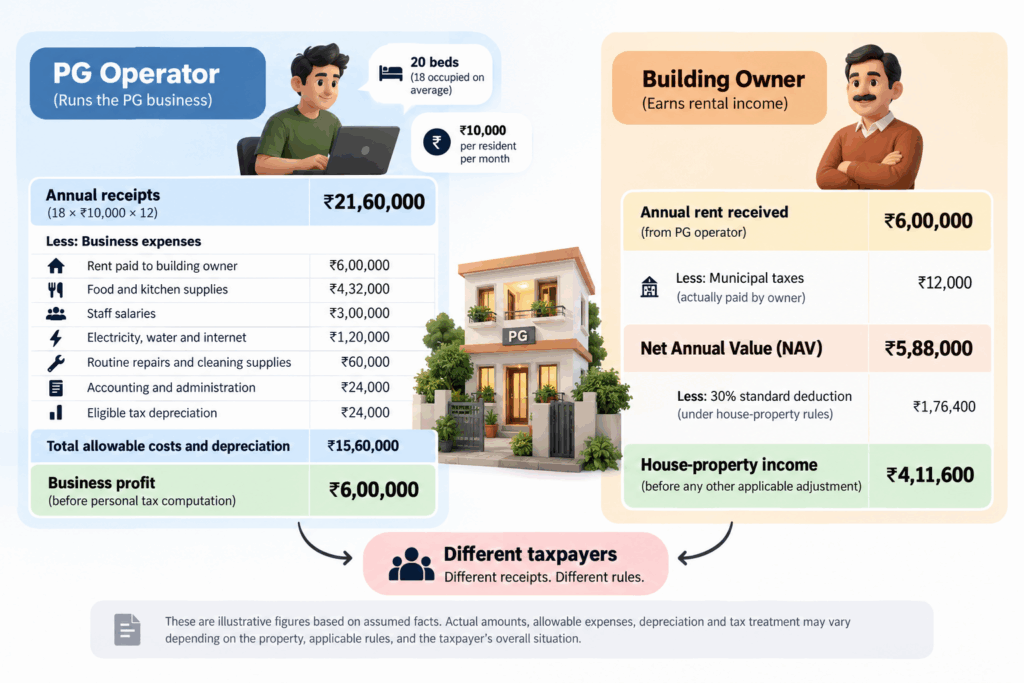
Consider an illustrative leased-premises PG business with 20 beds, averaging 18 paying residents throughout the year. Each resident pays ₹10,000 monthly. Assume genuine business treatment, regular accounts, fully allowable business expenses and no interest cost. The example excludes refundable deposits and assumes the resident supplies meet the GST exemption conditions.
The operator’s receipts and business profit
Annual receipts equal 18 × ₹10,000 × 12 = ₹21,60,000. Capacity alone would produce a misleading figure: the two vacant beds generate no assumed receipts.
| Annual item | Illustrative amount |
|---|---|
| Resident receipts | ₹21,60,000 |
| Rent paid to building owner | ₹6,00,000 |
| Food and kitchen supplies | ₹4,32,000 |
| Staff salaries | ₹3,00,000 |
| Electricity, water and internet | ₹1,20,000 |
| Routine repairs and cleaning supplies | ₹60,000 |
| Accounting and administration | ₹24,000 |
| Eligible tax depreciation, assumed | ₹24,000 |
| Total allowable costs and depreciation | ₹15,60,000 |
| Business profit before personal tax computation | ₹6,00,000 |
The ₹24,000 depreciation is an assumption, not a prescribed flat allowance. Actual depreciation depends on the assets and tax rules. This calculation uses regular accounting, so it does not also apply a 30% deduction or presumptive computation.
The building owner’s separate rental income
The owner receives ₹6,00,000 annual rent from the operator. Assume house-property treatment, that this is also the relevant gross annual value, ₹12,000 of qualifying municipal taxes actually paid by the owner, and no loan interest.
NAV equals ₹6,00,000 − ₹12,000 = ₹5,88,000. The 30% deduction equals ₹1,76,400, leaving ₹4,11,600 house-property income before any other applicable adjustment.
These figures belong to different taxpayers earning different receipts. The operator cannot choose the owner’s computation, and the owner cannot deduct the operator’s grocery bill. Neither profit figure is the final tax bill: other income, entity type, regime and available relief determine that amount.
How RentOK helps you track PG income and expenses
Your tax adviser needs records that explain your PG, including what residents owe, what they paid and what you spent. RentOK brings these operating records together so you can review them throughout the year instead of rebuilding them at filing time.
- Compare dues with collections: Tenant payment histories and ledgers help you identify unpaid charges and match collections with the relevant resident and period.
- Organise expenses by category and month: Record operating costs consistently, then review staff, utility and maintenance spending alongside income. Preserve invoices and payment evidence for the tax review.
- Review each property’s performance: RentOK’s money reports provide monthly and property-wise income, expense and profit views, making individual properties easier to examine.
- Prepare records for your accountant: Download financial reports and use the available Excel reports for income, dues, expenses and profit-loss to support reconciliation and return preparation.
These tools support record-keeping. Your accountant must still determine the tax head, test each deduction and complete the relevant tax filings; an app profit figure does not automatically equal taxable income.
Conclusion
The right tax on paying guest income starts with the actual arrangement. Establish who owns the property, what each receipt pays for and whether the activity represents residential letting, a genuine accommodation business or distinct components. Then apply the corresponding deductions and choose the return for the correct reporting year.
Keep that decision connected to your records. Regular income and expense reviews make it easier to explain your figures and claim eligible costs without mixing deposits, rent and service receipts. Track PG income and expenses on RentOK, and take a clear set of records to your chartered accountant before you file.
Frequently Asked Questions
Find answers to common questions about this topic
About the Author
Ishika Pannu
Ishika Pannu brings you the latest insights and easy-to-apply strategies in property management—helping you simplify renting and grow with RentOk.