Legal
How to Read a Rent Agreement Before Signing: What to Watch Out For

Written by
Ishika Pannu
Read Time
16 min read
Posted on
September 4, 2026
Overview
Overview
How to Read a Rent Agreement Before Signing: What to Watch Out For
A rent agreement can look straightforward at first glance. The rent is mentioned, the security deposit is written down, the tenancy period is specified, and both parties sign at the bottom. It may take only a few minutes to complete the formalities, but those few minutes can determine how several months of your tenancy will work.
For tenants, the mistake is often not signing an agreement without reading it at all. It is reading it only for the information that seems immediately important: rent, deposit, and move-in date. The clauses that create problems later are often the ones that receive the least attention.
What happens if you need to move out early? Who pays for repairs? Can the landlord increase the rent during your stay? When will your security deposit be returned? What exactly counts as damage? What does the agreement say about visitors, maintenance, utilities, or renewal?
These are not small details. They define your responsibilities as a tenant and, in many situations, your rights as well.
A well-drafted rent agreement should make the rental arrangement easier to understand, not leave you trying to interpret vague statements after a disagreement has already occurred. RentOk’s Rent Agreement Checklist: 15 Things Every Owner Should Include also highlights the importance of reviewing details such as rent, deposits, maintenance, house rules, lock-in periods, renewal, and exit conditions before an agreement is finalised.
Why Should You Read the Entire Rent Agreement?
The first thing to understand is that a rent agreement is not simply a receipt for the rent you are going to pay. It is the written record of the arrangement between you and the landlord.
That distinction matters because verbal conversations can easily be forgotten or remembered differently by the two parties. A landlord may have explained that maintenance would be handled by them, while the tenant may later discover that the agreement assigns certain repairs to the occupant. Similarly, a tenant may assume that giving one month’s notice is sufficient, only to find that the signed agreement contains a different exit condition.
Once the agreement is signed, the written terms become particularly important.
This is why you should read the document before signing rather than treating it as something to review only if a problem arises. Look at the agreement from the perspective of your entire tenancy: How much will you pay? What are you responsible for? What can the landlord expect from you? How should you respond if your circumstances change? And how does the tenancy end?
If you cannot understand a clause, do not simply assume that it is standard.
Ask what it means and request clarification before signing.

Start With the Money: Rent, Deposit and Additional Charges
The financial section deserves more attention than simply checking whether the monthly rent is correct.
Your agreement should clearly establish the amount you are expected to pay, the payment date, the payment method, and any additional charges that form part of your occupancy. Depending on the property, this could include electricity, water, maintenance, parking, housekeeping, food, internet, or other services.
A tenant should be able to look at the agreement and understand the difference between rent and other recurring charges.
For example, if electricity is charged separately, the agreement should ideally explain how it is calculated. If maintenance is included in the rent, that should be clear as well. If certain services are optional or charged separately, the terms should not be left entirely to verbal communication.
Before signing, check:
- Monthly rent: Confirm the exact amount, payment date, and method of payment. Also check whether the rent changes during the agreement or only when it is renewed.
- Security deposit: Verify the amount paid, the circumstances in which deductions can be made, and the process or timeline for its return after you move out.
- Additional charges: Look for electricity, water, maintenance, parking, food, housekeeping, internet, or other charges that may not be included in the headline rent.
- Late-payment terms: Check whether the agreement mentions a late fee or other consequence for delayed payment and under what circumstances it applies.
This is one area where clarity benefits both sides. A landlord gets a predictable payment structure, while the tenant knows exactly what financial commitments they are accepting.
If you want to understand the documentation side in greater detail, RentOk’s recent guide on How to Create a Legally Valid Rent Agreement in India covers the financial and operational terms that should be documented in a rental agreement.
The Lock-in Period and Notice Period Are Not the Same
This is one of the most important distinctions to understand before signing.
A lock-in period generally refers to a minimum agreed period during which leaving the tenancy early may have specified consequences. A notice period, meanwhile, refers to the advance notice required when either party wants to end the tenancy.
They can operate differently, so do not assume that one automatically replaces the other.
Imagine that your agreement mentions a six-month lock-in and a 30-day notice period. If you decide to leave during the third month, you need to know what the agreement actually says about that situation. Does the lock-in create a financial consequence? Does the notice period still apply? Is there a specific early-exit clause?
Do not rely on what the landlord casually told you during the property visit.
Read the actual wording.
This becomes particularly important for students and working professionals whose circumstances can change unexpectedly because of college schedules, job transfers, family situations, or relocation.
If the agreement contains a lock-in clause, ask:
- What exactly happens if I leave before the lock-in ends?
- Does the notice period continue to apply during the lock-in?
- Are there specific charges associated with early termination?
- Does the agreement provide any exceptions?
- How will the security deposit be treated when the tenancy ends early?
The purpose is not to negotiate every clause aggressively. It is to make sure you understand the financial consequences before agreeing to them.
RentOk’s guide to managing tenant lock-in periods without conflict explains why lock-in conditions work best when expectations are made clear during onboarding rather than discussed only after a tenant decides to leave.
What Does the Agreement Say About Maintenance?
Maintenance clauses can appear harmless until something breaks.
A tenant may assume that the landlord will handle a repair because the problem relates to the property itself. The landlord, however, may consider it a tenant responsibility under the agreement.
This is why maintenance should not be treated as a vague “landlord will handle repairs” statement.
Look for how the agreement separates routine maintenance from larger repairs. It should also be clear who is responsible for damage caused by negligence or misuse and what happens when an appliance, fixture, or furnishing stops working through normal use.
For a furnished property, this becomes even more important.
If the accommodation includes a bed, mattress, cupboard, desk, chair, refrigerator, air conditioner, washing machine, or other equipment, the condition of those items should be properly documented at move-in. This gives both parties a reference point if their condition becomes a question later.
The same principle applies to common facilities in PGs and co-living spaces.
A strong agreement does not necessarily need to contain pages of complicated legal language. It simply needs to answer practical questions clearly.
Security Deposit Clauses Deserve Extra Attention
For many tenants, the security deposit is one of the largest upfront payments associated with moving into a property. Yet it is also one of the areas where assumptions can create the biggest disagreements during move-out.
Do not stop at the amount.
Read what the agreement says about when the deposit will be returned and what deductions can be made.
A tenant should understand whether deductions may be made for unpaid rent, outstanding utility bills, property damage, missing items, or other obligations under the agreement. If the document contains a broad statement allowing deductions without explaining the basis, ask for clarification.
It is also useful to maintain your own record of the property’s condition when you move in. Photographs, videos, an inventory list, and written acknowledgement of existing damage can provide useful documentation later.
The objective is not to anticipate a dispute. It is to avoid having two completely different versions of the property’s condition when the tenancy ends.
RentOk’s rent agreement checklist specifically includes security deposits, responsibility for payments, repairs, termination, and dispute-related provisions among the areas that should be addressed in a rental agreement.
Look Closely at the Rules You Are Agreeing To
Not every important clause is about money.
Rental agreements can also establish rules about how the property may be used. Depending on the accommodation, these may cover guests, subletting, pets, smoking, noise, shared areas, parking, alterations, or other property-specific conditions.
This is particularly relevant for PGs, hostels, and co-living properties, where residents share facilities and the property may have additional operational rules.
Before signing, ask yourself whether the written rules match what you were told while viewing the property.
For example, imagine that you were told guests are allowed during reasonable hours. If the agreement contains a much stricter visitor policy, the written clause deserves clarification before you sign.
The same applies to restrictions that may affect your daily routine.
You should be comfortable asking questions such as:
- Are overnight guests allowed?
- Are there restrictions on using common areas?
- Can furniture be moved or modified?
- Are there specific timings or access rules?
- What happens if a property rule is violated?
- Are there building or society rules that also apply to tenants?
The goal is to identify anything that could affect your normal use of the accommodation.

Watch for Vague or One-Sided Clauses
A red flag is not necessarily a clause that looks complicated. Sometimes, the biggest warning sign is a clause that is too vague.
Phrases such as “other charges as applicable,” “reasonable deductions,” or “as decided by management” may require further clarification when they relate to your financial obligations or your ability to use the property.
That does not automatically mean the clause is invalid or unfair. It means you should understand what it is intended to cover.
Pay particular attention when:
- A financial obligation has no clear amount or calculation method: If you are expected to pay a variable charge, understand how that charge is determined.
- The landlord has broad rights without corresponding conditions: Check what the agreement says about property access, inspections, or other landlord actions.
- Deposit deductions are described very generally: Ask what types of deductions are contemplated and how they will be documented.
- Termination rights appear heavily one-sided: Understand when either party can end the agreement and what procedure applies.
- Important promises exist only outside the agreement: If something was important enough to influence your decision to rent the property, consider whether it should be documented.
A good rule is simple: if a clause could cost you money, restrict your use of the property, or affect when you can leave, read it twice.
Don’t Ignore Renewal and Rent Increase Clauses
Tenants often focus heavily on the beginning of the agreement and overlook what happens when the initial term approaches its end.
Look for clauses covering renewal, rent increases, and the process for continuing the tenancy. Does the agreement automatically renew? Does it require mutual consent? Is there a stated increase? How much notice is required if either party does not want to continue?
These details become especially relevant if you expect to stay for a longer period.
A renewal should not be treated as a completely separate issue from the original agreement. It is an opportunity for both parties to review whether the existing terms still reflect the actual arrangement.
RentOk’s Rent Agreement Renewal: When and How to Update Terms also explains why rent, deposit, notice periods, maintenance charges, and the duration of the renewed agreement should be reviewed rather than simply allowing an outdated agreement to continue indefinitely.
What Should You Ask Before Putting Your Signature Down?
If you are unsure about a clause, asking questions before signing is considerably easier than trying to resolve a disagreement after moving in.
You do not need to turn the signing process into a legal examination. Instead, focus on the clauses that directly affect your stay.
A useful final conversation with the landlord or property manager can cover:
- Money: What exactly is included in the rent, and which charges are separate?
- Deposit: Under what circumstances can deductions be made, and how is the final settlement handled?
- Exit: What notice is required, and what happens if you need to leave before the lock-in period ends?
- Maintenance: Which repairs are the landlord’s responsibility and which are the tenant’s?
- Rules: Are there any property or society rules that are not fully explained in the agreement?
- Renewal: What happens when the agreement reaches its end date, and can the rent or other terms change?
If the answer changes something important in the agreement, ask for the document to be updated rather than relying only on the verbal explanation.
How Can You Request Changes to a Rent Agreement?
You do not have to accept every clause exactly as it is presented.
A rent agreement is a negotiated document between the parties, subject to applicable law and the willingness of both sides to agree to changes. If something is unclear, unreasonable from your perspective, or different from what was discussed, raise it before signing.
The best approach is to be specific.
Instead of saying, “I don’t like this clause,” explain what you need clarified. For example, if the agreement says deductions may be made from the security deposit but does not explain the process, ask whether the clause can specify the circumstances and settlement procedure.
Similarly, if you and the landlord have agreed on a particular notice period, make sure the final document reflects that agreement.
Once changes are agreed upon, review the final version, not the earlier draft you originally received.
This final check is important because a clause may have been modified during negotiation, and you should know exactly what you are signing.
When Should You Pause Before Signing?
There are situations where rushing into a signature is unnecessary.
If major terms are unclear, important promises have not been documented, or you are being pressured to sign without being given a reasonable opportunity to review the agreement, pause and ask for clarification.
You should also be cautious if the final agreement differs materially from what was discussed during the property visit or negotiation.
The same applies when someone tells you that a clause is “just a formality” without explaining what it actually means.
A rent agreement is supposed to create clarity.
If the process of signing it is creating more uncertainty instead, that is a good reason to slow down.
For questions involving registration, stamp duty, or other legal formalities, remember that requirements can differ depending on the state, tenancy structure, and duration of the agreement. RentOk’s recent guide on Why Your Rent Agreement Must Be Registered – And How to Do It explains why the common assumption that every 11-month agreement is automatically exempt from registration can be misleading.
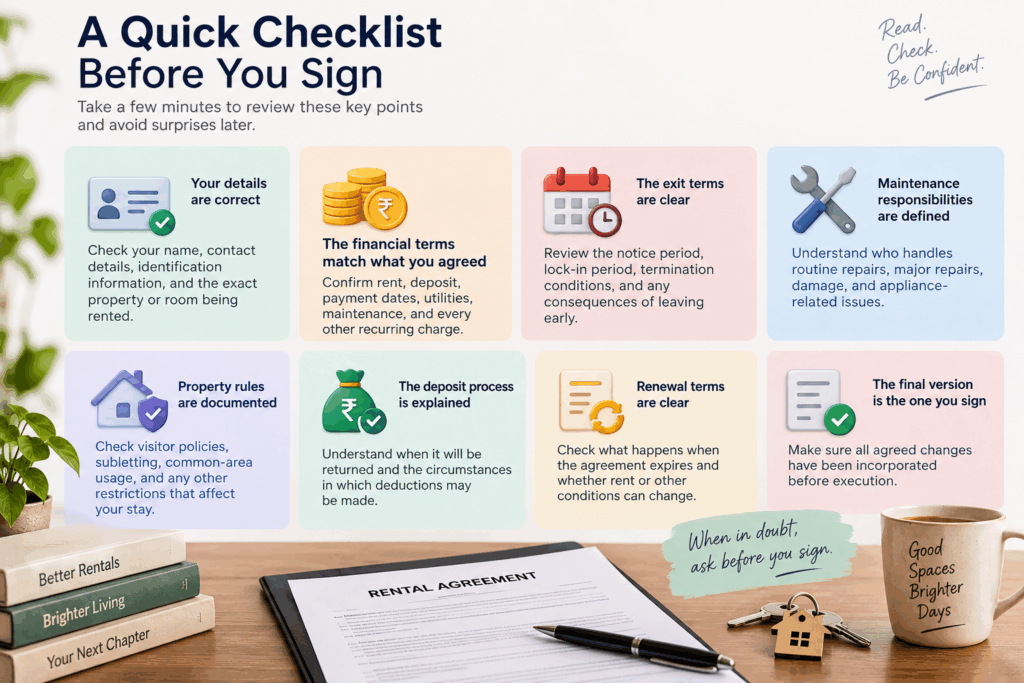
A Quick Checklist Before You Sign
Before putting your signature on the agreement, take a final few minutes to check the document from beginning to end.
Make sure:
- Your details are correct: Check your name, contact details, identification information, and the exact property or room being rented.
- The financial terms match what you agreed: Confirm rent, deposit, payment dates, utilities, maintenance, and every other recurring charge.
- The exit terms are clear: Review the notice period, lock-in period, termination conditions, and any consequences of leaving early.
- Maintenance responsibilities are defined: Understand who handles routine repairs, major repairs, damage, and appliance-related issues.
- Property rules are documented: Check visitor policies, subletting, common-area usage, and any other restrictions that affect your stay.
- The deposit process is explained: Understand when it will be returned and the circumstances in which deductions may be made.
- Renewal terms are clear: Check what happens when the agreement expires and whether rent or other conditions can change.
- The final version is the one you sign: Make sure all agreed changes have been incorporated before execution.
If something remains unclear after this checklist, ask.
There is no advantage in signing quickly simply because the document is ready.
How RentOk Helps You Manage Your Rental Journey
For tenants, understanding the agreement is only one part of managing a rental relationship. Once you move in, the same information needs to remain accessible when you need to check payment details, communicate with property management, raise an issue, or refer back to your tenancy records.
RentOk helps bring these rental processes into a more structured digital environment. For rental operators, the platform can centralise tenant information, payment visibility, communication, occupancy records, complaints, and other day-to-day workflows instead of leaving important information scattered across different conversations and manual records. This kind of structured approach is particularly useful as rental operations grow and the number of tenant interactions increases.
For tenants, that means a more organised experience where important rental interactions can be easier to track and manage throughout the tenancy rather than treating the agreement as a document that disappears into a folder after move-in.
Conclusion
A rent agreement is easiest to appreciate when everything is going smoothly. The real value of reading it carefully becomes apparent when something changes: you need to move out early, a repair becomes disputed, a deposit deduction is questioned, a payment is delayed, or the tenancy reaches its renewal date.
That is why tenants should look beyond the rent amount and security deposit. Read the clauses that define your responsibilities, your exit options, maintenance obligations, property rules, renewal conditions, and the treatment of your deposit. If something does not match what you were promised, ask for clarification before signing.
The objective is not to approach every landlord with suspicion. It is to make sure both parties enter the tenancy with the same understanding.
Review Your Rent Agreement, Use the RentOk Tenant Portal to keep your rental journey more organised and easier to manage.
Frequently Asked Questions
Find answers to common questions about this topic
About the Author
Ishika Pannu
Ishika Pannu brings you the latest insights and easy-to-apply strategies in property management—helping you simplify renting and grow with RentOk.