Tenancy Act
Chandigarh Tenancy Rules 2026: The UIN, 2-Month Deadline and New Rent Authority

Written by
Ishika Pannu
Read Time
11 min read
Posted on
November 19, 2026
Overview
Overview
Chandigarh Tenancy Rules 2026: The UIN, 2-Month Deadline and New Rent Authority
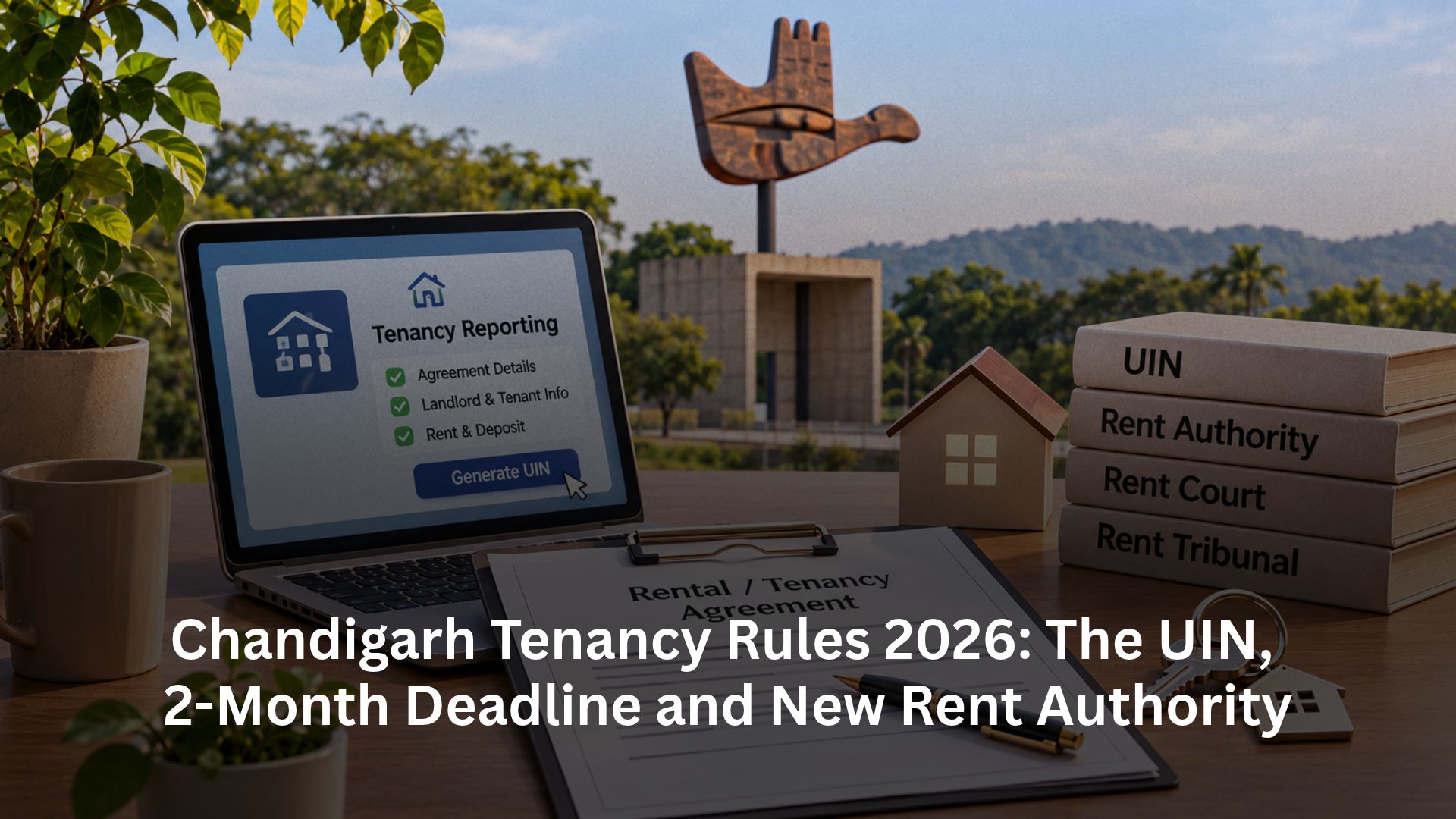
The Chandigarh tenancy rules notified on 10 September 2026 describe a more formal rental system: online reporting of tenancy agreements, a government-issued Unique Identification Number and specialist forums for disputes. For landlords and tenants, the practical change is a clearer record of who rented which premises, on what terms and from which date.
However, the notification does not answer every implementation question. The Punjab and Haryana High Court had earlier kept the notification extending the parent Assam law in abeyance. This article explains the notified framework, not a confirmed lifting of that restriction. Before filing, changing rent or choosing a dispute forum, check the latest court order and Chandigarh Administration directions. The distinction matters as much as the two-month deadline itself.
Why does Chandigarh’s new framework use an Assam law?
Chandigarh is a Union Territory. Through notification S.O. 2265(E), dated 6 May 2026, the Central Government invoked section 87 of the Punjab Reorganisation Act, 1966, to extend the Assam Tenancy Act, 2021, with modifications, to Chandigarh.
The September rules provide procedures under that extended Act. They deal with tenancy information, rent applications, electronic deposits, appeals and execution. This is a specific legislative route for Chandigarh; it does not mean that every provision of Assam’s housing administration applies to the city.
RentOk’s explanation of why rental agreement rules differ across India helps put this distinction in context. A framework from a neighbouring city or another state should not substitute for the law governing your property.
The High Court order remains a necessary status check
In CWP-15432-2026, the High Court’s 29 May 2026 interim order kept the May notification in abeyance and directed that the East Punjab Urban Rent Restriction Act, 1949, remain operational for the time being. It nevertheless allowed preparation of rules and infrastructure.
As of this article’s 19 November 2026 research check, a later order lifting that restriction has not been verified. September rule-making alone therefore cannot establish that every new remedy is enforceable or that every office accepts applications. Obtain the latest case order and official directions before acting; do not treat this evidence gap as proof that the case has had no further hearing.
The two-month reporting clock starts with execution
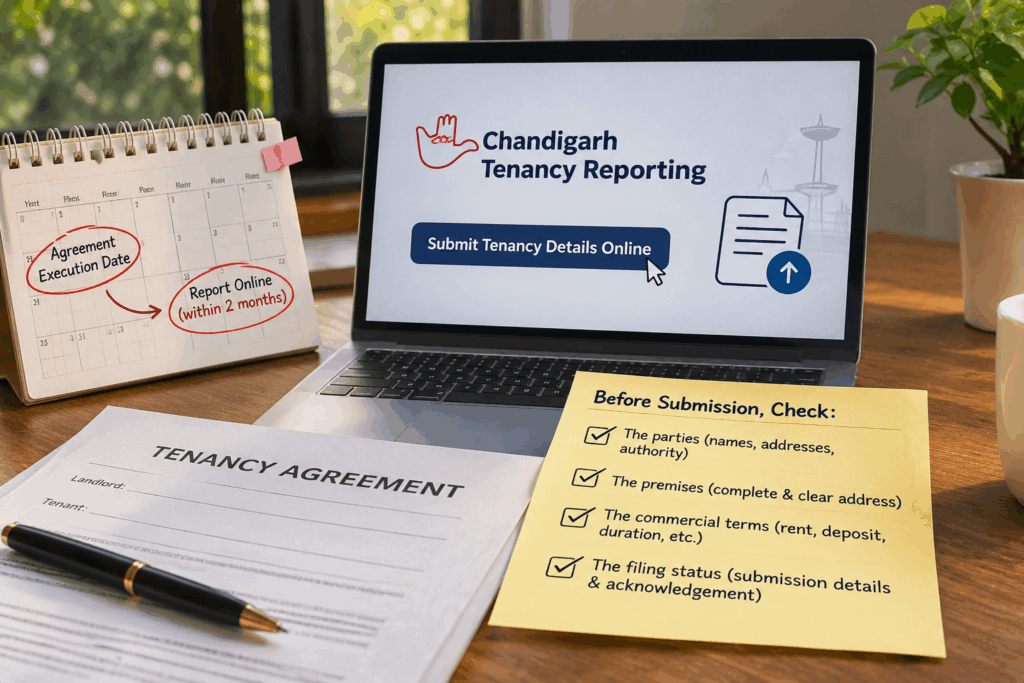
Rule 3 requires the landlord and tenant to intimate covered tenancy details jointly or separately, online, within two months of executing the agreement, using the First Schedule information. The starting point is the agreement’s execution date, rather than the day someone first hears about the rules.
The Administration’s notification announcement describes this reporting framework. Read it with the underlying Act, rules and court directions; “every tenancy” should not become a claim that excluded premises or every historical arrangement automatically follows one retrospective deadline.
Before submission, check:
- The parties: Match names, addresses and contact information to the agreement and relevant identity records; confirm who has authority to act for the landlord.
- The premises: Use a consistent property description, including the particular floor or portion where relevant, rather than an incomplete sector address.
- The commercial terms: Reconcile rent, deposit, duration and other agreed particulars with the signed document and supporting records.
- The filing status: Preserve what each party submitted, the submission date and any acknowledgement; separate filing should not produce contradictory versions.
The rules also address renewal, extension and supplementary-agreement records. Keep changes traceable rather than editing a signed agreement silently. If the official route is unavailable, seek written directions and preserve your attempts; an unavailable portal does not itself establish a legal extension. Do not pay an unofficial intermediary merely because they claim to control tenancy registration in Chandigarh.
What is the UIN, and how would you obtain it?
The Unique Identification Number, or UIN, identifies the reported tenancy. Rule 3 describes its delivery as an electronic receipt to the parties’ registered mobile numbers or email addresses after the Authority receives the required tenancy information and documents.
The rules specify seven days for issuing the receipt; the parent Act refers to seven working days for the UIN and upload process. Keep that drafting distinction in mind when checking the Authority’s current processing directions. Neither wording establishes that an unverified portal will issue a number immediately after a single upload.
The intended workflow is to prepare the First Schedule details, use the officially designated submission route, complete the required validation and save the resulting acknowledgement. The rules provide for OTP validation and require a digital platform within three months of setting up the Authority. That is an infrastructure deadline, not three extra months for tenants to report an agreement.
The notified rules also restrict access to tenancy information to the concerned parties and authorised persons. This is not a public directory of residents’ identity documents.
A UIN differs from Sub-Registrar registration, police verification and PG operating permission. It does not replace stamp duty or legal registration where those apply. RentOk’s guide to rent agreement registration explains why completing one documentation step may leave another outstanding.
Can the Rent Authority change the agreed rent?
Under the parent Act, agreed tenancy terms govern rent and its revision. The Authority can determine disputed revised rent and other payable charges on an application; reporting an agreement does not automatically trigger an official rent increase.
Rule 5 provides Form I for rent, Form IA for other charges and Form IB for the specified valuation request. The Authority may consider comparable nearby rents. The rules also provide for a government-recognised valuer in the stated circumstances, with the applicant bearing that valuation fee, and an order identifying the effective payment date.
Prepare the agreement, revision clause, previous payments and reasons for the requested change. A nearby advertisement alone may not explain differences in floor area, furnishings or included services. RentOk’s guide to how rent increases work and when they can be challenged explains why neither a standard annual percentage nor an owner’s demand decides every case.
Refused payments and the interest benchmark
Rule 6 describes payment attempts through recognised methods for two consecutive months where the landlord refuses rent or a receipt, followed by an application and electronic deposit with the Authority if refusal continues. Preserve evidence and confirm the available lawful route; do not simply stop paying.
Rule 8 sets a default benchmark of SBI’s highest MCLR plus two percentage points, unless the parties agree otherwise, for specified arrears and refunds. It covers relevant tenant liabilities and landlord refunds of security deposits or advance rent. It is not automatic interest earned on every deposit. Check the applicable benchmark, period and agreement before calculating a demand. These procedures remain subject to the implementation qualification explained above.

Three specialist forums, with different jobs and deadlines
The extended Act and rules envisage a Rent Authority, Rent Court and Rent Tribunal. They do not require every dispute to begin at the Authority and pass through three compulsory hearings. The remedy and statutory jurisdiction determine where an application starts.
| Forum | Role in the notified framework | Records to prepare |
|---|---|---|
| Rent Authority | Tenancy information and specified rent, maintenance or essential-service matters | Agreement, tenancy acknowledgement and evidence supporting the requested relief |
| Rent Court | Covered possession proceedings and appeals against Authority orders | Applicable application or appeal, supporting documents and challenged order where relevant |
| Rent Tribunal | Appeals against Rent Court orders | Certified order, grounds of appeal and supporting material |
For the specified Tribunal appeal procedure, the parent Act provides 60 days from service of the appeal notice for disposal. Execution applications have a 30-day period from service of notice on the opposite party. An appeal-filing deadline is a different clock; do not confuse it with the time available to decide the appeal.
These provisions do not guarantee that an entire dispute, appeal and recovery will finish within one month or two. Service, the relevant procedure and actual implementation matter. The extended Act contains the statutory distinctions.
Before filing, confirm the current forum and registry directions. RentOk’s rental dispute complaint guide explains how to organise a chronology, payment calculation and precise request rather than submitting an unsupported allegation.
Chandigarh PGs need a separate coverage and permissions check
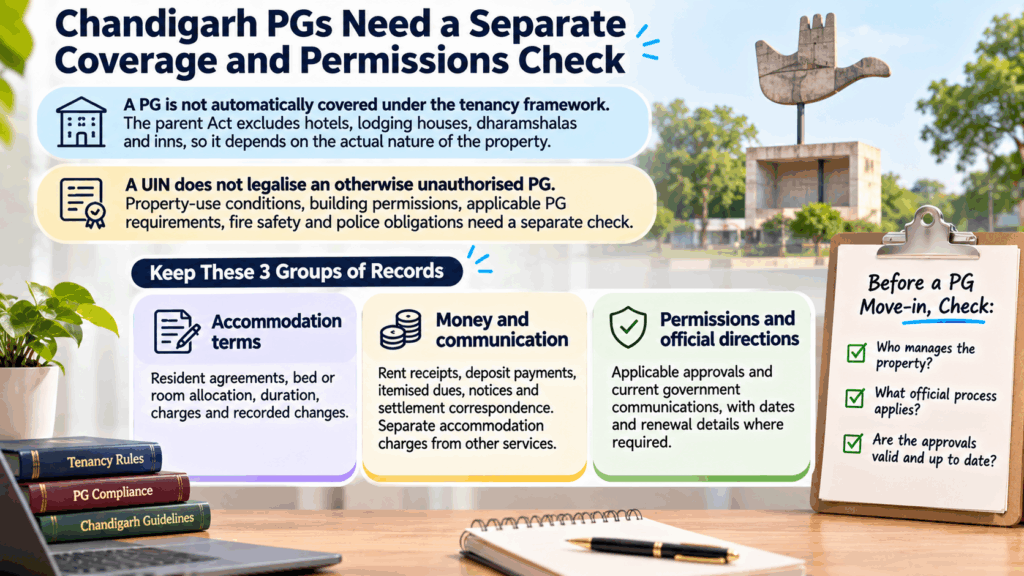
A PG operator should not assume that every resident agreement automatically falls within this tenancy framework. The parent Act’s definition of premises excludes hotels, lodging houses, dharamshalas and inns, alongside industrial use. Whether a particular PG arrangement falls within an exclusion depends on its actual character, not only the name printed on the agreement.
Similarly, obtaining a UIN would not legalise an otherwise unauthorised PG operation. Property-use conditions, building permissions, applicable PG requirements, fire safety and police-related obligations require separate checks. The relevant authority may depend on the property and allotment arrangements.
RentOk’s guide to checking whether a PG or hostel has the required registrations explains why a single certificate cannot answer every compliance question. Ask which approval a document represents and verify its address, issuing authority and validity.
For practical preparation, keep three groups of records:
- Accommodation terms: Maintain resident agreements, bed or room allocation, duration, charges and recorded changes, so the actual arrangement remains clear.
- Money and communication: Preserve rent receipts, deposit payments, itemised dues, notices and settlement correspondence; separate accommodation charges from other services where relevant.
- Permissions and official directions: Keep applicable approvals and current government communications together, with dates and renewal details where required.
For a resident moving in now, ask both who manages the property and what official process applies. Do not accept a screenshot labelled “registered” as proof of every permission, and do not assume uncertainty over this tenancy framework removes other existing obligations.
How RentOk helps keep tenancy records ready
Legal implementation can change, but owners still need an accurate account of residents, agreed charges and payments. RentOk supports everyday rental records so operators can prepare information for professional review or an official submission without reconstructing the history from scattered messages.
- Organise tenant details: Keep personal and renting information together and review submitted identity documents through the digital KYC workflow, reducing repeated requests and inconsistent resident records.
- Track payments and pending dues: Use recorded transactions and the tenant ledger to explain what the owner received and what remains outstanding before discussing revisions or disputes.
- Download financial reports: Select the property and download money reports, then reconcile the figures with bank evidence, receipts and the signed agreement.
The RentOk product website and money-report documentation describe these capabilities. RentOk does not issue Chandigarh UINs or replace the official filing process. Keep court directions, government acknowledgements and property approvals separately, and check the legal requirements before submitting anything.
Conclusion
Chandigarh’s September 2026 tenancy rules set out an important reporting framework: two-month intimation, an electronic UIN and defined procedures for rent-related applications and disputes. Understanding those provisions helps landlords and tenants prepare, but it does not settle the separate question of current enforceability after the High Court proceedings.
Verify the latest court order, notified officers and official submission route before relying on a new right or deadline. PG operators should also establish whether their arrangement falls within the Act and which property permissions apply independently. Keep tenancy records ready on RentOk so resident details, payments and pending dues remain organised while you complete the appropriate legal and administrative checks.
Frequently Asked Questions
Find answers to common questions about this topic
About the Author
Ishika Pannu
Ishika Pannu brings you the latest insights and easy-to-apply strategies in property management—helping you simplify renting and grow with RentOk.