
Legal
Why Rent Agreement Rules Are Different in Every Indian State


Written by
Ishika Pannu
Read Time
15 min read
Posted on
September 17, 2026
Overview
Overview
Why Rent Agreement Rules Are Different in Every Indian State
A rent agreement may look like a standard document. The landlord and tenant decide the rent, discuss the security deposit, agree on the duration, and sign the paperwork. However, the legal requirements behind that agreement can change from one state to another.
A rental arrangement in Delhi may follow a different process from one in Maharashtra. The same can apply when comparing Karnataka, Tamil Nadu, Gujarat, or other states. These differences may affect registration, stamp duty, notice periods, security deposits, rent control provisions, and dispute resolution.
This creates an important challenge for landlords and tenants. Many people rely on familiar practices or agreements used in a previous city. However, a process that worked in one location may not meet the requirements of another.
The reason is simple. India does not follow one identical rental law framework for every state. State legislation, local procedures, property categories, and the terms of the tenancy can influence the rules that apply.
For tenants moving between cities, understanding these differences can prevent confusion before signing an agreement. For landlords, it can reduce documentation gaps and compliance-related risks.
Let’s understand why rent agreement rules differ across India and what landlords and tenants should consider before finalising a rental arrangement.
Why Is Rental Law Different Across Indian States?
Rental laws differ because states have the authority to regulate several matters connected with land, housing, and tenancy. This allows them to create rules based on their local housing conditions and administrative requirements.
India’s rental market is not uniform. A metropolitan city may have high rental demand, frequent tenant movement, and a large number of managed properties. A smaller city may have a different rental structure and fewer formal documentation processes.
These differences influence how states approach landlord-tenant relationships. Some jurisdictions continue to operate under rent control legislation. Others have introduced newer tenancy frameworks or adapted existing laws.
The central government can also introduce model frameworks. However, these frameworks do not automatically replace the laws operating in every state.
The Model Tenancy Act, 2021, is a useful example. It was introduced to encourage a more organised rental housing market. It proposes written tenancy agreements, defined responsibilities, and structured dispute resolution. However, states and Union Territories must adopt or adapt the framework through their own legal processes.
This distinction matters because landlords cannot assume that a central model framework applies to every property. They must first identify the law that governs the specific rental arrangement.

Key Differences in Rent Agreement Rules by State
State-wise rental differences are not limited to the format of the agreement. They can affect several practical aspects of the tenancy.
The most important areas include registration, stamp duty, notice periods, security deposits, and rent control provisions. Each of these requires separate attention before an agreement is signed.
1. Stamp Duty and Registration Requirements
Stamp duty is a government charge imposed on certain legal documents. Registration is the formal process of recording a document with the relevant registration authority.
These processes are related, but they are not the same. Paying stamp duty does not automatically mean that a document has been registered.
Under the central Registration Act, 1908, certain leases require compulsory registration. This includes leases made from year to year or for a term exceeding one year. Leases for a period not exceeding one year are generally listed as optionally registrable under the central Act. However, state-specific laws may create additional requirements.
Maharashtra provides an important example. Section 55 of the Maharashtra Rent Control Act requires agreements for leave and licence or letting of premises to be written and registered.
This means that landlords should not rely only on the popular assumption that every 11-month agreement is exempt from registration. The actual requirement depends on the applicable law and the nature of the arrangement.
Before finalising an agreement, landlords should verify:
- Registration requirements: Confirm whether the agreement must be registered under the law applicable to the property. Do not rely only on the duration of the agreement.
- Stamp duty calculation: Check whether the amount depends on rent, duration, deposit, or other terms included in the document.
- Execution process: Identify whether the agreement can be completed online or requires an appointment with the registration authority.
- Supporting documents: Confirm whether identity proofs, witnesses, property documents, photographs, or other records are required.
For a detailed explanation of the process, readers can explore RentOk’s Why Your Rent Agreement Must Be Registered – And How to Do It.
2. Notice Periods Can Vary
The notice period determines how much advance information a landlord or tenant must provide before ending a tenancy. It is often treated as a standard clause, but its application can depend on the agreement and relevant legal provisions.
For example, one agreement may specify 30 days’ notice. Another may require 60 or 90 days. The parties must also understand how the notice period interacts with the lock-in period and termination conditions.
A notice clause should not be left vague. It should explain the required notice, the communication method, and the financial responsibilities during the notice period.
A well-drafted agreement should clarify:
- Notice duration: Mention the number of days required before termination or vacating the property.
- Notice delivery: State whether notice must be provided in writing, through email, or by another agreed method.
- Lock-in interaction: Explain whether the notice period applies during the lock-in period.
- Rent obligations: Clarify whether rent remains payable throughout the notice period.
- Final settlement: Mention how outstanding dues, property handover, and deposit adjustments will be handled.
A clear notice clause protects both parties from relying on informal conversations. It also gives property managers a consistent process for handling tenant exits.
Security Deposit Rules and Their State-Wise Impact
Security deposits are a common source of disagreement between landlords and tenants. The deposit is generally collected to cover unpaid rent, damage, or other legitimate liabilities under the agreement.
However, the permitted amount and applicable conditions may differ across legal frameworks. The Model Tenancy Act, 2021 proposes a security deposit limit of two months’ rent for residential premises. For non-residential premises, it proposes a limit of six months’ rent.
These provisions belong to the model framework. They should not be treated as automatically applicable to every rental property in India. Their application depends on adoption or modification by the relevant jurisdiction.
Landlords and tenants should therefore focus on the law applicable to their property. They should also ensure that the agreement clearly records the deposit and refund process.
Important deposit-related details include:
- Deposit amount: Mention the exact amount collected and the date of payment.
- Deduction conditions: Explain when deductions may be made for damage, unpaid rent, or other agreed liabilities.
- Refund timeline: State when the balance is expected to be returned after the tenant vacates.
- Property condition: Maintain move-in and move-out records to support any deductions.
- Outstanding payments: Clarify how unpaid utility bills, maintenance charges, or other dues will be adjusted.
These details become even more important in PGs, hostels, and co-living properties. Such arrangements may include furnished rooms, shared facilities, housekeeping, food services, and additional charges.
RentOk’s guide on How to Read a Rent Agreement Before Signing can help readers understand the clauses that require attention before entering a tenancy.
States With Rent Control Acts
Rent control legislation is another major reason rental rules differ across India. Several states have introduced laws that regulate particular aspects of landlord-tenant relationships.
These laws may address rent, eviction, tenancy rights, property occupation, and other related matters. However, the presence of a rent control law does not mean that every property in the state is automatically governed by every provision.
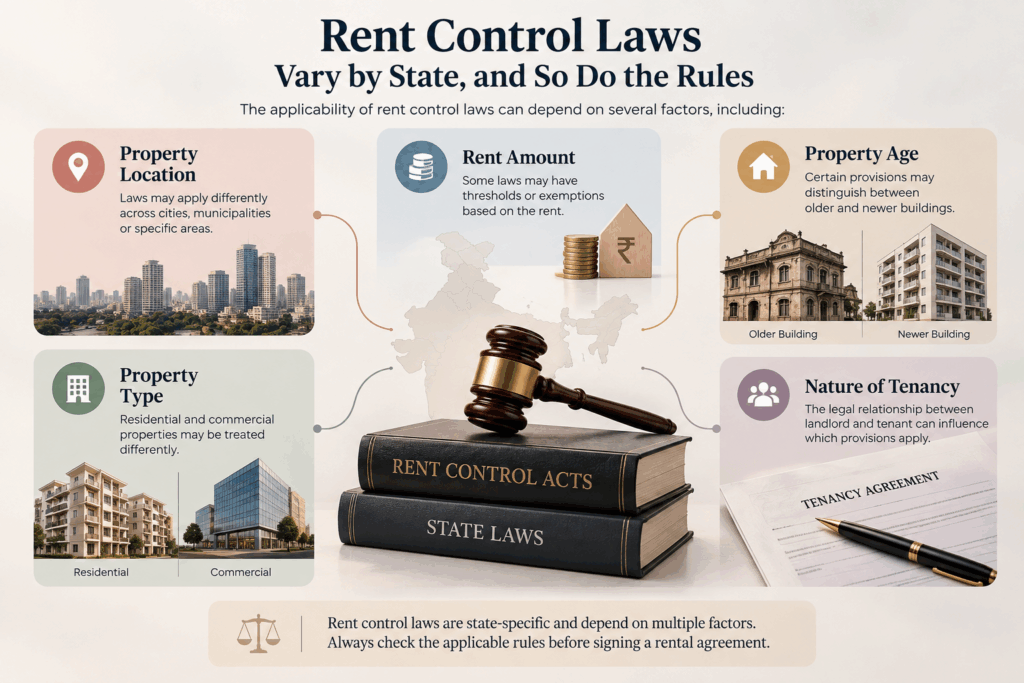
The applicability may depend on factors such as:
- Property location: Certain laws may apply differently across cities, municipalities, or specified areas.
- Property type: Residential and commercial premises may be treated differently.
- Rent amount: Some laws may contain thresholds or exemptions connected with rent.
- Property age: Certain rent control provisions may distinguish between older and newer buildings.
- Nature of tenancy: The legal relationship between the parties can influence which provisions apply.
This creates a practical responsibility for landlords. They should not assume that a generic agreement can override statutory protections or obligations.
Tenants should also understand that their rights may not depend entirely on the document they sign. Certain legal protections can apply independently, depending on the relevant legislation and circumstances.
When a dispute involves eviction, rent revision, or possession, both parties should verify the current legal position. Professional legal advice may be necessary where the matter has significant financial or legal consequences.
How the Model Tenancy Act Fits Into State-Wise Rental Laws
The Model Tenancy Act, 2021, was designed to encourage a more structured rental housing system. It seeks to formalise tenancy arrangements and establish clearer responsibilities for landlords and tenants.
The framework includes provisions related to written agreements, security deposits, rent authorities, repairs, and dispute resolution. It also aims to create a more balanced relationship between property owners and occupants.
However, the Act is not automatically applicable across all Indian states. States and Union Territories were invited to adopt it through fresh legislation or amendments to their existing laws.
This means that landlords must distinguish between the model framework and the law actually operating in their state.
The following differences should be understood:
- Model provisions: These are recommendations and legal structures included in the central framework.
- State adoption: A state may adopt the framework fully, partially, or with modifications.
- Existing legislation: Older rent control laws may continue to apply to certain properties.
- Local procedures: Registration, verification, and documentation requirements may still vary by jurisdiction.
A statement such as “the Model Tenancy Act limits security deposits to two months” must therefore be presented carefully. It describes the model framework, not an automatic rule for every rental agreement in India.
Why the 11-Month Agreement Creates Confusion
The 11-month rent agreement is widely used across India. Many landlords and tenants believe that this duration automatically removes the need for registration.
That assumption is not always correct.
Under the central Registration Act, leases for a term not exceeding one year are generally listed as optionally registrable. However, state-specific laws may impose stricter requirements. Maharashtra’s statutory registration requirement is one example.
The legal position may also depend on whether the arrangement is structured as a lease, leave and licence agreement, or another form of tenancy.
Landlords should not choose an agreement duration only to avoid registration. They should first understand the applicable legal requirements and then select the appropriate structure.
Tenants should also avoid assuming that an 11-month agreement automatically provides greater flexibility. The document may still include lock-in clauses, notice requirements, payment obligations, and early-exit conditions.
RentOk’s guide on What Is E-Stamping for Rent Agreements and Is It Legally Valid? explains why e-stamping and registration should not be treated as interchangeable processes.
What Tenants Should Know When Moving Between States
Moving to a new city often means entering an unfamiliar rental system. Students, working professionals, and families may relocate from Delhi to Bengaluru, Mumbai, Hyderabad, Pune, or another city.
It is natural to assume that the same agreement process will apply everywhere. However, tenants should review the new arrangement independently.
Before signing, they should check the rent, security deposit, notice period, lock-in conditions, maintenance charges, and registration requirements.
They should also confirm whether additional documents are required for tenant verification or property onboarding.
A practical checklist includes:
- Agreement formalities: Confirm whether the agreement must be stamped, registered, or completed through a specific state portal.
- Financial obligations: Review rent, deposit, electricity, maintenance, food, housekeeping, and other additional charges.
- Exit conditions: Understand the notice period, lock-in period, early-exit consequences, and deposit settlement process.
- Property rules: Check guest policies, shared-space usage, restrictions, and other conditions that apply to the premises.
- Document records: Keep copies of the signed agreement, payment receipts, identity documents, and property condition records.
This process is especially important for tenants living in PGs and co-living spaces. Their agreement may cover more than accommodation. It may also include food, housekeeping, internet, security, and shared amenities.
For landlords, the same level of clarity is necessary. A well-defined agreement can support smoother onboarding and reduce misunderstandings during the tenancy.
What Landlords Should Do When Managing Properties in Multiple States
Managing one rental property is different from managing a portfolio across several cities. When properties operate in different states, landlords must account for variations in documentation and legal procedures.
For example, an owner managing properties in Delhi, Maharashtra, and Karnataka may need separate checklists for registration, agreement execution, tenant verification, and renewal.
Using one agreement template across all locations may create gaps. The document may contain clauses that do not match the applicable state law or the actual services provided at the property.
Landlords should build a state-wise compliance process. This process should record the applicable documentation, agreement dates, registration requirements, and renewal deadlines.
They should also review agreements whenever the terms of the tenancy change. Rent revisions, deposit adjustments, additional services, and changes in occupancy should be properly documented.
This becomes more important in PG and hostel businesses. These properties often experience frequent tenant movement and multiple agreement renewals.
RentOk’s resource on How to Set Lock-In Period for PG Tenants explains why clear agreement terms can support better occupancy planning and reduce disputes.
Registration Is Only One Part of Rental Compliance
A registered agreement is important when required. However, registration alone does not guarantee that the entire rental arrangement is properly managed.
Landlords must also maintain accurate tenant records, complete applicable verification, document property conditions, and track payments. These steps support the agreement throughout the tenant lifecycle.
For instance, a landlord may have a registered agreement but still face difficulties if the deposit payment is not recorded properly. Similarly, a dispute over property damage can become complicated when there is no move-in inventory or condition report.
A complete documentation process should therefore include:
- A signed and properly executed agreement.
- Records of rent and security deposit payments.
- Tenant identity and verification documents.
- Move-in and move-out condition reports.
- Records of maintenance requests and property-related communication.
- Renewal, notice, and final settlement records.
This approach helps landlords and tenants rely on clear evidence instead of informal recollections. It also supports better property management when several tenants and units are involved.

How RentOk Helps Manage Rental Documentation
Managing agreements across different states can become difficult when tenant records are scattered across spreadsheets, emails, paper files, and messaging applications.
RentOk helps landlords, PG operators, and property managers organise their rental operations through a structured digital system. It brings greater visibility to tenant information, property operations, payment processes, and related records.
For businesses managing multiple properties, this organisation can support a more consistent tenant lifecycle. Landlords can maintain clearer records and reduce their dependence on disconnected manual processes.
RentOk can also help operators track important operational details connected with tenants, payments, occupancy, and property management. This makes it easier to maintain internal processes as the business grows.
However, software does not replace legal verification. Landlords must still confirm the state-specific requirements that apply to their agreements. Legal questions involving registration, eviction, rent control, or disputes may require professional advice.
Conclusion: Understand State-Wise Rent Agreement Rules Before Signing
Rent agreement rules differ across India because states follow different legal frameworks and administrative procedures. Registration, stamp duty, security deposits, notice periods, and rent control provisions must be understood according to the property’s location.
Tenants should not assume that an agreement used in one city will work in another. Landlords should also avoid applying a single template across properties without reviewing the relevant requirements.
The popular 11-month agreement practice does not remove the need for legal verification. Similarly, the Model Tenancy Act should not be treated as an automatically applicable law across every state.
The safest approach is to review the agreement carefully, verify the applicable state rules, and maintain organised records throughout the tenancy.
Get Agreements Right with RentOk. Explore RentOk’s rental management solutions to simplify tenant documentation, organise property operations, and manage the rental lifecycle with greater clarity.
Frequently Asked Questions
Find answers to common questions about this topic
About the Author
Ishika Pannu
Ishika Pannu brings you the latest insights and easy-to-apply strategies in property management—helping you simplify renting and grow with RentOk.
You may also like these
Related Articles

1 min read
How Working Professionals Can Complete Tenant Verification Quickly
Written by
Posted on
Ishika Pannu
Sep 17, 2026

1 min read
Student Tenant Verification: A Guide Before Moving Into a PG
Written by
Posted on
Ishika Pannu
Sep 16, 2026

1 min read
New UPI MDR Rule: What It Means for Rent Payments
Written by
Posted on
Ishika Pannu
Sep 16, 2026

1 min read
What Happens If You Break Your Rent Agreement Before the Lock-In Period?
Written by
Posted on
Ishika Pannu
Sep 14, 2026

1 min read
How Foreign Nationals Can Rent Property in India (Verification Guide)
Written by
Posted on
Ishika Pannu
Sep 14, 2026

1 min read
How Rent Increases Work in India and When They’re Illegal
Written by
Posted on
Ishika Pannu
Sep 11, 2026

1 min read
What Documents Do You Need for Tenant Police Verification?
Written by
Posted on
Ishika Pannu
Sep 10, 2026

1 min read
Why You Should Always Insist on a Registered Rent Agreement
Written by
Posted on
Ishika Pannu
Sep 10, 2026
1 min read
What Is the Legal Notice Period Before Vacating a Rented Property?
Written by
Posted on
Ishika Pannu
Sep 9, 2026

1 min read
Delhi’s Proposed PG Regulations: What Owners Need to Know
Written by
Posted on
Ishika Pannu
Sep 9, 2026
Stay ahead in property management with expert insights
Join thousands of property managers receiving exclusive tips delivered straight to your inbox.
Browse posts by category
Case Study
Cost of Living
Growth
Legal
Market Trends
News
Pg owner app
Property Management
Property Tax
Tech
RentOk
The easiest way to rent and manage your PGs and hostels.
Get the app


Contact us
hello@eazyapp.tech
HQ Office
COGROW, BASEMENT F-12/8A
BESIDE HOUSE OF STYLE SALON, SECTOR 28, DLF PHASE 1
GURUGRAM, HARYANA - 122002
South India Office
LUMIODESK COWORKING, 2ND FLOOR, 40, 14TH MAIN RD
BESIDE MC DONALD, 7TH SECTOR, HSR LAYOUT
BENGALURU, KARNATAKA - 560102
©️ 2026 EazyApp Tech Pvt Ltd. All rights reserved


